One of the distinguishing features of vertebrates is the presence of bones. We learned in an earlier post that not all vertebrates have bones, but if you do find an animal with bones, you can be confident you’re dealing with a vertebrate.
Structure of a bone. SEER – U.S. National Cancer Institute’s Surveillance, Epidemiology and End Results (SEER) Program Public Domain
You see them in everywhere in papers and posts related to paleontology.
Cladograms showing the same relationships in two different ways. Alexei Kouprianov CC BY-SA 3.0
Cladograms. Little tree-like drawings that show the relationships among different organisms. A cladogram is a hypothesis about the evolutionary relationships among different organisms (A, B, and C in the cladogram above). Another term for evolutionary relationship is phylogeny. Continue reading “The concept of the Clade”
A couple of days ago, I wrote a post about what makes vertebrates distinct from other animals. I alluded to the fact that our closest living relatives that aren’t chordates are the echinoderms, sea stars, sea urchins, sea cucumbers, sea lilies and apparently any organism for which the common name begins with ‘sea’ (except for sea horses – those are fish).
Our cousins, the echinoderms. Tripneustes ventricosus (West Indian Sea Egg-top) and Echinometra viridis (Reef Urchin – bottom). Nick Hobgood CC BY-SA 3.0
One of those things we do as geoscientists is try to figure out if the rocks in one place are the same as the rocks in another place. While it seems a very easy question to ask, it’s not so easy to answer.
This determination of ‘sameness’ is called correlation. But before we can do any correlating, we have to get more specific in our question. Do we want to know if rocks here and there are the same age, or do we want to know if they represent the same environment?
When I teach my course in Vertebrate Paleontology (see tweets at #UREES270), one of the first questions that arises is what is a vertebrate? What makes a vertebrate distinct from all other forms of life?
One interesting thing about vertebrates is that they don’t all have vertebrae. This one thing that seems like it should be the obvious thing that all vertebrates share, isn’t shared by all (although if you have an animal with vertebrae, it is most definitely a vertebrate!).
To make matters worse, you’d think that a big important group like the Vertebrata (the scientific name for the vertebrates) would get to have its own Phylum, like the mollusks, the cnidaria (jellyfish and kin), and the echinoderms (sea stars and sea urchins and kin), but no. The Vertebrata is relegated to Subphylum status within the Phylum Chordata, which means exactly nothing to most people.
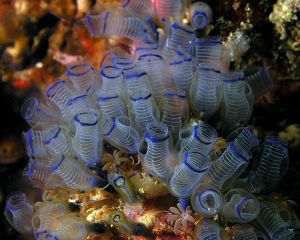
The chordates (members of the Phylum Chordata) are a really interesting group, however. There are some chordates that are not vertebrates, including the lowly sea squirt, and the lancet (Amphioxus). What these chordates have that is shared with all vertebrates (hence grouping them together) is a notochord.
I’ve been trying to do art in some form or fashion every day through November, as part of the Art Every Day Month challenge. Because I’m also doing NaNoWriMo, and attempting to write a 50000 word novel this month, I suppose that I’m accomplishing art every day so long as I’m writing every day.
Most vertebrate paleontologists agree that modern birds evolved from dinosaurs. To paleontologists, there is no simple bird-dinosaur dichotomy. Rather there is a continuum of animals that are at first, clearly dinosaurs (like Tyrannosaurus and Velociraptor), then at the end are clearly birds, like all the modern birds that we see. We recognize lots of ‘in between’ animals, like Archaeopteryx that appear to be at once both bird and dinosaur.
To simplify, many, including me, refer to birds as dinosaurs. Sometimes, we add the term ‘avian’ or ‘non-avian’ to the front of dinosaur, to distinguish between modern, flying birds and their relatives, and the big scary ones that went extinct 65 million years ago.
The interesting outcome is that what this means is that, at least in the United States, we traditionally have a huge family meal on the fourth Thursday of November, in which we consume vast quantities of roasted dinosaur meat.Continue reading “Your Holiday Dinosaur”



 Penny Higgins - Storyteller • Artist • Scientist