Scientist (Paleontology, Geochemistry, Geology); Writer (Speculative and Science Fiction, plus technical and non-technical Science); Mom to great boy on the Autism spectrum; possessor of too many hobbies.
One of those things we do as geoscientists is try to figure out if the rocks in one place are the same as the rocks in another place. While it seems a very easy question to ask, it’s not so easy to answer.
This determination of ‘sameness’ is called correlation. But before we can do any correlating, we have to get more specific in our question. Do we want to know if rocks here and there are the same age, or do we want to know if they represent the same environment?
When I teach my course in Vertebrate Paleontology (see tweets at #UREES270), one of the first questions that arises is what is a vertebrate? What makes a vertebrate distinct from all other forms of life?
One interesting thing about vertebrates is that they don’t all have vertebrae. This one thing that seems like it should be the obvious thing that all vertebrates share, isn’t shared by all (although if you have an animal with vertebrae, it is most definitely a vertebrate!).
To make matters worse, you’d think that a big important group like the Vertebrata (the scientific name for the vertebrates) would get to have its own Phylum, like the mollusks, the cnidaria (jellyfish and kin), and the echinoderms (sea stars and sea urchins and kin), but no. The Vertebrata is relegated to Subphylum status within the Phylum Chordata, which means exactly nothing to most people.
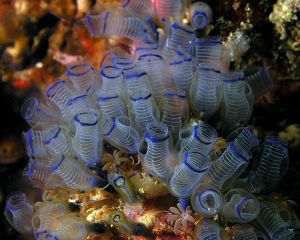
The chordates (members of the Phylum Chordata) are a really interesting group, however. There are some chordates that are not vertebrates, including the lowly sea squirt, and the lancet (Amphioxus). What these chordates have that is shared with all vertebrates (hence grouping them together) is a notochord.
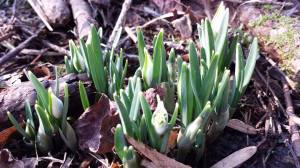
Today at our home in western New York state, the temperature peaked at 44 F (that’s about 7 C). At this time last year we were under a foot of snow. Today, nothing but sun!
Raising chickens means dealing with keeping the chickens healthy. Once common problem that chicks face is called “Pasty Butt.” I don’t know if this is a legit term, or if this is just something my husband made up, but it is a real problem. Pasty butt is when the chick’s poop clings to its feathers around the vent, ultimately blocking the vent, which can kill the bird.
We noticed that some of our chicks had pasty butt, so chick washing was called for this morning.
It turns out that though chicks aren’t terribly fond of being washed, they do seem to enjoy blow-drying.
Twenty-mumble years ago, when I was an undergraduate at Fort Lewis College, in Durango, Colorado, taking my first paleontology class, something happened that was humorous, but also touching, and has stuck with me ever since.
The instructor for the class was Dr. Doug Brew. He was a paleontologist that specialized in brachiopods. I loved this class, naturally because it was paleontology, but also because Dr. Brew was one of the most ‘human’ professors I had ever had.
The class was first thing in the morning. I typically arrived for class a little early, giving myself enough time to stop at the little cart near the door to pick up a cup of coffee before going in. On this morning I was running late, so I passed on the coffee and entered the classroom a little late. I sat down and scrambled to open my notebook to get started.Continue reading “Paying it Forward”
It’s hard to believe how quickly Comet has grown. He’s only about four and a half months old, but he’s already getting close to full grown. He’s certainly proportioned more like an adult dog than like a puppy any more.
The other day I was looking at him and it occurred to me: He actually looks a lot like a coyote. And he’s about the right size too. If a person wasn’t paying attention, they could easily mistake this pup for what is viewed as a dangerous pest.
Looking quite coyote-y
This wouldn’t trouble me too much, except that we live rurally, in an area that has lots of coyotes. And everyone has a gun.Continue reading “Comet’s New Clothes”
I prepared this text for my students to help them understand the difference between plagiarism and copyright infringement as they work on videos as a class project. There is always confusion about what’s legal and what isn’t and what exactly constitutes plagiarism. I hope this is helpful for all.
How to avoid plagiarism in your work: Plagiarism applies to ideas. If something is not your own original thought, then you cite the person or paper from which you got the idea. The complete reference for that paper or person must fo into the references cited.
How to avoid copyright infringement in your work: Copyright applies to whole documents, images, and video. If you did not take the photo, draw the drawing, make the video etc., then it’s not yours to use unless you have permission. A CITATION IS NOT ENOUGH!Continue reading “Plagiarism and Copyright – Know the Rules”



 Penny Higgins - Storyteller • Artist • Scientist