Beware of Movies! Age of the Earth

The Beware of Movies! series is meant to point out some of the scientific inaccuracies of popular movies, specifically in points related to the geological sciences.

This post will present some basic information about geologic time, how we know how old things are, and how movies often get these things wrong.

How do we know the order in which geologic events happened? And how do we know exactly when they occurred?

Uniformitarianism. This is an important concept used throughout the geological sciences. The short definition is “the present is the key to the past,” meaning that the processes that we observe on the modern Earth are identical to processes that occurred in the Earth’s past. Mountains exist today because of the motions of tectonic plates, thus ancient mountains also formed due to the interactions of plates.

This concept is useful for much of the Earth’s history, but might not be applicable to all of it, so it should be used with some caution. At least for the most recent 600 or so million years, it’s a safe assumption. Older than that, some important conditions on the Earth were different. One thing that is true, however, no matter how old of rocks we observe: Chemistry still works the same. Chemical reactions behaved the same 10 billion years ago as they do today. This is very important later on…

There are two basic ways of assigning ages (or dating) in the geological sciences: Relative and Absolute (or Numerical). Relative dating is used to place geological events in order of which came first, second, third, etc. Relative dating does not assign any ages (like ten thousand years ago) to events.

We’ll begin with relative dating, as this is the basis upon which our geologic time scale was originally developed.

There are six important principles used to assign an order to geologic events. Many of these apply especially to sedimentary rocks. Many of these will seem very, very obvious:

  • Principle of Superposition – When looking at a pile of rocks, the oldest rocks are on the bottom. Because rocks don’t just float in space with big gaps below them.
  • Principle of Original Horizontality – When sediments are deposited, they are deposited in horizontal layers. They’re flat. Thus, if we see rocks that are tilted in any way, we can assume that they were tilted after they were deposited.
  • Principle of Original Continuity – Rock layers are deposited over wide areas, not just in the one place where we see them exposed. We assume that a rock layer in one area is continuous with similar rock layers in other areas, even if we don’t see the direct connection. This is one of the most important principles needed to understand the development of the geological time scale.
  • Principle of Cross-Cutting Relationships – If there is a fault in a rock, or an obvious erosional surface, then we assume that these features occurred after the rock was deposited. That makes sense, because you can’t fault or erode something that does not yet exist!
  • Principle of Inclusions – If there are two rock types (rocks A and B) next to each other, and one (rock A) contains pieces of the other (rock B), then the rock containing inclusions of the other rock must be younger. Rock A is younger than rock B in this example.
  • Principle of Baked or Chilled Contacts – When magma comes into contact with pre-existing rock, reactions happen. The pre-existing rock is much cooler than the magma, causing the magma to cool rapidly and crystallize (making a chilled contact). At the same time the heat of the magma heats up and bakes the pre-existing rock, resulting in a baked contact. A baked rock is older than the igneous rock in contact with it. A chilled rock is younger than the rock it sits against.

Using these principles we can place geological events in relative order. We can trace rocks from one area to another and compile all the rocks in an area, and even on a continent into relative order. It is based upon this that the geologic time scale was developed. The divisions of the geologic time scale (like the Jurassic Period) get their names from the area in which rocks of that age were first described (like the Jura Mountains). Some divisions are also named based upon the types of rocks that characterize that division. The Cretaceous Period gets its name because many of the rocks are composed of chalk. The Latin word for chalk is “creta.” Using relative dating methods much of the Earth’s rocks deposited over the last 600 million years have been put in order.

The Geologic Time Scale

We can then add to this fossils with which we can determine a fossil succession using the principles above. It is from this that much about the evolution of life on Earth is understood.

Biostratigraphy is the use of fossils found in a rock to assign a relative or absolute age to that rock. Biostratigraphic units do not depend upon rock type and are thus defined according to the presence of a particular organism (an index fossil) or a complete fossil assemblage. Biostratigraphy is often used to correlate rocks of similar age but different rock types.

It is through principles of relative dating and biostratigraphy that we know that dinosaurs and humans have never co-existed.

Absolute (Numerical) dating is a means by which we can assign an number age to a rock or a fossil (or a geologic event). The method that most people have heard of is radiometric dating. To understand this, we have to talk a little about chemistry.

The chemical elements come in many forms. Some are stable and some are unstable. The unstable ones are also called radioactive. Some elements can come in multiple forms, some stable and some radioactive. The difference is in how many neutrons are in the nucleus, or what isotope the element is in. Carbon, for example, has three isotopes: Carbon-12, carbon-13, and carbon-14. Carbon-12 and carbon-13 are stable. Most of the carbon in the universe is carbon-12. There’s a little carbon-13, and even less carbon-14. Carbon-14 is radioactive, however. It doesn’t stay around forever. At some point it decays (or self-destructs), which is why radioactive elements are so dangerous.

Carbon-14 breaks down into Nitrogen-14, an electron, and an electron antineutrino, which sounds pretty awful. (And it is, if it happens inside your body! Those little extra bits can cause damage, which can lead to cancer.) Other radioactive elements break down (decay) in similar ways. The original element (in this case, carbon-14) is called the ‘parent.’ What’s left behind (Nitrogen-14) is called the ‘daughter.’ The decay of the parent into the daughter products occurs over a specific period of time, called the half-life, which varies from parent material to parent material. For carbon-14, the half-life is 5,730 years.

The half-life is how long it takes for half of the parent material to decay into the daughter product. Here’s an important thing about half-lives, however. This does not mean that after two half-lives, all the parent product is gone. With each half-life, half of the parent product decays. You never really get rid of all the parent material, though there does come a point where it is so small that it becomes impossible to measure.


Half-life number Percent parent material present Percent daughter product present
0 100 0
1 50 50
2 25 75
3 12.5 82.5
4 6.25 88.75


Radiometric dating uses this relationship to assign ages to rocks. One need only to measure the relative amounts of parent material and daughter products in a rock and know the half-life of the parent material in order to calculate the age of a rock. Different parent materials have different half-lives ranging from days to billions of years. A scientist will use the parent-daughter system that works the best for the age of the rocks their interested in. Here are a few examples:

Parent-Daughter Half-life
Carbon – Nitrogen (radiocarbon dating) 5730 years
Potassium – Argon 1.25 billion years
Uranium-238 – Lead-206 4.47 billion years
Uranium-235 – Lead-207 704 million years


For all of these, there are caveats. Firstly, it is important that all the materials being dated actually originally contained the parent material and has not lost any of the daughter product. This can be a problem for potassium-argon dating, for example, because argon, as a gas, can escape. Radiocarbon dating is only good to about 40,000 years before present, before there is so little of the parent material left that it no longer can work.

It is also important to realize that for all of these methods, time zero (or ‘now’) is actually not right now in 2013. It’s actually 1950, which is when the methods were first established. For most radiometric dating methods, this doesn’t matter a whole lot, but for radiocarbon, it can be problematic. Nothing younger than 1950 can be dated using radiometric carbon.

Beware of movies: In the movie Time Cop, with Jean-Claude Van Damme, there’s this shipment of gold that gets transported from the past into the future. This gold is radiocarbon dated (so they say) which informs the time cop agency that it was stolen from the past. Two problems: 1) There’s no carbon in gold. What exactly did they date? 2) If the gold came forward in time, via time machine, it should seem brand new. It should not date to the past. Unless somehow, radioactive decay speeds up in the beaming forward process.

Other radiometric dating methods:

Detrital Zircons: Most of the methods described above are best used to assign ages to igneous rocks. Only radiocarbon dating really works well for sedimentary rocks (but even then, is only useful back to about 40,000 years before present). Radiometric methods can be used to assign ages to sediments when applied to ‘detrital zircons.’ Zircon is a mineral that forms in igneous rocks as they cool and can be dated using the uranium-lead methods noted above. These zircons are very resistant to weathering and become part of sediments that form new sedimentary rocks.

Zircons can be isolated from sedimentary rocks and dated, which gives the age of the igneous rock that they came out of. From this, we can determine where the sediments came from. We also know that the sedimentary rock cannot be older than the youngest zircon that’s in it. Thus, we can derive a maximum age for the sedimentary rock, which can be useful to know.

Fission-track dating: When radioactive elements decay, they leave trails of damage (or tracks) in the matrix of a crystal. These little trails are obvious under the microscope and most often form from the decay of uranium-238. Counting these tracks can be used to assign an age to the mineral and thus the rock that they came from in ways similar to detrital zircon analysis.

Some other absolute dating methods:

Thermoluminescence (TL) dating is used to determine how long a mineral (and the rock that it is in) has been exposed to sunlight. As the mineral is heated, to emits a weak light signal, which is proportional to how much sunlight it was exposed to and therefore how long it sat on the surface. This can tell us how old a material is (like an archaeological artifact) or how long a surface (like a river terrace) has existed.

The use of cosmogenic nuclides for dating surfaces has also come to prominence of late. As it happens, cosmic radiation bombarding an exposed rock surface can cause the appearance of new elements that wouldn’t be there otherwise. A scientist can measure the amount of these so-called cosmogenic nuclides and assign an age to an exposed rock. This can be used to, for example, assign ages to the advances and retreats of glaciers.

There are other methods used by scientists in assigning ages to rocks and fossils, or the parts thereof. For example, one could simply count rings!

Dendrochronology is also known as tree-ring dating. Most trees have annual growth rings which can be used to count years from the initial growth of the tree to its death. If the tree is still alive, one can correlate events down to the exact calendar year. Dendrochronology can help us study paleoclimate and paleoecology, and has been used to calibrate radiocarbon ages.

Sclerochronology refers to the study of growth lines in the hard tissues of animals and plants. Clams show growth lines, as do corals. Some teeth do as well. These growth lines aren’t necessarily annual and may be annual, monthly, fortnightly, tidal, daily, and smaller increments of time. Study of these can help us understand the biology of ancient and extinct organisms.

Ice cores also have annual layers, due to yearly cycles of dust. It is possible to count the rings in ice cores that go hundreds of meters down and study ancient climate patterns, calibrated to precise years, using other geochemical methods. This is how we know much about global warming, glaciations, and climate changes.

Beware of movies: Actually, this is something they got right in “The Day After Tomorrow.” Ice cores are commonly used to measure the concentrations of greenhouse gasses in the Earth’s past atmosphere. They use layer-counting to get the ages right.

Some methods used for dating depend upon comparing patterns of change with similar patterns derived from rock sections of known age.

Magnetostratigraphy is a technique used to date sedimentary and volcanic rocks. The Earth’s magnetic field has not always been such that the north end of the compass needle points toward the north pole. The field has reversed itself many times, and these reversals have not been regular. Scientists can go out and collect rock samples through a series of rocks and measure which way the magnetic poles were pointing at the time the rocks were deposited. This pattern is then compared with the ‘geomagnetic polarity time scale’ for the Earth (which has ages assigned to it). Where the patterns match gives an age for the rocks.

Chemostratigraphy or correctly termed Chemical Stratigraphy is the study of the variation of chemistry within sedimentary sequences. Much like magnetostratigraphy, variations of particular chemical markers also provide useful time markers. For example, the Paleocene-Eocene boundary (~55 million years ago) is defined by a huge spike in the amount of carbon-12 in the Earth’s atmosphere, which is recorded in the rock. Chemostratigraphy can also be used to track environmental changes, since chemical markers change when climates and environments change.

This post has covered most, but not all, of the potential methods by which geological units and events might be dated by geoscientists. If there are other methods that you’ve heard of, comment about them and I can explain those too.

Remembering Coach Bish

In high school I was a runner. That’s how I identified myself. They were formative years for me, when I learned a great deal about stick-to-it-ive-ness. I no longer run competitively (injuries took me out), but I still lean on the lessons learned in high school when I’m faced with difficult times.

High School me, running my legs off!

My cross-country coach was Ron Bish. He was an amazing guy. He had a business job, and would come to practices more often than not in a business suit and running shoes. On days of home meets, he would be seen in this attire setting out the cones along the course. Every race he would scream himself hoarse. He was always there. Always the voice of determination.

He died a little over a week ago. Wow. Am I so old? Was he? I reflected on all the things he ever said to us. I refer to them to this day.

Get out and exercise “…while the competition is home by the fire.” Every rainy day he would say this to us. Yes, our foes would be home staying warm and dry and we’d be out doing intervals. I remember one such day when we went out for a quick three-miler in the pouring rain. The lightning was pink, and despite the fact that we were all soaked, everyone’s hair was standing up. (In retrospect, we really shouldn’t have been out there that day, for safety reasons.) To this day, when I find myself in a situation where I have a legitimate excuse to not do something, I remember this, drag myself up, and get started. Because the competition is home by the fire.

“Get mad!” This Coach Bish reserved for me. He knew this was how to reach me. Others needed pep talks and encouragement. I needed to be mad. “Don’t let her beat you!” he’d say. The starting line of each race started the same. He’d single me out. “Get mad, Penny.” And I would. I couldn’t let that made-up, perfume-wearing girl outrun me! I’d get mad, and I’d run as fast as I possibly could. No other coach that I have ever had has been able to make that connection with me. They have always tried the gentle encouragement method. Fact is, I have to be furious to get the job done. These days, I find that I am most productive when I’m angry. My best work is done when I feel like I have something to prove. But now, the difference is that I’m competing against myself. I have to show myself that I can do what must be done. My own complacency is what makes me mad. Once I’m mad, work starts to happen.

I don’t run competitively anymore, though in the last year I have finally been able to run again, after a ten-year hiatus. Every step I take reminds me of my high school cross-country days. I still work out almost every day. And on those days when I really don’t want to exercise, I remember Ron. Get mad, Penny. Don’t sit there by the fire.

Thanks, Ron.

Bad Geology Movies: The Day After Tomorrow, 2004

The Day After Tomorrow

2004

Dennis Quaid, Jake Gyllenhaal

Premise: When the world’s ocean circulation patterns are disrupted by melt water due to global warming, the Earth is plunged into a sudden ice age.

There’s a fair amount of good in this movie, and a fair amount of hoo-hah as well. I’ll focus on the Earth Science problems that I have at least a little expertice in. I’m not a meteorologist, so I can’t say a lot about the huge storms that play an enormous role in the movie (though I suspect they fall into the category or hoo-hah).

Ice core drilling: This is, in fact, a common means by which we have learned a great deal about Earth’s past climate. And we can go back ten thousand years quite easily. The ice-coring set-up that they have is quite unlike any I’ve ever seen, and I really don’t think any intelligent scientist would be coring on an ice shelf, but for the sake of a movie… ok.

A two-century long ice age that started 10,000 years ago: There was a substantial climate change that occurred ten thousand years ago. It was warming, though, not an ice age that lasted 200 years. This was about the time that humans found themselves in North America and was also about the same time that all the cool ‘megafauna’ went extinct (like mammoths, mastodons, woolly rhinos, ground sloths, etc.) There is a great deal of debate over whether it was the appearance of humans or this climate change that did in the megafauna.

Greenhouse gasses from ice cores: This is actually a commonly used research track by paleoclimatologists. In fact, we have two such scientists in our tiny department here at the University of Rochester. Atmospheric gasses are trapped in snow which is later buried and turns to ice in the massive glacial sheets of the Arctic and Antarctic. These gasses can be retrieved and studied, providing information about past concentrations of greenhouse gasses in the atmosphere.

By the way, we can assign ages to different parts of ice cores by simply counting annual rings. During the winter, snow tends to be clean, but in the summer there tends to be a lot of dust in the snow. Each year, then, there is a layer of clean ice and dirty ice in an ice core. We can count these (like tree rings) to know the age of a part of an ice core. Pretty cool, eh?

Ocean circulations: What the main character says about the disruption of ocean currents by the introduction of fresh water (from melting ice sheets), which then leads to climate change is actually an accepted hypothesis. It has been put forward by Wally Broeker, one of the most respected paleooceanographers in the world.

Unfortunately, the movie does make a mistake here. Not a severe one, but I’m sure Wally himself would facepalm. They talk about the North Atlantic Current – which is a real thing – being shut down by all the meltwater. The North Atlantic Current is a surface current in the ocean. It is the continuation of the Gulf Stream, which runs north along the eastern margin of North America. The Gulf Stream plus the North Atlantic current is what keeps the climate of Europe so pleasant despite being so far to the North. Surface currents, like the North Atlantic Current, are driven by wind.

If you look at the drawings that the main character of the film is referring to, as well as Wally Broeker’s work, you’ll realize that the currents that would be disrupted by the freshwater are not surface currents at all. While it might affect the North Atlantic Current, the influx of meltwater would more likely disrupt the deep ocean currents, called “Thermohaline Circulation.”  These currents are driven by differences in temperature (Thermo-) and salt-content (haline) of the water. Saltier water sinks, as does colder water. This global circulation keeps the ocean water mixed from north to south and from ocean to ocean. An influx of freshwater from melting glaciers in the north and south would stop the downwelling in those areas, which would disrupt this circulation. This, it is widely accepted, could have a profound effect on global climate.

The ocean’s deep currents.

Water inundating New York City: This is a head-scratcher. Sure, if sea-level rises, then water could rush into the city. And now, post Hurricane Sandy, we know that water can make it quite a ways into the city. There is a lot of water tied up in the world’s ice sheets, too, so an immense sea level rise is not out of the question if we melted all of the ice. But the converse is true, too. In an ice age, sea level can drop because all the Earth’s water is tied up in ice sheets at the poles. Somehow, I suspect that these two competing phenomena would have prevented the great wall of water that struck New York in the movie. But it was pretty cool to have a massive ship floating in front of the library, eh?

Only storms in the Northern Hemisphere: Was anyone bothered by this? Why wouldn’t there be enormous storms in the Southern Hemisphere too? How come Australia gets out Scot-free? This actually might not be that big of a problem. It seems that the great ice ages did not affect the Southern Hemisphere in the same way as the Northern Hemisphere. There were no huge ice sheets in the south. Part of this is because there really isn’t much land mass in the south. There are some tall mountains that even now have glaciers that may have expanded during the northern ice ages, but it seems that “ice ages” as we think of them were a primarily northern phenomenon. There’s active research on that topic going on right now. So it’s possible that a new ice age might only affect the Northern Hemisphere.

 An ice age in a week? I think this is fundamentally the biggest problem with “The Day After Tomorrow.” The premise is ok, and the idea that run-away greenhouse gasses could cause major climate disruptions isn’t that far off, but that an ice age can begin and coat much of the Northern Hemisphere in ice in less than a week is a unlikely. Years is a better scenario, and we’d probably have a little warning. Can can observe the flow of the thermohaline currents. We’d see them stopping most likely. Alas, I don’t think that there’s a thing in the world we could do to re-start the flow should it stop. Climatic disruption is the most likely outcome.

Friday Headlines: 12-28-12

Friday Headlines, December 28, 2012

THE LATEST IN THE GEOSCIENCES


ERUPTION MAY HAVE STARTED AT COPAHUE ON THE CHILE/ARGENTINA BORDER


Copahue is a stratovolcano on the border between Argentina and Chile.

This volcano is the result of subduction of the Pacific Plate below the South American Plate.

Subduction Zone

On December 22, a plume of ash was noted in an image from the GOES satellite.

Plume of ash from Copahue on December 22

Since then, alerts have been issued and the volcano is clearly erupting.

FIGHTING MAY HAVE SHAPED EVOLUTION OF HUMAN HAND

Michael Morgan and David Carrier of the University of Utah have shown that the human hand is not only a dexterous appendage, capable of precision gripping, but is also an effective weapon, but only when it is balled into a fist. When the fist is formed, it causes all the forces of a hit to be transmitted through the knuckles – a small surface area – resulting in a focused transmission of the power of the blow, maximizing the potential damage. The human hand can clinch a fist where the curled fingers leave no gaps at the palm of the hand (which would weaken the blow), and where the thumb can further buttress the fingers. No other animal can do this.

X-ray of a hand balled into a fist

PHOTO: MOUNT EVEREST, IN 3.8 BILLION PIXELS

You just have to go and look at this picture. It’s amazing!

Toughest Job You’ll Ever Love

National Blog Posting Month – December 2012 – Work

Prompt – What is the hardest job you’ve ever done?

Hardest job ever?

Parenting. Hands down. No contest. No comparison.

Toughest job I’ve ever done for a paycheck?

Graduate student. Lousy paycheck (though still pretty decent, really). Long hours. Little respect. Nightmares. Uncertain outlook.

Positive aspects of both jobs?

Rewarding. Meaningful outcome. ‘Character building’ (whatever that is).

If I had it to do over, would I?

Yes.

For 12-28-12

HEMA – inspiration through perspiration

It seems that a great number of practitioners of the Historical European Martial Arts (HEMA – think of them as the Knightly Arts of Swordplay) are also writers and enjoyers of great literature. This seems to be the case for women, anyway. I am a member of an international group of female HEMA participants, called Esfinges, and this question was put forward to the writers in the group:

How many of you are inspired in your art by the things you read, and what in particular inspires you?

I hadn’t really thought about it. I know that attempting to write a novel that included swordplay is what made me seek out an instructor so that I could finally properly study HEMA. But I was already interested. I’d been fascinated with swordplay and the discipline of knighthood for what seems to have been the better part of my life. But I’ve also always wanted to be a writer. So which came first, the sword or the pen?

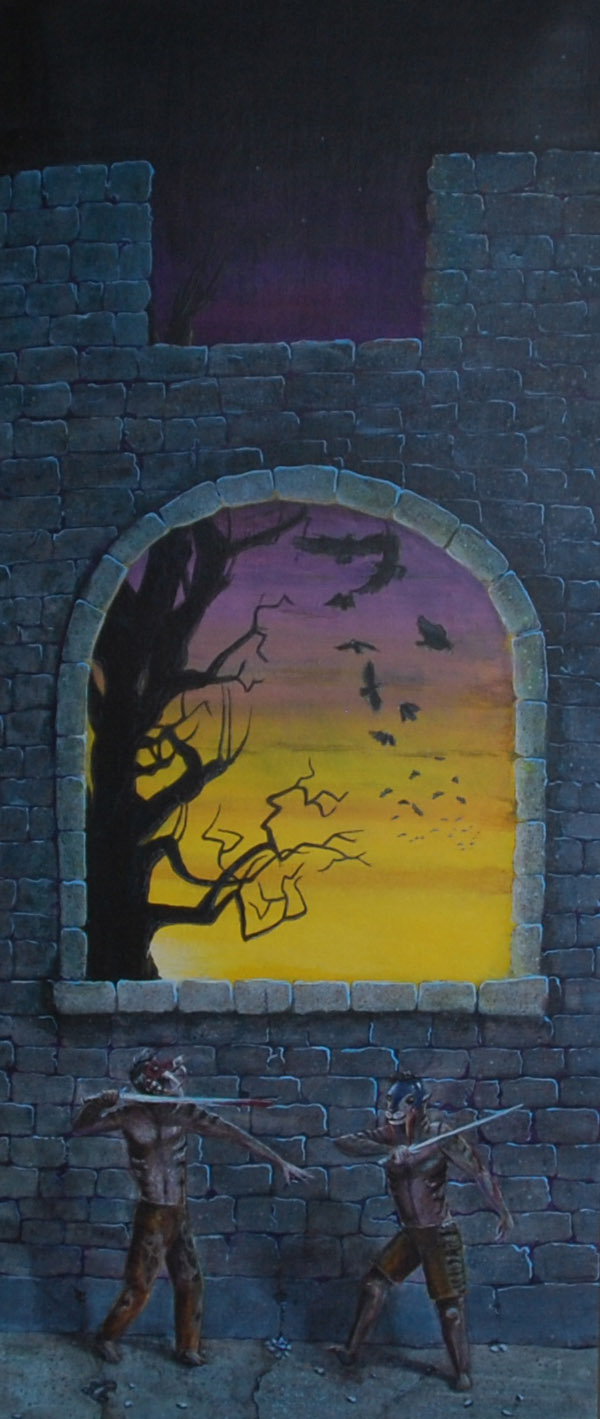
It’s funny as I think about it, because I think both followed from imagery. I know this, because images of swords have been a part of my repertoire for years. Check out this painting I did in high school. There are swords there. I was trying to capture a moonlit battle. I don’t think I succeeded, but I still like the painting.

Caniberons sword fighting. Acrylic on canvas board. Done back in high school. See? My interest in swordplay goes way back! All rights reserved.

When I think about the sword, I see pictures. Images of the gallant knight on his steed. The violent battle, ending with the battered and bloodied knight kneeling in prayer over his lifeless opponent. I feel it in my chest – the pounding of my heart. And in my arms and back – the violent shock of steel meeting steel. Reading solidifies these images, as does watching sword fights (especially those that are realistically choreographed), or looking at page after page of photos in knights in armor. Writing is how I try to express these feeling and visual impressions. Actively participating further helps me find that connection between the real and the envisioned.

Then I write and practice more, and rewrite and read books and papers, and I rewrite once more after pondering deeply for a few days.

Both my writing and my desire to participate in HEMA derive their inspiration from the images conjured in my head when thinking about the knightly arts. I have always felt that European swordplay is one of the most elegant displays of art in action. There is beauty in the discipline that crosses over to all arenas of life. I long for that peace that comes from such mastery of the body and mind, that is reflected in HEMA. I struggle to express it in my writing. I hope some day to find it and feel it. It’s there. I know it.

Working alone… with others

National Blog Posting Month – December 2012 – Work

Prompt – Would you rather work alone or with other people?

This is a hard one. There are situations in which having partners on a project is great as well as those which wind up being a nightmare.

Working with others means that you have back-up if there are problems and built-in help. It means also that you don’t need to know every single thing – your colleagues can fill in for your knowledge gaps. The downside is that, unless you’re working with a great set of people, sometimes you might wind up being more of a cheerleader for an unmotivated group. This can result in a pretty crappy result (if any ever arises).

Working alone means that you don’t have to coordinate meetings and you can work at your own pace. Plus, you can take full credit if the project is successful. Downside: Failure is all your’s too, and there’s no-one prompting you or encouraging you to stay on task. Things might never get done!

I’ve had successes and failures in both scenarios. I like to think that I’d prefer to work alone, that I’d be more successful if I didn’t have to deal with other people, but there are a lot of things I just can do on my own. It doesn’t help that I have social anxiety – just picking up the phone to call someone to ask on their progress can be a nightmare! If I could, I’d rather work alone, but the reality is that I just can’t. So I often get into collaborative projects, and hope that either a) my colleagues will be as motivated as me and won’t need much prompting or b) I’m not the leader on the project. It doesn’t always work that way, and I’ve suffered through many failures. I’ve also had many successes.

So I’m going to take the middle road and say ‘both.’ If I could, I would probably prefer to work alone, but I accept that that is not a viable option in most cases. I move on. Things have to get finished. And they do – most of the time.

For 12-27-12

I can haz career?

National Blog Posting Month – December 2012 – Work

Prompt – Do you think you have a job or a career?

To me, having a ‘job’ would be working for an hourly wage at something that you do only for the pay and not because of any long-term goal. ‘Jobs’ are typically positions that do not provide much (if anything) in the way of benefits or retirement plans.

A ‘career’ involves working at a single type of work (hopefully at a single place of employment) with a long-term goal of working up to higher positions and greater pay and usually includes some manner of retirement plan.

Most definitely, I have a career. It’s hard not to have a career when one has put the time into getting a Ph.D. (though it happens). I expect to be doing the same sort of work (science and teaching and maybe a little writing) until I’m ready to retire.

Further evidence that I have a career: I finally got business cards. I feel all grown up.

Back off, man! I'm a scientist!
Back off, man! I’m a scientist!

For 12-26-12

Going for a ride…

National Blog Posting Month – December 2012 – Work

Prompt – How far would you travel daily for a job you love?

Since I really like my current job, let’s examine how far I travel each day to get to it, shall we?

The drive is approximately 35 miles one-way, according to my car’s trip odometer. That means 70 miles round-trip each day, 350 miles a week. Happily, the drive itself tends to take less than 45 minutes, unless there’s heavy traffic or lots of snow. Some folk’s commutes take that long and they only have to go two miles!

It’s worth it because I also really like the house we live in: an 1830’s colonial farm house on two acres. It’s huge and has space for all our books.

Yup, I have a job I like and a home I like, and it only costs me 350 miles a week.

For 12-25-12

Our Protectors (and How Our Society is Sick)

It’s Christmas Eve. I’ve come down with a cold and am basically miserable. I don’t feel much like celebrating anything as it is.

On Friday night into Saturday morning, we had a windy storm blow through. It knocked a tree into the powerlines across the street from our house. I remember sipping my coffee and wondering why there were firetrucks on the street. Then I saw it:

A tree leaning on the power lines in front of our house. This is just before massive fireballs and breaking wires!
A tree leaning on the power lines in front of our house. The tree was burning, as evidenced by all the smoke. This is just before massive fireballs and breaking wires!

Very soon after I took this photo (from my front window, mind you), the thing went up in a huge fireball. Well, actually three fireballs, until the lines broke. Then we left to camp at some friends’ house to wait for the electric to come back on.

I’m grateful for our firemen who were there that morning. I have to say that. It seemed trivial at the time, but I feel it now, very strongly. I thanked a firefighter as we left, just from basic respect for doing what he most likely considers ‘just his job.’ I was glad he was there. I knew our home would be fine.

This morning, this was on the local news:

Something is wrong with this headline.

How could this be? Firefighters doing nothing more than what they consider their job, shot and killed in the line of duty. Two more in the hospital. And Webster is only two towns over! This is in my back yard!

//platform.twitter.com/widgets.jsWhat is wrong with our society? How can this happen? Why did someone feel that they needed to shoot at our protectors?

<rant>

This is my rant. This is my opinion. I know that this is a more complicated problem than what I present here, but as this falls on the heels of the CT shooting at Sandy Hook Elementary, and all the other obscene murders that have happened of late, I submit this.

Our society is sick. It is sick because we have decided that it is more important that everyone should get a prize just for trying, so that they feel good about themselves. Fundamentally, it’s great to encourage people to be happy in their own skin, but we’ve done a disservice by always providing prizes for participation and always trying to make sure ‘everyone wins.’

In the real world, not everyone wins. People fail. Things go wrong. People leave the school systems feeling good because they’ve always been given positive reinforcement after they falter, then when real failure comes (can’t find a job, lose your job, can’t afford the car you want), they don’t know how to cope. We don’t teach people how to accept failure and move on, because we protect our children from failure. So when real life happens, complete with failure, they go on a rampage.

Most people do figure out the difference between real-life and the A-for-effort they always got in school, and learn how to deal with failure. Yet still, most people are left with a sense of entitlement. “I deserve that fancy car!” It doesn’t help that most advertizing plays on this, telling people that they deserve the best. Then folks go out, spend money they don’t have, and have problems. They fail. And then…

Our society is sick. We are not entitled to things just because we put in a little effort, or have lived X-amount of years. And failure is a part of life that we need to learn to cope with. Success isn’t granted. It’s not a participation sticker. You’ve got to work, and learn, and FAIL once in a while.

I’m not saying that I don’t suffer from this sense of entitlement just like everyone else. I’m sure I do. We’re an entirely spoiled society. We have a lot of our basic needs provided. We don’t know just how good we’ve got it (until the day the power goes out and you realize that the house is going to get very cold and you don’t know what to do about it!)

Accept failure, folks. Learn from it. Rise above it. DON’T BLAME OTHERS FOR IT! Get over yourself and move on.

</rant>

Thanks for listening. I apologize for any typos – I wrote this in a hurry. I apologize for any offense as well. I recognize that 1) there are always exceptions and 2) broad sweeping generalizations tend not to apply equally to everyone. Let’s all try to enjoy this celebratory time of year, no matter how you choose to do so.

********Added Christmas day:

//platform.twitter.com/widgets.js

Or, support your local fire department. These people serve us. Let’s give a little back…