Scientist (Paleontology, Geochemistry, Geology); Writer (Speculative and Science Fiction, plus technical and non-technical Science); Mom to great boy on the Autism spectrum; possessor of too many hobbies.
As I was driving home from work yesterday, I was pondering what the next great bit of science would be that I should publish. I started thinking about this project that has been back-burnered for a while.
Projects in the sciences get back-burnered for many reasons. This particular one has been set aside as I wait for results from other colleagues from other institutions. This happens, and is a common occurrence in the sciences. But as I was driving, I realized that part of the project is complete and can be its own paper in the absence of the contributions from the others for the greater project.
Co-authors, get ready. There’s a manuscript coming together by ME!
So, what’s it about? And why is the title of this post “Rodents of Unusual Size”? ROUSes don’t exist anyway, so what am I worried about?
Well, there are some big rodents out there. The largest modern rodent is the Capypara (or Carpincho), which roam around in South America. These rodents average about 50 kg (110 pounds), so they are fairly large. But in the ancient past, South America hosted even larger species of rodents, including Arazamys, Isostylomys, and Josephoartigasia. The latter, is thought to have potentially weighed 1000kg (2200 pounds)! Now that’s a rodent of unusual size!!
Capybara Grazing (by FinlayCox143)
A common research question that I answer with my type of research is “what did the animal eat?” I can get at this using geochemical analysis of tooth enamel. The larger project that my colleagues and I are working on seeks to answer the question, “What did these giant fossil rodents eat?”
The obvious answer, of course is, “Anything it wants!” But we want to be a bit more specific. So how do we do this? By studying the isotope geochemistry of tooth enamel.
Diet recorded in tooth enamel
We joke in isotope geochemistry that “You are what you eat, plus a few permil.” When I’m analyzing samples, I’m comparing the amount of Carbon-13 (’heavy’ carbon, but not the radioactive stuff, Carbon-14) relative to the amount of Carbon-12 (the common carbon in the world). Slightly less than 99% of all carbon atoms in the universe are Carbon-12. Around 1% of all carbon atoms are Carbon-13. (And whatever is left is the radioactive Carbon-14). A mass spectrometer can measure the relative amounts of Carbon-12 to Carbon-13 and gives us a number, called a ‘delta value’ in units of ‘permil’ (‰).
We write this like: δ13C = -14‰ (said “delta 13-C equals minus fourteen permil”)
Depending upon what you’ve just measured the isotopes from, this delta value can be interpreted in a number of ways. For diet and tooth enamel, it goes like this:
Plants, in general, use one of two types of photosynthesis. These two types are called C3 and C4. C3 plants are typically trees and bushes (or occasionally grasses) that live in cooler moist environments. C4 plants are typically plants especially grasses that live in arid environments. (This is an over-generalization, of course, but is usually our first assumption.)
Luckily for us, C3 and C4 plants have different δ13C values. C3 plants are usually about -27‰; C4 plants usually around -13‰.
Now, let’s say an animal comes along and eats these plants. You are what you eat, they say. Plus a few permil… In the case of mammal tooth enamel and plants, it’s plus 14‰. So a bison grazing on C4 grasses has a tooth enamel δ13C of about 1‰. A horse that prefers to eat the bushes with have a tooth enamel δ13C of about -13‰.
The difference in δ13C in tooth enamel reflects a difference in diet. In general, we assume that animals that show a C4 diet (tooth enamel δ13C around 1‰) probably were grazing (grass-eaters) and those that show a C3 diet (tooth enamel δ13C around -13‰) were probably browsing (leaf-eaters). Of course, there are animals that do some browsing and some grazing (horses in particular). We can tease out the relative amounts of grazing and browsing in a single animal too.
So the plan is to look at the tooth enamel of the giant rodents Arazamys, Isostylomys, and Josephoartigasia and figure out if they were browsing or grazing. We might assume that they were grazing, since some of the largest land mammals are also grazers (like elephants), but they might also be browsing, just to eat enough food to fuel such a giant body!
Capybara diets
It’s always a good idea to ground-truth your assumptions whenever you have the opportunity. There are lots of assumptions that go into inferring that an animal is either a browser or a grazer when there is only isotopic data to look at. We decided it would be worthwhile to examine the isotopes in modern giant rodents to see if our predictions and assumptions are borne out. Since capybaras are the largest modern rodents, we decided to study them.
Capybaras are known to be grazers. We can sit and watch them graze on grass in an environment where there is lots of C4 grass to be eaten. We also know that there are some C3 grasses in the places where capybaras live, but we might assume that since the majority of grasses are C4, then the majority of the capybara’s diet is C4 as well. Thus we predict that the tooth enamel δ13C from a capybara would be around 1‰.
Well, guess what?
Capybaras selectively eat the C3 grasses. Their tooth enamel only reflects a C3 diet! But we didn’t know this until we ran the isotopes! We ran a couple hundred samples, so we know it’s not an error. This was completely unexpected. Seems like we have a problem, right?
Well, really, it’s not the end of the world. It is what it is. This is how science works. We know that capybaras are grazers, but if all we had to go on was tooth enamel, we’d get it wrong.
But we have other things. We have the shape of the teeth themselves. Long and rootless teeth are common in animals that eat an abrasive diet – and is a common characteristic among grazing animals. Have you ever looked at a horse tooth? Most rodents, including the capybara, have these long and rootless teeth.
We can also look at microwear on the surface of the tooth. An abrasive diet (actually, any diet) will scratch and wear the tooth surface, leaving tell-tale marks that we can observe using microscopes. Specific types of marks are associated with different diets: grazing, browsing, fruit-eating, etc. This is the realm of my colleagues. They are looking at the microwear on the teeth of the giant fossil rodents. Hopefully, they’ll get on that soon. I ought to start bugging them.
What does an ROUS eat?
The isotopic analyses from the fossil giant rodents are done. But in the light of what we learned from the capybaras, the interpretation is sketchy. I can’t say more than that right now. Until we have the microwear data, all we can say is “Huh.”
In the meantime, though, the conclusions of the capybara study are important and need to be published, since they kind of shake up some of our basic assumptions for interpreting diets from carbon in tooth enamel. Now all I gotta do is decide which journal. Hmm.
Day 19: Today is a day that will change your character’s life forever. What course of events occurs? How does your character react? Write a scene from this day.
——
Trey stood as his mother fussed about his gowns. He stared at her, watching her, without quite registering what was happening. It was all like a dream to him.
“Trey?” his mother asked.
He blinked and looked at her. “Hm?”
She smiled at him. “Where are you right now, son?”
“I don’t know, Mother. I feel lost.”
“This nation is ready for its new King, aye,” she smiled softly at him. “And your father and I are ready to enjoy our waning years ignorant of politics.” She winked at him.
“Aye, you deserve thus, Mother.” He puffed his cheeks. “But am I ready?”
“You are more fit than you ever have been, Trey.”
Trey gazed upon her with a smile. She looked radiant and happy. He was glad to see joy on her face. He bent and kissed her softly on the cheek. “I shall not disappoint you, Mother.”
“You could never disappoint me,” she said softly as she stroked his cheek. “I am proud of you.”
—
Sunlight streamed in through the stained glass windows and poured over the people gathered in the chapel. Despite being crowded with noble men and women, and being surrounded by heavily armored bearers of the Mark, the room was completely silent.
Trey was aware of his own breathing. He heard his heart beating. He looked at the older man who stood in front of him. The King – his father – Anthony of Herongarde, looked upon him warmly. Slowly, Anthony removed the ornate crown from atop his own head and carefully set it upon Trey’s. A look of sadness passed across Anthony’s face as he stepped back, then softness and love.
“You now are sovereign King of Herongarde, Trey of Herongarde, my son. And now, I serve you.” Anthony bowed to Trey, a gesture that Trey returned gently.
The crown felt heavy to him. His head and shoulders now bore the responsibility of direction and protection of an entire nation. He wondered if he could do it.
Anthony presented Trey to the crowd. All stood and cheered, but Trey didn’t hear it. He looked around at the joyous faces. His brothers of the Mark were cheering. He knew they would support him. He would have to ask a lot of them.
Then his eyes fell to Hanna. She smiled back warmly, tears fresh on her face. He felt a smile parting his own lips, and suddenly he felt strong. She would be beside him. He would ask more of her than anyone else, but he knew she would ever be at his side. He loved her.
He looked over at his mother and father, now no longer reigning King and Queen of Herongarde. Their relationship had survived the death of two sons and brutal wars. Here they stood now, embracing each other and gazing with pride on their last living son. This is what he would strive for.
Trey looked back to Hanna. Yes, with her, he could do it.
Trey grinned broadly, nodding as he looked around at the beaming faces.
Suddenly, he thrust his fist into the air. “Herongarde forever!” he shouted.
His fist was joined by a hundred others in the chapel, then by thousands from those gathered outside the walls. “Herongarde!” shouted the people. His people. He was King.
Day 18: Your character has a conversation with an influential person in their life. It can be a parent, a teacher, a mentor, anyone your character looks up to. Why are they having the conversation? Write the scene.
——
“Markus! You—,” cried Trey.
“Why suddenly concern yourself so with that woman, aye?” returned Markus. “What in God’s name was she doing on the battlefield?”
“Markus, please.”
“What fool are you for this? Think you that she is a proper warrior?”
“Her orders—.”
“Orders, aye? In what fevered delusion did you deliver such an order?”
“I made not the order, Markus.”
“No woman has business on the battlefield! Your bodily desires are best served in your chambers!”
“I never!”
“I truly pray that her presence did not result in the unnecessary death of our own men, aye.”
“Uncle! Surely I would be dead were it not for her actions!” cried Trey.
“Iain could have shielded you.”
“Hanna is a better swordsman.”
“How can she be better, aye? A woman?!”
“Uncle, please! Hear me! Her orders.”
“What orders!” yelled Markus.
“You know,” said Trey. “Don’t you?”
The men stared at each other, breathing hard from the angry exchange, trying hopelessly to read each other’s thoughts.
“What order?” asked Markus more calmly.
Trey looked around, checking for curious bystanders.
“We must talk, Uncle,” Trey said trying to regain his composure. “We must speak privately.” Trey put a hand to Markus’ shoulder and pointing down the hall toward the King’s Hall.
They entered, and Trey shut the door behind them. Markus turned abruptly.
“Now you’ll explain? Why was she with you?” Markus carefully pronounced each word of the last sentence.
“Uncle,” said Trey, making great effort to remain calm. “You recall the order given her by His Majesty?”
“Of course! She was to attend to your injuries, then serve with the other Ladies.”
“Is that all you know?”
“What more is there to know, Trey?”
“Surely, His Majesty told you.”
“Told me what?” Markus was growing impatient.
Trey drew a breath and straightened up. He didn’t know how to say what needed to be said, so he decided to just spit it out. He looked Markus in the eyes. “Neither His Majesty, nor I, nor Lord Gilbert was confident that Balayn would adequately protect me.”
Markus sighed. “Yes, I felt the same,” Markus replied, feeling shame that his own son would be considered untrustworthy. “But you were fit, aye?”
“No.”
Markus frowned and regarded his nephew. “No?”
Trey shook his head. “Though I may be fit now, it took many weeks to recover well enough.”
Markus looked away, examining the tapestries that hung in the hall.
“I am surprised that His Majesty did not share this with you,” said Trey softly.
“What order was she given?”
“She was tested for skill with the sword,” said Trey. Markus looked back at him shocked. “It was decided that she should remain close to me, and defend me — with sword, if need be.”
“Her?!”
“She has a talent, but had no training. I—.” Trey hesitated. “I have provided her some training since. She’s a fair fighter.”
“Training?!”
“By order, Uncle. Only by order of the King himself.”
Markus looked away. He began to walk around the room.
“Uncle, please. The decision was difficult to make, but seemed the best in the interest of our nation. That, and we did not wish to insult the honor of Lord Balayn, nor your own. Perhaps this is why my father has not told you.”
“So she is your protector?”
“Yes.”
“Then why do you act as though you love her?”
Trey was stymied, momentarily. “Wha—, I do love her.”
Markus turned to Trey, raising an eyebrow.
“These are unrelated things, Uncle.”
“Unrelated?”
“I have grown to love her, these months. But her duty has been to protect me, and that is what she has done.”
“Jason told me of the attack near Maldok.”
“Yes, and she killed many last night. In my defense, of course. I owe her my life!”
“And how do you know you love her?”
Trey paused. He drew a breath and closed his eyes. “I love her,” he stated. “I wept when I thought her dead. I wept when I thought I’d not see her again.” He sighed. “And when I found she had survived, I thought I could fly.”
Markus smiled.
“I fear for her now, Uncle. Where could she be? She was with me. Right beside me! But she was injured.” Trey looked around the room. “And now she’s disappeared and no one cares!”
“Jason has expressed concern,” remarked Markus. “Does he know of this order?”
“No, Uncle. Jason knows not. Of course, he is aware that Hanna is not helpless with a sword.”
Markus nodded. “Your father would not approve of this – er — relationship.”
“I would be dead without her, Uncle. I assure you.”
“Aye, Trey. Your loss would be terrible. Then I pray she is found. But you must not forget your duties to Herongarde, Trey.”
“Yes, Uncle. I know.” Trey looked at the banner of Herongarde hanging over the head table. “I swore to her I would ever remember my duty and my place in Herongarde. She would refuse my love otherwise.”
“You have professed your love to her?”
“Aye, Uncle. And I will honor her convictions. But, please God, let her live!” Trey’s eyes were moist with tears.
Markus smiled warmly at Trey, approaching him then embracing him. “Here is the man I knew once. Our future King.” He gripped Treys shoulders and looked him in the eye. “I will pray for her safety, and will advocate for you to your father. But you must be strong and remember your duties, aye?”
Trey smiled and nodded wearily. The men embraced again. Then with a heavy slap on the back, Markus reminded Trey that they had duties yet this day. They left the King’s Hall, both happier, returning to a world of war and chaos.
I had a great experience the other day – the kind of experience that all educators want. I converted someone.
I didn’t know if they needed or wanted conversion, but they were skeptical of what I was presenting. And I – entirely unwittingly – provided that bit of information that converted them from ‘skeptic’ to ‘believer.’
A fair question to ask at this point is, “What didn’t they believe in?” We’ll get there.
I had been invited to give a talk/presentation on the nebulous topic of ‘dinosaurs.’ The group that invited me had recently had a lively discussion about dinosaurs, but found that they still had questions for which no Google search provided adequate answers. So there I was.
I was a little trepidatious, because, despite the fact that I am a ‘vertebrate paleontologist,’ I really don’t know a whole lot about dinosaurs. There are thousands of 9-year-olds who know more about dinosaurs than I do. Mammals are my thing. But they sent me a list of questions, and I realized that I could address most of them easily. Most had less to do with dinosaurs than they did about the science of paleontology.
As it happened, the group was a delight. We had a fabulous time talking about how the turkey you eat at Thanksgiving really is a dinosaur. We talked about how bones and teeth were made of minerals (essentially rocks) and that’s why they don’t rot (and why they’re preserved as fossils). We talked about what was wrong with Jurassic Park. We talked a bit on how we name, and how we recognize, new species, and about some of the ‘mistakes’ paleontologists have made along the way. We talked about tracks and pseudofossils. Really, there were few topics in paleontology that we didn’t cover, and it was only an hour-and-a-half presentation.
With about 15 minutes to go, the skeptic was revealed (paraphrased):
‘If humans and dinosaurs never co-existed – so humans never saw dinosaurs – how do we know that dinosaurs are real? How do we know that they ever really existed?’
From how the question was asked, I could tell that our skeptic was genuinely curious – not intent on discrediting me or the science, but honestly confused. And as I listened, I was frankly boggled by where the confusion was.
You see, I’ve been at this so long that the reasons why we know that dinosaurs existed seem so self-evident, I don’t understand how people don’t see them. However, one thing I have learned in recent years while teaching introductory geology courses: It is impossible to remember what you didn’t know before you started your studies. That is to say, I don’t remember not knowing how we determine relative ages of rocks. I don’t remember not knowing that rocks exposed on the surface are of all different ages. I finally realized that our skeptic didn’t know these things any more than I did 20+ years ago. I also realized that the answer our skeptic wanted didn’t come from paleontology, but from geology. No wonder Google wasn’t being helpful.
So I stepped back and described Hutton’s original observation of the unconformities in Scotland and how this helps us understand of the depth of geological time. Then I explained how some basic principles (original horizontality, superposition, cross-cutting relationships) can help us put rocks in the correct chronological order. Then I drew a stack of rocks and showed that humans were at the top of the stack and dinosaurs were at the bottom.
And the skeptic’s eyes opened wide. ‘I get it! There were dinosaurs!’
Others in the room were delighted. They’d been trying to ‘prove’ the existence of dinosaurs to the skeptic for a while, and here I had done it with two drawings in five minutes.
I was never my intention to go in there and ‘convert’ anyone. (In fact, I hesitate to use the term ‘convert,’ only that the term was being tossed around by everyone in the room when the presentation was done, including by the skeptic.) I was simply there to answer people’s questions about dinosaurs. I don’t care what they believe about evolution or the age of the earth or anything. I was there to be a better database than the world wide web. I think they got the answers that they wanted, and then some.
And I got that fantastic satisfaction that we all yearn for as educators: Somebody learned something – something that may well alter their world view – and thanked me for it.
So I wrote a poem. I wasn’t sure what to write about, so I looked for a prompt on-line. I found one here: Write an ode to the first thing you look at.
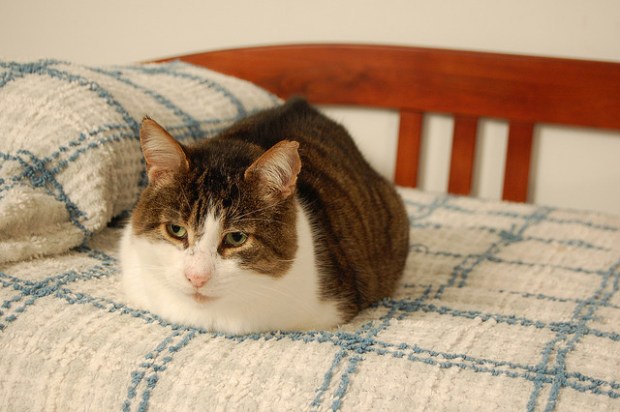
I looked at my cat Niko. Niko usually has his tongue hanging out of his mouth. He’s kind of a disaster, after having lived for many years as a feral cat.
Niko looks dapper.
Here’s my poem:
Ode to a Drooling Cat
How do you sleep, your face flat down,
Or jammed into a sack?
How do you lay in such repose,
Without wrecking your back?
How do you rise, your back end first,
Unwinding like a spool?
Oh! How you make me laugh with joy,
Each time I see you drool!
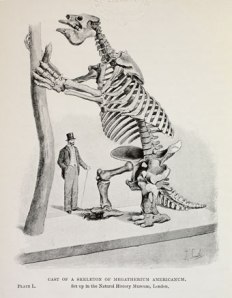
Modern sloths are curious beasts. Generally fairly small, tree-dwelling critters, they’re notorious for their slowness. But they come from a grand tradition of great size. Until the big extinction of large mammals that occurred about 10,000 years ago, there roamed across the land giant ground sloths that would have made most people run in terror.
Megatherium americanum
These giant sloths coexisted with great beasts like mammoths and woolly rhinos and saber-toothed tigers. They didn’t live in the trees; they were far too big. Instead, they moved about on the ground, using their huge claws to rake leaves from trees to eat.
All this is romantic, but seriously, if giant sloths were as slow as their modern cohorts, wouldn’t they have just been gobbled up by the saber-tooth tigers and the dire wolves?
Well, that’s a good question. How can it be answered?
Modern sloths are slow because they have low metabolic rates. Their diets consist of foods of poor nutritive value, so they balance this by sticking high in the trees and taking their time to get around. The low metabolic rate is reflected by having a low body temperature. Most mammals (like us, or horses and cattle) keep their bodies at 37-39°C. Modern sloths (and other low-metabolic-rate mammals) keep theirs at around 32°C.
So all we need to do is measure the body temperature of a giant sloth! Oh, wait. They’re extinct. Dang.
Geochemistry to the rescue!
Almost all of my research revolves around the geochemical analysis of fossilized teeth in mammals, to make inferences about their biology, and the environments in which they lived. To do this, I measure the relative amounts of stable isotopes (not the radioactive ones!) of carbon and oxygen from tooth enamel. The methods I use are (relatively) straightforward, and have been used actively for decades. The relative amounts of the different isotopes of oxygen and carbon can be related to temperature – and here’s our foot in the door to get at body temperature.
It can be complicated though, especially for oxygen, and until recently we couldn’t easily distinguish temperature changes from things like changes in the amount of precipitation. We also could only look at changes in environmental temperature, rather than body temperature. (Sigh.)
That changed a few years back with the development of a new method of temperature determination called “clumped isotope” paleothermometry or just delta-47 (Δ47). As it happens, the heavy isotopes of carbon and oxygen can exist together (clump) in a single molecule of carbon dioxide, CO2 (which is what we measure with the mass spectrometer). This carbon dioxide comes from carbonate (CO3) which comes from the tooth enamel. How often the heavy carbon and heavy oxygen clump in a molecule is directly related to the temperature at which the molecule formed. In the case of mammals, this is the temperature of the mammal’s body.
So all we have to do is count how many carbon dioxide molecules have both the heavy carbon and the heavy oxygen (= clumped isotopes) and we can measure body temperature!
It sounds simple, it’s really not, but only because there aren’t that many molecules with the clumps, so we need a lot of material and tons of analytical time to get it done. This makes it expensive and it’s hard to get materials because you basically have to destroy most of a tooth. Museums don’t like to lend you specimens that you’re going to destroy. I don’t blame them, really.
We’ve been fortunate, however. One museum has recognized the importance of this study: We really do need to know the metabolic rates of giant sloths if we want to understand their biology and behavior. We were lent teeth from two species of giant sloth, as well as teeth from a horse and a bison from the same cave locality that the sloths came from. We know body temperature in horses and bison, so we can use those results for comparison.
We’re also lucky that the clumped isotope method is so new, that the few labs that are capable of running these analyses are eager to try different things. Right now, we’re not having to pay for the analyses, though we do plan to see if we can get funding to pay for more analyses later.
Cool! Let’s do it!
But wait. There’s another problem. You see, sloths don’t have tooth enamel.
We use enamel from fossil teeth because it’s really hard and resistant to alteration during the process of fossilization. If the material we want to measure the isotopes from has been altered, we may be measuring something besides the body temperature signal – and that could be anything!
Sloth teeth are made entirely of dentine (which we have in our teeth, too, underneath the enamel). Sloths have two layers of dentine, a harder outer layer equivalent to enamel and a softer inner layer like our dentine. We’ve decided to measure the clumped isotopes from both the inner and outer dentine layers (assuming that the outer one is less likely to be altered, because it is much harder). We’re also measuring the clumped isotopes from the enamel and dentine of the horse and bison. This is how we’re going to determine if there is any alteration of the dentine in the sloth. If the sloth outer dentine gives the same temperature as the dentine in horse and bison, we have to be suspicious that it represents some alteration value and not really body temperature (and then all this work is for naught!).
Where we are.
Well, the preliminary data are in. They weren’t what I expected, but I’m not a sloth expert, so I’ll wait for my colleagues to chime in.
In the meantime, it’s time to start writing an abstract on the subject for the Society of Vertebrate Paleontology Annual Meeting, which this year will be in Raleigh, North Carolina. I think it’s gonna be pretty exciting!!!
April 9, 2012 was the 100th day of 2012. To celebrate, April 9 was National 100-word story day. I wrote one, and posted it on the 100-Word Story Facebook page.
Here’s my entry – a vignette from that one book I’m working on:
He looked out over the tournament grounds. All was silent. No evidence remained of what had taken place there. Her cries of frustration still rang in his ears, though she no longer was there. The only part of her remaining was the bit of lace he held between his fingers. He looked back at the castle walls. This was his home. It should be her home, too. Instead, it was her prison. He looked at the fabric in his hand. No, this had to be her home, and he was intent to make it so.
I’m not sure why I’ve decided to do this. Lord knows I’m not exactly overflowing with extra time! Oh well! It’s coming up on Renaissance Festival season, and I want some new costumes. And just in time comes this challenge:
The contest calls for me making three costume layers (underwear to outerwear) and some accessory. I’m trying to decide how to approach this. Strangely, the problem isn’t really what I should make, but for whom shall I make it? I’m thinking I’m gonna make something for the husband in this case. Last year’s costumes were more Medieval than Renaissance, but we can re-use those for another trip to the Faire. And this time, we have a workable costume for the boy as well!
Over the winter, I was inspired to make some more Renaissance-y costumes for myself, so I’m set more or less. My costumes aren’t *exactly* what one might have worn during the Renaissance, but they’re close enough.
Costumes for the man, it is!
So, for the man, I first need to make a shirt [Item 1]. I’ve actually made him one before, but for the contest I must 1) make everything from scratch, and 2) make something a little more Renaissance. This new shirt will need an upright collar, and maybe some embroidery.
I’ll probably also want to make him some hose – joined hose [Item 2], that is. I made hose last year, too, but not joined hose. I love telling the husband that he’ll have to wear hose. It makes him cringe.
Then a doublet [Item 3]. Not surprizingly, he has one of those too. But the one he’s got is sleeveless and collarless. This time, I’ll go with sleeves and an upright collar, and maybe poofy shoulders. Yeah, he’ll like that.
I need to make slops [Item 4]. It took me a while to figure out what ‘slops’ were. If they’d’ve just said ‘poofy pants’ I would have gotten it.
Then I need something to put over that, a cloak or cape. A cloak [Item 5] will do, methinks.
Finally, I need an accessory. So, I need to think of a man’s accessory. Probably it’ll have to be a hat [Item 6] of some sort.
Well then let’s lay it out.
[Item 1] – shirt: the costuming book I have calls for 3.75 yards of 45 inch wide linen. Linen is *really* expensive, so that’s not going to happen. But there’s some linen-look fabrics that I can buy. This is probably the simplest piece I’ll be making.
[Item 2] – joined hose: Wow. This pattern calls for 2.5 yards of 50 in wide wool plus 2.5 yards of 50 inch wide cotton or linen. Wool is also expensive. Might have to improvise there. Cotton will be cheap.
[Item 3] – doublet: Now we’re getting complicated. Wings and tabs and points and ahmahgahd!! All right, but we can do this! This pattern calls for 2.75 yards each (at 45 inches wide) of calico, top fabric, and lining. Let’s see here. What’s gonna give…
[Item 4] – slops: Crap. Panic is setting in. This is complicated. Panes? WTF? All right, I can do this. Everything should be 45 inch wide fabric: 4.5 yards of calico, 1.25 yards of top fabric and lining for the panes, 0.75 yards of top fabric for the lining, 0.75 yards of top fabric for the canions (whatever they are), And then some lining (1.5 yards) and wadding (1.3 yards).
[Item 5] – cloak: Well, my one book has nothing on cloaks, but that’s OK. I’ll fret about that later.
[Item 6] – a hat: This is another thing that will wait a while.
So the contest actually begins on April 15th, but I can at least purchase all the fabrics I need before then. Maybe I’ll have a better idea of how exactly I’ll accomplish this after I get the fabric.
This is the first installment of my attempt to convert a scientific paper (my own) into plain language that is accessible to everyone. Feel free to ask questions in the comments. I’ll respond there, or with additional blog posts.
Climate change at the Paleocene-Eocene boundary: New insights from mollusks and organic carbon in the Hanna Basin of Wyoming.
There is a lot of interest in climate change these days, especially global warming. Especially if that global warming can be blamed on increasing amounts of carbon dioxide in the atmosphere. The problem is that it’s hard to know if the trend toward warmer temperatures (at least the global average) is due to natural cycles of the Earth or due to increases in atmospheric carbon dioxide because of the burning of fossil fuels by us, or if there is even a relationship between increasing carbon dioxide and warming (maybe increases in both are coincidence, but not not due to some causal relationship).
This paper doesn’t make any arguments to support or refute any ideas about modern global warming. However, it is relevant because it explores a past episode of rapid global warming. This ancient event took place about 55 million years ago. Global average temperatures might have increased by as much as 10 degrees, and did so relatively rapidly (over about 10,000 years). It is suspected that this rapid warming was due to the release of massive amounts of carbon dioxide into the atmosphere.
So the warming of 55 million years ago seems similar to modern warming in being rapid (though not as rapid as in the modern scenario) and being potentially blamed on increased carbon dioxide in the atmosphere. In this paper, we assume that the warming at 55 million years ago did happen, lasted about 150 thousand years, then things cooled back down to more-or-less where they had been before. For the sake of this paper, it doesn’t matter what caused the warming, only that it was.
This warming event began at the boundary between two epochs on the geologic time scale: the Paleocene and the Eocene. We call this event the Paleocene-Eocene Thermal Maximum, or the PETM.
The Paleocene-Eocene boundary is actually defined based upon the onset of warming, as identified by a big change in the relative amounts of two isotopes of carbon (13-C and 12-C) in the atmosphere, and consequently in all organic material that was deposited at that time. How we measure these amounts and what the actual numbers mean are the topic of another paper or blog post. What’s important is that these relative amounts, or isotopic ratios, are presented in what we call the ‘delta notation’ (like δ13C, δ15N, and δ18O) in units of permil (‰). When delta values are more negative, there’s relatively more 12-C in a sample; when delta values are more positive; there’s more 13-C in a sample. The PETM, then, is recognized by a negative carbon isotope excursion (CIE), where the delta values suddenly drop by three to five permil. The PETM ends when carbon delta values go back to what they had been before the CIE started.
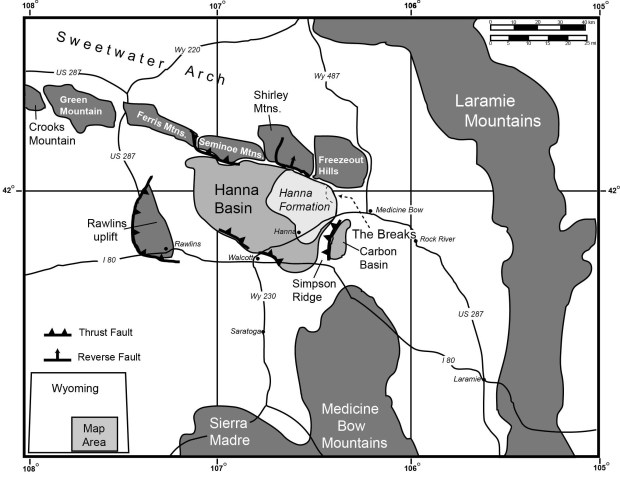
Much of what’s known about the climate change at the PETM, and the Earth’s subsequent recovery, is known from cores of rock and sediment collected from the ocean floors. Naturally, we’re interested in what would happen to us – those of us stuck on land. In the Hanna Basin, in south-central Wyoming, there is a sequence of rocks that began to be deposited before the PETM started, and continued to be deposited during the PETM and after the PETM. These rocks were deposited on land and are sediments from lakes and floodplains. In these lakes and small rivers were living lots of organisms, in particular, mussels. There was also a lot of organic material being deposited – so much so that now it is represented by many thick coal seams that are actively mined.
Location Map showing where the Hanna Formation lies
This sets up a scenario where we can use the organic carbon (from the coals) to identify the CIE, and therefore the Paleocene-Eocene boundary and the PETM in a terrestrial rock sequence. Then, we can look at the fossil mussels, and other things, to examine the environmental changes that happened during and after the PETM. The main questions, and ones that are relevant to modern concerns about climate change, are:
1) after the warming ended, did the environment go back to its original state or was it forever changed?
2) what effect did climate change have on the organisms that lived through it?
FINDING THE PETM
First, let’s look at the rocks. The Hanna Formation, the rock unit I’m studying, is about three kilometers thick (or about two miles). The part we care about is in the top half. The bulk of the Hanna Formation is composed of sediments deposited on floodplains, with little shallow streams that wound around (called fluvial). There are two parts of the Hanna Formation that have lake beds in them (called lacustrine), cleverly called the upper and lower lacustrine units (ULU and LLU). The focus of this study is on the upper and lower lacustrine units and some fluvial rocks in between them. I had reason to suspect, when I started this study that the Paleocene-Eocene boundary lies between the lacustrine units. This is borne out in this paper.
The Hanna Formation – its total thickness and where the study section is
It turns out that is wasn’t very easy to identify the CIE (and therefore the Paleocene-Eocene boundary) in the Hanna Formation. The delta values from the coals and other organic materials jump around a lot, probably because the organic carbon I was looking at comes from lots of different types of plants, all of which are slightly different isotopically. One conclusion of this study is that we need to do more ‘compound-specific’ work. That is to say, if we can isolate specific organic molecules and analyze them separately from everything else, that should make the carbon isotope values less variable. Unfortunately, the type of instrument and laboratory that’s needed to do that isn’t present here at the University of Rochester. I’m working on it.
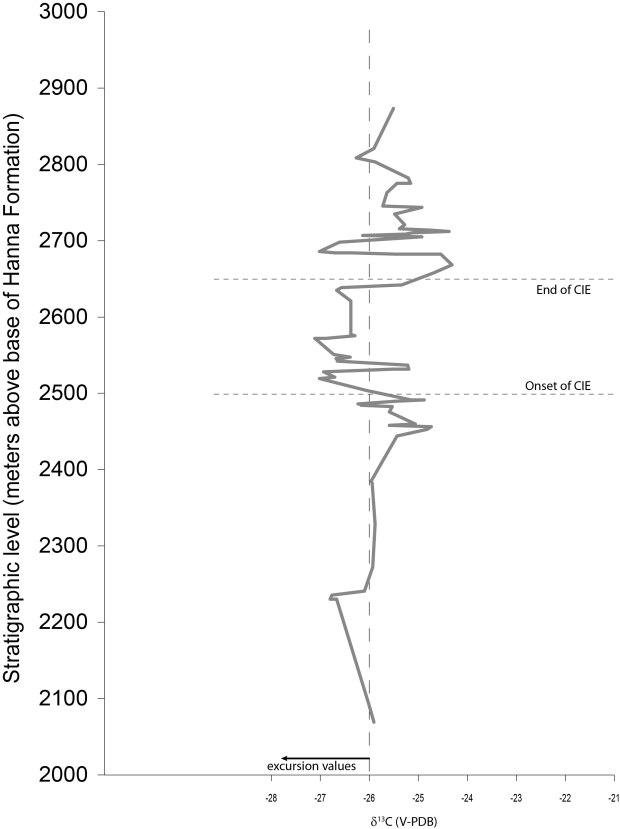
Nevertheless, in general where the values are more negative than -26‰, you’re in the CIE. To help make it more clear, I used a three-point running average of the raw carbon isotope data. This tends to smooth out the line, while keeping the big jumps visible. The first major jump into more negative values occurs at about 2500 meters, which coincides with estimations made using mammal fossils and fossil mollusks by others who have worked in the Hanna Formation before.
When I compared this overall pattern with other published patterns of carbon isotope variability (some from ocean cores and some from terrestrial sections), things matched up pretty nicely. Using pattern matching, I placed the top of the CIE (and the end of the PETM) at about 2650 meters, which is in the lower part of the upper lacustrine unit. This means that the 150 thousand years of the PETM are represented by about 150 meters of rock in the Hanna Formation, or that a meter of rock was laid down every 100 thousand years. This is actually reasonable – no one in the geological sciences is bothered by this rate of deposition.
Carbon Isotopes from the Hanna Formation, showing the CIE and the location of the LLU and ULU
ENVIRONMENTAL CHANGE
Now that the CIE is identified, I could begin to address the environmental changes that might have occured during that period of warming. I approach this in two ways:
1) Looking at isotopes of nitrogen – which gives us information about the organisms from which the organic matter is coming (e.g. we can distinguish between a stagnant pond or a lively lake).
2) Looking at isotopes of carbon and oxygen in the mussels that have been collected – which can give us information about annual changes in the environment that the mussels lived in.
NITROGEN
Most of the organic molecules that go into coal also have nitrogen in them, though not as much nitrogen as carbon. Usually, when looking at fossil organic carbon, the amount of carbon is so low that there essentially is no measurable nitrogen in the samples. In the case of the Hanna Formation, though, we have coal, which is basically ALL organic carbon-bearing molecules. That means that there’s some hope of finding measurable nitrogen, and that’s what I did.
So really, this part of the study was basically done for giggles – just to see if I could do it. And once I had data, well, I had to interpret it.
There are two ways to think about nitrogen. One is to simply compare how much nitrogen there is relative to carbon (C/N ratios). A second is to look at the ratios of two isotopes of nitrogen, 14-N and 15-N. C/N ratios give us information about the origin of the organic molecules (from algae or land plants, for example) and the isotopic ratios tell us about status of lake, whether it be full of actively photosynthesizing plants or if it is stagnant.
Using the combination of C/N ratios and nitrogen isotopes, it seems that for the most part the organic carbon in the lakes of the Hanna Formation is dominated by land plants. So these are leaves and litter that were washed into the lakes. One interesting isotopic data point sits at the bottom of the CIE. From this point, it seems that there was might have been drying of the lake at the beginning of the PETM. That would make sense, assuming that warming could cause greater evaporation.
MUSSELS
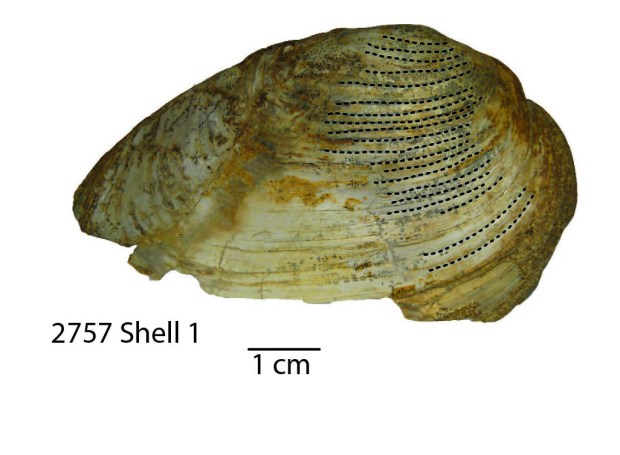
The work with the mussels is actually been the topic of two undergraduate senior theses that I’ve advised. They’ve been doing some great work to look at the annual changes in isotopes by collecting multiple samples from single shells, following growth lines, to put together a picture of environmental changes that happened during the individual animals’ lives. I don’t say much about that work in this paper. That’ll be published later. What I do talk about is trends. I’ve taken the averages from individual shells and used those to look at how the isotopes of carbon and oxygen from the shells change over time. I also talk about how carbon and oxygen isotopes change relative to each other within a single shell.
Mussel Shell – dashed lines show where isotopic samples were collected
So, how are carbon and oxygen in the shells of mussels, you ask? Mollusk shells are made of calcium carbonate (CaCO3) which contains one carbon and three oxygen atoms. We collect powdered bits of the shells by using a dental drill and take this powder and put it into the mass spectrometer. The calcium carbonate is converted to carbon dioxide (which is easily measured by the mass spectrometer) by reacting the powders with acid. You put acid on the calcium carbonate, it fizzes, making carbon dioxide, which is drawn into the mass spectrometer and – wango! – we have carbon and oxygen data.
Carbon in mussel shells is thought to be derived mostly from carbon dioxide that has been dissolved in the water, and so should track the isotopic value of atmospheric carbon dioxide. Atmospheric carbon dioxide, as mentioned earlier, gets more negative during the CIE then returns to the pre-CIE values. The average values from the shells seem to follow this trend, so there’s no surprises.
But now we’re talking about yet another isotope: Oxygen. The isotopes that we measure are 16-O and 18-O. Isotopes of oxygen are a big topic of discussion when dealing with climate change. That’s because oxygen is an important component of water, and water is an important component of climates. For example, climates can be described as arid or humid. There can be rainy seasons or monsoons. Precipitation can take the form of rain or snow. All of these processes affect the isotopes of oxygen in water. Temperature also affect oxygen isotopes. Unfortunately, isotopes of oxygen in water are a very complex system, and would best be discussed in a separate blog post. What is important is that there isn’t any obvious trend in the average values of oxygen from the shells over time, either.
Since oxygen is affected by climate, one would expect that there should be some change if there’s been a significant climate change. However, because oxygen is so complicated, the changes in oxygen isotopes by changing one part of climate (the time of year when it rains, for example), might be offset by other changes (like a change in average temperature). The fact that there isn’t any obvious trend or change in oxygen isotopes over time doesn’t mean that there wasn’t any change in climate.
And we do see a difference when we compare the variations in carbon and oxygen within a single shell. Carbon and oxygen in shells from the lower lacustrine unit (before the PETM) tend to change in opposite directions (or are negatively correlated). When oxygen isotopic values get more positive, carbon isotopic values get more negative. Shells in the upper lacustrine unit show the opposite pattern. Carbon and oxygen values change in the same direction (are positively correlated), so when oxygen gets more positive, so does carbon. From this, it’s possible to infer that before the PETM there was a lot of vegetation and photosynthesis going on around the lakes, whereas during the PETM, photosynthesis might have slowed down during the warmer months and bacteria might have dominated life in the water. This seems reasonable since in the upper lacustrine unit there are also huge fossilized bacterial mats called stromatolites.
CONCLUSION
So that’s what this paper is about. We see some evidence of environmental change due to warming at the Paleocene-Eocene boundary. Particularly, we have the one really positive nitrogen isotopic value near the base of the CIE and we see a change in the relationships between carbon and oxygen isotopes in individual mussel shells during the PETM as compared to pre-PETM.
One thing that hopefully is obvious however: there is more work to be done.
The work with nitrogen isotopes started with a shot in the dark. More samples should be analyzed. There’s definitely more work to be done there.
My students’ work on the mussel shells will greatly contribute to this as well. Since I wrote this paper, there have been more shells collected and more samples analyzed. That work needs to be wrapped up and published soon.
We really need to do that ‘compound-specific’ work I mentioned earlier to help clarify the CIE. It’ll also help clear up what sorts of plants were around at that time, so we can better interpret the nitrogen data.
Also, though not discussed at all in the paper, is the fact that there are paleobotanists out there looking at fossil leaves and pollen. There’s a story to be told there, and someone’s getting a Ph.D. For their efforts. I can’t wait until that work is done!
TL;DR summary: In my opinion, every scientist should be required to write a plain-language summary of each professional publication that they write, so that everyone else in the world can understand the point and importance of the research. This is especially important where publications aren’t open access!
I’m a ‘real’ scientist. That is to say, that I work in a lab, read the ‘primary’ literature, and occasionally publish professional papers in peer-reviewed, globally available journals.
Most people that I might meet randomly at the grocery store or a bar don’t know that I’m a ‘real’ scientist, and are often surprised when I reveal the truth. Yup, I have a Ph.D. Yup, some days I wear a white lab coat. Yup, not only have I read and understood that new paper on the feathered Tyrannosaur, I know some of the authors.
I’ve had people make comments to the effect of ‘you don’t look like a scientist,’ or better (or worse, depending on how you think about it), ‘I wouldn’t have expected a scientist like you to be so nice.’
What this has driven home to me is that there is a huge disconnect between the people doing science and everyone else in the world. This touches on the whole stereotype that scientists sit in their ivory towers and look down upon the common people. No! Really, we’re just ordinary people, but with a different type of education, experience, and often world view.
Some folks are working hard to dispel this stereotype. One of my favorite blogs to visit is “This is What a Scientist Looks Like”. (Here’s my entry, if you’re wondering.) Most scientists are just goofy people like the rest of the world’s population.
Fundamentally, however, I think the disconnect between ‘scientists’ and everyone else is about language. And I would add that this problems goes both ways. We just don’t talk the same. We have our jargon – there’s no avoiding it – and since we spend far too long in laboratories or out in the field either alone or with other science types, we forget that we’re different. And even when we make the most concerted effort to remember how it was before we started our more scholarly pursuits, we actually forget what we didn’t know. Admittedly, a lot of the greatest dynamos in science don’t make such concerted efforts, they’re too absorbed in their science.
What is important here is that scientists are scientists because they’re passionate about what they do. The hard part is that we don’t express it very well. Even I’ve learned that in certain company, I’m best off just keeping my mouth shut, because I stand out as so ridiculously different. But at least I step away from the lab from time to time, and when the opportunity arises, I do advocate for the sciences in general (and that’s when I get comments like those above).
I’m not that different from everyone else in the scientific community or otherwise.
I have a job that I’d like to keep
I have a house that I’d also like to keep
I have a husband that most of the time I’d like to hang onto
I have a special needs son that I love very much
I have pets
I have hangnails (those I could do without)
I like to sew
I enjoy a good ale
I like going to movies
And occasionally, I do a little writing
In the absence of the knowledge that I work at a university and spend my days turning knobs on a mass spectrometer, you’d think I was just like any other person. And in ordinary conversation, you still might not notice anything special. But if topics turn to science (like global warming, or evolution), I turn into the scientist, and people are usually a little surprised that I’m actually kind of an expert on those things. ‘But you’re so nice.’
So one of my motivations for working on this blog is to try in my own little way to dispel the rumors that scientists are all creepy angry lab lurkers who think they’re smarter than everyone else.
Since I believe that one of the barriers we face is that of language, I am making an effort to take things that are familiar science to me, but woefully mis-understood outside of my field, and translate them into ordinary language (as best I can, anyway). There’s a lot of stuff out there that I could ‘English-ify,’ an overwhelming amount, in fact, so naturally I have to limit myself.
I will focus on my own research and also on the science of geology. I am a paleontologist and I could blog on paleontology, but there are many bloggers out there who do a worthy job of that. I’ll leave that to them.
As it happens, my own research may be of broad interest anyway. I do a lot of research on ancient climate change. There seems to be a lot of discussion about climate change in the news lately, so I think there might be some interest. However, I know that my professional publications on that topic, though openly accessible, would be a semantic nightmare for the casual reader. As my dad once told me, ‘I’ve read all your papers. I don’t know what you’re talking about, but you sound really smart!’
So I’ll write a plain English summary of my own papers, at least. That way everyone can get from the work the important lessons. I hope that other scientists would consider doing the same.


 Penny Higgins - Storyteller • Artist • Scientist