What is this “Mass Spectrometer”?

What is a mass spectrometer? I was just asked this question. It gave me pause.

You know, most of us forget that what is completely familiar to us in our daily lives might be utterly foreign to 99% of the world. For example, I’m a vertebrate paleontologist and know many, many paleontologists. Sometimes, I think the whole world is teeming with paleontologists. But when I think about it, there’s maybe 5-10 thousand people in the world that can call themselves a vertebrate paleontologist. Still a big number, but when compared to the world’s population of ~7 billion, or the population of New York City at ~8 million, it’s quite possible that I may be the only paleontologist that many of my non-paleontology friends know and may ever meet.

I suspect that there are more mass spectrometer technicians in the world than paleontologists, just because there are so many different kinds of mass spectrometers and zillions of applications for mass spectrometry. Nevertheless, most people’s exposure to mass spectrometry comes from watching episodes of CSI, where (naturally) the television show gets it mostly wrong. (Seriously, you don’t just turn on a mass spectrometer in the morning and expect to get results in a few hours. I switched ours on yesterday and I’m extremely hopeful that I can start running analyses tomorrow!)

So, then, what’s a mass spectrometer? Breaking down the name itself is a good start.

Mass: This is the science kind of mass, not a religious ceremony. Mass is generally equated with ‘weight’ or ‘size.’ ‘Mass’ in science-ese is actually more specific than that, but this works. We’re basically considering something in terms of its size or weight.

Spectrometer: Well, the ‘spectro-’ part is the same as spectrum – a range. Just like a spectrum of colors: red, orange, yellow, green, blue, violet. The ‘meter’ part just says that a measurement is being made. We’re measuring a range of something.

Since it’s a MASS spectrometer, we’re measuring a range of sizes or weights.

OK, but measuring weights of what?

Now here’s the fun part, and why I say there are so many kinds of mass spectrometers. We’re usually looking at the weights of components of some material. It may be an unknown material, and we want to know what it is. Or it may be a known material, but we want to look for impurities or (potentially) for its origin.

Some mass spectrometers are set up to look for heavy elements like strontium or uranium and measure their abundance. Others look at organic compounds like fats or waxes to determine, for example, how much unsaturated fat versus saturated fat there is. The one I work with is highly sensitive and can only be used with ‘light’ elements like carbon, oxygen, and nitrogen (and occasionally hydrogen – but I hate hydrogen… we won’t go there!)

All mass spectrometers have the same general components: A means to get the sample into the instrument (an inlet system or peripheral device), a means to separate the masses, and a means to measure the different masses.

A common instrument you might see on a TV show like CSI is a gas-chromatograph mass spectrometer (or GC-MS, seriously, that’s a mouthful!). The inlet system is a combustion chamber (a furnace) where the samples are burned, causing the original molecules to break down into smaller molecules that are now gaseous (rather than a solid). These molecules are separated, by mass, using a chromatographic column, which is essentially just a really, really long narrow tube. The smaller molecules flow faster down this tube than the bigger ones. At the end of the tube is a collector of sorts, which basically counts how many molecules of each size pass through the tube and we get a spectrum of the different sizes of molecular fragments that came from our original sample. The pattern of molecule sizes and amounts is characteristic of a particular material.

Another common mass spectrometer is a quadrupole mass spectrometer. This is used for the heavy elements, and makes measurements atom by atom (not whole or fragmentary molecules). We had one running here at the University of Rochester for a while. The inlet system on it was experimental, but fun. A laser was shot at the sample, forming a fine dust which was then carried into the inlet system in Argon gas. There it went into a plasma torch and was burned up and the gas went into the mass spectrometer. This system has the fancy name of Laser Ablation Inductively Coupled Plasma Mass Spectrometry, or LA ICP-MS. Changing voltages on the four metal rods for which the quadrupole instrument gets its name is how the different masses are selected. A collector is at the end of these rods, which measures how many of our specified atoms got through.

The instrument that I manage is called an isotope ratio mass spectrometer (IRMS). There are several different peripheral devices attached to ours, one of which has a furnace like on the GC-MS, and another that has a series of vials with a moving needle. The peripheral devices are where the solid samples are converted to gas. In the first, samples are burned up and converted only to carbon dioxide and nitrogen gasses. In the other, the solid samples placed in the vials are reacted with phosphoric acid to make carbon dioxide gas, which is what we measure. (And I inject that acid drop-by-drop, vial-by-vial. So when you see me say that I’m dropping acid, that’s what I’m doing!). These gasses go into the mass spectrometer and are ionized by an electron beam (3000 Volts!!) after which they fly away from the electron beam toward the collectors. The different masses are separated by a strong magnet and a voltage is measured by the collector cups.
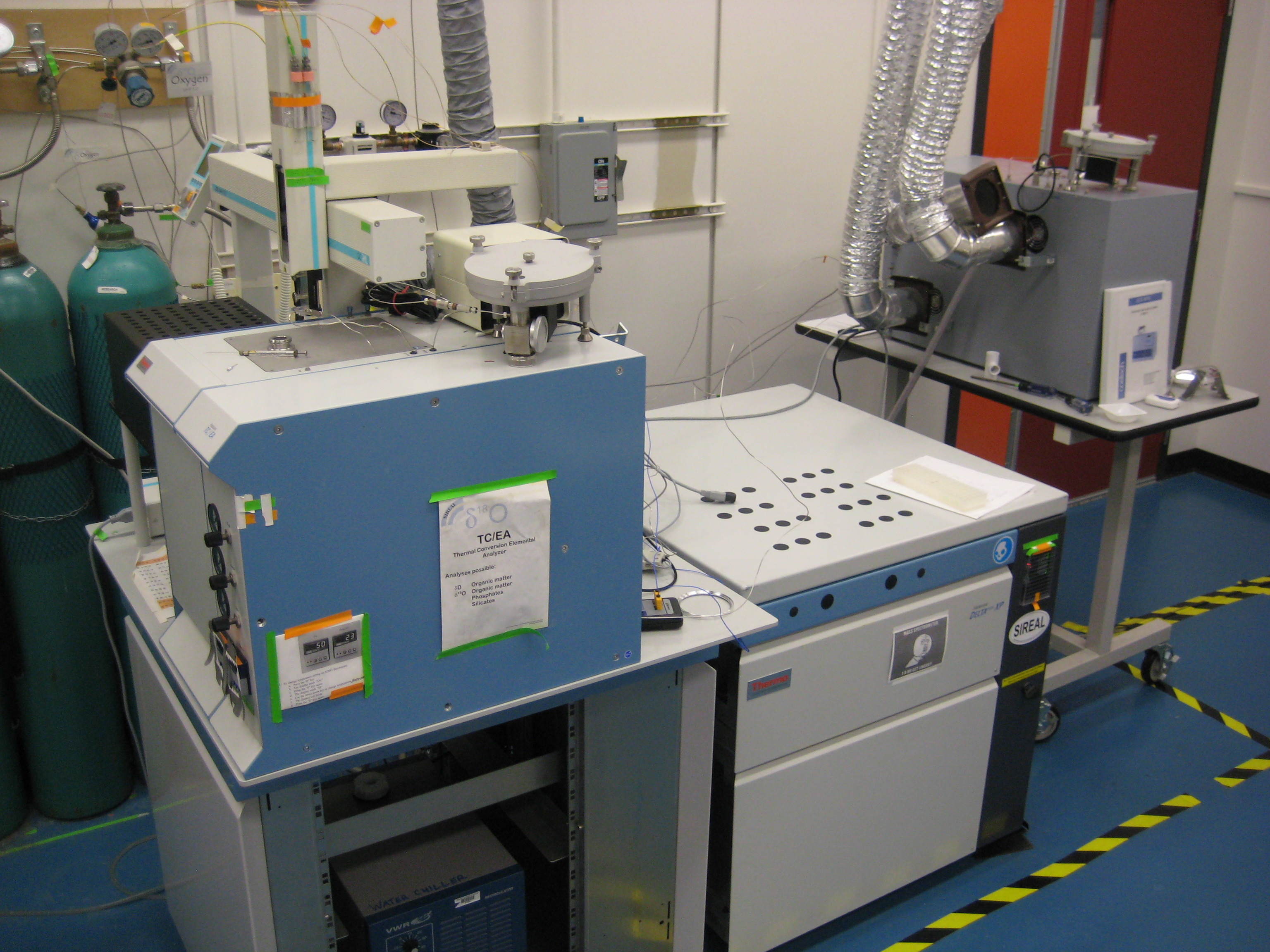
Speckminster Fuller, or Specky for short. The mass spectrometer I take care of every day.

What’s different about what I do is that I’m only looking at one molecule at a time, usually carbon dioxide. But I’m looking at isotopes. Not radioactive isotopes, but stable ones. Isotopes are atoms of the same element, but with different masses (or weights).  Every atom is an isotope. Some are just unstable.

Carbon dioxide has carbon and oxygen. Carbon has two stable isotopes: Carbon-12 and Carbon-13 (and one unstable, radioactive isotope, Carbon-14). Oxygen has two important isotopes: Oxygen-16 and Oxygen-18.

Some math: carbon dioxide = one carbon plus two oxygens. Most carbon dioxide is composed only of carbon-12 and oxygen-16. Take those numbers and add them up: 12 (the carbon) plus 16 (one oxygen) plus 16 (the other oxygen) equals 44 – the total mass of ‘light’ carbon dioxide.

Let’s say the carbon is the ‘heavy’ isotope instead (Carbon-13). Math again: 13 (the ‘heavy’ carbon) plus 16 (one oxygen) plus 16 (the other oxygen) equals 45 – the mass of carbon dioxide with heavy carbon.

What if one of the oxygens are heavy? 12 (the carbon) plus 16 (one oxygen) plus 18 (the ‘heavy’ oxygen) equals 46 – the mass of carbon dioxide with one heavy oxygen.

Obviously, there are other combinations possible, but these are rare and we don’t worry about them. What’s important is that carbon dioxide comes in three masses: 44, 45, and 46. An IRMS can separate these out and we can measure them.

Subtle differences between the relative amounts of heavy and light isotopes of oxygen and carbon (and nitrogen and hydrogen) can tell us a lot about the origins and history of the sample that we’re analyzing. For some examples from my own research, look in my blog under “stable isotopes

Larry and Bob – The Lemmings

This is what happens when you are a little slap-happy one ‘night’ in the High Arctic. Written by me and my tent buddy, Julie.

Larry Lemming
Larry Lemming

Larry and Bob were two lemmings living on the Kanguk Peninsula of Axel Heiberg Island. They were pals who lived in adjacent holes on a river terrace. there was lots to eat, plenty of water, and luxuriant moss to rest on to enjoy the twenty-four hours of summertime daylight.

One day, a gust of wind blew furiously over their terraces. They hid for a few hours. When they finally had the courage to emerge, they were shocked to see a row of brightly colored soft stones by their holes and five huge yellow flowers. From the yellow flowers came the strangest creatures they’d ever seen.

“Dude, that an ugly caribou,” said Larry to Bob.

“Naw, them’s musk oxen. but how they walk like that?” asked Bob.

These oxen would go into their flowers when the sun was low in one part of the sky, but emerge and go away when the sun was on the opposite side of the sky. The oxen would put on huge hooves on their hind legs and go away until the sun was low again.

After a few repeats of this apparent oxen ritual, Larry and Bob started to get bold.

“The oxen are asleep,” said Larry.

“Let’s find their food,” said Bob.

Larry and Bob found where the food was hidden, in strange hollow square rocks. But they couldn’t get into the rocks to get to the food.

“This stinks. Let’s do something else,” said Bob.

“They can’t get to the food without their hooves on,” remarked Larry.

“Uh, yeah?” said Bob.

“So… Let’s get hooves on!”

So Larry and Bob scurried around the flowers looking for hooves. they finally found a matching set when they crawled under a flower petal. Quickly they realized these hooves would not fit on their feet.

But they could tip them over and drag them into the open. They dragged the hooves to the square hollow rocks and waited.

Nothing happened.

“Wait! they need to be standing up!” exclaimed Larry.

So Larry and Bob stood them up.

Still nothing happened.

“Well, we’re still not wearing them!” said Bob, quite insightfully.

“Yes!” cried Larry.

They each took a hoof and climbed in. They peeked out at the square hollow rocks. Still nothing.

“They stomp!” exclaimed Larry. “So let’s stomp!”

“Um, how?” asked Bob.

“Jump! Jump!”

So they jumped and the hooves moved. They stomped and stomped. The rocks still didn’t open, so they stomped more.

Suddenly a flower popped open and a particularly wooly musk ox came out, howling and growling.

Larry and Bob lept from their respective hooves and raced back to their holes.

-THE END-

Reflections on Paleontology

As I prepare for the first of two field excursions this summer, I reflect upon what it is to be a paleontologist.

Truly, there are days when I wonder why I do this. Now that I’m married and a parent, the whole leaving-for-a-month thing no longer has the same charm. And on the eve of my first departure to the Canadian High Arctic, I find myself wracked with anxiety. I’m trying to figure out whence it stems.

Being a paleontologist is a delight, most of the time. With younger kids, it’s especially fun to introduce myself, since they generally actually know what a paleontologist is. But in all cases, once we’ve established what I do, the conversation is enjoyable.

Of course, one of the first things I get asked is about the ‘coolest’ thing I ever found. Uh, yeah. I feel like I got nothing. I mean, I named a new species once. A multituberculate mammal, based upon one and a half teeth. Then I have to explain what a multituberculate is and how one can name a new species using only one tooth.

Ooh, wait. There was that turtle skull I found once. Hmm. No idea what species it was. Kinda botched prepping it myself. Not so cool.

Really, I can’t think of anything ‘cool’ that I’ve ever found. Maybe it’s just a matter of perspective.

Then I’m asked where I’ve gone to do paleontology. Well, I have gone some cool places. Bolivia has been fun. Uruguay. Wyoming, a lot. And now the High Arctic.

I hope I find something cool in the Arctic.

In the meantime, I’m still anxious. I’ll miss my son and my husband, and the creature comforts of home. Of course, I won’t miss my office and that darn mass spectrometer.

I think the anxiety stems from my usual wound-uppedness about traveling, and my general worries about my son, who is on the Autism spectrum. There will be essentially no way for me to know what is happening back home. I’ll probably have one of those horrible nightmares early on about something terrible happening to the boy. It’ll have me in knots.

It’s moments like this that I start to seriously reconsider the necessity of fieldwork. But I do it anyway because I know that once I’m on the ground, I’ll enjoy myself. I find it rejuvenating. And really, what kind of idiot would I be to turn down a chance to go to the Arctic? I’ll be all right once I’m there.

In the meantime, I think I might just explode!

Sigh.

I hope I find something cool in the Arctic. That’d be nice.

25 Days of Writing – Day 23

Day 23: Write a scene between your character and another character of your choice (whether brought up previously in the other scenes or not) using only dialog. The setting and situation is up to you, but you cannot not use descriptive exposition, only dialog.

——

“You’ve been talking in your sleep, woman,” said Trey.

“Oh dear,” mumbled Hanna.

“You were weeping.”

“Oh. I was having a bad dream, my Lord.”

“You have had a most difficult day, woman.”

“Yeah.” She sniffed.

“I am really quite pleased with your performance this day, woman. You fought well.” He paused briefly. “You should be proud. Not many would have fared so well.”

“I got my face smashed in.”

“Ah, but you were there. And there’s little doubt that Jason would be lost but for your quick action.”

“I killed a man.”

“Aye, a man of Falgarth. Hardly human,” Trey snorted.

Silence.

“You really think that way, my Lord?” Hanna asked. “His life is less that yours because he his from an enemy nation? He probably thought the same of you. Is that fair?”

“It is war, woman.”

“But is it fair?”

“In war, all is fair.”

“So life has no meaning?”

“Now—”

“That guy could have been someone’s father, or brother, or son, or husband, or whatever. He could have been the world to someone, and I killed him.”

“We accept such risks when we raise weapons in war,” retorted Trey.

“Yeah, you do. What about the people who love you? You’re not an evil man, but you kill. He probably wasn’t an evil man either. He might have been your friend, under different circumstances.”

“If he was truly a good man, God will sort him out.”

“Not much comfort for those left behind.”

“They would be together again in the afterlife. We worry not for such things.”

“Yeah? Well what if there isn’t an afterlife? What if this is all we have? What then? The man is dead and gone forever. And because of me. I don’t know if I can live with that.”

“Surely you jest. There must be afterlife. Where would we have come from?”

“I don’t believe that.”

“Don’t believe?”

“I don’t believe in the afterlife. I never have. I’ve hoped for it, but I don’t believe it.”

“So God would just snuff us out? That makes no sense, woman.”

“I don’t believe in God, either,” said Hanna softly.

“How could you… not?” asked Trey.

“I could never explain. I have tried, but I can’t.”

“So you think me mad?”

“No. I’m glad that God offers you comfort. I envy you for it. But that doesn’t make me believe.”

“No God. No afterlife.”

“And I took a man’s life today. And I never want to do that again.”

Silence again.

“If you had not slain him, Jason surely would have died,” Trey said softly.

“I’m glad Jason is alive. I’m glad I could help him.”

“None of us who bear the Mark enter into a battle planning to kill the greatest number. We fight to protect our nation and our King. Men must die to do that. We accept that in fact we ourselves may be the men who die.”

He paused. “I hope you can forgive for the lives taken, and those that will be taken, in the defense of Herongarde.”

Hanna sighed, but said nothing.

“I pray you will forgive yourself for this life you have taken, and others you may have to take later, aye?”

“I hope so too, my Lord.”

25 Days of Writing – Day 22

Day 22: Today is the end of an era in your character’s life. How do they feel about this? What is happening today? Write a scene of your character on this day.

——

Trey stood unsteadily in the center of the tournament grounds. He gazed sadly over the bodies of the dead, lain neatly in two rows, one to each side of him. Each of these people, men and women, had died to protect him, the King, and the nation of Herongarde.

The bodies of the dead lined a path toward one last body, lain on a raised platform before him. His father lay there, having sacrificed his life to find peace and freedom for Herongarde, and to preserve the country over which Trey now reigned.

Trey raised his eyes and scanned the crowd gathered here. Hundreds of people covered the hill slopes, stood on walls, and sat in trees to observe the proceedings. The people of Herongarde mourned the loss of good King Anthony.

He looked to his side at his mother. She stood looking on stoically, her face emotionless aside from the tears streaming down her cheeks. Trey’s heart ached for her. She and Anthony were to enjoy their remaining years in peace – a peace shattered by the renewed attack of Falgarth.

He swayed, nearly falling. He felt a hand grip his other arm, supporting him. He glanced to see Hanna holding him, a look of deep concern on her face. Hands touched his shoulders as well. Markus stood behind him, ready to catch him, should he fall.

Trey nodded, and they began to walk forward. Trey gazed down on each face as he passed. He knew them all, though some touched him more than others. Elsbeth, who captured the heart of the confirmed bachelor, Dean. She was a good woman and an asset to the nation. Trey bent and touched her face.

He moved on. Three women and five men – five Mark-bearers – dead by the steel of Falgarth.

Trey paused lastly at the body of Kevin. Anthony’s oldest friend, ever the skeptic, but he loved his King and his country. He fought fiercely for justice and the defense of the codes of Herongarde. Few Mark-bearers had more experience. He would be missed.

A few more steps brought him alongside the body of his father, King Anthony. He took his father’s hand and dropped to his knees. Trey leaned his head upon his father’s shoulder.

“I know not if I can do this, Father. Please guide me.”

All was silent.

Trey felt a hand on his back. His mother knelt beside him, holding him. He leaned upon her and allowed his emotions to flow. He shook with tears for a few minutes.

Slowly, he regained himself. He rose, with the help of Hanna and Markus, who remained close by.

He looked at his mother, who returned his gaze. “We must continue,” he muttered.

“Yes, my son. We move on.”

Trey drew a deep breath and nodded. They walked back to the platform where they had started their walk, upon which Trey stood and faced the crowd. He held up his hands.

“Let it be known this day that not one of these fine warriors gave their lives in vain. These are noble men and women of our nation. Their sacrifice will be remembered evermore and we shall celebrate their gift to us.”

Trey drew his sword and held it aloft. “Herongarde lives on!”

Every sword, staff, rake, or cane possessed by those who observed rose up. A great shout filled the air. Cheering. Trey was King. And the people loved their King.


Adventures in Mass Spectrometry

For the most part, I quite enjoy what I do. Running a lab, working with students, and learning about the ancient past using a select few molecules is really, really interesting!

But there’s a downside. See, I have to run a lab, and when things break, I have to fix them. The most important thing for which I am responsible is a $350K mass spectrometer. Anytime something breaks, or runs out, or whatever, I crack out the lab checkbook and spend a thousand dollars or so to get it going again – on the assumption that I can figure out what went wrong.

There are common problems: The filament might burn out or acid might get drawn into the system. Then there are less common problems – the ones where I scratch my head wondering why it’s not working. I had one of those recently.

It started as a simple problem: The filament burned out. Cool, I can fix that in about an hour, and the instrument is out of commission for a day. Well, gee, since I had to shut it down anyway, I decided to perform the annual maintenance on the mass spectrometer. I cleaned the source (size of my fist, ~80 parts including little wires and screws). No problem. I changed out a vacuum pump. No sweat. Turned it on again, pumped everything down. Looks great! Turned on the source. Got the three beams I’m supposed to have. The whole thing couldn’t have been smoother. I left the lab to do something else.

Then, something happened.

When I returned a few minutes later, my beams were gone. Weird. I shut off the source and turned it on again. (Funny that mass spectrometers can be a little like computers. “Did you try shutting it down and turning it on again?”)

BBZZZT. No beams.

I shut it off. I tried again.

BBZZZZZZTTTTT! No beams. And definitely not a sound you ever want to hear coming from a mass spectrometer. That’s 3000 volts I was turning on, and BZZZT is BAD!

I shut the whole system down again and re-cleaned the source. I probably had a wire crossed, right?

Yeah. Two days later I had the system all together again and tried to turn on the source: BBBZZZZZZZTTTT – Sizzle-sizzle.

Uh. Yeah.

Head scratching. The electronics were the culprit, obviously. I don’t do electronics. I do vacuum. I do glass capillaries. I do 100% phosphoric acid. I’ll even do hydrofluoric acid (sometimes). I don’t do electronics.

Now here’s the fun part. Thankfully, this wound up being a great experience. Oftentimes, electronics issues become a nightmare of chasing around charred components. I braced myself for a long and difficult process, and expected that the whole thing would cost the lab at least $4000 dollars. Ugh!

It was suggested to me by an engineer from the manufacturer of the mass spectrometer that I should find a local electronics shop. (A great suggestion! Thanks Roger!) As it happens, we have an electronics shop here at the University, and the guys over there really like getting out of their office once in a while. They came over to look at the electronics (on which I could find no evidence of damage). It was a field trip to them, and it wound up being great comic relief for me.

Picture this: Two adult men kneeling in front of a circuit board that handles 3000 volts of electricity. We all know something is wrong, but we don’t know where.

“OK, turn it on,” says the first.

Click. Pause. BZZZZTTTTT!

“Ooh! Cool!” says the second.

“There it is,” says the first.

“Yeah, shut it off.”

Click. Silence.

The two men crown in and start touching things. Wiggling things. Then cleaning things.

“Turn it on again.”

Click. Pause. BZZZZZTTT!

“Ooh! Wow.”

“Turn it off.”

Wiggle, wiggle. Prod, prod.

“Turn it on again.”

Click. Pause. BZZZZZTTTT!

Me: “Should I shut it off?”

“Oh, yeah, probably.”

Seriously, they looked like they were having the time of their lives. Meanwhile, I’m flipping out a bit about 3000 volts arcing across a circuit board. They were completely nonchalant about it.

Now, I do realize that their comfort has everything to do with their experience, and that my own discomfort is the reason why I’ve said since the beginning that I won’t screw with electronics. Undoubtedly, I do the same thing to students and other lab users when I threaten them with bodily harm if they break anything on the mass spectrometer, then I proceed to pound on it with my fist. It’s all about experience.

I just found it completely humorous.

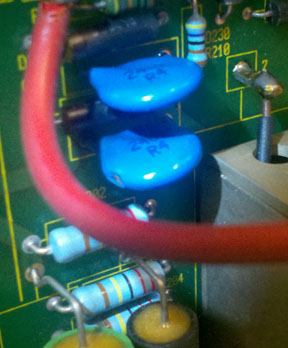
Well, they found the problem. A little capacitor I’ve named Sparky. The next day, they came over and traded Sparky for another capacitor. It took them all of an hour, and that included us socializing afterwords.

Sparky. The lower blue capacitor with the hole in the side. Capacitors shouldn’t have holes in them!

The next day, I tried turning on the source again, bracing myself for another round of BBBZZZTT.

Nothing.

But hey! Beams!

It was fixed!

We’re running again!

I asked the guys from the electronics shop what we owed them. Their response: Nothing. They had the parts on hand, and it was a fun escape for them.

So what I thought would be a $4000 job wound up costing exactly nothing. And I made some new friends. (Thanks Bob and Wade!) AND the mass spectrometer is running GREAT!

I wish all repairs went like this.

25 Days of Writing – Day 21

Day 21: FREE DAY! Write any scene you want!

——

The clashing of swords had stopped. Trey looked around and saw Orrin standing unsteadily, with blood soaking the front of his tabard. The wound to Orrin’s neck was deep, and bled freely, but was not fatal. Trey moved to Orrin quickly, to catch the man before he collapsed. Donnal moved with Trey and they both caught Orrin as he dropped to his knees.

“Orrin,” said Trey and the bleeding man leaned onto him.

“My Lord,” murmured Orrin, his eyes closed with exhaustion.

“Lie you down, Orrin,” instructed Donnal. “I shall attend to this,” Donnal said to Trey.

“Hanna—,” started Orrin.

“Aye, Hanna,” agreed Donnal. He looked at Trey. “How fared she?”

Trey’s face paled and he began to look around. “I know not,” he said absently. His eyes fell upon Balayn and Dean, who were bent over looking at someone. Dean was blocking Trey’s line of sight. When Dean stood abruptly, Trey suddenly recognized the dress of the person who lay there.

“Dear God,” Trey whispered as he rose. “Hanna?” He strode toward the group. Balayn looked up.

“My Lord,” spoke Dean. Trey ignored him. He saw that Hanna was not moving. Balayn was stroking her bloodied face.

“Hanna?” Trey said louder. Suddenly he was running. “Hanna!” he screeched. He raced to her side, falling to his knees beside her.

“Hanna?” Trey’s voice shook as he stroked her face. “Darling?”

Balayn studied Trey’s face. He watched tears form in Trey’s eyes and run down his cheeks and drip from his nose. Tears rose in his own eyes. Balayn knew that Hanna lay there now because she took her attention from her own attackers to fell a man who would have killed him. That moment of inattention was an opportunity capitalized upon by one attacker who smashed her face with the pommel of his sword.

Another tear dripped from Trey’s nose, splatting on Hanna’s cheek. She flinched slightly and her lips moved. “Hanna?” said Trey. “Please, wake.”

Balayn turned his attention back to Hanna. He saw her moving slightly. “Hanna,” he said. “Wake, wake.”

Dean leaned in to observe. The three men crowded over her, speaking encouragingly. Her eyes moved and flashed open for a moment. She seemed to try to speak, her lips moving but no sound came out. She opened her eyes again for a moment, her gaze pausing for a moment on Trey before she closed her eyes again. Her mouth stretched into a grimace and she cried softly.

Trey bend in, stroking her cheek. “It’s all right. It’s all right,” he murmured.

“Hurts,” Hanna hissed back between subdued sobs.

“I know. I know,” spoke Trey.

Donnal leaned in, putting a hand on Trey’s shoulder. “We’ll put her in my wagon. She can rest there, aye.”

Trey looked up, startled. He hadn’t heard Donnal approach. “Wagon?”

“Balayn. Dean. We’ll make a litter for her, aye?” ordered Donnal. Balayn and Dean moved off quickly to their work.

Trey continued to stroke Hanna’s cheek, once again oblivious to Donnal’s continued presence. Trey whispered to her and she responded with little nods and noises. Donnal wasn’t sure what was being said, but he knew love when he saw it. Donnal smiled. Trey had suffered long enough.

“I’m sure she’ll be fine, Trey,” Donnal spoke into Trey’s ear. Trey looked at him, again startled. Donnal was smiling. Donnal looked at Hanna and stroked her cheek with his own hand. “Aye, Hanna. You’ll be fine.”

Donnal returned his attention to Trey. “We’ll get her comfortable in my wagon and we’ll depart this place. Tis best we move on, aye?”

Trey looked at Donnal for a moment, then looked around, remembering the situation. “Aye, Donnal. We would not wish to spend much more time here.”

“I’ll watch over her myself, Trey. You have other responsibilities.”

“I wish not to impose thus on you, my Lord,” said Trey. He looked back to Hanna sadly. Her eyes were shut again, but her face wore a weak smile. “Though there is no other I would trust her to more.”

Donnal leaned close to Trey, speaking in a low voice. “I know you love her.”

Trey felt embarrassed. He felt his face burning. “Not a day goes by that I do not think of Rose.”

Donnal smiled. “And Rose loved you. And I loved you both.” Trey looked at Donnal sadly. “We must all move on, aye?” Donnal paused. “So long as you live, my Rose lives on. That you might love another is not offense to me or to her.”

Donnal gripped Trey by the shoulders, commanding his attention. “Cherish her, aye? Love her. You deserve such happiness.” He looked at Hanna, who was watching him wearily. “And I shall love her, too.”

Poultry, death, and life-lessons for the autistic

Yesterday morning, I went out to check on our chicks and let the adult hens out for their daily forage. This is part of the usual morning routine. I let the hens out of their coop, but they didn’t race out as they often do, and I didn’t hear the usual cheeping of the chicks coming from the chick’s run, so I peeked in. To my horror, I saw ten piles of feathers. I got closer and realized that I was looking at ten dead chicks, spread throughout the run. I’m not sure what sounds I made at that moment, but they were loud and distressed. I went back into the house and told the husband and son, trying not to completely freak out. They were both initially confused, then upset.

On one level, it seems kind of silly to be distraught about chickens. I mean, they’re just birds, right? People eat them. But, for one, we have been raising them for the last few months from hatchlings. They’re cute as hell, and many of them have developed recognizable personalities and some even had names. We’ve been completely responsible for their health and welfare. That they died – were killed – makes me feel like the ultimate in horrible parents.

Another reason to be distressed is that at least one of them ‘belonged’ to the boy. I don’t know if there were others that the boy was fond of but Ben, our only cockerel (soon to be a fabulous rooster), was selected by the boy and they had bonded as much as any person can bond with a non-mammalian species.

Still, this might not seem like much, but consider that my son has ‘high functioning’ autism. Because of his autism, the boy doesn’t express emotion very well. He can’t verbalize very well how he feels, so it’s a challenge to know what he’s thinking. I know he’s taking the chicks’ deaths hard, because he’s dwelling on it. It’s the major topic of conversation with him. He’s now very concerned about predators (we’re pretty sure an opossum got to the chicks). We have to be active to help him assign words to feelings, then teach him appropriate responses. We have to be sure we don’t over-react. We have to ensure that we respond appropriately. So what can we do?

Last night, the husband took the boy to a nearby farm to purchase some more chicks to show him the necessity of moving on. I took it on myself to dig a grave for the dead chicks. When they got home, we had a short but solemn ceremony to bury the chicks, in order to teach to boy how to respectfully mourn such a loss and get ‘closure’ (if there is such a thing). Hopefully all this will help him. At least, I think it helped my husband and I know it helped me.

Now we’ve got six new chicks that we are going to raise. Hopefully, there will be no hideous disasters like this again. Hopefully, the boy will grow from this. Hopefully, you all can gain a positive lesson from this as well.

Thanks for listening.

25 Days of Writing – Day 20

Day 20: Your character is in a new place. What brought them there? Why are they there? How are they reacting to this change of scenery? Write a scene of your character in this new place.

——

A light shown in his eyes. Trey forced his eyes shut from the onslaught, and tried to turn his head when that failed. His head wouldn’t move and the light came again, this time in the other eye. He thought the sun was behaving strangely.

Voices were surrounding him. He didn’t quite understand what was being said. It sounded like orders and instructions. He tried to speak by something was in his mouth and throat. He reached toward his face and quickly found his arm restrained.

People touching him. He tried to pull his arm away again but it was held fast. Something was around his neck and face. A pillory? He couldn’t move. A light moved over and past him. No. He was moving.

There was a bump and pain shot through him. He tried to cry out. Nothing. He began to recognize pain in his body. Everywhere.

Someone touched his hair and said something soothing that he didn’t understand. He opened his eyes and saw a masked woman bending over him. She was speaking the soothing syllables. His eyes rolled and he saw himself surrounded by people in masks and thin blue robes.

Another bump. He shut his eyes.

The motion stopped and the discussion rose. Trey opened his eyes again and saw the robed men in discussion with others dressed in solid black. Nods were exchanged and he was moving again. The men in black were left behind and there was another bump.

Brilliant light blinded Trey. He squeezed his eyes shut. He felt himself going light and the noise of discussion quieted. He was lifted up.

The hissing sound repeated, over and over. Trey found it comforting until he started to wonder what it was. He heard footsteps and the gentle humming of a woman. She was speaking to him. He’d heard that accent before.

Hanna? He wanted to speak, but still something remained in his mouth and throat. He tried to reach up, but found that his arms were restrained. He fluttered his eyes open, but closed them in the uncomfortable brightness.

The hissing sound continued.

Trey felt his arms being touched. “Let’s see how you’re doing,” said the woman. It wasn’t Hanna’s voice, but it was her accent. He tried to open his eyes again, blinking in the brightness.

The woman didn’t see that he was awake and watching her. She lifted the blankets off his body and looked at the multiple bandaged wounds on his body. She seemed to be a nurse-maid of some sort, dressed in a brightly patterned tunic and… hose?

He could barely see the bandages she was attending to. Whatever was in his mouth was blocking his view. He again tried to reach for his face. The nurse-maid saw him moving and looked up at him.

“Well, look who’s awake!” she smiled.

Trey pulled again against the restraints on his arms.

“It’s OK. It’s OK. Shh-hh-hh,” said the nurse-maid, stroking his hair.

He felt panic creeping in. He struggled weakly to free his arms.

“Shh-hh-hh,” said the nurse-maid again. “Let’s get a doctor in here.”

In moments, the room was filled with people, and Trey felt full-blown panic set in. Several people were now leaning on him to keep him still.

“Easy. Easy!” said a man who had entered. The man looked at the nurse-maid, and nodded. “Let’s get him to relax.” The woman did something, and Trey felt his body grow numb.

The hissing sound continued.

Herongarde – The Pitch

I’m experimenting with a pitch for my novel/screenplay. And it’s a short synopsis of the story. Would you be interested in this story?

—–

Herongarde

Medieval speculative fiction; Drama

Trey of Herongarde is a disenchanted Prince. His world has been dark to him since the loss of his beloved wife and son in childbirth ten years earlier. It grew still darker when, soon after, his elder brother – the heir to the throne – was killed. For years, Lord Trey has moved through life, disinterested in everything except for a good duel at tournament and the unconscious hope for his own death. Though heir to the throne of Herongarde, Trey has done all possible to avoid the politics of the realm, preferring to ride wide and dangerous patrols. He refuses to be addressed as royalty. He wishes only to be acknowledged as a warrior and a Bearer of the sovereign Mark of Herongarde.

On his patrols, Lord Trey has become increasingly convinced that the neighboring nation of Falgarth intends to make war upon Herongarde. Alas, his pleas to the King (his father) for caution are not taken seriously. Trey has only been able to provide circumstantial evidence that Falgarth means to attack, and in light of Trey’s increasing agitation, all the nobles of Herongarde fear that Trey is on the brink of madness. Trey is correct however, and the story opens as Trey rides on the patrol which finally provides proof of the imminent danger to Herongarde. And it nearly costs him is life.

Hanna Tisdale is a tenured academic in a functional, but dull, marriage, facing mid-life with a sense of apathy. Due to a fluke of relativistic physics, a thunderstorm, and a poorly-timed cell phone call, she finds herself wrenched from her comfortable New England life and plopped into the middle of the brewing war between Herongarde and Falgarth. Unaware of this war, and mostly certain that she is merely dreaming, Hanna boldly rescues Trey from certain death and returns him safely to Herongarde Castle. War begins, and an unlikely bond forms between Hanna and Trey, one that saves a nation and heals the broken heart of a weary Prince.

It is not a smooth path. While the nobles and armies of Herongarde are away at war, Trey is left behind at Herongarde Castle, the seat of the nation’s government, to attend to the prosperity of his country. Trey must also recover from the physical injuries that nearly killed him (and that ignited this war), and in doing so must put faith in a woman he barely knows. This trust his hard-won. He has despised women since the loss of his love. Hanna earns his trust in an unexpected sword battle with men of Falgarth that have infiltrated deeply into the lands of Herongarde. This small attack is the harbinger of a much larger plan to occupy Herongarde Castle, and destroy the nation from within.

Though there was some warning about the assault on Herongarde Castle, with the armies away, the defense of the castle goes poorly. Trey does not have the mind for strategy as other lords of Herongarde and makes crucial errors, ultimately finding himself staring down the business end of a longsword. At that moment, he discovers that he loves Hanna, but he is certain that she has fallen in battle. Hanna is clever, however, and is able to once again protect Trey from a gruesome fate.

As they sit later, hidden in a culvert, battle raging about them, Trey professes his love. Hanna accepts his affection, but only if he faces the reality of his fate. He is heir to the throne of Herongarde, and that throne is on the brink of destruction. Though all seems hopeless, Trey agrees and they plunge again into the fury. Herongarde survives when a small force from Herongarde arrives from the battle front and repels the enemy.

Herongarde will live for another day. Its Prince has once again found his heart – and love – and is willing to proudly lead his nation. But when the war ends, Trey must face the reality that his relationship with Hanna is forbidden by the Codes of Herongarde, and that the King will never approve of their courtship. He is torn between his country and his love, ultimately respecting Hanna’s earlier wishes and standing with his nation. The day before Hanna is to be sent away, she finds herself challenged at tournament. She is battered by some of the finest warriors of Herongarde, but keeps her feet under her. Though she is defeated in the end, it gives the King and the other nobles pause for thought. Maybe she was worthy of the Prince after all?