Beware of Movies! Meteorites and Magnetism – More on the Earth’s Interior

The Beware of Movies! series is meant to point out some of the scientific inaccuracies of popular movies, specifically in points related to the geological sciences.

This blog post will point out the major inaccuracies portrayed in movies about the Earth’s composition and its magnetic field.

Today (January 15, 2013) I presented a Beware of Movies lecture at a local retirement community. The focus was on the Interior of the Earth, and was the topic of an earlier blog post. It was a wonderful experience. (I love doing those things!) In the process of preparing, then delivering, the presentation, I did realize that I left a few critical things out. Hence, a new blog post!

Meteorites — What do they have to do with the Earth’s interior?

One of the big problems that arises with bad geology movies is that they get the composition of the Earth all wrong. There aren’t amethysts in the mantle. Diamonds and rubies would not co-exist. We know that the mantle of the Earth is composed of mafic and ultra-mafic rocks (think back to Bowen’s Reaction Series). That means it’s mostly low-silica, high iron and magnesium rocks down there. Even deeper, we know that the core is composed mostly of iron and nickel.

As we stand on the Earth’s surface, such minerals and rocks are rare. It’s easy to think that most of the rocks of the Earth should be felsic things like granite, with tons of quartz. This is simply not the case.

But why? How can we make the assumption that the mantle is mafic and the core is iron and nickel. We know some of this because there are a few places on Earth where mantle rocks have been exposed at the surface (usually due to tectonic events). We can hypothesize some compositions based upon how seismic waves refract through the body of the Earth (seismic waves travel at different rates through different materials).

We can make some assumptions about the overall composition of the Earth based upon studies of meteorites. We assume that the bits of rock and dust that collected all those billions of years ago to form our beloved planet formed from the same bits of rock and dust that make up meteorites. If you take a meteorite and grind it up, you find it to be of mafic composition, with low silica, and high concentrations of iron, magnesium, and nickel. Some meteorites are almost pure nickel and iron. Others are more rocky. This is assumed to be the starting point for the Earth’s composition.

A Chondrite – a very primitive stony meteorite. Photo by H. Raab
A polished surface of an iron meteorite – photo by Opsoelder

Over millions of years, these mafic pebbles that came together to form the planet fused, and then underwent a process called ‘differentiation,’ which is just a fancy way to say ‘the heavy stuff went to the middle.’ Thus, the nickel and iron are at the core of the Earth, surrounded by the mantle of mafic rocks. Felsic rocks, like granite, tend to be light and naturally ‘float’ to the surface, which is why they are what we usually see in the rocks around us!

Magnetism — The Earth isn’t exactly a giant bar magnet, but it’s similar.

Here’s the neat thing about the core. It’s iron and nickel. Iron is a conductor. If you have an electrical current, you have a magnetic field. And voila! The Earth has a magnetic field.

The core is divided into two parts, the liquid outer and the solid inner. The mantle is also solid. Because the Earth rotates, flow is set up in the Earth’s liquid outer core. With that flow, and a little nudge, an electric current is set up. The flow is thought to be in several isolated cylinders surrounding the solid inner core. This is where the ‘bar magnet’ analogy fails, because each cylinder has it’s own field, and these combine to form the magnetic field of the Earth. This is referred to the geomagnetic dynamo.

Geomagnetic dynamo. All this is happening in the core.

Because of the dynamic nature of flow in the core, the magnetic pole never quite lines up the the Earth’s rotational axis. In fact, the magnetic poles move around quite a bit, sometimes even reversing themselves (though this takes more than a single human’s lifetime). There are lots of questions regarding how the magnetic field forms and how it might reverse itself, and is an active field of research in geophysics.

Beware of movies! The basis of the entire movie “The Core” is that the flow in the liquid outer core has stopped, thus causing the Earth’s magnetic field to fail. If we did lose the magnetic field, there could be repercussions, however, the magnetic field on Earth has gone essentially to zero multiple times in Earth’s history. Every time the magnetic poles reverse themselves, the field goes to zero first. While there is some evidence that this might have caused problems for certain single-celled organisms, large animals have not been affected. The cataclysms that are shown in the movie would not be expected. So don’t worry.

Bad Geology Movies: Caveman, 1981

Caveman

1981

Ringo Starr, Dennis Quaid, Barbara Bach

Premise: Could the awkward defeat the hulking in one zillion BC?

Caveman has got to be one of my all-time favorite movies. I liked it when I was a kid, because it was just plain silly. As I got older, I liked it because it had Ringo Starr in it (I was a Beatles fan – I guess I still am!). As an adult, I’m entertained by the subtext. (Zug-zug!) And as a paleontologist, I am wildly entertained by all the inaccuracies.

It’s comedy, so of course it’s fraught with inaccuracy. A lot of it is intentionally blatant. That’s what makes it funny. Because this movie is billed as comedy, any intelligent person knows better than to believe anything in it. I’ll just point out the paleontological silliness and warn you that if you haven’t seen this movie before, there are lots of spoilers ahead!

It opens with a big guffaw. One zillion B.C. it reads on the screen. Zillion isn’t even a proper number, but it is certainly much larger than a billion, thus exceeds the known age of the Earth (even back in 1981).

Setting— Everything about where the movie was shot, down to the tar pits, says California. Well, cavemen were not kicking around in California. They were in Europe.

Dinosaurs and humans— What were they even doing there? Dinosaurs and humans never co-existed. They missed each other by at least 60 million years.

The Dinosaurs themselves— Only two dinosaurs were depicted. One was a lizard-y guy with spikes on his back and tail and a big pointy horn. This guy also had chameleon-like eyes that moved around this way and that. He also had a sprawling stance (his legs out to the side like an alligator). This was clearly made up. This could be a take on the original interpretation of Iguanodon, but I think it was just made up for the sake of the show.

The original (now known to be inaccurate) reconstruction of Iguanodon – Photo by mugly on Flickr

The other dinosaur was Tyrannosaurus rex (I assume). This version of T. rex is a nod to the original interpretation of the dinosaur, with the body held vertically and the massive tail resting on the ground. This is in marked contrast with the interpretation of T. rex in Jurassic park, which itself is totally different from modern depictions of the beast. These days, T. rex is seen as a fleet-footed predator that held its body horizontally and its tail straight out behind. The modern view of T. rex also includes feathers.

The Tyrannosaurus of Caveman is a talented dinosaur, however, able to emulate howling wolves, crowing roosters, and hooting owls. It’s actually worth a bit of a chuckle to think that the crowing and hooting aren’t so far off from possible, given that modern birds are thought to be the closest living relatives to dinosaurs, especially theropods like T. rex.

The pterosaur and the giant egg— Pterosaurs and humans never co-existed either. Though not dinosaurs, pterosaurs lived during the same time and went extinct at the same time as dinosaurs. The giant egg was clearly too large to have been laid by the pterosaur that we see flying around in the movie, but it sure lends itself to a hilarious sequence of events.

A nearby ice age…— This is hilarious because we know it ain’t possible. An ‘ice age’ is a time period, not a place, and certainly, no-one is going to walk from the desert to a frozen wasteland in one day. Nevertheless, the snow beast is adorable and you just have to feel for him. Maybe he was just trying to make friends.

My favorite part of this movie has nothing to do with paleontology. I love the bit where Atouk’s little tossed together tribe has an impromptu fireside music, song, and dance fest. It just makes me happy.

Bruce Tortilla Soup – Recipe

I hate to cook. I mean I really hate to cook. It’s not that I can’t cook. When I do cook, it’s always received very well. It’s just that cooking makes a mess. And messes are very difficult for people with OCD to deal with. (Yes, I have OCD.)

I do have a spaghetti sauce recipe that I like. I’ve never eaten anything like it anywhere else.  Fundamentally, I think it’s because I start with a roast, rather than ground meat. Secondly, I think it’s because I almost always use game meat. (Speaking of which, I have a bunch a venison in the freezer. I see more spaghetti sauce coming on!)

One thing I have learned to make is tortilla soup. I decided I wanted to make tortilla soup at Thanksgiving time in 2011, because I hate the big holiday production (again, the OCD) but I still wanted to cook a turkey. I decided I would make turkey tortilla soup. It also happened that my husband would be out of town that day, so it was just going to be me and the boy, so simple was better. (It wound up not being just me and the boy, and the tortilla soup was just perfect to share with my guests!)

I searched the Internet for a while and read up on the various recipes for tortilla soup. I picked out the common themes and created my own recipe, keeping it as simple as possible. I was basically winging it. Here’s my recipe for turkey tortilla soup:

Ingredients:

1 can (15 oz) red enchilada sauce

1 can (15 oz) stewed (or some other kind of) tomatoes (just plain, no spices or addtional stuff)

2 cups of chicken broth

1 tsp cumin

1/2 cup Half-and-Half

1 cup (or however many you want) crushed white corn tortilla chips

2 cups (or whatever) chopped up turkey bits (pre-cooked white meat)

Mix the enchilada sauce, tomatoes, chicken broth, cumin, and turkey in a crock pot. Put it on low. AT some point during the day, realize that you forgot to add the half-and-half and add that. When you’re bored, crush up some tortilla chips and add them. Later on, add some more turkey and some more corn chips. (The moral here is that the amounts of turkey and chips are not exact.)

Cook all day in your crock pot on low.

Serve in bowls with extra corn chips as a garnish. I’m guessing shredded cheese would also be good on top, but I forgot to serve that. No one complained.

I imagine that you could add other veggies (most recipies call for these) and it would work out well. I also saw a recipe that recommended green enchilada sauce. That would probably be good too.

I have since made this recipe with chicken and with green enchilada sauce. It was good both ways.

So what’s this about “Bruce Tortilla Soup,” you ask?

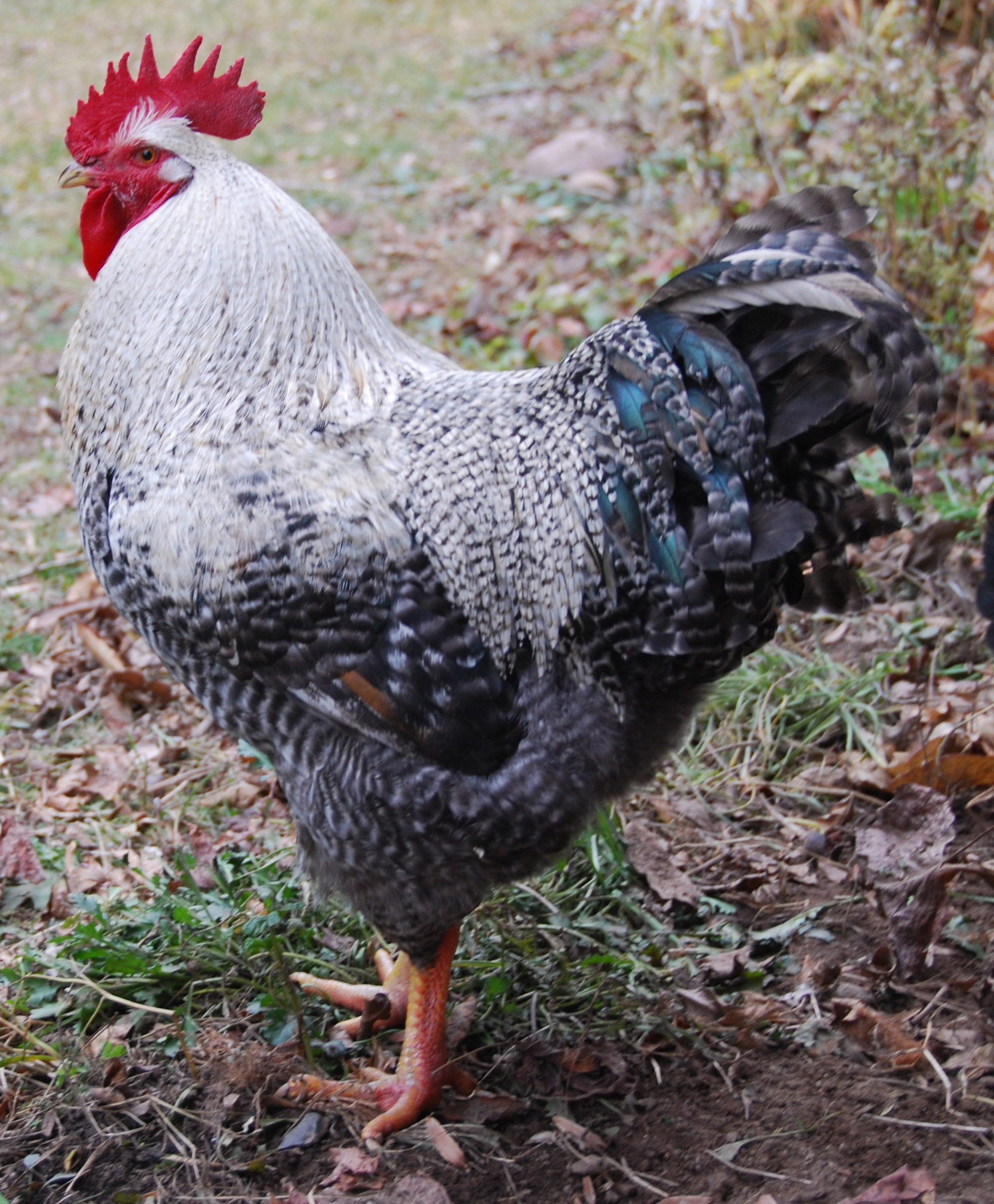
This is Bruce. Sorry, this was Bruce:

Bruce - A "Black Sex Link" a cross between a Rhode Island Red sire and a Plymouth Rock dam.
Bruce – A “Black Sex Link” a cross between a Rhode Island Red sire and a Plymouth Rock dam.

Bruce was a beautiful rooster. He was good and protective of the flock. Actually a great bird to have around. The problem was, he has been aggressive toward us as well. He’d jumped at me a few times, and even bloodied my hand. He went after my husband and my brother-in-law. But worse than that, Bruce had gone after my son more than once. My son was so afraid of Bruce that he wouldn’t go outside if he saw the rooster. Well that’s it. We’re done.

We don’t really need a rooster, and as it happens, we actually have two. Here’s our other rooster, Rocky:

Rocky - Rhode Island Red
Rocky – Rhode Island Red

Rocky is a nice rooster. He’ll let us pet him. He’s definitely not the menace that Bruce was. Hopefully, his personality won’t change with Bruce gone.

In the meantime, we’ve got tortilla soup cooking! It’s going to be wonderful. I’ll let you know how it comes out. You’ll probably hear it first on Twitter, where I’ve been live tweeting it!


Swordplay: Why do I do this?

It’s Saturday night and I am lying on my bed (writing this post). My entire body aches. I’m trying to identify any major muscle groups that don’t hurt right now. Even my finger muscle hurt (in my forearms). What have I done to myself?

Today I had a sword lesson. Actually several.


After spending several months searching, I finally found a sword instructor willing to teach me the longsword as well as the entire discipline of the western martial arts. Such instruction is hard to find, because most current sword instruction out there is primarily in sport fencing. I’m not interested in sport fencing; I don’t want to go to the Olympics. I want to know the entirety of the western martial arts, or historical European martial arts, or the knightly arts of swordplay. This includes the longsword as well as smallsword, rapier, saber, and foil fencing. But it’s a martial art, not a game of who can touch whom more often. There’s the mentality with it, and the rigorous discipline.

I found an instructor willing to teach me the longsword, but only after teaching me the more applicable skills of classical fencing. Everything I learn about classical fencing will parlay into the smallsword, then ultimately into the longsword. But no longsword until I master fencing and the smallsword.

I’ve accepted this. I have no argument. The longsword is a very specialized weapon. Certainly not something one might ever carry on one’s hip on a day-to-day basis. Fencing teaches a sound basis for all manner of swordplay. Necessary things like balance and footwork, and more fundamentally an awareness of where your body is as well as the point of your sword.

I have been completely delighted to begin the journey into swordcraft. The only challenge is that this instructor is two hours drive away from my home. While lessons and classes are conveniently on Saturday, it is still not practical to take a lesson each week. Instead, I make the trip once or twice a month, join in two consecutive classes (one beginning, one advanced), then take a private lesson. That’s two and a half hours of fencing fun. It makes the trip worthwhile, but it makes the body very, very weary.

Why, then, do I do this? That’s a lot of driving to beat the crap out of myself. And, as I’ve noted, I’m actually not learning exactly what I set out to learn in the first place. And seriously, what good is it to learn the sword anyway? At least Karate can be used in self-defense, but it’s not like I’m going to now start strolling down the street with a sword on my belt. Right? Is this not just a waste of time and money?

The reason is simple. It’s not just because of the sword. It’s not just the romance of it, or the coolness factor. In practicing swordplay, I’m learning a lot about myself. What am I actually capable of? What can’t I do, and how can I compensate (I’m 40, I don’t bend like I used to)? I’ve learned that I have a lot more strength than I thought. I’ve tapped into that endless energy that I recall from my youth.

These are powerful things. It helps me slog through a brutal week. It gives me the strength to say ‘no.’ Or to say ‘yes’ when it needs to be said. It makes me feel like I’m in control of my body and emotions like I have never felt before. Undoubtedly, these feelings will get better.

I’m sore today. And I’ll really hurt tomorrow. But it’s totally worth it. If I could do it every week, I would. I feel good about how things are going. I feel like I’m improving and developing. It’s a wonderful way to feel when you’re middle-aged and have been thinking like it’s too late to start something new.

Totally worth it, indeed!

Friday Headlines: 1-11-13

Friday Headlines, January 4, 2013

THE LATEST IN THE GEOSCIENCES

PINK DIAMOND ‘BEHAVIOUR’ SOLVED BUT COLOUR STILL A MYSTERY


Pink diamonds are curious. First, they’re pink. Second, they change color depending on the wavelength and the intensity of light that hits them. They stay pink, but are different shades.

A pink diamond

Scientists are attempting to figure out what gives these diamonds their pink color. In many minerals, it is impurities that cause the color. In pink diamonds, it actually appears that the colors change from electrons changing their energy state due to the light being shone on them.

MARS ROVER CURIOSITY FINDS MARTIAN ‘FLOWER’ AND SNAKE-LIKE ROCK


The Mars Curiosity Rover has made some great discoveries in it’s short tenure on Mars. It recently tried out it’s Hand-Lens Imager to get a close look at the individual grains that make up a rock. One of the grains was rather transparent, and some have thought it looks like a flower.

Spoiler: It’s not a flower. My guess is that it’s probably just quartz. I see mineral grains like that in sedimentary rocks all the time. Nevertheless, it’s pretty cool. Finding quartz like this can tell us something about the history of Mars as a planet.

There’s also a little line of rocks near the lower center of this image. NASA scientists are calling it “Snake River.”

From Mars Curiosity Rover. “Snake River” is in the lower center of the photo

Curiosity will likely visit Snake River to have a peek at what it really is. Given how it appears to cut across layers, it is likely that it formed after the main layers in this photo. Understanding what it is, then, can also teach us something about the geologic history of Mars.

LOCALS SAY SHIFTING SEA ICE FREES TRAPPED WHALES


This is just nice. A pod of killer whales had found themselves cut off from the open sea and trapped in the Hudson Bay when sea ice blocked their route out. Before you say ‘well, couldn’t they have just gone under the ice?’ remember that whales are mammals and need to breath air. If their path is completely iced over, they can’t breathe. Whales can drown.

Trapped Killer Whales

Luckily, warmer temperatures and winds seem to have shifted the ice, making it possible for the whales to escape. This story has a happy ending!

So, why is this in here? Oceanography is part of the earth-sciences for one. And for two, the reason why the whales were in Hudson Bay so late in the season could potentially be due to the effects of global warming. Perhaps we’ll see more events like this in the future.

Bad Geology Movies: Dinosaur, 2000

Dinosaur

2000

D.B. Sweeney, Julianna Margulies and Samuel E. Wright

Premise: What would happen if a dinosaur was raised by lemurs?

OK. This is totally a kids’ movie. I won’t say anything about talking dinosaurs. And I know there has to be tons of artistic license. Fine. Nevertheless, there are some things about this movie that are terribly inaccurate.

But I only took two pages of notes, and, admittedly, the pencil was blunt and there were pictures. So there’s not too much.

Dinosaurs that I recognized: Iguanodon (e-K), Carnotaurus (l-K), An Oviraptor (Rinchenia) (l-K), Velociraptor (l-K), Brachiosaurus (l-J), Styracosaurus (l-K), Ankylosaurus (l-K), Parasaurolophus (l-K), Struthiomimus (l-K)

Those funny little parenthetical bits there denote the age of rocks in which each of these animals are typically found. (l-K) means the late Cretaceous, just before the dinosaurs went extinct. Luckily, most of the animals depicted in the movie are from the late Cretaceous. That makes sense. The whole movie begins with an asteroid impact which, presumably, represents the one that killed off the dinosaurs at the end of the Cretaceous.

There are a couple of problems though. For one, the main character is an Iguanodon. Iguanodon lived in the early Cretaceous (e-K). That could be 50-70 million years before the rest of the characters. But if that’s not bad enough, Brachiosaurus is from the late Jurassic (l-J), which is tens of millions of years older than that.

So, these animals never actually co-existed.

Lemurs, or any modern primate did not appear on the Earth until at least ten million years after the dinosaurs went extinct. So that just wouldn’t happen. But fuzzy animals with goofy personalities are great for the show.

There are some other bits that were worrysome: Why are the lemurs on an island separated from the mainland? Why aren’t there dinosaurs on that island? How come the nesting grounds are unaffected by the meteor impact? Why are all the dinosaurs essentially sentient, except for the poor ankylosaur?

That landslide was a little sketchy, too. Where did that rock come from?

Oh, and hey. Why did any dinosaurs survive? After all, didn’t the asteroid wipe them out at the end of the Cretaceous? In the end, this is actually OK. Maybe some relict populations did survive beyond the end of the Cretaceous, but died out soon thereafter. There’s even some evidence that this occurred, though most paleontologists are skeptical. The point is that it is plausible that not everything died immediately after the impact.

Besides, it’s a kids’ movie. What do you want?

Overly Honest Methods

If you’re familiar with Twitter, you’re familiar with the concept of the ‘hashtag.’ A hashtag is used to mark a tweet so that it can be collected with tweets on a similar topic. For example, there’s a new television show coming out called “The Following.” If I want to see what other people are tweeting about The Following, I just look for the hashtag #thefollowing. The pound symbol at the front of the tag is what distinguishes it as a hashtag.

When I teach, I devise a hashtag for my class: #UREES101 for the introductory geology class and #UREES207 or #UREES270 for my upper-division paleontology courses. Students can use the hashtags to tweet questions and answers (or whatever they want) that’s related to the course and anyone who searchs for the hashtag can find their tweets.

The other day a hashtag was started that’s been a delight to follow: #overlyhonestmethods. People using this hashtag post about the scientific methods and techniques used in their research, as if they were writing them up for a professional paper, but being totally honest about why they did what they did. You can look at the posts here, through tweetchat. You don’t need to have a Twitter account to enjoy them.

There are a couple of good blog posts already out there too:

POPSCI

io9

Here are my own contributions:


The main reason why these are so funny is that there is truth in all of them. Yes, there was a globetrotting postdoc in our lab for a while, and washing shave cream from beard hairs is no fun.  That data was never published, but if it were published, we’d find a better way to describe why we selected our sample subject.

It’s also true that we use 14 injections because it worked, and I didn’t want to keep fiddling with the method. I would probably leave out the last bit about being tired of messing with the water analyzer.

So many things that go on in labs are done for convenience. But, that does not make the science wrong. We always outline what exact our methods were. If the eyeballs sat in the drawer for 18 months, we report that. We just leave out the bit about how we forgot about them.

We lay out what we did, not necessarily the ‘why,’ unless it would have a profound effect on our results. It doesn’t matter that we had a convenient traveling postdoc. All we do is report that there was a human subject who had to shave anyway. Who cares if it’s 14 or 5 injections? When we run our analyses, we get the same results as other labs. We’re good.

What #overlyhonestmethods provides is a tongue-in-cheek behind-the-scenes look at what life as a scientist is really like. Some of the posts are clearly jokes, others are absolute truth. But all reflect the reality, and fun, of being a scientist!

To sleep, perchance to dream- ay, there’s the rub.

National Blog Posting Month – January 2013 – Energy

Prompt – If you could be given the option to never sleep and also never be tired, would you take it if it meant you’d also never dream again?

In my current state of affairs, there is a particular appeal to never sleeping and never dreaming again. I’ve been having some bouts with insomnia of late (which I will be discussing with my doctor), so it seems that I’m inclined to not sleep anyway. And last night, I had a dream that my parents had died, which was a little jarring. Maybe dreaming isn’t such a great thing.

Add to the mix the complete overload of work that I need to be doing and the continuous, low-level state of panic that I’ve been in for the last couple of months (which might be the origin of the insomnia, you think?), and the concept of being able to function for 24 hours a day is pretty exciting!

Then again, I’ve had some fascinating dreams that have sparked some fun thought paths, some toward fictional plots and others, resolving work- or school-related problems. I do remember the time I suddenly understood the strange NMR pattern I got from a compound that I had synthesized. I remember waking and sitting bolt upright in bed. “Intermediates!” I shouted to no one. Or how about this story seed I wrote about back in November? Without sleep, I would never have had this dream.

Now, if you could offer me functionality of four hours of sleep a night, I’d probably go for that, but in truth, I think I like the down time that sleeping offers. It forces you to shut down for a while. I need that. If my mind is allowed to range for too long, my anxiety kicks in and suddenly I’m in trouble. So, no, I’ll keep my sleep and my dreams. Dreams are something to look forward to. I don’t want them taken away.

**********

Note added early AM on January 8: Last night I dreamed that I was covered with black widow spiders. I take back what I said about wanting to keep my dreams. Nevermind.

For 1-8-13

Rockin’ to the Oldies!

National Blog Posting Month – January 2013 – Energy

Prompt – What is your favourite song that gives you energy?

A song that gives me energy… Wow. That’s a toughie.

There’s no one song that gives me an energy boost. At least not one that I can think of. I do have a playlist on my iPod called ‘SOS’ that I put on when I need some energy. I like to listen to it when I workout (if I’m not using a workout video). It’s full of songs that have a solid beat that I can sing along to. I like to listen to it when I’m driving.

In fact, last time I drove out to Wyoming (three days of driving) I had two students in the car with me and we listened to the SOS playlist the whole way. One of my students called it ‘epic playlist.’ She loved it. I took that as a compliment, given that I’m old enough to be her mother, yet am somehow hip enough to have music that a student of mine might like.

When I reflect back, there was a time in my student career when I relied entirely upon music for energy. Somewhere during the writing process of my dissertation, I developed severe acid reflux. I had heartburn for five weeks straight. It was horrible! I had to abandon caffeine completely, but I still needed to maintain some energy to get my work done. That year I listened to the same Blink 182 album (Enema of the State) on repeat hundreds if not thousands of times. It was perfect: completely raucous and energizing, but so simple as to not be distracting. It got to a point that the music would get stuck in my head and I couldn’t sleep. It was equally as effective as any amount of caffeine consumption I’ve done in the past. To this day, I’ll pop it in if I need some energy. (Strangely, though, none of those songs are in my SOS playlist! Go figure.)

For 1-7-13

Bad Geology Movies: Jurassic Park, 1993

Jurassic Park

1993

Sam Neill, Laura Dern and Jeff Goldblum

Premise: What if we could clone dinosaurs and made a theme park around them?

You were probably waiting for this one. I had to do Jurassic Park. I’m a paleontologist. It’s a rule, right?

When Jurassic Park came out, I was in my fourth year as an undergraduate (I’d been a senior for a while already, and wouldn’t graduate for at least one more year), studying both geology and biology. I was going to be a vertebrate paleontologist, and I was pretty sure I was going to study dinosaurs. (I never have studied dinosaurs, but I did become a vertebrate paleontologist. 50% is pretty good, right?)

I never did see this in the theater. I saw it a year later when it came out on video. I watched it the evening of the day that I took the GRE exams. Yes, exams in the plural. This is back when there were only two dates a year you could take the GRE and it was a hand-written test. I took both the general and the subject exam in one day. I was fried that night. I remember laughing at the cute dinosaurs while my roomates and friends fell on me in terror.

Since then, this movie has been a popular one to watch with the various geology clubs I’ve been associated with. It’s full of problems with both paleontology and biology. I’ll try to stick to the paleontology problems.

The bottom line is this: We’re probably not EVER going to see cloned dinosaurs. Now, maybe we can do some genetic engineering and get dinosaur-like animals from modern birds, but that’s about it.

I’m only planning to review the first Jurassic Park movie. The others are based upon accepting the assumptions from the first, so there’s little point in considering the others (with the possible exception of the character Robert Burke, from the second movie, The Lost World).


PORTRAYAL OF PALEONTOLOGY: Oh, goodness, it’s wrong. Just wrong. The setting, the outcrops, were all right, but what the science looked like is wrong.

Exposing the fossil: 1) I have never been to a fossil locality where a brush was all that was needed to expose a fossil. Additionally, paleontologists tend NOT to expose fossils as they dig. They only uncover enough so that they can determine the exent of the the fossil. Then they trench around the specimen, keeping as much rock as possible in place. Once a trench is dug, and the fossil is still encased in rock but now sitting on a pedestal, paleontologists will jacket the fossil with plaster and take it into a laboratory to fully remove it from the rock. Never, never, never do we do such detailed preparation in the field. The specimens will be ruined, if not by people walking on them (or helicopters landing nearby), but by the elements. It takes time, sometimes years, to get a fossil out of the ground. The more that remains encased in rock, the better.

Seismic: Not that I fully understand how seismic works, but I’m certain that a single shotgun blast isn’t going to yield an image by which a paleontologist can recognize the half-moon shape of the dinosaur’s wrist bone.

The fossil itself: Y’know, sometimes a complete fossil is found in its death pose, but usually even then some of the bones are out of place. To find as single complete specimen is unusual. To find two, both laid out perfectly, is so unlikely that I could not suspend reality to accept that part of the movie. And something as big as the ‘Velociraptor’ that they portray would almost certainly have damage or distortion somewhere.

Science and funding: Apparently Hammond, the creator of Jurassic Park, has been providing Drs. Grant and Sadler with $50,000 a year to fund their research. That might seem like a lot of money to you, but in reality, that’s chump change. Just saying. Research efforts like those are expensive, especially if Sadler and Grant are getting any salary from it. I’ve submitted some ‘cheap’ grant requests for less than $50,000 per year. That covers my research expenses and only two months of my salary. Most programs need much more than that.


THE DINOSAURS: They did pretty good with the dinosaurs, all things considered. I’m glad that Spielberg isn’t going to go all “George Lucas” on these movies and fix them up though…

Velociraptors and the relationship with birds: What Alan Grant in the movie says about the relationship between birds and dinosaurs is mostly true. Most of us in the paleontological community refer to birds as ‘avian dinosaurs.’ We have chickens and I am always calling them my little dinosaurs. What Dr. Grant says about ‘raptor’ meaning ‘bird’ may also be true, but let’s face it, that’s not evidence that birds and dinosaurs are related. If I start calling a donut a banana, does that make the donut fruit? No. (Besides, ‘raptor’ actually means ‘thief’!)

Speaking of Velociraptors: The true ‘Velociraptor’ is a little animal that would stand about hip-high on most adult people. The veolociraptors in the movie were enlarged to make them look cooler. When Spielberg came up with this, paleontologists said, ‘Well, ok. Sure. It’s a movie. Go ahead,’ basically accepting that this was going to be wrong. But at about the time that the movie came out, a huge new species related to Velociraptor was discovered in Utah, and was named Utahraptor. The velociraptors of the movie could be Utahraptors in real life. And the paleontology community breathed a collective sigh.

Inferences about behavior: Velociraptors hunt in packs. Gallimimus ran in herds. This is arm-waving. This is literary license. This is not something that can be inferred directly from the fossil record. We don’t know exactly how these animals interacted. We don’t know how they behaved. We can observe modern birds and assume that dinosaurs might have behaved in similar ways. Nothing more.

Inferences about perception in dinosaurs: Apparently, Tyrannosaurus can’t see you unless you move. Dr. Grant knew this somehow. OK, we don’t actually know this. There are animals that can only see objects if they move quickly, like some frogs, but we can’t possibly know if this is true with dinosaurs. By the same token, we don’t know if velociraptors can stare you down, either. If we’re going to base this inference on their nearest living relatives, however, I’m pretty sure that T. rex could see you even if you were sitting still.

Modern understanding of dinosaurs: If this movie were to be made today, the velociraptors would most likely be completely covered with feathers. The T. Rex would also have feathers, probably. Any of the theropods would be feathered. Now, I’m not sure about the sauropods – the big Brachiosaurus – I’m sure someone else knows.

By the way, Dilophosaurus: Dilophosaurus does not have the neck frill that is shown in the movie, and it didn’t spit poison, either.


Cloning: So this is biology, and a bit of chemistry. 1) DNA wouldn’t last. Over 65 million years it would degrade so much that it would be unrecognizable. 2) Frog DNA? If they were clever, they’d use bird DNA. Seriously, a FROG?! Now if we really wanted dinosaurs, what we need to do is study the anatomy of dinosaurs and compare that with birds as adults and embryonically. Then let’s try to make the embryo of modern birds develop to make a dinosaur-like skeleton and see what we get… This, I think, is within the realm of possibility, but the ‘dinosaur’ we’d get won’t be any dinosaur that ever walked the Earth!


Females turning male: Actually, such things are possible. In many vertebrates, the temperature of the eggs during development will determine the sex of the young when they’re born. Equally possible, though not mentioned, is parthenogenesis, wherein a female simply gives birth or lays eggs without fertilization. The babies are clones of the mother. This is known in many species of lizards. It’s a stretch, but it’s possible.


I could go on. There are several little details in the movie that I found annoying, but these are the big ones (or so I think). I’ve got other movies to watch and review…