I’ve only just become aware “The Accretionary Wedge,” a geological blog carnival! It’s basically a monthly amalgamation of the thoughts of geoscientists world wide in reference to an earth-science related prompt.
What a fun concept.
This month, the prompt was for ‘dream geology classes.’ You know, the ones you really wish were offered back in your undergrad days. There are a few that I’ve always wished were taught, some of which I see are already touched upon in the responses to the call for posts. I’ll just talk about one.
FIELD METHODS -or- Rock-breaking 101
One class that I’ve noticed is sorely missing from almost all geology programs is a “Field Methods” class. It could be that the geosciences are heading more and more into the laboratory or onto computers, but it seems that field geology is suffering. A person can actually get a degree in the earth sciences without doing more than a day or two of field work ever!
*gasp*
I was fortunate that where I did my undergraduate (Fort Lewis College), they actually offered a one-semester field methods class. This wasn’t field camp, that was different. This was a full semester course on how to read maps and use compasses. It taught you haw to take notes and how to deal with the geologist’s ‘laboratory,’ where it could rain on you while you’re working. It was ‘field-camp-mini,’ but it put those of us who later took a formal field camp (also offered by my school) at a huge advantage over our less-skilled classmates. (I’m glad to see that Fort Lewis still offers the field methods class, though it looks like field camp might have gone by the wayside.)
I loved that class. I learned in that class that I had what I needed to become a real geoscientist.
The only thing that the class lacked that I wished were in there was specific training on how to collect a hand sample. Seriously, I wanted to learn how to break a rock with a hammer. Over the years, I’ve gotten pretty good at it. There’s a finesse – a certain amount of skill – needed to break off the perfect chunk of rock, completely dependent upon the equipment you have and the type of rock. A two-hour lab exercise would have been effective to teach that.
That’s the class I think needs to be offered in every department at every school. I know I benefited greatly from having it, and I’m certain that students of the geosciences would benefit as well.
When I was about four years old, my mother first told me about the horse she had when she was growing up. His name was ‘Watch Charm,’ but Mom just called him Charmie. After that, I became a typical horse-crazy girl growing up in the middle of the city. But I can trace that fact that I’m sitting here, now, as a paleontologist back to that conversation. This is how it worked.
I had this one toy horse that I loved. In fact, I still have that toy horse. I should find it an post a picture here. Anyway, I sat down and started drawing pictures of that horse. I wanted to draw the perfect horse. It was my way of imagining actually having one.
I spent years perfecting my drawings. I would study some of the toy horses that I had and sketch those. Then I graduated into looking at pictures of horses and copying those. I got some ‘how to draw’ books.
Something clicked in me around middle school. I noticed that horses and humans had all the same bones, they were just arranged differently, for different functions. In fact, I realized that all terrestrial vertebrate (though I didn’t call them that at the time) had all the same bones. Then I got creative.
Of course, I didn’t fully understand biology or evolution then, but I tried to imagine what animals that evolved in different environments would look like. Or what a sentient horse would be like. I spent years creating strange new alien species, mostly mammals, based upon what I understood of comparative anatomy (all of which I taught myself).
In middle school, I read parts of Gray’s Anatomy, and began to think about how muscles and bones work together. Every animal I created had to ‘work’ to the best of my knowledge. I would draw skeletal and muscular reconstructions for each animal. Things were getting pretty detailed.
By the time I was in high school, I’d gone so far as to invent some cultures and interactions for some of the species, but still, they were mostly mammalian. I took a number of art classes and was by then producing some great paintings and drawings of my critters doing unexpected things: the Ulfrese (my biological answer to the ‘transformers’) were cheetah-like and seemed to like to ride mountain bikes. Then there were the Pronons that were my functional concept of a minotaur, that for whatever reason, enjoyed winter sports (it could have been that the Winter Olympics were on!).
An Ulf riding a bike. Pencil on illustration board. I drew this in high school. All rights reserved.A Pronon ski jumping. Watercolor. I painted this in high school. All rights reserved.A Pronon speed skating. Watercolor. I painted this in high school. All rights reserved.
Then my art teacher challenged us to invent an animal that looked like a plant, or vice versa (I don’t remember). I naturally came up with an animal the was a plant, and spent a great deal of time conceptualizing it’s fern-like reproduction.
When high school was nearly over, I had established a few things about myself that remain true today: I am an artist and I am a scientist. I was mulling over how I could be both and make a career of it. The obvious choice was dinosaur reconstructions. I’d be the artist that fleshes out the dinosaurs. I’d be a paleontologist!
I went to college to study geology and biology. I already knew that paleontology was an interdisciplinary science. I knew I could never do what I wanted to do without solid training in both geology and biology, so I double-majored.
The unexpected occurred. I found that I really liked geology a lot! I could actually see myself being just a geologist. That’s OK. There’s a future in that. I also rekindled an old interest in chemistry, which surprised me.
I learned also that paleontology isn’t just something you major in. If you wanted to be a paleontologist, you had to get an advanced degree. That degree would either be in geology or biology. When I was near graduation, I started applying to graduate programs in both fields, but the ones that attracted me the most were those in geology. I wound up in a Ph.D. program at the University of Wyoming to study vertebrate paleontology. But here’s the kicker: I wasn’t going to work with dinosaurs or even with life reconstructions.
Well, it’s worked out. As a grad student, I was introduced to isotope geochemistry, which is what I do to get paid now. Occasionally, I even get to work with dinosaur fossils. I’ve never become a paleoartist and done reconstructions. Perhaps I should be disappointed, but the people who actually are paleoartists do some amazing work. I don’t think I could do that! I do still draw – a lot! I do my own figures for papers. It’s nice to not have to hire anyone to do that for me. I really enjoy putting together posters for professional meetings. I get a little arsty-fartsy with them. It’s a lot of fun. And doodles of horses appear everywhere!
Artsy-fartsy rendition of my singular new species of Mammal, _Fractinus palmorem_ . Pen and ink and watercolor. Did this in graduate school. Never finished it. All rights reserved.
Here’s the fun thing: After grad school I found myself on a postdoctoral project working with – you guessed it – horses. Yeah, it came full-circle. I started with a love of horses, and today I do a lot of work with fossil horses (and other cool mammals). I still have it in my head to one day own a horse, though honestly, I’d be happy with any equid. Mules are nice. Donkey’s are cute and fuzzy. Maybe not a zebra…
So. I’m a vertebrate paleontologist. And an isotope geochemist. All because my mom told me the story of her horse way back when I was four years old. Never underestimate the influence your little story might have on someone. Such things could be life-changing!
There are those who think I have a little too much fun while I’m teaching. These complaints typically come from students who think that college-level teaching has to be the ivory-tower-residing professor standing at the front of the classroom authoritatively spouting facts that the students are to dutifully write down and memorize for exams. College instructors are not to laugh or use colloquialisms. Professors must not be human.
Well, for that one percent of students: I’m sorry. You won’t like my class.
For the rest of you, let me preview your experience if you decide to take one of my classes.
I definitely do the standard spouting of information, as professorial-types are supposed to. I enjoy spouting information and drawing simultaneously. I was particularly proud of my artwork the day I described surface and deep currents in the ocean:
Sometimes I get a little silly, like when I used the table-top as a chalk-board and used a bunch of my son’s toys to illustrate the relationships of the major dinosaur groups:
Dinosaur phylogeny with toys and chalk
I think one of my teaching coups was when I devised the hypothetical continent of ‘Cupcakeia’ to help students understand the motions of tectonic plates and the importance of apparent polar wander. (You’ll need to take my class or do a little research to find out what that is.) It got better when I added the sub-continent of ‘Frosteringia,’ that collides with Cupcakeia to make a nice mountain range. So proud of that. Even prouder when my students use Cupcakeia as an example on their exams. (**See, they know it’s fake. It has to be. But they have a chuckle and they REMEMBER! Gasp! They learn! Woot!**) I wish I had a photo or drawing of Cupcakeia and Frosteringia. Maybe next year.
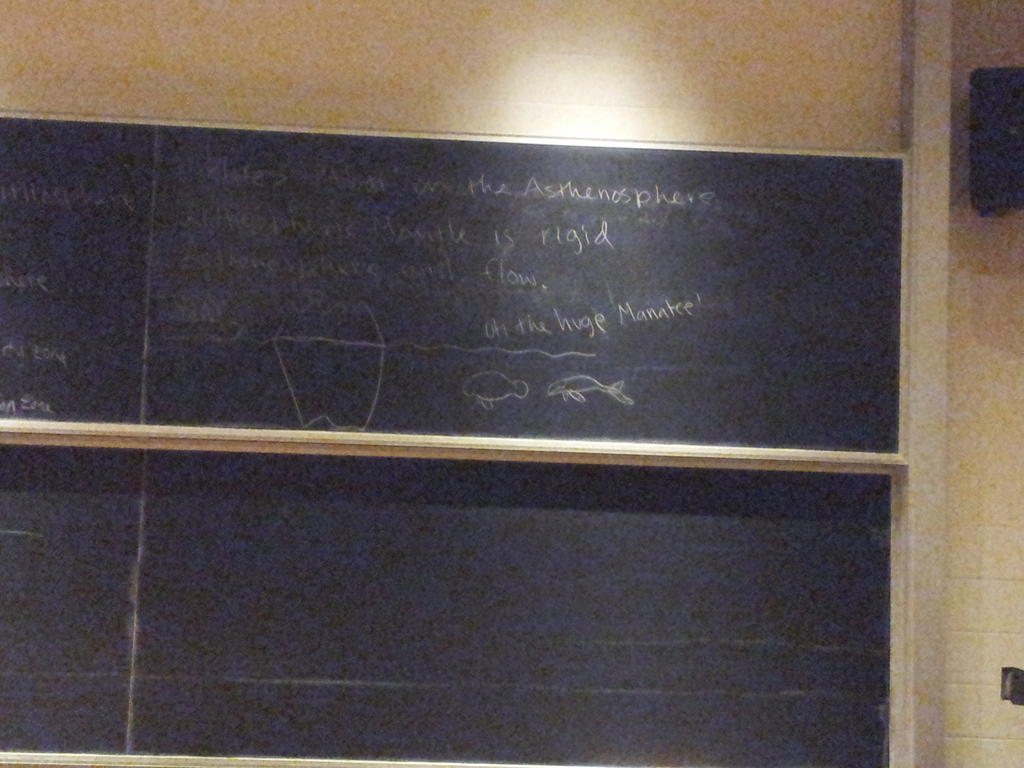
There are definitely the days when I’m as grumpy as the students are about being in class so freaking early. Those are the days when we really have fun. The other day I was trying to make the simple point that when ice floats in water, part of it (the root, if you will) is under water. I could have done that professorially in less than a minute. I think I spent at least five minutes drawing a picture that included a humpback whale, the Titanic (which upset the students), a lost polar bear, and a very large manatee, about which I wrote “Oh! The huge manatee!”
Oh! The huge manatee! (Photo by my student @parroyo9 on Twitter)
Yeah. I lost the class for a while that day. But hey, in the end, no one regretted coming to class. So yay! Success.
My most recent lecture involved the invention of new terms: Oosh and Schlorque. Ooshing was a term invented by one student as an alternative to “ridge push.” I like ooshing much better. Schlorque was invented by another student as an alternative to “slab pull.” My students dutifully photographed this and posted it on Twitter so that I wouldn’t forget.
Definitions of Oosh and Schlorque. The spelling of schlorque was selected because it makes it seem more sophisticated. (Photo by my student @parroyo9 on Twitter)
Like I said, there are those who might think I goof off a little too much in my classes. But, you know, I have a good rapport with my students, and I typically have 30-35 students (of a class of 43) who actually show up for lecture every day. Any attendance greater than 50% for an introductory course is really darn good.
I think they like the class. I sure like teaching it.
There are likely to be many out there who will object to the fact that I am now an owner of a handgun. Well, ok. Not quite. Apparently there’s the whole ‘pistol permit’ I need to get before I can bring the gun home, but that’s just a matter of time and paperwork. Fact is, I’ve got a gun.
What is it with people feeling the necessity to own handguns? Let me lay out the reasons why I want this one. No, it’s not because I’m some sort of militia-type who wants to seceed from the country. It’s not even for protection against home invasion. The ‘coolness’ factor, while it’s there, is still not the reason why I want a gun.
I’m a geologist. More specifically, I’m a paleontologist. When I’m doing field work, there’s really no telling what you might bump into. Where I work there are rattlesnakes. And occasionally badgers, bobcats, and bears. (There is also the slightest chance of bumping into some unpleasant members of the human race as well, though most people you might encounter are not interested in doing you any harm.) I take students with me to remote areas where such animals could be encountered. These places are usually a good hour hike to our vehicle and two hours drive to civilization. I can’t just call 911 if something comes prowling around. I need a weapon for protection.
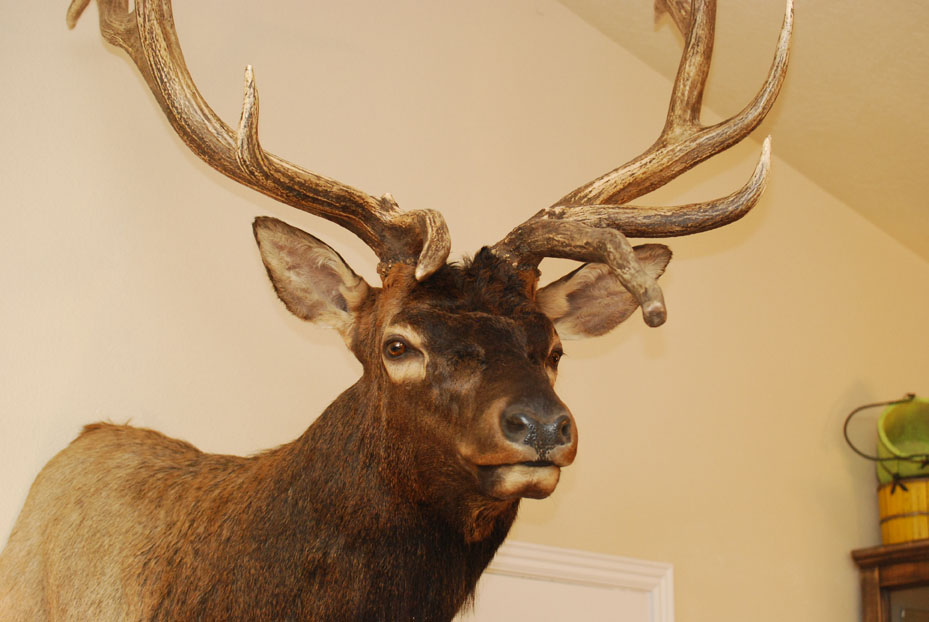
Last fall (like a year ago) I went on an elk hunt with my dad. We chatted about weapons and such, and I expressed to him my desire to have a handgun. I told him about the gun that I really wanted: a .44 caliber revolver. Why do I want that? Here’s where the ‘coolness’ factor comes in. But also, I wanted something that would actually protect me against the attack of a large mammalian predator. We went back and forth about it. Dad would much rather me have a 9mm semi-automatic pistol, which makes sense, but my heart says ‘revolver.’ .44 caliber is a bit much for me, says Dad. I say, ok, just something that will work. .357, he suggests.
Boris. Dad’s trophy from last year’s hunt.
Well, we hadn’t talked about it since then, but when we came out to visit them in Utah, Dad waved me into his garage. He pulled out a beautiful .44 caliber revolver. I got giddy. He has, of course, reminded me of all the things he doesn’t like about revolvers, including the fact that they really don’t have much of a safety to keep them from firing accidentally. He apparently couldn’t find a .357 revolver, but he found this, and got it for me, cautioning that he won’t let me take it until he’s sure I can handle the extra umph of the .44 caliber.
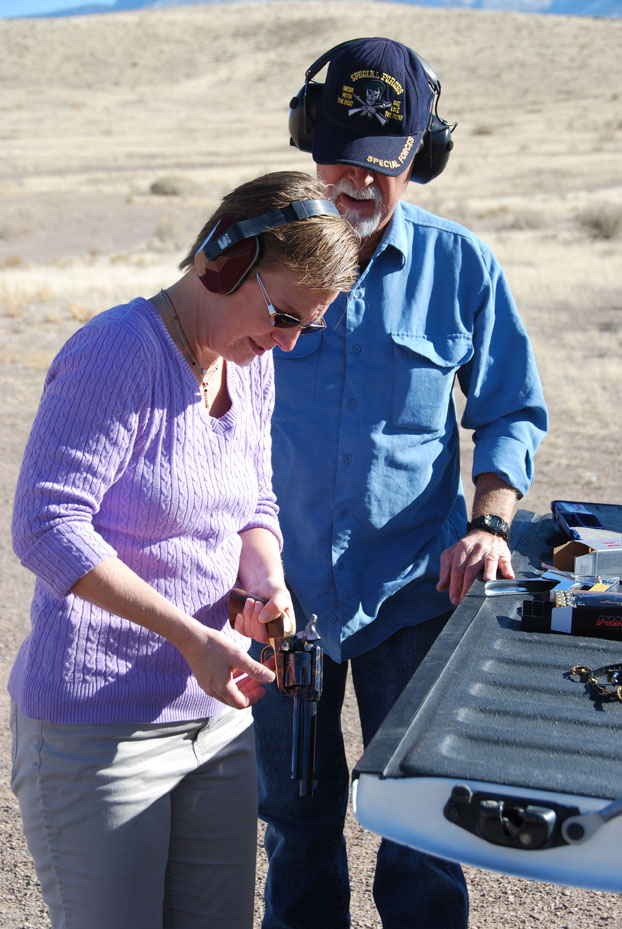
Loading Captain Shooty
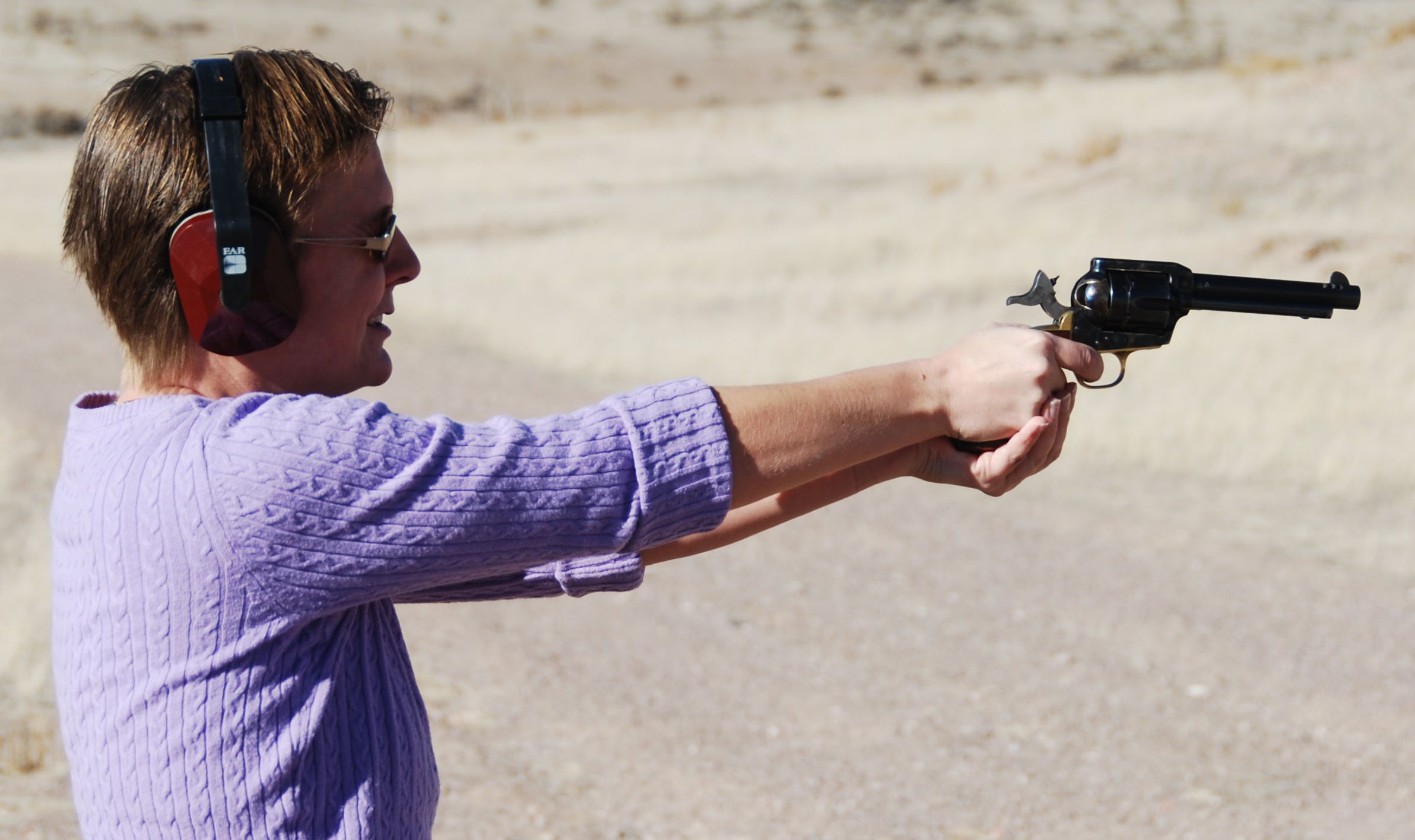
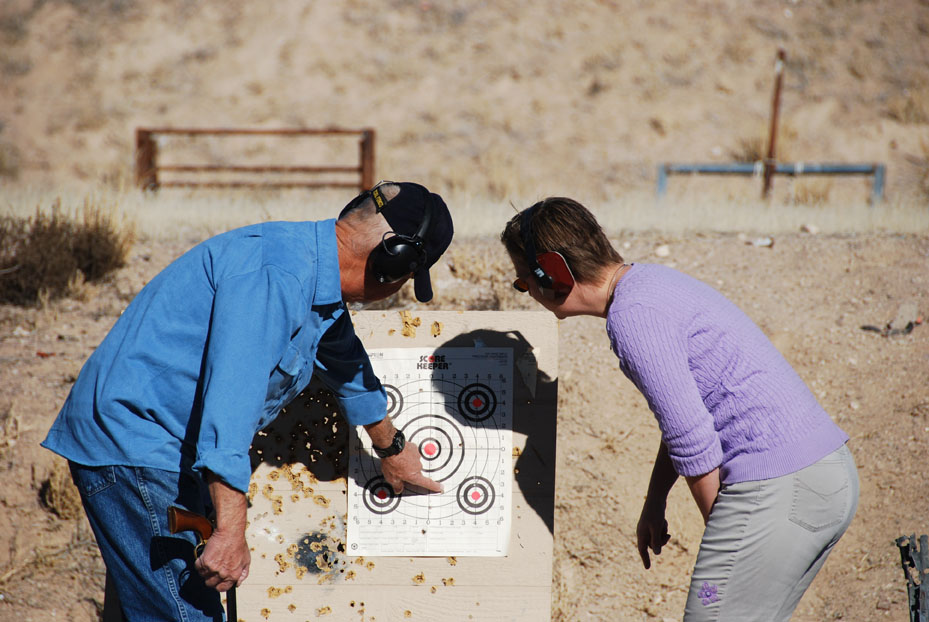
We took it out this morning and fired it. Once I got past the initial terror, expecting a huge kick, I discovered that I really didn’t have any trouble shooting it. Then, Dad loaded the .44 magnum shells and I tried that. That was substantially more kick, to be sure, but I still hit the target. Yup. I like the gun.
Me and Captain ShootyChecking my accuracy
Tonight, Dad’ll show me how to clean it. My husband has been researching how best to get it home to us. (There’s that whole permitting thing again.) But I love it! It’s exactly what I wanted. Maybe I’ll later add a smaller gun to the arsenal, but this is the weapon I want. And it’s perfect for what I need it for.
My blog posts are getting shorter as my days are getting busier. And as I get busier, I get less inclined to think a lot. More than once in the past couple of days I’ve been faced with a decision that I have to make, but that doesn’t really matter. So I pose the question to Twitter and Facebook.
Someone else decide for me, please.
Crowdsourcing is really an interesting idea. I’m using it for mundane things right now (soup or salad) but it can be powerful. It’s not even that new of a concept. Seriously, “Ask the audience” in Who Wants to be a Millionaire? Yeah: Crowdsourcing.
I like to think that one of these days, I can post to Twitter something like: Hey, help fund my research! And then suddenly there will be funding. Some folks are getting this to work. I don’t have a big enough following yet. Maybe someday.
So, uh, I’d like to go out to Wyoming next summer to study global warming at the Paleocene-Eocene boundary. Anyone want to support me. Financially, I mean?
It’s clear that I spend too much time in the laboratory. The INTERIOR laboratory that has no windows. That’s full of expensive equipment that make lots of noises (including the one that goes ‘ping’).
I should have known I was in trouble when I first started naming things. It was innocent enough at first. Specky is what I call the mass spectrometer. “Now Specky! You do as you’re told.” Bzzz-zzz-zzzt. “Or not…”
We had some issues with the fume hood at one point. I got tired of always having to clarify that I’m talking about the fume hood, not the laminar flow hood. Blah, blah, blah. It helped when I just started calling the fume hood Josie, and the laminar flow hood Tina. “Put the samples in Tina when you’re done with the pretreatments.” Yeah, that can be misunderstood.
Then we got the water analyzer. Its name arose pretty quickly. It’s obviously a ‘special’ instrument, because when it’s running well, it says it’s own name over and over: Norm. Norm-norm-norm. Once in a while it gets upset and has a ‘hiso’ fit. Kind of a brat, really.
The elemental analyzer (which we’ve had for eight years) just got a name: Iago. I was so excited, I had to tweet about it. I think I started to realize that something was wrong with me at about that time.
I knew I was in trouble the day I most concernedly tweeted about poor Norm. Yup, he needs a valve replacement. You know (now) that Norm is a piece of instrumentation in the laboratory. But when you tweet about poor Norm and the valve replacement he needs ASAP, it doesn’t sound like that, does it?
Yeah.
Well, here’s to your good health, Norm. May your valve replacement surgery go well!
Today is one of those days when I start really thinking about changing careers. I like my job, but it has its frustrations, and they’re all piled up today. This will be a short post because of it.
I have customers in need of data, and employees capable of preparing the samples. But just when I think everything is ready: Oh hey! Look! None of the standards were weighed!
Goody! Just what I want to do. Spend a half-hour weighing out standards.
OK, crisis averted.
Oh, Damn! Look! We’re running low on helium. Change the tank. Crisis averted.
Crap. No one told me we were running of of weigh boats. Go order more. OK. Good. Crisis averted.
Well, dang. So-and-so needs water data. Need to have a chat with the water analyzer. Let’s see how it’s doing. Probably just need to change the septum. Oh. Look. Water. In the lines. It doesn’t belong there. Oh. Goody. The vacuum pump is caput. Crisis – still crisis. Dang.
</headdesk>
All right. I gotta salvage this day somehow. At the very least I should be able to get a set of carbonates run, right? We’ll see. When I came in this morning, the mass spectrometer was not in its ready state as it should have been. See, a student ran some analyses yesterday and didn’t leave the instrument as it should have been. Not that I’ve told them this… but, sigh. We’ll hope. It should be OK.
I’ve been teaching here at the University of Rochester for about five years now, at first only one class a year, but for the last three years at least one course every semester. It keeps me busy, but I like it because I get to interact with students in the department. I feel more like a member of the department rather than merely a laboratory grunt, which is what I’d pretty-much be otherwise. Plus, I get to teach, which is something I have always wanted to do.
I love teaching. I love sharing what I know, and my enthusiasm for that knowledge, with anyone willing to listen. This is why I almost never turn down an opportunity to give a talk to any old group that’s interested. The downside to teaching, of course, is that I have to actually assign grades, which stinks, but these are people’s careers we’re talking about. Assessment is necessary.
One of the problems I face as both an instructor and a laboratory manager (and, really, any faculty member has this problem) is making myself available to my students outside of the classroom for whatever matters they might want to discuss. I have office hours, of course, but in the five years I’ve been teaching, I think I’ve seen students actually use my office hours twice a semester. Part of the problem is that students have other classes. They can’t make my office hours. The other part of the problem is that, unless there is a student actually in my office, I’m usually in the lab, doing science-y things. Most of the time, students just e-mail me and that works OK.
This year I’ve decided to try something different. In the spring, I went to a two-day conference supported by The Rochester Institute of Technology’s Faculty Institute on Teaching and Learning. There were many options for sessions to attend, but for whatever reason, I was drawn to those focusing on social media.
It seems that social media, like Twitter, are getting a lot of mileage in some professions, and are beginning to be used in courses training students for those professions. Typically, these programs are in journalism or political science, not in the ‘hard’ sciences like geology. Twitter especially, has been used effectively as a teaching and communication tool. I was impressed.
I recalled that I once used Facebook in my classes, but that had problems, not least of which was that not everyone was on Facebook (or wanted to be). I gave up on that pretty quickly. But Twitter is another beast altogether. I decided to try out Twitter for my introductory geology class this fall. I came up with a hashtag (#UREES101) which students could use to post questions about their materials. Students could troll that hashtag and watch without even signing up for Twitter. Alternatively they could engage in discussions without having to ‘friend’ or ‘follow’ anyone. I thought using Twitter would enable two things: 1) Students could communicate with me whenever they needed to, even if they couldn’t make my office hours or if they weren’t comfortable asking questions in class; 2) Students would also learn how to be succinct in their questions and answers – a skill notably lacking for a lot of people.
While I still have office hours (that no one still comes to), I also have set Twitter hours, late in the evening, when students know that I’ll be on-line and they can use the hashtag and tweet their questions. My colleagues expressed skepticism that this could ever work. But it has, and much better than I anticipated!
I have interacted more with my students this year than in all the other years past combined. Students ‘come’ to Twitter hours with their questions, and though usually only one or two are talking, other students tell me that they do look and watch. Other things have come out of this, too. Students are answering each other’s questions. They are discussing things! And sometimes their discussions include geological colleagues outside of this class or even this continent.
I’ll pose questions on Twitter for students to struggle with. These are usually things that have been problematic in years past that I want them to think a bit more about. I’ve had people from all over the world explain these things – like strike and dip – in ways that I couldn’t. I think the students benefit from someone else’s explanation.
All-in-all, I am excited about how social media is enhancing my classroom. Yeah, I’m ‘on call’ a bit more often, but that’s OK. It lets me do what I want to do: teach. Students have questions, I (or someone else) answer them, students move on rather than struggling for a while and giving up. It’s win-win. It’s easy. It’s free.
Well, I’m already a week and a half late in submitting my book order for next semester’s Principles of Paleontology class. I’m late this year because I’m considering changing textbooks.
Here’s a selection of the books I have to choose from:
A selection of books available for use in teaching an introductory paleontology course.
No two of these books are the same, and what your preference is really depends upon how you might teach the course. There are two general ways with which an introductory paleontology class is taught.
1) Taxonomically. In this case the focus of the class is more biological than geological, and vast amounts of time are spent discussing each group of fossils, usually focusing on the invertebrates (those lacking backbones) because they are far more abundant, and useful, than the vertebrates (animals with backbones.) My first paleontology class was like that and I loved every minute of it. I used an earlier edition of Clarkson’s book (the upper right book in the photo) back then. Such a class is very helpful for students who might need to work out which species lived where and when.
2) Methods and Principles. Here, the focus would be on the mechanics of doing paleontology, with little focus on the individual fossil groups. Here, students would learn about evolutionary rates and rarefaction and lots about geology, with little biological input. This sort of class teaches the skills that students would need to effectively do paleontology irrespective of their favorite fossil groups – which is good when they might wind up studying anything later in their careers. Foote and Miller (in the lower right) is really great for this.
When I first taught EES 207 (which was then called Invertebrate Paleontology), I immediately used the latest edition of Clarkson’s book and taught the class just like I had learned it. But I realized after completing the class, that I had left the students with a great knowledge of what the fossils were, but with no skills on how to work with them. I realized that because my paleontology class had been taught the same way, that I had started graduate school with basically no concept of how paleontology was really done. I decided I needed to re-vamp the class.
I changed the name of the class to Principles of Paleontology and decided to focus on how paleontology was done moreso than on the different fossil groups. I switched to the Foote and Miller book. But I knew that what students want out of such a class – and what I my self would expect – would be at least some knowledge of the fossil groups, So I arranged the class with a formal lecture two days a week, and then what I called ‘Fun Friday’ where students would explore one of the major fossil groups. My hope was that out of such a class, students would leave with a working knowledge of the major fossil groups and that they could actually do paleontology. The problem with Foote and Miller as a text is that it offers absolutely nothing in terms of description of the fossil groups. I tried adding optional texts (like “Fossils at a Glance” by Milsom and Rigby), but no one would buy them. I wound up preparing all manner of supplementary materials for the students for each of the major groups of fossils. This has been a pain.
This coming semester, I’m faced with a new problem. My class is going to be huge, with 24 students, so ‘Fun Friday’ as it has been in the past is going to have to change. Suddenly, I wish there was a lab section to go with the class. Maybe that will arise next time I teach the course. I’m not sure how I’m going to handle it, put supplementary packets are definitely not an option.
One thing is for sure: I need a book that covers the mechanics of paleontology as well as the important fossil groups. Two books that do this are the “Bringing Fossils to Life” by Prothero and “Introduction to Paleobiology and the Fossil Record” by Benton and Harper. One or the other of these books are going to be my choice for the coming semester. I’ve been informally asking my colleagues which book they prefer, and so far the overwhelming preference is for the Benton and Harper book, so I’m leaning that way. It seems to be a good balance of readability, mechanics, and taxonomy that I’m looking for. The Benton and Harper book is relatively new to me, so I have to think about it more. I have had a copy of the Prothero book for a while, and decided against using it because it didn’t quite cover all the topics I wanted to cover in the detail that I’d like, though it could still be workable. Benton and Harper looks pretty promising, though I’ve only flipped through it a bit.
I need to make a decision in the next few days (since the book order forms were due nearly two weeks ago). Does anyone else have an opinion?
On Saturday, I’ll be giving an hour-long presentation to some seniors (you know, the over 55 set) on the topic of “Woolly Mammoths in New York State.” Well, it’s a pretty nebulous topic, and I only have an hour, so that means I can direct my presentation in pretty-much any direction I want.
You know some paleobiology is going to go in there. What is the difference between a mammoth and a mastodon, for example. And why are they extinct? Someone’s going to ask why we don’t find dinosaurs in New York. Naturally, I have to talk about geochemistry, too, since I might have done a little work with that (see my other blog post).
I guess the obvious thing for me to start with is to explain what a mammoth is, ‘cause it’s not just a big fuzzy elephant!
What is a mammoth?
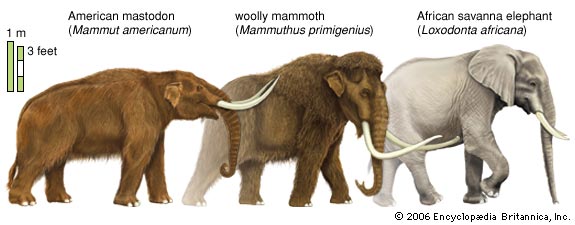
Mammoths, mastodons and elephants are in a larger group of mammals called proboscidians, so named in reference to their big long noses. Mammoths and elephants are actually very similar, in skeletal and in tooth structure. Mastodons have very different looking teeth, which is an important distinction between to two ice-age dwelling proboscidian groups.
Mastodon, Mammoth, and Elephant for comparison
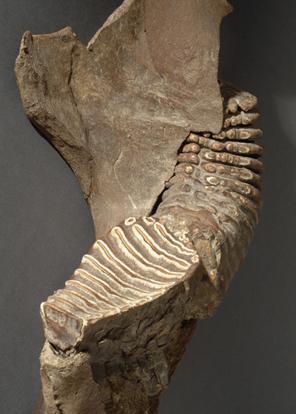
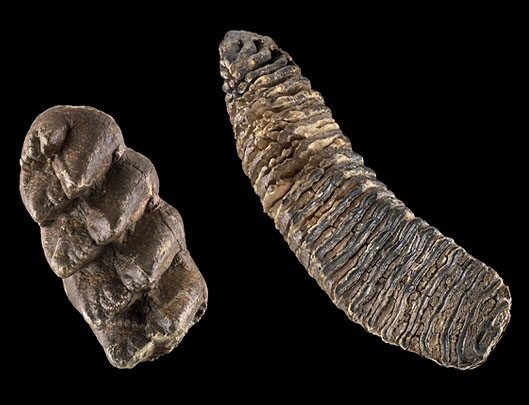
Mammoths (and modern elephants) have teeth composed of a series of plates, that form a washboard-like grinding surface which is perfect for the foods that they eat. Both elephants and Mammoths are (or were) grazing animals (like cattle are today). Mastodon teeth are smaller and have several huge cusps, which aren’t so great for grazing but are good for eating leaves and such. Mastodons were browsers, much like giraffes, for example. Because they had different diets, they were able to coexist.
Asiatic elephant toothMammoth teeth still in the jawMastodon tooth (left) and Mammoth tooth (right)
The structure of the teeth is the easiest way to distinguish between mammoths and mastodons, but their skeletal structures are also distinct. Mammoths tend to be taller in the front end than in the back end, their heads held high – the top of the head being slightly higher than the shoulder. Mastodons are a little stockier, with their head often slightly lower than the shoulder.
Mastodon skeleton (left) and Mammoth skeleton (right)
Types of Mammoths
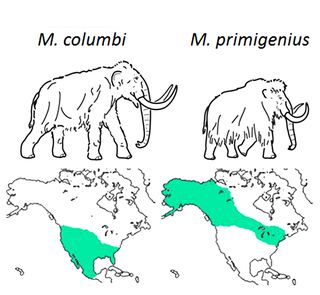
Mammoths in North America fall into two species: the Woolly Mammoth (Mammuthus primigenius) and the Columbian Mammoth (Mammuthus columbi). The woolly mammoth was smaller than the Columbian mammoth, and a lot hairier. Woolly mammoths lived further north, closer to the edges of the great glaciers that once covered much of northern North America. Columbian mammoths stayed further south. Only woolly mammoths would be expected in what is now New York State.
Distribution of Columbian Mammoths (left map) and Woolly Mammoths (right map)
What’s special and unique about mammoths (and mastodons and elephants)?
Several things stand out as interesting about proboscidians. Here are some fun facts:
Mammoths and elephants have only one tooth on each jaw (upper, lower; right, left) in wear at any one time. We have all of our teeth in use all the time.
There are only six teeth in each jaw (upper, lower; right, left) that an elephant or mastodon ever gets. They grow into the mouth one at a time from the back and fall out the front when they’re worn out. Once the sixth tooth is worn out, there’s no more teeth and the mammoth or elephant starves to death.
The pattern of tooth replacement in the jaws of elephants
Mastodons have the same pattern of tooth replacement, but usually have more than one tooth at a time in use. Their teeth don’t wear out as quickly though, because they eat softer food.
Proboscidians are in a larger group of mammals called ‘subungulates’ which are grouped together because they have hoof-like structures on their feet, but they’re not quite hooves.
Some of the closest relatives to elephants, mammoths, and mastodons are manatees! Manatees are also subungulates and have hoof-like structures on their front flippers. They also have the same sort of conveyor-belt tooth replacement, but they aren’t limited to only six teeth.
When and why did they go extinct?
About 10,000 years ago, mammoths and mastodons, plus a lot of other large mammals that live in North America (woolly rhinos, giant ground sloths) went extinct (Wikipedia article). Most of the animals that went extinct were huge, so we refer to them as “Megafauna.” No one is certain why this happened, but it did coincide roughly with the melting back of the continental ice sheets as well as the appearance of humans in North America. It is an interesting point of controversy. There are two main camps here and then a few extra ideas (maybe the lunatic fringe?).
Main hypotheses:
Human overhunting
It is possible – even likely, knowing how we as humans are – that humans might have been responsible for the loss of the mammalian megafauna. We have been known, once in a while, to over-use resources, and it is known that humans actively hunted members of the ice-age megafauna, like mammoths.
Climate change
We also know that climate was changing rapidly then, warming up after the end of the ice-age. The ice sheets melted back and the landscape was changed. Organisms had to adapt, and big animals like the mammoths likely had a hard time adapting.
These both seem like reasonable hypotheses. So which is it? Most scientists straddle the fence on this one: Well humans were hunting a lot, and the animals were already in trouble because of the climate change…
Other ideas:
Meteor impact
Because asteroid impacts have resulted in many extinctions in earth’s history (like the extinction of dinosaurs), it seems sensible that this extinction might also have been caused by an impact. There is some evidence that there might have been an impact, but some things about the extinction event are cause for skepticism. For example, why did ONLY the large mammals go extinct?
Second-order predation
Here the idea is that not only did humans decimate the populations of the prey animals, they also hunted the predator animals (like saber-tooth tigers). Without the primary predators, the prey animals rapidly overpopulated the area, destroying their own resources and thus killing themselves off.
Hyperdisease
Humans coming from another continent would have brought a few ‘friends’ with them. Perhaps the humans brought along their own animals that carried diseases for which the native animals had no immunity. This could very quickly decimate the native population as has been seen when humans and their livestock have populated new places in modern times.
How can we find mammoths?
A common question that people ask of paleontologists like me is “How do you know where to look?” I have a standard answer for that: We look at maps, maps that geologists before us have drawn showing the various rocks exposed in an area, describing those rocks, defining their ages through various means. We look at the maps for rocks that should have the right fossils in them, and then we go out to the rocks in the real world and walk around until we find something.
At times it’s a little more sophisticated than that. We can use remote-sensing/sattelite methods and find the most probable areas using neural networks on computers. Many times though, it’s a whole lot less sophisticated. Sometimes, you just walk across a field and kick something and when you look down, it’s a fossil bone. Mammoths are often found when people bring in backhoes to dig a hole for a new pool. Their digging and suddenly there’s a bone. They were digging a new reservoir in Snowmass, Colorado, and they found what’s now called the “Snowmastodon” Site!
What can geochemistry teach us?
My own research centers on the chemical constituents of tooth enamel in fossil animals. From that, we can learn a lot about extinct species, including what their food preferences were, what the weather was doing while they were alive, and how their teeth might have grown. One of my undertakings is described here. I presented my results at the Society of Vertebrate Paleontology annual meeting a couple of weeks ago, to find out that the project I had done has actually been done before (just never published). My results were quite different, however. Through discussion with other scientists, I think we all understand the source of the differing results. Now if I can just get them to publish their work!
Recent discoveries: Mammoth mummies!
Of late, Siberia has been yielding numerous mummies of mammoths (and other mammals). The far North is a good place to look for mummies of any animal, because the cold temperatures will preserve the animals like a giant ice-box. The ice itself can encase the mummy, keeping it from becoming a meal for modern scavenging animals. YukaBaby mammoth
Cloning of Mammoths
Because of the exquisite preservation of the mummified mammoths, there has been talk of attempting to clone mammoths. So long as the nuclei of cells are not totally destroyed by freezing or decay, a scientist could extract the DNA and create a clone. Will this be done? Should it be done?









 Penny Higgins - Storyteller • Artist • Scientist