Amniotes are important. You are an amniote (I promise). Birds are amniotes. Turtles are amniotes. Crocodiles are amniotes. Dinosaurs were amniotes. Dogs and cats are amniotes. Lizards are amniotes.
It was a very good question in my class last week – a series of them actually – that stimulated me to prepare this post.
We were talking about the development of limbs and how the formation of the various bones is directed by the action of homeobox or HOX genes. HOX genes are highly conserved among animals, meaning that the same gene in humans is likely to also be found in fish or even more distantly related animals, like fruit flies.
HOX genes direct the development of the overall body plan of animals. They help the developing organism differentiate between the head-end and the tail-end of the animal. HOX genes regulate the formation of bones in limbs, insuring the common pattern shared among all land vertebrates and the lobe-finned fishes.
My day’s focus was to have a long talk with the mass spectrometer and get it to behave properly. As I noted last week, I had taken it apart and had some problems getting it back together. Now it’s running again, but not performing very well. Today was the day to tune it.
So I did.
Tuning the mass spectrometer means having to turn a knob every 40 seconds. For some systems, this process is automated, but for ours, I am the automation.
But you’d be really surprized what you can do in 40 second intervals.
One of the other problems in the lab right now is that we have about 80 very, very tiny samples of tooth enamel that need to be ground down to a much finer powder than they are currently ground.
Before grinding. There’s not much in there, and it’s all so coarse that it would never react properly for analysis.Continue reading “Grinding Teeth”
Things have been perhaps a wee bit busy of late. And as I enumerate all that’s going on in my life right now, I wonder how I’m even functioning. Big stressors this week are the National Science Foundation grant proposal deadline on Friday (I’m almost ready), the start of my online course on the Business of Craft Beer (I’m a student), and the stupid mass spectrometer deciding to inconveniently blow a filament. All this is on top of ‘the usual’ stresses of teaching, weather, dealing with my son and all his therapies, the dog… oof.
So today I’m cleaning the ion source for the mass spectrometer.
In biology and paleontology, species is everything. It’s a point of pride to have named a new species, just like I feel about naming Fractinus palmorem.
In your middle-school science class, you probably learned that a species is defined as organisms that can reproduce, yielding living and fertile offspring, and that do so naturally. This is the biological species concept. It works great, but for fossils, this idea doesn’t work so well. We can’t observe behavior or reproductive success in the fossil record.
Though we have this strict definition, for practical purposes we recognize different species because members of a species look similar to each other. With fossils, comparing overall ‘looks’ or morphology. Using this method, we can consider fossil species as morphological species.Continue reading “Name that Species!”
One of the distinguishing features of vertebrates is the presence of bones. We learned in an earlier post that not all vertebrates have bones, but if you do find an animal with bones, you can be confident you’re dealing with a vertebrate.
Structure of a bone. SEER – U.S. National Cancer Institute’s Surveillance, Epidemiology and End Results (SEER) Program Public Domain
You see them in everywhere in papers and posts related to paleontology.
Cladograms showing the same relationships in two different ways. Alexei Kouprianov CC BY-SA 3.0
Cladograms. Little tree-like drawings that show the relationships among different organisms. A cladogram is a hypothesis about the evolutionary relationships among different organisms (A, B, and C in the cladogram above). Another term for evolutionary relationship is phylogeny. Continue reading “The concept of the Clade”
A couple of days ago, I wrote a post about what makes vertebrates distinct from other animals. I alluded to the fact that our closest living relatives that aren’t chordates are the echinoderms, sea stars, sea urchins, sea cucumbers, sea lilies and apparently any organism for which the common name begins with ‘sea’ (except for sea horses – those are fish).
Our cousins, the echinoderms. Tripneustes ventricosus (West Indian Sea Egg-top) and Echinometra viridis (Reef Urchin – bottom). Nick Hobgood CC BY-SA 3.0
One of those things we do as geoscientists is try to figure out if the rocks in one place are the same as the rocks in another place. While it seems a very easy question to ask, it’s not so easy to answer.
This determination of ‘sameness’ is called correlation. But before we can do any correlating, we have to get more specific in our question. Do we want to know if rocks here and there are the same age, or do we want to know if they represent the same environment?
When I teach my course in Vertebrate Paleontology (see tweets at #UREES270), one of the first questions that arises is what is a vertebrate? What makes a vertebrate distinct from all other forms of life?
One interesting thing about vertebrates is that they don’t all have vertebrae. This one thing that seems like it should be the obvious thing that all vertebrates share, isn’t shared by all (although if you have an animal with vertebrae, it is most definitely a vertebrate!).
To make matters worse, you’d think that a big important group like the Vertebrata (the scientific name for the vertebrates) would get to have its own Phylum, like the mollusks, the cnidaria (jellyfish and kin), and the echinoderms (sea stars and sea urchins and kin), but no. The Vertebrata is relegated to Subphylum status within the Phylum Chordata, which means exactly nothing to most people.
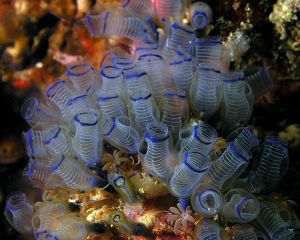
The chordates (members of the Phylum Chordata) are a really interesting group, however. There are some chordates that are not vertebrates, including the lowly sea squirt, and the lancet (Amphioxus). What these chordates have that is shared with all vertebrates (hence grouping them together) is a notochord.


 Penny Higgins - Storyteller • Artist • Scientist