The third week of our field season will be spent in Natural Trap Cave, which is a wonderful Pleistocene fossil locality.
The only problem is that is it a cave.
And a natural trap.Continue reading “Field Gear – Getting Into (and Out of) the Cave”
Penny Higgins - Storyteller • Artist • Scientist
Combining Science and Joyful Creativity
The third week of our field season will be spent in Natural Trap Cave, which is a wonderful Pleistocene fossil locality.
The only problem is that is it a cave.
And a natural trap.Continue reading “Field Gear – Getting Into (and Out of) the Cave”
One of the myriad of things I wind up doing in the field is “measuring section.”
Measuring section is a means of determining the actual thickness of layered sedimentary rocks in an area. To do this, I need a couple of pieces of equipment:Continue reading “Field Gear – What I Need for Measuring Section”
It’s July.
The summer has only just begun for my son (who starts 5th grade next fall), but I feel like my summer ‘vacation’ is already over.
Summers are hard when you’re an academic in a science that involves field work. Summer vacations – family time – are often lost to the necessity of travel to distant places that aren’t accessible at other times of the year. Then, as soon as you get back, it’s time to buckle down and prepare for the fall semester. No vacation for me.Continue reading “Of Stress and Blogging”
I think the most intimidating thing that happened to me when I started my Ph.D. work was being presented with drawers of fossil teeth and being instructed to identify them to species.
How do you even begin?
I still struggle with this, twenty years on. But now I have tools to get past the initial steep, seemingly insurmountable, learning curve.Continue reading “Learning to Identify Fossil Species”
On Monday, I had the privilege of joining a classroom of 10-year-old-ish students and introducing them to the science of paleontology.
Like most classroom visits, the kids were excited and wanted to touch everything I brought. They were fairly disappointed when I wouldn’t pass around the rock hammers (but, yeah, we all know how that would end).
There was one question that arose for which I could not provide the students with a satisfactory answer, and it occurs to me that it’s an important question that even many adults struggle with.
Why don’t I just take the fossils home and keep them?Continue reading “Who Owns the Fossils?”
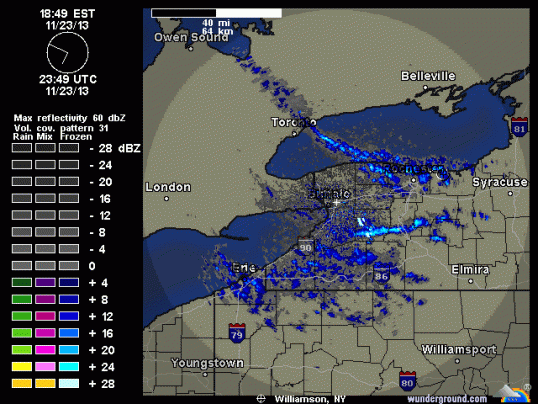
One of the cool (or perhaps not-so-cool, depending on your opinion of snow) things about living in western New York is the phenomenon known as “Lake Effect Snow” or LES.
I have a research proposal for the attendees of the annual meeting of the Society of Vertebrate Paleontology (SVP). I need your help.
You see, I know when I’m at an SVP meeting based upon the sound of conversations whether in bars or in poster sessions or anywhere. Do you know what I’m talking about?Continue reading “A Modest Research Proposal: The Sounds of Paleontology at #2013SVP”
This is a rant. Though it is a rant that I suspect many women in the sciences can relate to.
I teach at a university. I have a Ph.D. My title, then, is properly “Dr. Higgins.” I am not a professor, not adjunct, not tenure-track, so technically I shouldn’t be called “Professor Higgins,” but it happens and I let it go.Continue reading “Why I hate being called Mrs. Higgins (by my students)”
It occurs to me that it’s been a while since last I posted and introduction to myself. And since I’ve signed on for a couple blog-every-day challenges, I thought I might take a moment to say hi.Continue reading “Me and My Blog”
Earlier this week, I explained how color can be quantified and how the use of color might be used to examine orbital cycles in ancient rocks.
Here, I’ll describe another potential application. In this case, we’d like to be able to better define the boundary between the older Uinta Formation and the overlying Duchesne River Formation. (As an aside, Duchesne is pronounced Doo-shayne.)Continue reading “Color – Part Three – Rock Formations”

 Penny Higgins - Storyteller • Artist • Scientist