National Blog Posting Month – December 2012 – Work
Prompt – What do you consider yourself a “pro” at?
—
It seems strange to ever consider myself a “pro” at anything. I’m ‘good’ at a lot of things, and feel like I’m pretty well-rounded as a person and a scientist, to say “pro” makes me hesitate.
However, there is one topic (work-related, of course) that about which it appears that I am considered a world expert. I get sufficient requests from entities globally each year to corroborate that conclusion. On that one thing, I will – still reluctantly – call myself a “pro.” That topic is the analysis of light stable isotopes from bioapatites.
In English, this is basically the geochemical analysis of tooth enamel. I work mostly with the teeth of fossil mammals. The data collected from such analyses can be used to interpret ancient environments and habits and dietary preferences of extinct animals. From that, we can study things like climate changes that occurred millions of years ago. That’s my schtick.
There are lots of scientists actually that work with such data. By lots, I mean maybe a few hundred, so still a small number but greater than zero. What makes me unique is that I’m one of the very, very few who actually knows how to operate the instrumentation to do the analyses. It’s one thing to understand how to interpret the data. It’s quite another to know how to get the data. Not only can I run the analyses, I can replicate my results, which is actually much harder than it sounds.
I always giggle a bit when I get an e-mail that says something to the effect of “I’ve heard you’re the best at this, so here’s some samples, can you run them?” My first thought is, Clearly these people haven’t met me. But I get these requests from all over the world, with projects pending and running from Australia, Brazil, Uruguay, and Siberia, not to mention the stuff happening in the United States, so there must be something to it.
So that’s what I’m a “pro” at, I guess. Isotopic analysis of bioapatites. I’ll put that on my resume.
When I was about four years old, my mother first told me about the horse she had when she was growing up. His name was ‘Watch Charm,’ but Mom just called him Charmie. After that, I became a typical horse-crazy girl growing up in the middle of the city. But I can trace that fact that I’m sitting here, now, as a paleontologist back to that conversation. This is how it worked.
I had this one toy horse that I loved. In fact, I still have that toy horse. I should find it an post a picture here. Anyway, I sat down and started drawing pictures of that horse. I wanted to draw the perfect horse. It was my way of imagining actually having one.
I spent years perfecting my drawings. I would study some of the toy horses that I had and sketch those. Then I graduated into looking at pictures of horses and copying those. I got some ‘how to draw’ books.
Something clicked in me around middle school. I noticed that horses and humans had all the same bones, they were just arranged differently, for different functions. In fact, I realized that all terrestrial vertebrate (though I didn’t call them that at the time) had all the same bones. Then I got creative.
Of course, I didn’t fully understand biology or evolution then, but I tried to imagine what animals that evolved in different environments would look like. Or what a sentient horse would be like. I spent years creating strange new alien species, mostly mammals, based upon what I understood of comparative anatomy (all of which I taught myself).
In middle school, I read parts of Gray’s Anatomy, and began to think about how muscles and bones work together. Every animal I created had to ‘work’ to the best of my knowledge. I would draw skeletal and muscular reconstructions for each animal. Things were getting pretty detailed.
By the time I was in high school, I’d gone so far as to invent some cultures and interactions for some of the species, but still, they were mostly mammalian. I took a number of art classes and was by then producing some great paintings and drawings of my critters doing unexpected things: the Ulfrese (my biological answer to the ‘transformers’) were cheetah-like and seemed to like to ride mountain bikes. Then there were the Pronons that were my functional concept of a minotaur, that for whatever reason, enjoyed winter sports (it could have been that the Winter Olympics were on!).
An Ulf riding a bike. Pencil on illustration board. I drew this in high school. All rights reserved.A Pronon ski jumping. Watercolor. I painted this in high school. All rights reserved.A Pronon speed skating. Watercolor. I painted this in high school. All rights reserved.
Then my art teacher challenged us to invent an animal that looked like a plant, or vice versa (I don’t remember). I naturally came up with an animal the was a plant, and spent a great deal of time conceptualizing it’s fern-like reproduction.
When high school was nearly over, I had established a few things about myself that remain true today: I am an artist and I am a scientist. I was mulling over how I could be both and make a career of it. The obvious choice was dinosaur reconstructions. I’d be the artist that fleshes out the dinosaurs. I’d be a paleontologist!
I went to college to study geology and biology. I already knew that paleontology was an interdisciplinary science. I knew I could never do what I wanted to do without solid training in both geology and biology, so I double-majored.
The unexpected occurred. I found that I really liked geology a lot! I could actually see myself being just a geologist. That’s OK. There’s a future in that. I also rekindled an old interest in chemistry, which surprised me.
I learned also that paleontology isn’t just something you major in. If you wanted to be a paleontologist, you had to get an advanced degree. That degree would either be in geology or biology. When I was near graduation, I started applying to graduate programs in both fields, but the ones that attracted me the most were those in geology. I wound up in a Ph.D. program at the University of Wyoming to study vertebrate paleontology. But here’s the kicker: I wasn’t going to work with dinosaurs or even with life reconstructions.
Well, it’s worked out. As a grad student, I was introduced to isotope geochemistry, which is what I do to get paid now. Occasionally, I even get to work with dinosaur fossils. I’ve never become a paleoartist and done reconstructions. Perhaps I should be disappointed, but the people who actually are paleoartists do some amazing work. I don’t think I could do that! I do still draw – a lot! I do my own figures for papers. It’s nice to not have to hire anyone to do that for me. I really enjoy putting together posters for professional meetings. I get a little arsty-fartsy with them. It’s a lot of fun. And doodles of horses appear everywhere!
Artsy-fartsy rendition of my singular new species of Mammal, _Fractinus palmorem_ . Pen and ink and watercolor. Did this in graduate school. Never finished it. All rights reserved.
Here’s the fun thing: After grad school I found myself on a postdoctoral project working with – you guessed it – horses. Yeah, it came full-circle. I started with a love of horses, and today I do a lot of work with fossil horses (and other cool mammals). I still have it in my head to one day own a horse, though honestly, I’d be happy with any equid. Mules are nice. Donkey’s are cute and fuzzy. Maybe not a zebra…
So. I’m a vertebrate paleontologist. And an isotope geochemist. All because my mom told me the story of her horse way back when I was four years old. Never underestimate the influence your little story might have on someone. Such things could be life-changing!
My blog posts are getting shorter as my days are getting busier. And as I get busier, I get less inclined to think a lot. More than once in the past couple of days I’ve been faced with a decision that I have to make, but that doesn’t really matter. So I pose the question to Twitter and Facebook.
Someone else decide for me, please.
Crowdsourcing is really an interesting idea. I’m using it for mundane things right now (soup or salad) but it can be powerful. It’s not even that new of a concept. Seriously, “Ask the audience” in Who Wants to be a Millionaire? Yeah: Crowdsourcing.
I like to think that one of these days, I can post to Twitter something like: Hey, help fund my research! And then suddenly there will be funding. Some folks are getting this to work. I don’t have a big enough following yet. Maybe someday.
So, uh, I’d like to go out to Wyoming next summer to study global warming at the Paleocene-Eocene boundary. Anyone want to support me. Financially, I mean?
It’s clear that I spend too much time in the laboratory. The INTERIOR laboratory that has no windows. That’s full of expensive equipment that make lots of noises (including the one that goes ‘ping’).
I should have known I was in trouble when I first started naming things. It was innocent enough at first. Specky is what I call the mass spectrometer. “Now Specky! You do as you’re told.” Bzzz-zzz-zzzt. “Or not…”
We had some issues with the fume hood at one point. I got tired of always having to clarify that I’m talking about the fume hood, not the laminar flow hood. Blah, blah, blah. It helped when I just started calling the fume hood Josie, and the laminar flow hood Tina. “Put the samples in Tina when you’re done with the pretreatments.” Yeah, that can be misunderstood.
Then we got the water analyzer. Its name arose pretty quickly. It’s obviously a ‘special’ instrument, because when it’s running well, it says it’s own name over and over: Norm. Norm-norm-norm. Once in a while it gets upset and has a ‘hiso’ fit. Kind of a brat, really.
The elemental analyzer (which we’ve had for eight years) just got a name: Iago. I was so excited, I had to tweet about it. I think I started to realize that something was wrong with me at about that time.
I knew I was in trouble the day I most concernedly tweeted about poor Norm. Yup, he needs a valve replacement. You know (now) that Norm is a piece of instrumentation in the laboratory. But when you tweet about poor Norm and the valve replacement he needs ASAP, it doesn’t sound like that, does it?
Yeah.
Well, here’s to your good health, Norm. May your valve replacement surgery go well!
Today is one of those days when I start really thinking about changing careers. I like my job, but it has its frustrations, and they’re all piled up today. This will be a short post because of it.
I have customers in need of data, and employees capable of preparing the samples. But just when I think everything is ready: Oh hey! Look! None of the standards were weighed!
Goody! Just what I want to do. Spend a half-hour weighing out standards.
OK, crisis averted.
Oh, Damn! Look! We’re running low on helium. Change the tank. Crisis averted.
Crap. No one told me we were running of of weigh boats. Go order more. OK. Good. Crisis averted.
Well, dang. So-and-so needs water data. Need to have a chat with the water analyzer. Let’s see how it’s doing. Probably just need to change the septum. Oh. Look. Water. In the lines. It doesn’t belong there. Oh. Goody. The vacuum pump is caput. Crisis – still crisis. Dang.
</headdesk>
All right. I gotta salvage this day somehow. At the very least I should be able to get a set of carbonates run, right? We’ll see. When I came in this morning, the mass spectrometer was not in its ready state as it should have been. See, a student ran some analyses yesterday and didn’t leave the instrument as it should have been. Not that I’ve told them this… but, sigh. We’ll hope. It should be OK.
I explained in an earlier blog post the significance of the sampling effort that was undertaken to understand the pattern of isotopic values, and how this changed over time, of precipitation coming from Superstorm Sandy as it made its landfall and slowly died over the interior of North America.
I ended my sampling effort on Saturday night after collecting a total of nine samples, one every twelve hours since about the time Sandy made landfall on Monday night, the 19th of October. There was only one span of time – on Halloween – when it did not rain sufficiently for me to collect a sample.
Precipitation samples from Superstorm Sandy collected at my house. Rain water was collected in a bucket (that was strapped down so it wouldn’t blow away!) then poured into vials at approximately twelve-hour intervals. The bucket was dried then set out again.
These nine fine samples are now on their way to the University of Utah where their isotopic values will be measured. But, see, I’m also an isotope geochemist. And I also have a water analyzer in my lab. And I might be just a tad impatient.
So I analyzed the waters before I sent them off.
Our water analyzer, Norm, analyzing the Sandy waters. This is a Los Gatos Liquid Water Isotope Analyzer.
Let’s think back on what I said before, about Rayleigh Distillation. So if a cloud rains, the isotopically heavier water (mass 19 or 20) is more likely to fall (because it’s heavier) than the more common, lighter (mass 18) water. So the rain is isotopically heavier than the cloud. After the rain has fallen, the cloud is isotopically lighter than it was before.
So, what happens when that cloud rains again?
When a big storm (like Sandy) moves inland, the rain causes the cloud to get lighter and lighter. And since the cloud water is getting lighter and lighter, so does the rain coming from the cloud, though it is always heavier than the cloud itself. This leaves a tell-tale pattern of heavier isotopes near the coastlines where the storm first came on land, to lighter and lighter isotopes further inland.
So what pattern would you expect if you did all your sampling in one place and a storm simply passed over? What if a storm parked over your house and rained for days and days? What would that look like?
Think about it. I’ll give you a few minutes. I need a glass of water.
.
.
.
.
.
.
.
Keep thinking. I need to check my e-mail.
.
.
.
.
.
.
.
.
Any ideas?
Well, it would stand to reason, that unless – somehow – heavy water vapor was getting back into the cloud, the isotopic values would get lighter and lighter over time.
So, one might predict that the rainwater that I collected would get lighter and lighter over time.
Let’s see:
Isotopic values from precipitation from Superstorm Sandy collected near Rochester. Blue lines and symbols are hydrogen; Red lines and symbols are oxygen. The patterns are very similar, as they should be. Hurricane Sandy makes landfall on the left side of the graph. Water samples are plotted according to when I collected the sample (at the end of the twelve-hour period). In the final analysis, it’ll probably be plotted by the mid-point of the sample interval.
The pattern we expected to see was completely borne out for the first three collections, from when Sandy made landfall, to when the center of the storm was supposed to be over the Rochester area, where the samples were being collected.
But then what happened? The values start to increase again. Any ideas?
Well, for one thing, Sandy was supposed to pass over Rochester on Halloween, but it didn’t. The bulk of the storm passed to the south. In fact, it didn’t rain at all on Halloween (which made trick-or-treating possible!). Superstorm Sandy swung south and then west of Rochester before becoming too diffuse to know where the core of the storm was.
Something happened. Something changed.
Well, maybe some heavier isotopes did make it into the vapor mass. Perhaps it was the arctic front that was swooping down from the north as Sandy struck from the east that brought the isotopically heavier rain. It definitely cooled off. It was snowing occasionally during those last two sampling intervals. I suppose it’s also possible that the storm picked up some moisture from the Great Lakes as well.
Again, this is the beauty of the larger project and sampling effort. With only one sample site, we can’t be sure. But once we have all the data from the 100+ sampling sites, we’ll be able to map in detail what was happening. It will be obvious of secondary vapor masses (clouds, storms) joined up with the remnants of Sandy. We’ll be able to tell where and when that occurred.
It’ll be a while before all those samples are gone through and analyzed. I sent my own samples off to Dr. Bowen, so he can re-analyze them using his own instrument and add the data to his huge database. In the meantime, I have this one tiny subsample of the data and a lot of excitement for what will be discovered when the entire data set is complete!
As a scientist I am frequently asked to review other people’s writing. Typically, it’s a scholarly journal article that I need to read. Other times it’s a textbook that needs a review. These things don’t pay (though sometimes they have perks) and take time, sometimes lots of time. So why bother?
Why should I spend hours and hours reading someone else’s paper when I could be working on my own? My job might depend upon me publishing something scholarly every year. Sometimes more than one paper. And the work I might do on reviews isn’t ‘billable,’ so if you have that kind of job, why waste your time?
Well, here’s some reasons why:
1) You get to read the latest in research even before it’s published.
2) You can keep BAD science from getting published.
3) You can learn the difference between a well-written paper and a poorly written paper, thereby improving your own work.
4) You can help someone make a good paper much, much better.
5) You can save a scientist from accidentally publishing something that has a blaring error.
Really, the peer review process is intended to make sure that anything that makes it to publication is grounded in reality. Published scientific papers should report ‘truth,’ or at least as close to truth that is possible given the current state of knowledge. Peer review is a necessary part of the scientific process. If scientists stop reviewing each other’s papers, science stops. If you’re not willing to review someone’s paper, then I’m not sure you’re doing science right.
So I keep reviewing papers whenever I’m asked. I do the best I can. And when I publish something, I’m grateful to the reviewers who looked at it, whether they remained anonymous or not, or even if their entire review is snarky. That’s okay. I learn something anyway.
Earlier this week, Hurricane Sandy (an anomalous late-season hurricane) made landfall in the United States near Atlantic City, NJ (also anomalously far North). Because of the timing of Sandy (near Halloween), and it’s coincidence with another strong system moving across North America from the West, the weather event was given the moniker “Frankenstorm”.
This storm was a big deal, and my heart goes out to everyone adversely affected by its aftermath. My own heart broke with each image the popped up on my Twitter-feed that night. Yet there were some heartwarming stories, and certainly some good will come from this unfortunate event.
Much of the discussion of Sandy revolved around how unusual it was and how it might be related to global warming. I even got a call from a local journalist wondering if I would be willing to comment on that. (I said no, because it’s really outside of my realm of expertise, but hopefully might be contacted later regarding ancient episodes of global warming which really are my specialty.) There are plenty of web resources on the topic, which cover that question better than I can. This is one of my favorites.
This is all interesting, but is not why I was kind of excited about Sandy (in the way only a geochemist can be). For me, Sandy provides an opportunity to verify what we think we can learn about ancient weather patterns using chemical tracers in rocks. That is, Sandy is a natural isotopic experiment. I’m not the only person who thought this. Gabriel Bowen of the University of Utah thought of it first. I’ll explain below.
Before you get upset about the term ‘isotope,’ remember that all atoms are isotopes and that not all isotopes are radioactive. Most atoms are ‘stable’ meaning that they don’t undergo radioactive decay. It’s just that the term ‘isotope’ makes people think of nuclear reactors and meltdowns (and somehow Homer Simpson).
So then, what do I mean by an isotopic experiment? I’ll save the details of how isotopes work for a later blog post, and just start with a simpler story of just water. Different isotopes have different masses, or weights. Most water molecules have a weight of 16 atomic mass units. Let’s just say most water has a mass of 18. Some water molecules have a mass of 19, where one of the hydrogen atoms is ‘heavy’ (but stable) and some molecules have a mass of 20, where the oxygen atom is ‘heavy’ (but also stable).
When the mass of the molecule is heavier than most (19 or 20 versus 18) the molecule is, well, heavy! That means that if water evaporates, the lighter (mass 18) molecules evaporate first, because they’re lighter, leaving the heavier water (mass 19 and 20) behind in the puddle. This seems very common-sense, and it is. Vapor that evaporates from puddle is lighter than the water that remains in the puddle and, in fact, the remaining water gets heavier. This process is called fractionation.
Now, if we have a bunch of water vapor, like a cloud for example, and the vapor condenses, the heavier water condenses first and falls as rain (because it’s heavier). The rain is heavier than the vapor in the cloud and the cloud’s water gets lighter and lighter as it rains more. Again, this is fractionation.
When we’re talking about isotopes, we use this crazy delta notation. If we want to say something about the oxygen isotopes in water we use δ18O. For hydrogen, we use δD or δ2H. The number we report is really a ratio, but we tack on the permil symbol (‰) to make the numbers easy to talk about (again, this is something to talk about later). What’s important is that if the delta value is more positive, that means that the water is heavier. If the delta value is more negative, the water is lighter. Everything is measured relative to ocean water which has been assigned a delta value of zero for both hydrogen and oxygen. δ18O = 0‰ and δD = 0‰ for ocean water.
A hurricane, like Sandy, gets all its water from the evaporation of the ocean – so the clouds forming over the ocean will have delta values more negative than zero. As long as the storm is over the ocean rain from the hurricane and falls back on the ocean and new water evaporates keeping the isotopic value of the clouds stable. But once the storm moves over land, the addition of new water vapor from the ocean stops, but lots of water is lost as rain.
The result is that as a storm moves across the landscape, the isotopic value of the cloud gets lighter and lighter over time. The precipitation coming from the cloud also gets lighter and lighter over time, though it’s always heavier than the cloud it came from.
This is called Rayleigh Distillation, and is one of the basic concepts in isotope geochemistry. It seems pretty straight forward and reasonable, and has been used as the basis of isotopic interpretation for many years. But it’s been difficult to test… Until now. With electronic messaging and, more importantly, social media, it is now possible to recruit a fleet of people of a broad geographic area with only a few hours notice to collect rain samples that can then be measured for their isotopic values. We can finally ground-truth this important hypothesis!
This was tried for the first time with a storm called “Snowzilla” (now less creatively called the ‘Groundhog Day Storm’) that happened in 2011. Snow fractionates from clouds just like rain does, so would be expected to show a similar isotopic pattern as rain water. When this huge storm that hit much of the eastern United States, and Gabriel Bowen, then at Purdue University, put out a call for people to collect snow samples and send them to him. The results are detailed here.
The pattern of hydrogen isotopes from the Groundhog Day Storm in 2011. Warmer colors represent isotopically heavier water.
Looking at the figure, we see that the isotopic values shift from more positive in the southeast to more negative in the northwest. From this, it’s easy to see that the vapor moved in from the Gulf of Mexico and Atlantic Ocean.
What might we expect to see from Sandy? Well, this time when the call went out, Dr. Bowen asked participants to collect samples over specified time intervals and to record those times, meaning that it will be possible to make an isotope movie and perhaps watch Sandy move across the continent.
So… Why does this matter? Oxygen isotopes from rain can be preserved in rocks. As rain water is exposed to carbon dioxide and percolates through the soil, it forms carbonate (CO32-)which is then bound into carbonate minerals like calcite. This calcite can form little nodules in the soil or a calcrete layer. The oxygen in the carbonate records the oxygen in the water (with a little more fractionation). Later – as in millions of years later – geoscientists like me can analyze the oxygen from the carbonate and get back to the original distribution of oxygen isotopes in the rain water. From there, we can then figure out ancient air-flow patterns around the world.
With this knowledge, we can start answering other questions. How does the uplift of high mountains (like the Himalayas) affect global air flow? What happens to air circulation when climate changes rapidly, whether it be warming or cooling? We can address these questions and more, which might help us understand what the future might bring if projections of warming bear out.
In the meantime, I’m a participant in the project myself and am still collecting waters. Sandy’s not quite dead, though her destructiveness is well past. We’ll see what the data tell when all is said and done!
***UPDATE***
Here they are: the sample set from my house. I’m done sampling, so the analyses can begin!
Nine rain water samples I collected for the isotopic study of Hurricane Sandy.
Ah! The annual meeting of the Society of Vertebrate Paleontology (SVP)! My favorite thing in the world! Four days of paleontological bliss, where I don’t have to define terms or defend your chosen profession. Where you can escape from the forced isolation of being the only paleontologist in your department, or worse, in your city. Where evolution is accepted and assumed rather than danced about using clever euphemisms. And where you can trot out your *really* bad science puns and everyone laughs.
Overall, this year seemed no different than other years, but some things really stood out to me. Because I chose to live-tweet sessions, I felt more connected to the happenings at the meeting than I ever have before (and got to make some new friends, to boot!) And, incredibly, there was not a single talk that I went to that I felt was poorly executed. Usually, there’s one or two a day that are agony to sit through, for whatever reason, but this year it didn’t happen. Every talk was not only enjoyable, but offered something worth tweeting about. A good chunk of the meeting was Storify-ed by Jon Tennant (@protohedgehog on Twitter), so you can see what we were doing.
The venue was splendid. I enjoyed the convenience of all the sessions being side-by-side, and the posters were less than 3 minutes walk from the oral session. Even better, the hotel (if one chose to stay there) was less than 5 minutes from any of the sessions. And (after a little nudging), there was even free wi-fi! Perhaps the best (or worst) part of the venue was the seats that apparently had whoopie-cushions built in. There was a lot of accidental tooting, which was finally recorded here.
Highlights of presentations included video of a hyena eating a pig neck in about 30 seconds (noting the bone breaking capabilities of hyenas) and several videos of crocodiles and alligators running (including a blooper reel!).
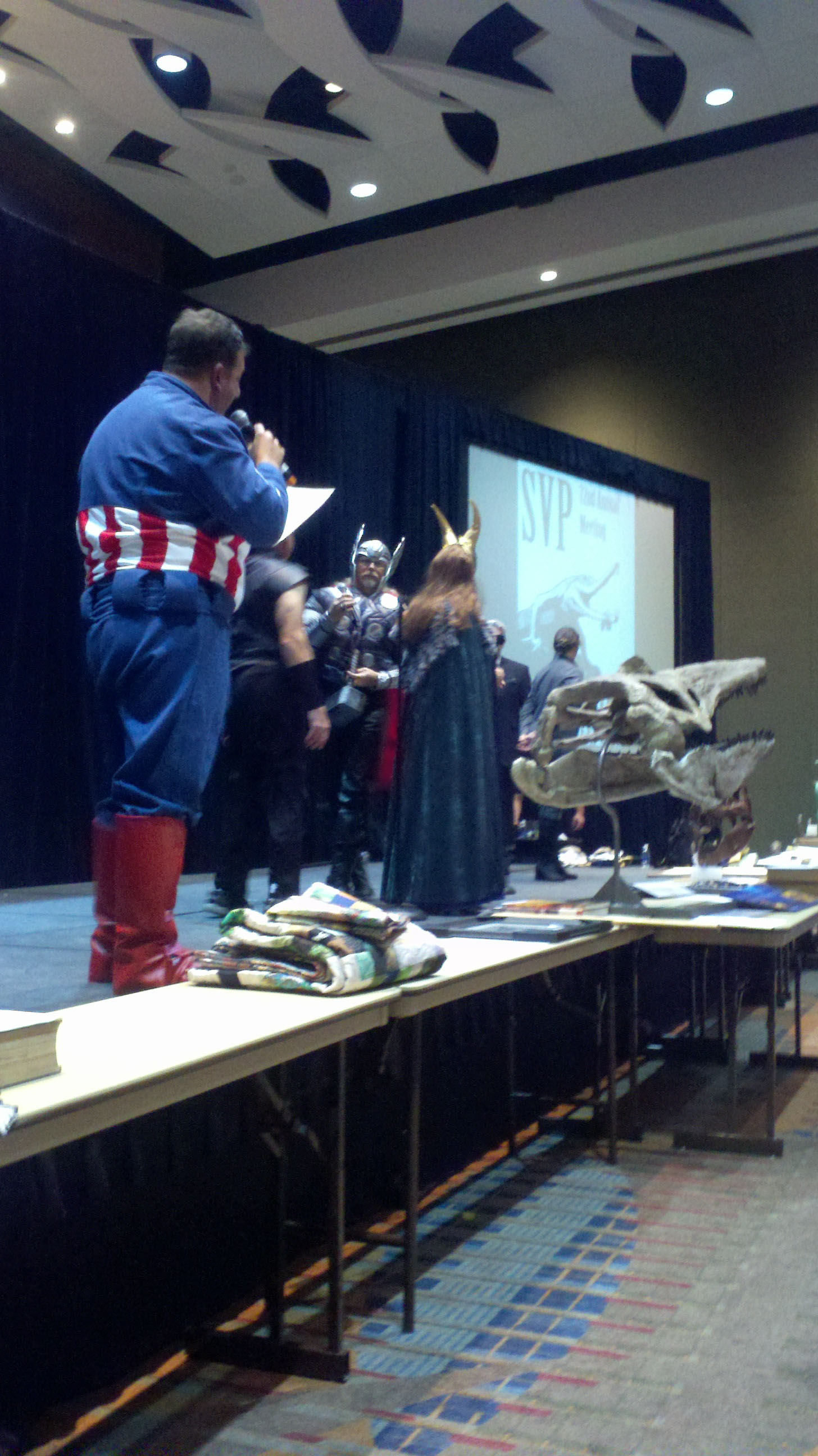
For me, one of the biggest parts of SVP is the annual auction. I’ve helped with the auction ever since I started graduate school and finally became a member of the auction committee sometime soon after getting my Ph.D. At first, it was always just a matter of helping with the set-up, but over the last 10 years, we’ve started dressing in costume with a theme for the live auction each year. Those of us on the committee put a great deal of time and effort (and sometimes money) into constructing our costumes. The theme is usually established sometime during the summer prior to the meeting, and we rush to create our costumes while simultaneously preparing our professional presentations for the meeting as well. This year, the theme was the Avengers. I chose to dress as Mockingbird, who did not appear in the movie, but has been in a few of the comics. I liked the look of her costume, which is why I chose her. She also has a Ph.D., so how can I go wrong?
Auction, Avengers-style.
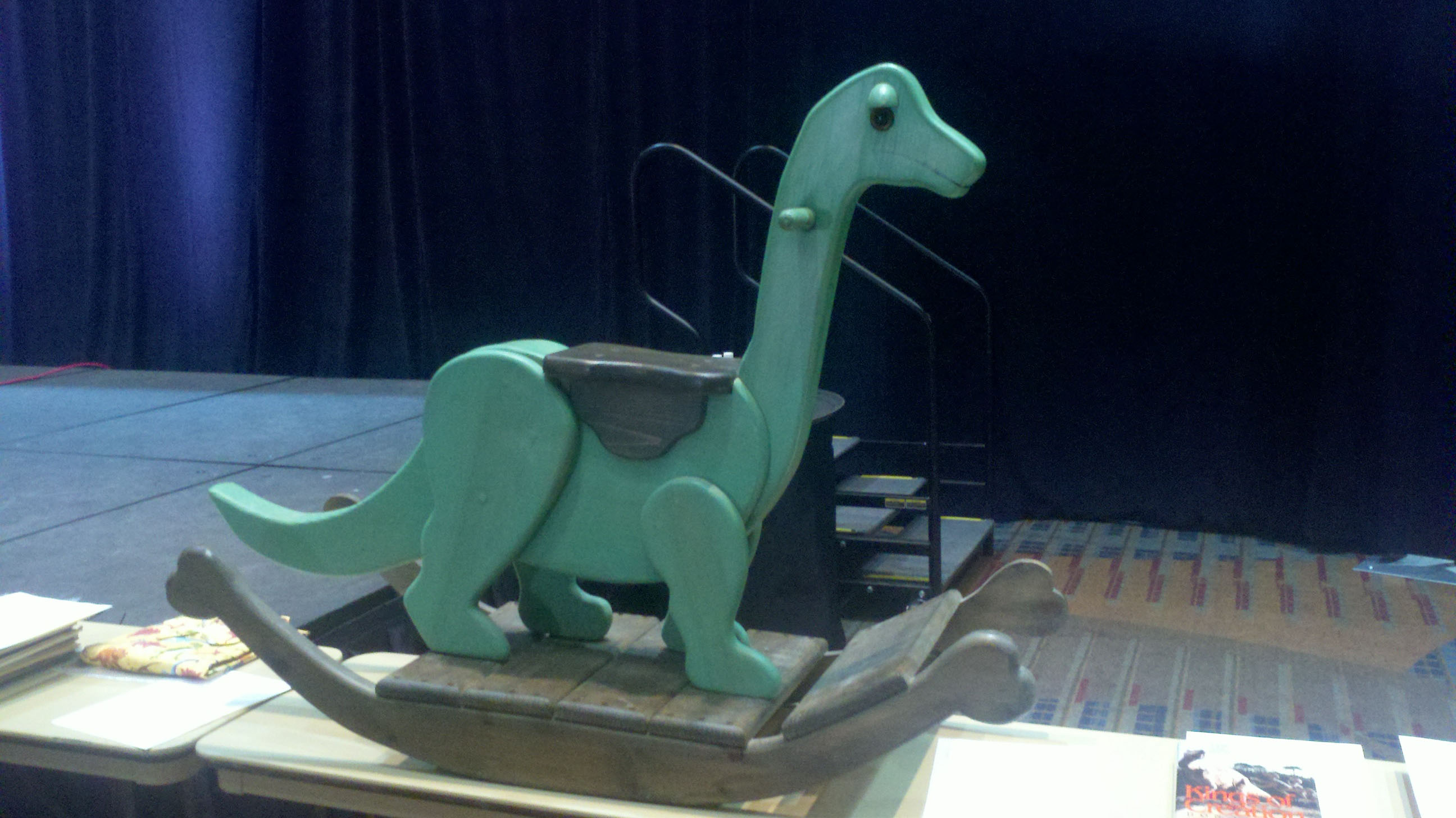
This year, I brought back an item I bought back in 2004: a big wooden rocking dinosaur. My son was an infant then. Now, at eight, he’s not so into the dinosaur. Hopefully, it’s off to make some other kid really happy and the auction winner will bring it back when his child has out-grown it.
The ol’ dino-rocker is off to a new home!
The auction raises money for various programs at SVP that support students. I’m glad to be able to help the society in this way. This year the auction made $22,700!
Dino-Thor?
As usual, I was able to drum up some new work for the lab while I was there, and perhaps start some new collaborations. I’m suddenly thinking an awful lot about microwear on teeth. I found out that what I presented was actually old news — only that the folks who had already done the same project kinda hadn’t bothered to publish it yet. (grumble) All told, this was one of the most productive meetings I have ever had. And somehow, I didn’t get sick during the whole event. I’m still healthy, two days after getting home. How’d that happen?
Well, while the iron’s hot, it’s time for me to attack some old research projects. There’s a short paper burning in me about the problems with the taxa Phenacodus and Tetraclaenodon. Then there’s that huge dataset that I tabulated as a postdoc that still hasn’t seen the light of publication. Yeah, I should get on that. I love this feeling of frantic motivation. I hope it lasts!
If you’re not satisfied with what I have to say about the meeting, then check out what others have said, (below). I’ll be updating this as I hear about other people’s posts.
This post was written a while ago, but my blog (for whatever reason) was down. It’s fixed now, so I’m publishing it – after the fact. My musings on the meeting will come later..
—–
I’m currently in Raleigh, North Carolina, sitting in my hotel room, winding down after a crazy-awesome day-and-a-half. I’m here for the annual meeting of the Society of Vertebrate Paleontology, which is, hands down, my favorite meeting. Every year I go to this meeting no matter what the cost. (I’ve been going to this meeting since 1994, and only skipped a few when I was a poor, starving graduate student.) The Society of Vertebrate Paleontology is the one professional organization that I likely will never allow myself to not be a member of.
This year, the meeting is proceeding as it always does for me: Interacting with colleagues; learning about new methods; developing collaborations; making new friends. I brought some research (as I always do) and will be presenting it this afternoon in a poster session. Tomorrow will be busy as the Friday of the meeting always is, because of the annual auction and that I’m an auction committee member.
What’s different about this year over the others is that I’ve decided to join the ranks of those who use social media to disperse what is being discussed in sessions to the wide world. I’ve been ‘live-tweeting’ sessions: commenting on speakers using the hash tag #2012SVP so that other interested parties can know what’s happening if they couldn’t come to the meeting or if they’re just in the room next door listening to someone else. I don’t say much, only commenting on things that really grab my attention and I think others out there would be interested to know.
This experience has been great so far. Over the past year I’ve begun to think that social media and science outreach was a better fit for my interests and passions than hard-core research (even though I do plenty of research and have new results to present every year). The interactions (face-to-face and electronic) I’ve had during this meeting have been amazing and now, more than ever, I’m realizing that my suspicions are true. Research is great. Sharing it with others is even better.
There are two and a half more days to the meeting. I expect my feelings will grow stronger as this time goes on. I like where I am right now. I like where things are going. Stay tuned!





 Penny Higgins - Storyteller • Artist • Scientist