Friday Headlines: 2-1-13

Friday Headlines, February 1, 2013

THE LATEST IN THE GEOSCIENCES


TAPEWORM EGGS DISCOVERED IN 270 MILLION YEAR OLD FOSSIL SHARK FECES

Do I really need to say more? It’s an intestinal parasite…

Tapeworm

…in fossil shark poop.

It poopeth!
Fossil shark poop.

Ew.


Two related headlines here:

STUDY REBUTS HYPOTHESIS THAT COMET ATTACKS ENDED 9,000-YEAR-OLD CLOVIS CULTURE

PREHISTORIC HUMANS NOT WIPED OUT BY COMET, SAY RESEARCHERS

Comet, asteroid, and meteor impacts have been blamed for several of the Earth’s greatest extinctions, including the one at the Cretaceous-Tertiary (K-T) Boundary that led to the extinction of the dinosaurs (and later dominance of mammals). It’s only natural then, when an extinction is identified in Earth’s history, to take a moment and look for evidence of an impact.

The Clovis culture disappeared from North America about 9,000 years ago. That’s similar to when many of North America’s ‘megafauna,’ or giant animals, went extinct, like the woolly mammoth and giant ground sloth. For the extinction of the megafauna, most arguments hinge around human over-hunting or climate change, because that was about the same time that humans made it onto North America and it was also the end of the last glaciation.

There are some, however, who argue that an impact event caused the extinction of the megafauna and then also the demise of the Clovis culture. There was even a Nova documentary about it. Alas, the newest and best evidence soundly rebuts this idea. There are no impact craters from that time period (though it’s been argues that the comet hit the ice cap). There’s no shocked minerals either. Minerals take on the appearance of being disrupted (or shocked) due to the force of impacts. Shocked quartz is common from the K-T boundary event, but there is none associated with this 9,000 year old event. No impact occurred.

The downside is that we still don’t know what happened to the Clovis people.

Beware of Movies! Fossils and Paleontology

The Beware of Movies! series is meant to point out some of the scientific inaccuracies of popular movies, specifically in points related to the geological sciences.

This post will point out the major inaccuracies portrayed in movies about the science of paleontology. I’m a paleontologist. This oughtta be good…

Commonly, about two seconds after I tell someone I’m a vertebrate paleontologist, they ask me what I think of Jurassic Park. Then I laugh. It’s either that or they ask me if I carry a whip like Indiana Jones. Then I snarl something about how 1) Dr. Jones was an archaeologist and 2) Indiana was the dog!

Continue reading “Beware of Movies! Fossils and Paleontology”

Friday Headlines: 1-18-13

Friday Headlines, January 18, 2013

THE LATEST IN THE GEOSCIENCES

FLORIDA PALEONTOLOGIST ERIC PROKOPI PLEADS GUILTY TO SMUGGLING PRICY DINOSAUR BONES, FACES 17 YEARS BEHIND BARS

On May 20th of last year, a Tarbosaurus skeleton went up for auction in New York City. Paleontologists familiar with Tarbosaurus (sometimes called Tyrannosaurus, as they are closely related) immediately realized that this specimen, a complete skeleton, could not have come from anywhere but Mongolia. Mongolia does not permit the export of its fossils, and it was clear that this specimen had been removed relatively recently.

Mounted skeleton on exhibit in Cosmo Caixa, Barcelona – by FunkMonk

There was a great deal of argument, and the auction still went ahead, with the Tarbosaurus being sold for $1,052,500. The check was never cashed, luckily, as the case was under investigation.

The result of the investigation was that, in fact, the skeleton was illegally poached. Now the commercial collector, Eric Prokopi, faces up to 17 years in prison for his acts. This particular Tarbosaurus skeleton isn’t the only one out there that Prokopi had a hand in smuggling out of Mongolia. Hopefully the rest will be found.

Read more about it here.


LAKE VOSTOK WATER ICE HAS BEEN OBTAINED

Underneath the massive ice sheets in Antarctica, isolated from the atmosphere for 100,000 years or more exists a lake of liquid water called Lake Vostok. Scientists have drilled through nearly 4000 meters of ice (more than two miles) to reach this remote lake. They wish to study it and see if there is anything living in there, as a potential analogue for the harsh environments of distant planets. On January 10th, the first sample was collected. Research can now commence.

Cross-sectional map of Lake Vostok situation (before drilling was complete) (Credt: National Science Foundation)


STORMS REVEAL IRON AGE SKELETON

Not quite geology, but close to paleontology, so it counts…

Storms reveal iron age skeleton

These sorts of things happen a lot in paleontology, actually. A storm causes a stream bank or cliff to collapse, and suddenly there are bones sticking out of the fresh surface. Given that these were human remains, the police were called initially. Archaeologists later said they thought the bones were as much as 2000 years old. Sadly a second storm caused to bones to be lost.


Bad Geology Movies: Caveman, 1981

Caveman

1981

Ringo Starr, Dennis Quaid, Barbara Bach

Premise: Could the awkward defeat the hulking in one zillion BC?

Caveman has got to be one of my all-time favorite movies. I liked it when I was a kid, because it was just plain silly. As I got older, I liked it because it had Ringo Starr in it (I was a Beatles fan – I guess I still am!). As an adult, I’m entertained by the subtext. (Zug-zug!) And as a paleontologist, I am wildly entertained by all the inaccuracies.

It’s comedy, so of course it’s fraught with inaccuracy. A lot of it is intentionally blatant. That’s what makes it funny. Because this movie is billed as comedy, any intelligent person knows better than to believe anything in it. I’ll just point out the paleontological silliness and warn you that if you haven’t seen this movie before, there are lots of spoilers ahead!

It opens with a big guffaw. One zillion B.C. it reads on the screen. Zillion isn’t even a proper number, but it is certainly much larger than a billion, thus exceeds the known age of the Earth (even back in 1981).

Setting— Everything about where the movie was shot, down to the tar pits, says California. Well, cavemen were not kicking around in California. They were in Europe.

Dinosaurs and humans— What were they even doing there? Dinosaurs and humans never co-existed. They missed each other by at least 60 million years.

The Dinosaurs themselves— Only two dinosaurs were depicted. One was a lizard-y guy with spikes on his back and tail and a big pointy horn. This guy also had chameleon-like eyes that moved around this way and that. He also had a sprawling stance (his legs out to the side like an alligator). This was clearly made up. This could be a take on the original interpretation of Iguanodon, but I think it was just made up for the sake of the show.

The original (now known to be inaccurate) reconstruction of Iguanodon – Photo by mugly on Flickr

The other dinosaur was Tyrannosaurus rex (I assume). This version of T. rex is a nod to the original interpretation of the dinosaur, with the body held vertically and the massive tail resting on the ground. This is in marked contrast with the interpretation of T. rex in Jurassic park, which itself is totally different from modern depictions of the beast. These days, T. rex is seen as a fleet-footed predator that held its body horizontally and its tail straight out behind. The modern view of T. rex also includes feathers.

The Tyrannosaurus of Caveman is a talented dinosaur, however, able to emulate howling wolves, crowing roosters, and hooting owls. It’s actually worth a bit of a chuckle to think that the crowing and hooting aren’t so far off from possible, given that modern birds are thought to be the closest living relatives to dinosaurs, especially theropods like T. rex.

The pterosaur and the giant egg— Pterosaurs and humans never co-existed either. Though not dinosaurs, pterosaurs lived during the same time and went extinct at the same time as dinosaurs. The giant egg was clearly too large to have been laid by the pterosaur that we see flying around in the movie, but it sure lends itself to a hilarious sequence of events.

A nearby ice age…— This is hilarious because we know it ain’t possible. An ‘ice age’ is a time period, not a place, and certainly, no-one is going to walk from the desert to a frozen wasteland in one day. Nevertheless, the snow beast is adorable and you just have to feel for him. Maybe he was just trying to make friends.

My favorite part of this movie has nothing to do with paleontology. I love the bit where Atouk’s little tossed together tribe has an impromptu fireside music, song, and dance fest. It just makes me happy.

Bad Geology Movies: Dinosaur, 2000

Dinosaur

2000

D.B. Sweeney, Julianna Margulies and Samuel E. Wright

Premise: What would happen if a dinosaur was raised by lemurs?

OK. This is totally a kids’ movie. I won’t say anything about talking dinosaurs. And I know there has to be tons of artistic license. Fine. Nevertheless, there are some things about this movie that are terribly inaccurate.

But I only took two pages of notes, and, admittedly, the pencil was blunt and there were pictures. So there’s not too much.

Dinosaurs that I recognized: Iguanodon (e-K), Carnotaurus (l-K), An Oviraptor (Rinchenia) (l-K), Velociraptor (l-K), Brachiosaurus (l-J), Styracosaurus (l-K), Ankylosaurus (l-K), Parasaurolophus (l-K), Struthiomimus (l-K)

Those funny little parenthetical bits there denote the age of rocks in which each of these animals are typically found. (l-K) means the late Cretaceous, just before the dinosaurs went extinct. Luckily, most of the animals depicted in the movie are from the late Cretaceous. That makes sense. The whole movie begins with an asteroid impact which, presumably, represents the one that killed off the dinosaurs at the end of the Cretaceous.

There are a couple of problems though. For one, the main character is an Iguanodon. Iguanodon lived in the early Cretaceous (e-K). That could be 50-70 million years before the rest of the characters. But if that’s not bad enough, Brachiosaurus is from the late Jurassic (l-J), which is tens of millions of years older than that.

So, these animals never actually co-existed.

Lemurs, or any modern primate did not appear on the Earth until at least ten million years after the dinosaurs went extinct. So that just wouldn’t happen. But fuzzy animals with goofy personalities are great for the show.

There are some other bits that were worrysome: Why are the lemurs on an island separated from the mainland? Why aren’t there dinosaurs on that island? How come the nesting grounds are unaffected by the meteor impact? Why are all the dinosaurs essentially sentient, except for the poor ankylosaur?

That landslide was a little sketchy, too. Where did that rock come from?

Oh, and hey. Why did any dinosaurs survive? After all, didn’t the asteroid wipe them out at the end of the Cretaceous? In the end, this is actually OK. Maybe some relict populations did survive beyond the end of the Cretaceous, but died out soon thereafter. There’s even some evidence that this occurred, though most paleontologists are skeptical. The point is that it is plausible that not everything died immediately after the impact.

Besides, it’s a kids’ movie. What do you want?

Bad Geology Movies: Jurassic Park, 1993

Jurassic Park

1993

Sam Neill, Laura Dern and Jeff Goldblum

Premise: What if we could clone dinosaurs and made a theme park around them?

You were probably waiting for this one. I had to do Jurassic Park. I’m a paleontologist. It’s a rule, right?

When Jurassic Park came out, I was in my fourth year as an undergraduate (I’d been a senior for a while already, and wouldn’t graduate for at least one more year), studying both geology and biology. I was going to be a vertebrate paleontologist, and I was pretty sure I was going to study dinosaurs. (I never have studied dinosaurs, but I did become a vertebrate paleontologist. 50% is pretty good, right?)

I never did see this in the theater. I saw it a year later when it came out on video. I watched it the evening of the day that I took the GRE exams. Yes, exams in the plural. This is back when there were only two dates a year you could take the GRE and it was a hand-written test. I took both the general and the subject exam in one day. I was fried that night. I remember laughing at the cute dinosaurs while my roomates and friends fell on me in terror.

Since then, this movie has been a popular one to watch with the various geology clubs I’ve been associated with. It’s full of problems with both paleontology and biology. I’ll try to stick to the paleontology problems.

The bottom line is this: We’re probably not EVER going to see cloned dinosaurs. Now, maybe we can do some genetic engineering and get dinosaur-like animals from modern birds, but that’s about it.

I’m only planning to review the first Jurassic Park movie. The others are based upon accepting the assumptions from the first, so there’s little point in considering the others (with the possible exception of the character Robert Burke, from the second movie, The Lost World).


PORTRAYAL OF PALEONTOLOGY: Oh, goodness, it’s wrong. Just wrong. The setting, the outcrops, were all right, but what the science looked like is wrong.

Exposing the fossil: 1) I have never been to a fossil locality where a brush was all that was needed to expose a fossil. Additionally, paleontologists tend NOT to expose fossils as they dig. They only uncover enough so that they can determine the exent of the the fossil. Then they trench around the specimen, keeping as much rock as possible in place. Once a trench is dug, and the fossil is still encased in rock but now sitting on a pedestal, paleontologists will jacket the fossil with plaster and take it into a laboratory to fully remove it from the rock. Never, never, never do we do such detailed preparation in the field. The specimens will be ruined, if not by people walking on them (or helicopters landing nearby), but by the elements. It takes time, sometimes years, to get a fossil out of the ground. The more that remains encased in rock, the better.

Seismic: Not that I fully understand how seismic works, but I’m certain that a single shotgun blast isn’t going to yield an image by which a paleontologist can recognize the half-moon shape of the dinosaur’s wrist bone.

The fossil itself: Y’know, sometimes a complete fossil is found in its death pose, but usually even then some of the bones are out of place. To find as single complete specimen is unusual. To find two, both laid out perfectly, is so unlikely that I could not suspend reality to accept that part of the movie. And something as big as the ‘Velociraptor’ that they portray would almost certainly have damage or distortion somewhere.

Science and funding: Apparently Hammond, the creator of Jurassic Park, has been providing Drs. Grant and Sadler with $50,000 a year to fund their research. That might seem like a lot of money to you, but in reality, that’s chump change. Just saying. Research efforts like those are expensive, especially if Sadler and Grant are getting any salary from it. I’ve submitted some ‘cheap’ grant requests for less than $50,000 per year. That covers my research expenses and only two months of my salary. Most programs need much more than that.


THE DINOSAURS: They did pretty good with the dinosaurs, all things considered. I’m glad that Spielberg isn’t going to go all “George Lucas” on these movies and fix them up though…

Velociraptors and the relationship with birds: What Alan Grant in the movie says about the relationship between birds and dinosaurs is mostly true. Most of us in the paleontological community refer to birds as ‘avian dinosaurs.’ We have chickens and I am always calling them my little dinosaurs. What Dr. Grant says about ‘raptor’ meaning ‘bird’ may also be true, but let’s face it, that’s not evidence that birds and dinosaurs are related. If I start calling a donut a banana, does that make the donut fruit? No. (Besides, ‘raptor’ actually means ‘thief’!)

Speaking of Velociraptors: The true ‘Velociraptor’ is a little animal that would stand about hip-high on most adult people. The veolociraptors in the movie were enlarged to make them look cooler. When Spielberg came up with this, paleontologists said, ‘Well, ok. Sure. It’s a movie. Go ahead,’ basically accepting that this was going to be wrong. But at about the time that the movie came out, a huge new species related to Velociraptor was discovered in Utah, and was named Utahraptor. The velociraptors of the movie could be Utahraptors in real life. And the paleontology community breathed a collective sigh.

Inferences about behavior: Velociraptors hunt in packs. Gallimimus ran in herds. This is arm-waving. This is literary license. This is not something that can be inferred directly from the fossil record. We don’t know exactly how these animals interacted. We don’t know how they behaved. We can observe modern birds and assume that dinosaurs might have behaved in similar ways. Nothing more.

Inferences about perception in dinosaurs: Apparently, Tyrannosaurus can’t see you unless you move. Dr. Grant knew this somehow. OK, we don’t actually know this. There are animals that can only see objects if they move quickly, like some frogs, but we can’t possibly know if this is true with dinosaurs. By the same token, we don’t know if velociraptors can stare you down, either. If we’re going to base this inference on their nearest living relatives, however, I’m pretty sure that T. rex could see you even if you were sitting still.

Modern understanding of dinosaurs: If this movie were to be made today, the velociraptors would most likely be completely covered with feathers. The T. Rex would also have feathers, probably. Any of the theropods would be feathered. Now, I’m not sure about the sauropods – the big Brachiosaurus – I’m sure someone else knows.

By the way, Dilophosaurus: Dilophosaurus does not have the neck frill that is shown in the movie, and it didn’t spit poison, either.


Cloning: So this is biology, and a bit of chemistry. 1) DNA wouldn’t last. Over 65 million years it would degrade so much that it would be unrecognizable. 2) Frog DNA? If they were clever, they’d use bird DNA. Seriously, a FROG?! Now if we really wanted dinosaurs, what we need to do is study the anatomy of dinosaurs and compare that with birds as adults and embryonically. Then let’s try to make the embryo of modern birds develop to make a dinosaur-like skeleton and see what we get… This, I think, is within the realm of possibility, but the ‘dinosaur’ we’d get won’t be any dinosaur that ever walked the Earth!


Females turning male: Actually, such things are possible. In many vertebrates, the temperature of the eggs during development will determine the sex of the young when they’re born. Equally possible, though not mentioned, is parthenogenesis, wherein a female simply gives birth or lays eggs without fertilization. The babies are clones of the mother. This is known in many species of lizards. It’s a stretch, but it’s possible.


I could go on. There are several little details in the movie that I found annoying, but these are the big ones (or so I think). I’ve got other movies to watch and review…
I can haz career?

National Blog Posting Month – December 2012 – Work

Prompt – Do you think you have a job or a career?

To me, having a ‘job’ would be working for an hourly wage at something that you do only for the pay and not because of any long-term goal. ‘Jobs’ are typically positions that do not provide much (if anything) in the way of benefits or retirement plans.

A ‘career’ involves working at a single type of work (hopefully at a single place of employment) with a long-term goal of working up to higher positions and greater pay and usually includes some manner of retirement plan.

Most definitely, I have a career. It’s hard not to have a career when one has put the time into getting a Ph.D. (though it happens). I expect to be doing the same sort of work (science and teaching and maybe a little writing) until I’m ready to retire.

Further evidence that I have a career: I finally got business cards. I feel all grown up.

Back off, man! I'm a scientist!
Back off, man! I’m a scientist!

For 12-26-12

Dinosaurs in the backyard

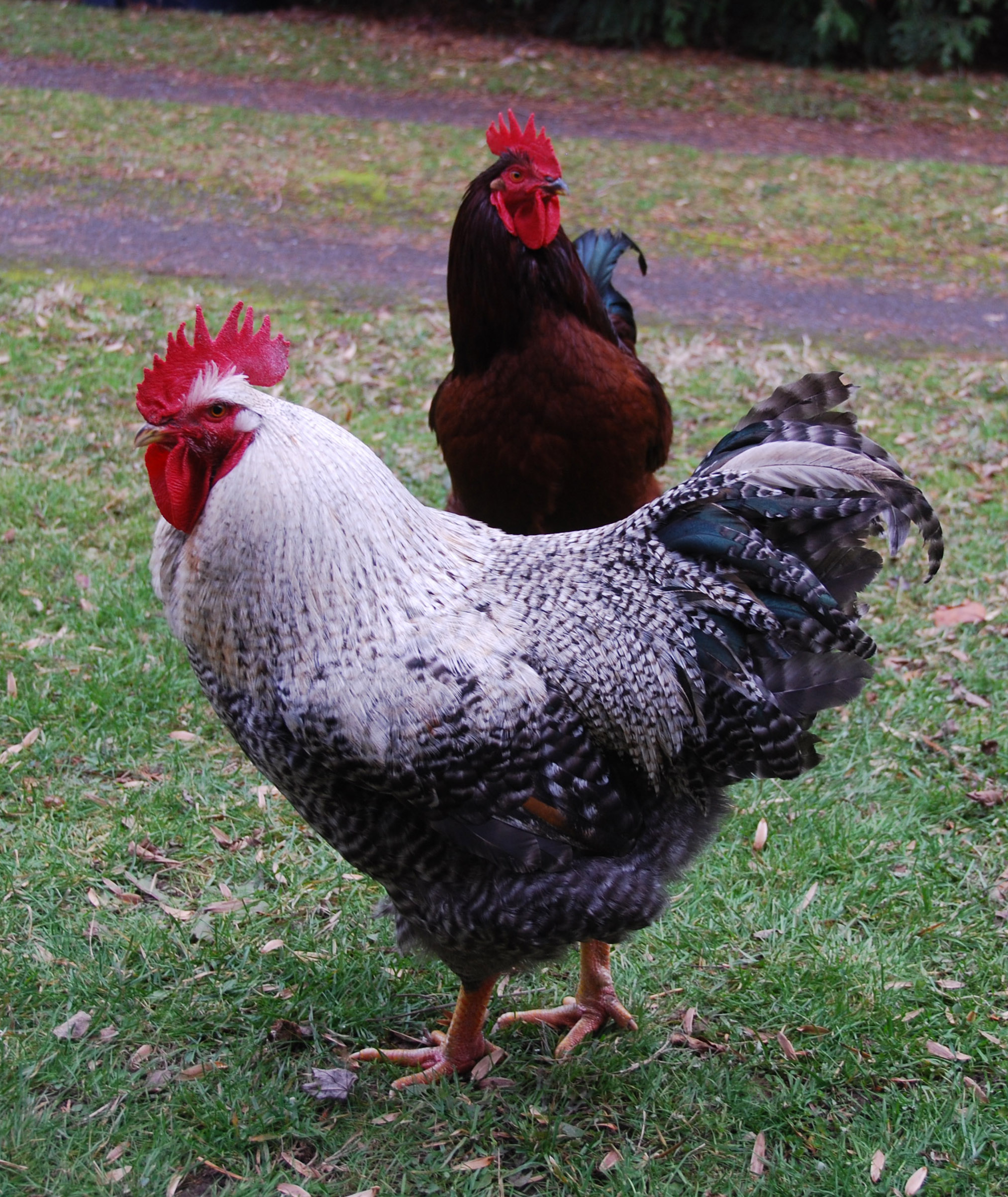
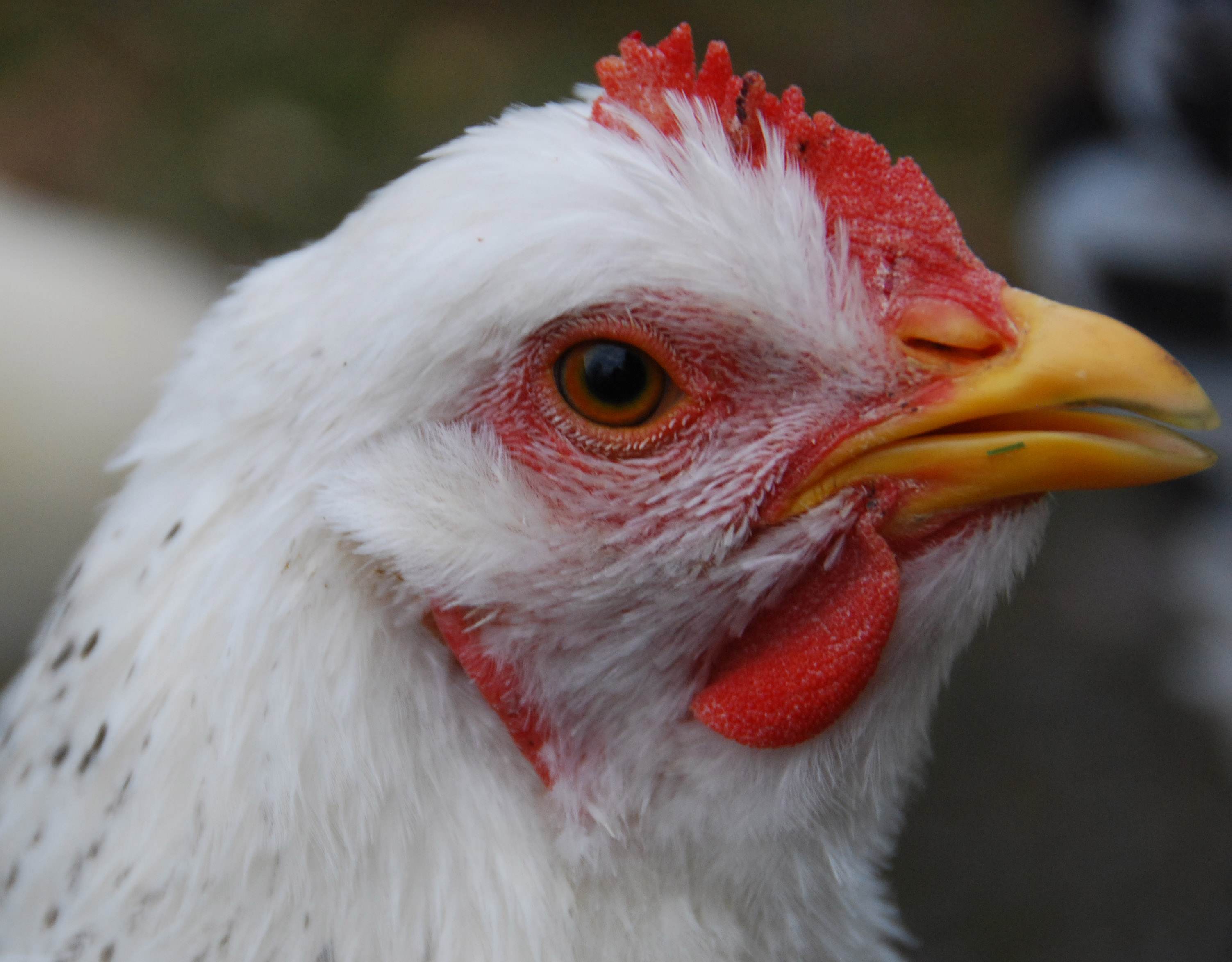
I don’t know if I’ve ever mentioned that we have chickens. But…we have chickens. I love them (and hate them). They do provide some entertainment and lots of eggs, but they can stick a bit, and be noisy (and down-right dangerous if you make them mad).

In the paleontological community, there is very little debate that modern birds are direct descendents of the dinosaurs. And if you sit and watch the chickens for a while, you can believe it.

So, we have dinosaurs in our backyard. We like them. Turns out they’re pretty hard to photgraph, but I think I got decent shots of most of them anyway. Here are some photos.

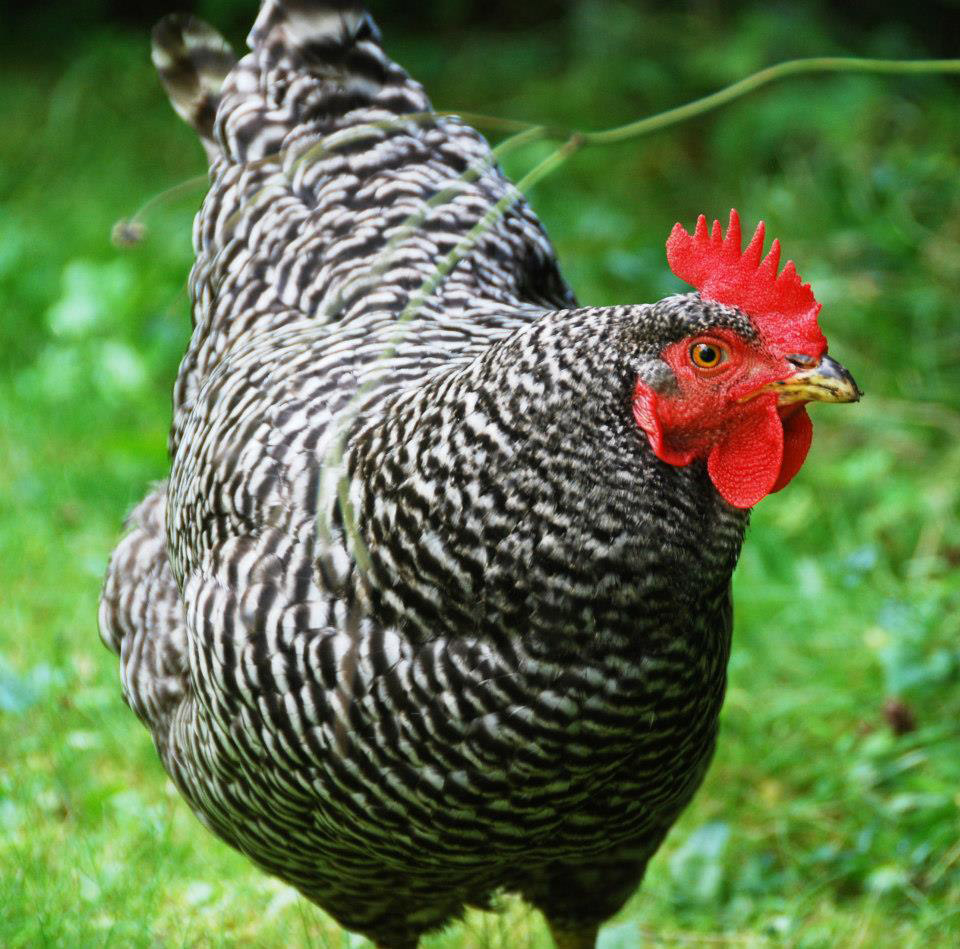
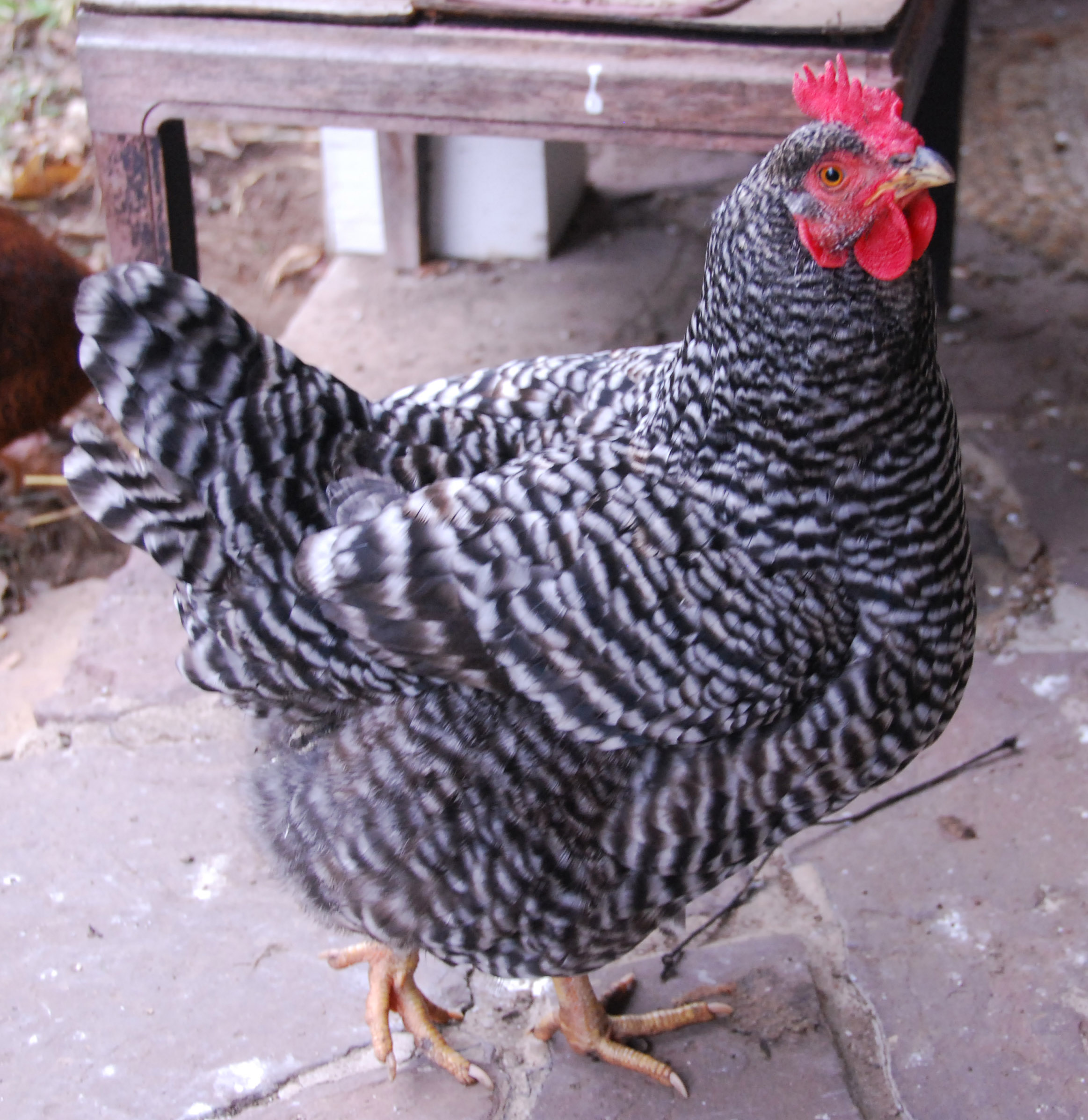
Rosey is the matriarch. She’s the oldest, having already survived one winter here.

Rosey – A Barred Plymouth Rock
Another shot of Rosey

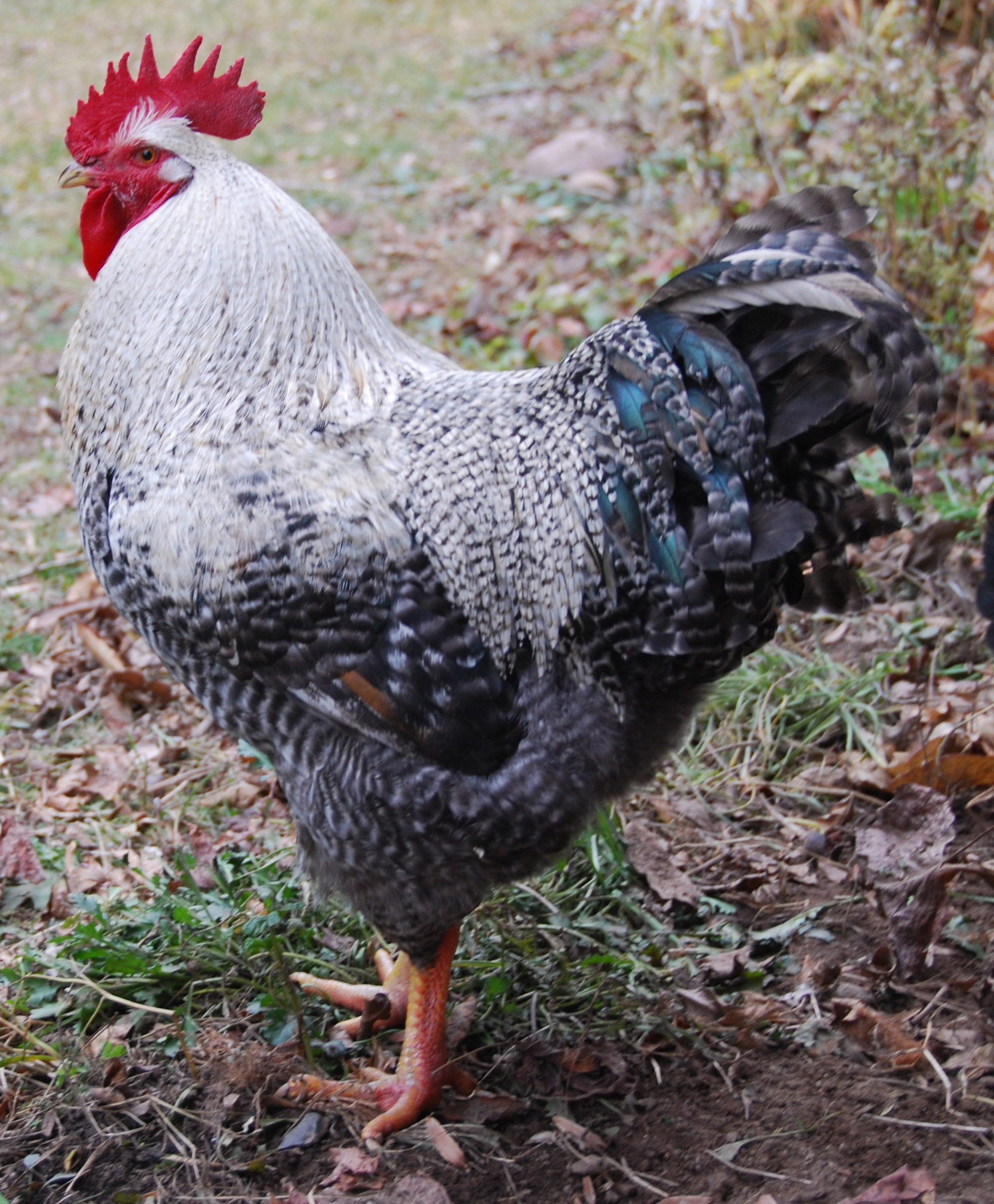
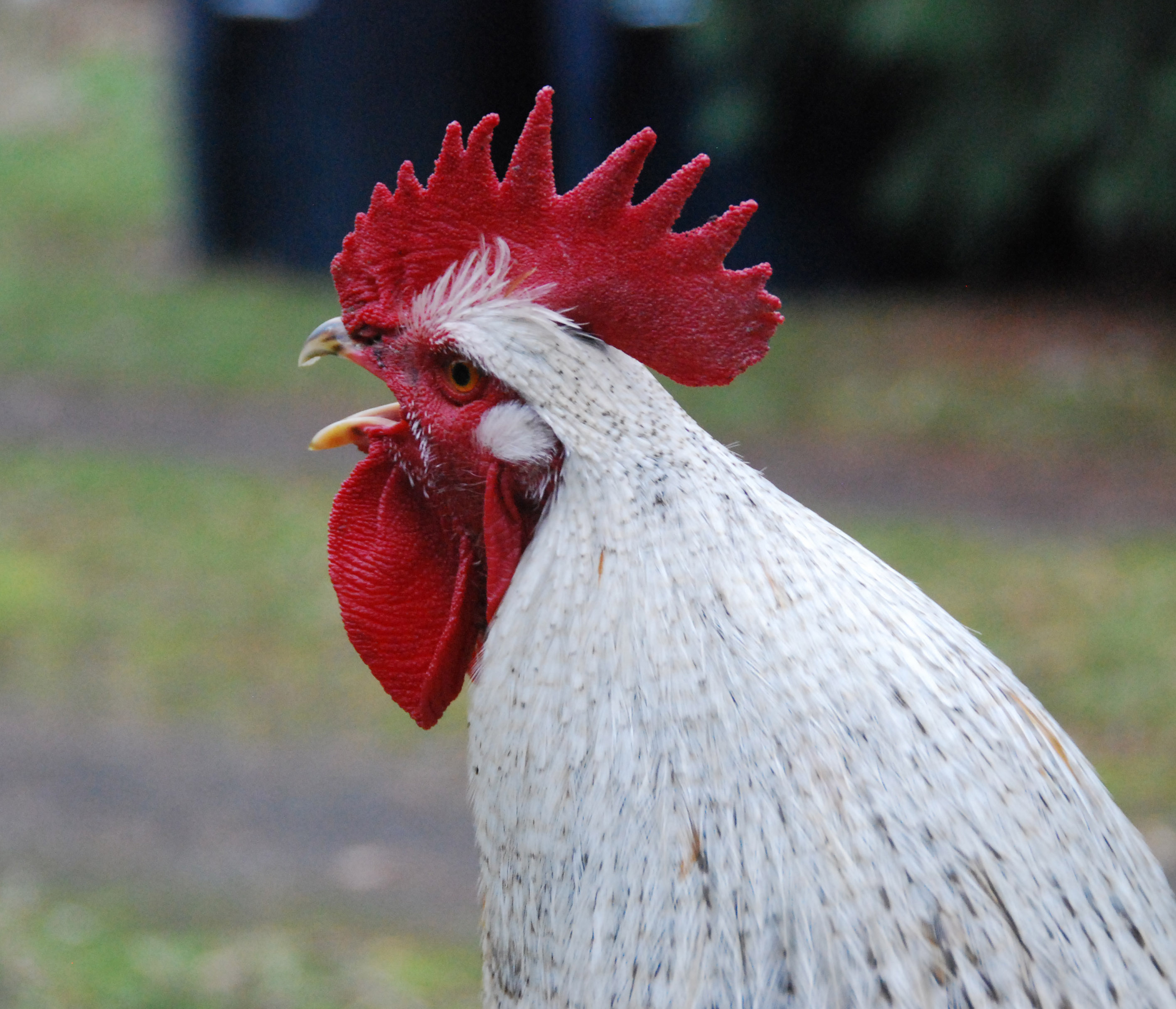
We have a couple of roosters, Bruce and Rocky:

Bruce – A “Black Sex Link” a cross between a Rhode Island Red sire and a Barred Plymouth Rock dam.
Bruce crowing
Rocky – Rhode Island Red
Bruce and Rocky get along…mostly

And a few of our hens:

Two Partridge Chanticlers. I haven’t named these two. I can’t tell them apart.
Red – a Red Chanticler
Brahma Mama – a Light Brahma.
Della, ready for her close-up – a Delaware
Wynona and Bruce – Wynona is a Silver-Laced Wyandotte

We also have a Buff Chanticler (Buffy) and a White Leghorn (Leggy). Yes, sometimes the naming isn’t all that creative. I couldn’t get anything but blurry photos of those girls, so I didn’t include any. Maybe I will at a later date.

In the meantime, now you’ve met most of our dinosaurs. They’re silly little birds, but we enjoy them. And they can be rather pet-like. This is what happens whenever I walk past the group:

Chicken entourage. You hear the clicking of nails on pavement and look back. There they are, following you!

We love our girls and hope you enjoy them too!

How horses made me who I am

When I was about four years old, my mother first told me about the horse she had when she was growing up. His name was ‘Watch Charm,’ but Mom just called him Charmie. After that, I became a typical horse-crazy girl growing up in the middle of the city. But I can trace that fact that I’m sitting here, now, as a paleontologist back to that conversation. This is how it worked.

I had this one toy horse that I loved. In fact, I still have that toy horse. I should find it an post a picture here. Anyway, I sat down and started drawing pictures of that horse. I wanted to draw the perfect horse. It was my way of imagining actually having one.

I spent years perfecting my drawings. I would study some of the toy horses that I had and sketch those. Then I graduated into looking at pictures of horses and copying those. I got some ‘how to draw’ books.

Something clicked in me around middle school. I noticed that horses and humans had all the same bones, they were just arranged differently, for different functions. In fact, I realized that all terrestrial vertebrate (though I didn’t call them that at the time) had all the same bones. Then I got creative.

Of course, I didn’t fully understand biology or evolution then,  but I tried to imagine what animals that evolved in different environments would look like. Or what a sentient horse would be like. I spent years creating strange new alien species, mostly mammals, based upon what I understood of comparative anatomy (all of which I taught myself).

In middle school, I read parts of Gray’s Anatomy, and began to think about how muscles and bones work together. Every animal I created had to ‘work’ to the best of my knowledge. I would draw skeletal and muscular reconstructions for each animal. Things were getting pretty detailed.

By the time I was in high school, I’d gone so far as to invent some cultures and interactions for some of the species, but still, they were mostly mammalian. I took a number of art classes and was by then producing some great paintings and drawings of my critters doing unexpected things: the Ulfrese (my biological answer to the ‘transformers’) were cheetah-like and seemed to like to ride mountain bikes. Then there were the Pronons that were my functional concept of a minotaur, that for whatever reason, enjoyed winter sports (it could have been that the Winter Olympics were on!).

An Ulf riding a bike. Pencil on illustration board. I drew this in high school. All rights reserved.
A Pronon ski jumping. Watercolor. I painted this in high school. All rights reserved.
A Pronon speed skating. Watercolor. I painted this in high school. All rights reserved.

Then my art teacher challenged us to invent an animal that looked like a plant, or vice versa (I don’t remember). I naturally came up with an animal the was a plant, and spent a great deal of time conceptualizing it’s fern-like reproduction.

When high school was nearly over, I had established a few things about myself that remain true today: I am an artist and I am a scientist. I was mulling over how I could be both and make a career of it. The obvious choice was dinosaur reconstructions. I’d be the artist that fleshes out the dinosaurs. I’d be a paleontologist!

I went to college to study geology and biology. I already knew that paleontology was an interdisciplinary science. I knew I could never do what I wanted to do without solid training in both geology and biology, so I double-majored.

The unexpected occurred. I found that I really liked geology a lot! I could actually see myself being just a geologist. That’s OK. There’s a future in that. I also rekindled an old interest in chemistry, which surprised me.

I learned also that paleontology isn’t just something you major in. If you wanted to be a paleontologist, you had to get an advanced degree. That degree would either be in geology or biology. When I was near graduation, I started applying to graduate programs in both fields, but the ones that attracted me the most were those in geology. I wound up in a Ph.D. program at the University of Wyoming to study vertebrate paleontology. But here’s the kicker: I wasn’t going to work with dinosaurs or even with life reconstructions.

Well, it’s worked out. As a grad student, I was introduced to isotope geochemistry, which is what I do to get paid now. Occasionally, I even get to work with dinosaur fossils. I’ve never become a paleoartist and done reconstructions. Perhaps I should be disappointed, but the people who actually are paleoartists do some amazing work. I don’t think I could do that! I do still draw – a lot! I do my own figures for papers. It’s nice to not have to hire anyone to do that for me. I really enjoy putting together posters for professional meetings. I get a little arsty-fartsy with them. It’s a lot of fun. And doodles of horses appear everywhere!

Artsy-fartsy rendition of my singular new species of Mammal, _Fractinus palmorem_ . Pen and ink and watercolor. Did this in graduate school. Never finished it. All rights reserved.

Here’s the fun thing: After grad school I found myself on a postdoctoral project working with – you guessed it – horses. Yeah, it came full-circle. I started with a love of horses, and today I do a lot of work with fossil horses (and other cool mammals). I still have it in my head to one day own a horse, though honestly, I’d be happy with any equid. Mules are nice. Donkey’s are cute and fuzzy. Maybe not a zebra…

So. I’m a vertebrate paleontologist. And an isotope geochemist. All because my mom told me the story of her horse way back when I was four years old. Never underestimate the influence your little story might have on someone. Such things could be life-changing!

Textbook for Paleontology

Well, I’m already a week and a half late in submitting my book order for next semester’s Principles of Paleontology class. I’m late this year because I’m considering changing textbooks.

Here’s a selection of the books I have to choose from:

A selection of books available for use in teaching an introductory paleontology course.

No two of these books are the same, and what your preference is really depends upon how you might teach the course. There are two general ways with which an introductory paleontology class is taught.

1) Taxonomically. In this case the focus of the class is more biological than geological, and vast amounts of time are spent discussing each group of fossils, usually focusing on the invertebrates (those lacking backbones) because they are far more abundant, and useful, than the vertebrates (animals with backbones.) My first paleontology class was like that and I loved every minute of it. I used an earlier edition of Clarkson’s book (the upper right book in the photo) back then. Such a class is very helpful for students who might need to work out which species lived where and when.

2) Methods and Principles. Here, the focus would be on the mechanics of doing paleontology, with little focus on the individual fossil groups. Here, students would learn about evolutionary rates and rarefaction and lots about geology, with little biological input. This sort of class teaches the skills that students would need to effectively do paleontology irrespective of their favorite fossil groups – which is good when they might wind up studying anything later in their careers. Foote and Miller (in the lower right) is really great for this.

When I first taught EES 207 (which was then called Invertebrate Paleontology), I immediately used the latest edition of Clarkson’s book and taught the class just like I had learned it. But I realized after completing the class, that I had left the students with a great knowledge of what the fossils were, but with no skills on how to work with them. I realized that because my paleontology class had been taught the same way, that I had started graduate school with basically no concept of how paleontology was really done. I decided I needed to re-vamp the class.

I changed the name of the class to Principles of Paleontology and decided to focus on how paleontology was done moreso than on the different fossil groups. I switched to the Foote and Miller book. But I knew that what students want out of such a class – and what I my self would expect – would be at least some knowledge of the fossil groups, So I arranged the class with a formal lecture two days a week, and then what I called ‘Fun Friday’ where students would explore one of the major fossil groups. My hope was that out of such a class, students would leave with a working knowledge of the major fossil groups and that they could actually do paleontology. The problem with Foote and Miller as a text is that it offers absolutely nothing in terms of description of the fossil groups. I tried adding optional texts (like “Fossils at a Glance” by Milsom and Rigby), but no one would buy them. I wound up preparing all manner of supplementary materials for the students for each of the major groups of fossils. This has been a pain.

This coming semester, I’m faced with a new problem. My class is going to be huge, with 24 students, so ‘Fun Friday’ as it has been in the past is going to have to change. Suddenly, I wish there was a lab section to go with the class. Maybe that will arise next time I teach the course. I’m not sure how I’m going to handle it, put supplementary packets are definitely not an option.

One thing is for sure: I need a book that covers the mechanics of paleontology as well as the important fossil groups. Two books that do this are the “Bringing Fossils to Life” by Prothero and “Introduction to Paleobiology and the Fossil Record” by Benton and Harper. One or the other of these books are going to be my choice for the coming semester. I’ve been informally asking my colleagues which book they prefer, and so far the overwhelming preference is for the Benton and Harper book, so I’m leaning that way. It seems to be a good balance of readability, mechanics, and taxonomy that I’m looking for. The Benton and Harper book is relatively new to me, so I have to think about it more. I have had a copy of the Prothero book for a while, and decided against using it because it didn’t quite cover all the topics I wanted to cover in the detail that I’d like, though it could still be workable. Benton and Harper looks pretty promising, though I’ve only flipped through it a bit.

I need to make a decision in the next few days (since the book order forms were due nearly two weeks ago). Does anyone else have an opinion?