Feelings. Tyrannosaurid feelings – #365papers – 2017 – 92

#365papers for April 2, 2017

Carr, Varricchio, Sedlmayr, Roberts, and Moore, 2017, A new tyrannosaur with evidence for anagenesis and crocodile-like facial sensory system: Nature Scientific Reports. DOI:10.1038/srep44942.

What’s it about?

This paper describes a new member of the Subfamily Tyrannosaurinae from the late Cretaceous of Montana. Two important things came from this study:

  1. The different species of tyrannosaurids that occur at different times may be the result of evolution along a single lineage, a process called anagenesis
  2. The structure of the skull suggests that the face of this tyrannosaurid was highly sensitive to touch.

Continue reading “Feelings. Tyrannosaurid feelings – #365papers – 2017 – 92”

B is for Bunomeryx – #AtoZChallenge – 2017 – Uintan Mammals

B is for Bunomeryx.

Bunomeryx is a member of the Family Dichobunidae, a group of hoofed mammals potentially related to pigs and hippopotamuses.They would have been small in size (probably less than 20 pounds). Their feet had several toes, each ending in a tiny hoof.

Uintan Mammals from A to Z – #AtoZChallenge – 2017

It’s April, so it’s time for the A to Z Blogging Challenge!

Each year in April there is a challenge to write 26 blog posts during the month, one for each letter of the English alphabet. I’ve done:

Women in Science, Technology, Engineering, and Math (STEM) (2016)
Beer and Brewing (2015)
Cameras (2014)
Paleocene Mammals (2013)

This year, I’m going back to a paleontology theme. I’ll be looking for fossils of Uintan Age mammals, provided I can find them.

The Uintan is a North American Land Mammal “age,” that is, a period of time in North America defined by a particular suite of fossil mammals. In years, the Uintan lasted from around 45 to 40 million years ago.Continue reading “Uintan Mammals from A to Z – #AtoZChallenge – 2017”

When the Environment Changed, Animals Made Skeletons – #365papers – 2017 – 90

#365papers for March 31, 2017

Wood, Ivantsov, and Zhuravlev, 2017, First macrobiota biomineralization was environmentally triggered: Proceedings of the Royal Society B, v 284: 201700059

What’s it about?

It’s skeletons that we mostly see in the fossil record. The fossil record prior to the advent of mineralized skeletons (bones and shells, for example) is pretty sparse. Here, the authors show some very early organisms with skeletons (from around 550 million years ago) that have similar counterparts that lack the skeletons. Skeletons appear to have developed during times of environmental change, when minerals naturally grew around the bodies of the originally soft-bodied animals. Later, organisms took charge of this mineral growth to build the complex skeletons that we see in modern animals and plants.Continue reading “When the Environment Changed, Animals Made Skeletons – #365papers – 2017 – 90”

Not All Joints Are Flexible – #365papers – 2017 – 89

#365papers for March 30, 2017

Bailleul and Holliday, 2017, Joint histology in Alligator mississippiensis challenges the identification of synovial joints in fossil archosaurs and inferences of cranial kinesis: Proceedings of the Royal Society B, v. 284: 20170038

What’s it about?

In the past, when paleontologists have observed joints between bones, especially in the skull, that possess smooth surfaces, an assumption as been made that these joints are flexible. Flexible joints in the skull result in cranial kinesis, where the head can be deformed as exemplified by modern snakes as they consume prey much larger than their own heads. The authors show, through study of modern alligator skulls, that smooth joint surfaces don’t necessarily mean that a joint was movable, and that detailed study of the structure of the bone itself is needed to know if a joint could bend or not.Continue reading “Not All Joints Are Flexible – #365papers – 2017 – 89”

Telling the Boys from the Girls in Fossils – #365papers – 2017 – 88

#365papers for March 29, 2017

Mallon, 2017, Recognizing sexual dimorphism in the fossil record: Lessons from nonavian dinosaurs: Paleobiology, DOI:10.1017/pab.2016.51

What’s it about?

In paleontology, we define species by what they look like. This can be problematic if males and females of one species look markedly different from one another. Some authors have claimed to see sexual dimorphism, the difference in shape between males and females in a species, based on size. Here, the author shows that it is essentially impossible with the fossil record to make such determinations.Continue reading “Telling the Boys from the Girls in Fossils – #365papers – 2017 – 88”

When Water Stopped the Dinosaurs – #365papers – 2017 – 87

#365papers for March 28, 2017

Getty, Aucoin, Fox, Judge, Hardy, and Bush, 2017, Perennial lakes as an environmental contol on theropod movement in the Jurassic of the Hartford Basin: Geosciences, v. 7, doi:10.3390/geosciences7010013

What’s it about?

This is a paper about dinosaur tracks. Specifically, it discusses how dinosaur tracks, when they all seem to go in the same direction, are used as evidence that dinosaurs traveled in herds. Here, they show that the reason why the dinosaurs were all going the same way has to do with a lake near by, and not that the dinosaurs were all traveling together.Continue reading “When Water Stopped the Dinosaurs – #365papers – 2017 – 87”

Reading the Fossil Record: Look at the Rocks – #365papers – 2017 – 86

#365papers for March 27, 2017

Matthews, Liu, and McIlroy, 2017, Post-fossilization processes and their implications for understanding Ediacaran macrofossil assemblages; in Brasier, McIlroy, and McLoughlin, eds, Earth System Evolution and Early Life: a Celebration of the Work of Martin Brasier: Geological Society, London, Special Publication 448, 19 pp.

What’s it about?

Ediacaran fossils represent the oldest fossils of multicellular life, from between 580 and 541 million years ago (the Ediacaran Period). This paper discusses how the preservation of the fossils – the rock processes of deposition, erosion, deformation etc – affect our interpretations of the organisms.Continue reading “Reading the Fossil Record: Look at the Rocks – #365papers – 2017 – 86”

Some New Mammals from Ancient New Mexico – #365papers – 2017 – 85

#365papers for March 26, 2017

Williamson, Brusatte, Secord, and Shelley, 2016, A new taeniolabidoid multituberculate (Mammalia) from the middle Puercan of the Nacimiento Formation, New Mexico, and a revision of taeniolabidoid systematics and phylogeny: Zoological Journal of the Linnean Society, v. 177, p. 183-208.

What’s it about?

This paper discusses a group of large multituberculates that lived during the Paleocene (approximately 66 – 55 million years ago). Multituberculates, alas, are extinct, but resembled rodents in many ways. They were distinguished by their multi-cusped teeth (that looked a little like Legos) and blade-like premolars.

The right upper fourth premolar of Ptilodus gnomus. Notice the rows of pointed cusps, characteristic of multituberculates.
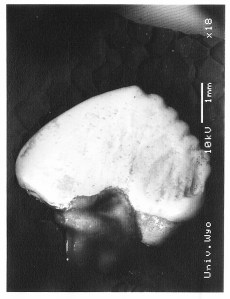
SEM image of the type specimen of the multituberculate Fractinus palmorem UW 27063 from locality V-90043. This is the blade-like tooth that is also common to multituberculates.

Taeniolabidoids would have been squirrel to marmot sized – as a group much larger than most other multituberculates.Continue reading “Some New Mammals from Ancient New Mexico – #365papers – 2017 – 85”