Well, it’s November 16th, just past half-way for both National Novel Writing Month and National Blog Posting Month. I’ve made it this far and I’m on track to succeed on both counts.
Of course, now we have the Thanksgiving holiday and all its distractions next week. It’ll be fun. I will get to see my parents, who I haven’t seen in a year. That’ll be nice. And I’ll be out of the office. Even nicer.
There’s tons to do before I can enjoy the break, but I’m slowly whittling down the pile. I want to get ahead on the NaNoWriMo writing a bit before we leave. I imagine that I’ll do some writing while we’re en route, so that’ll help. The blog posts might be a bit more challenging. They’ll probably be a little simpler than usual. Maybe I’ll include pictures and discussions of the cool places we’ll go as a family. Hmm. That sounds good.
I already know I probably won’t be working out much while I’m away. That’s OK. I think my body wants a break. And I’ll be with my FAMILY! And there’s shopping to be done!
Today is one of those days when I start really thinking about changing careers. I like my job, but it has its frustrations, and they’re all piled up today. This will be a short post because of it.
I have customers in need of data, and employees capable of preparing the samples. But just when I think everything is ready: Oh hey! Look! None of the standards were weighed!
Goody! Just what I want to do. Spend a half-hour weighing out standards.
OK, crisis averted.
Oh, Damn! Look! We’re running low on helium. Change the tank. Crisis averted.
Crap. No one told me we were running of of weigh boats. Go order more. OK. Good. Crisis averted.
Well, dang. So-and-so needs water data. Need to have a chat with the water analyzer. Let’s see how it’s doing. Probably just need to change the septum. Oh. Look. Water. In the lines. It doesn’t belong there. Oh. Goody. The vacuum pump is caput. Crisis – still crisis. Dang.
</headdesk>
All right. I gotta salvage this day somehow. At the very least I should be able to get a set of carbonates run, right? We’ll see. When I came in this morning, the mass spectrometer was not in its ready state as it should have been. See, a student ran some analyses yesterday and didn’t leave the instrument as it should have been. Not that I’ve told them this… but, sigh. We’ll hope. It should be OK.
A bunch of things came together in April of 2011, the end result of which is that I’m now 30 pounds lighter and calling myself a writer.
So how’d that happen?
It was in April that I decided that I was going to make costumes for our local Renaissance Festival so that my husband and I could to a renewal of vows in August in period-appropriate garb. So I started doing a little research. This included buying a bunch of books and some period movies. At about this same time, I started working on this 25-day writing challenge to describe a character of a book. This is when Trey of Herongarde was born. Trey was based upon James Purefoy’s character Marshal in the movie Ironclad (which I watched while doing my research).
It got my mind going in a way it hadn’t gone in a while. I pondered to myself, what would happen if I (me, Penny, paleontologist) was suddenly dropped into the middle of the 14th century? The first thing I realized is that I’d be in big trouble on several fronts: 1) As a 21st century woman, I’m a little independent and probably a lot cheeky. I’d get into trouble. 2) As a highly educated woman, on top of being cheeky, I’d probably be labeled a witch and burned right away. 3) I don’t have any skills that would be really useful in the 14th century. I’d starve! 4) I was in really, really bad shape, comparatively. I was a little jiggly in the middle and definitely not as strong as I used to be.
Thus was born the beginnings of the Herongarde Trilogy, which I’m still working on. I had to come up with a scenario in which I (me, Penny, paleontologist) wouldn’t wind up very dead if I blipped into the 14th century. The first book is written. Let me know if you want to read it and learn how I dodged burning at the stake.
The books involve a lot of swordplay and the ‘me’ character, Hanna, has to learn to wield a sword. I looked in the mirror and realized that I couldn’t even begin to do that. I did field work that May and was winded by all the hiking. What had happened to me? I used to be able to run eight miles!
So I started losing weight. First it was just portion control (I’m a comfort eater). That took 15 pounds off me over the summer. Then in September, I started a fitness program (various things through Beachbody). It was painful, but I started to feel better. I could move again. The aches and pains started to go away.
Come November, I was feeling pretty good. It was then I learned about National Novel Writing Month, and started putting the Herongarde novels down on paper. I started thinking a lot about swordplay, and wanted to try it out. I wanted to see what it would feel like to swing a sword and hit someone. Or be hit. But I wasn’t ready yet.
I went through a couple more of the various fitness programs offered by Beachbody and was starting to feel pretty fit. I thought I was ready to try some swordplay and began to seek lessons. Read about that here. I did figure out pretty quickly that I still was not quite as fit as I needed to be, but I was much closer.
Today, I think I’m in better shape than I was 20 years ago. I can’t go out and run eight miles still. But I can run circles around my students. I can curl 15 pounds. And I can eat a horse (geez, my metabolism has kicked up!). And, I’m learning about swordplay and know what it’s like to hit and be hit.
I’m in great shape now. Not perfect, but comfortable. I feel good. And all because I started to write a little book.
I’ve been teaching here at the University of Rochester for about five years now, at first only one class a year, but for the last three years at least one course every semester. It keeps me busy, but I like it because I get to interact with students in the department. I feel more like a member of the department rather than merely a laboratory grunt, which is what I’d pretty-much be otherwise. Plus, I get to teach, which is something I have always wanted to do.
I love teaching. I love sharing what I know, and my enthusiasm for that knowledge, with anyone willing to listen. This is why I almost never turn down an opportunity to give a talk to any old group that’s interested. The downside to teaching, of course, is that I have to actually assign grades, which stinks, but these are people’s careers we’re talking about. Assessment is necessary.
One of the problems I face as both an instructor and a laboratory manager (and, really, any faculty member has this problem) is making myself available to my students outside of the classroom for whatever matters they might want to discuss. I have office hours, of course, but in the five years I’ve been teaching, I think I’ve seen students actually use my office hours twice a semester. Part of the problem is that students have other classes. They can’t make my office hours. The other part of the problem is that, unless there is a student actually in my office, I’m usually in the lab, doing science-y things. Most of the time, students just e-mail me and that works OK.
This year I’ve decided to try something different. In the spring, I went to a two-day conference supported by The Rochester Institute of Technology’s Faculty Institute on Teaching and Learning. There were many options for sessions to attend, but for whatever reason, I was drawn to those focusing on social media.
It seems that social media, like Twitter, are getting a lot of mileage in some professions, and are beginning to be used in courses training students for those professions. Typically, these programs are in journalism or political science, not in the ‘hard’ sciences like geology. Twitter especially, has been used effectively as a teaching and communication tool. I was impressed.
I recalled that I once used Facebook in my classes, but that had problems, not least of which was that not everyone was on Facebook (or wanted to be). I gave up on that pretty quickly. But Twitter is another beast altogether. I decided to try out Twitter for my introductory geology class this fall. I came up with a hashtag (#UREES101) which students could use to post questions about their materials. Students could troll that hashtag and watch without even signing up for Twitter. Alternatively they could engage in discussions without having to ‘friend’ or ‘follow’ anyone. I thought using Twitter would enable two things: 1) Students could communicate with me whenever they needed to, even if they couldn’t make my office hours or if they weren’t comfortable asking questions in class; 2) Students would also learn how to be succinct in their questions and answers – a skill notably lacking for a lot of people.
While I still have office hours (that no one still comes to), I also have set Twitter hours, late in the evening, when students know that I’ll be on-line and they can use the hashtag and tweet their questions. My colleagues expressed skepticism that this could ever work. But it has, and much better than I anticipated!
I have interacted more with my students this year than in all the other years past combined. Students ‘come’ to Twitter hours with their questions, and though usually only one or two are talking, other students tell me that they do look and watch. Other things have come out of this, too. Students are answering each other’s questions. They are discussing things! And sometimes their discussions include geological colleagues outside of this class or even this continent.
I’ll pose questions on Twitter for students to struggle with. These are usually things that have been problematic in years past that I want them to think a bit more about. I’ve had people from all over the world explain these things – like strike and dip – in ways that I couldn’t. I think the students benefit from someone else’s explanation.
All-in-all, I am excited about how social media is enhancing my classroom. Yeah, I’m ‘on call’ a bit more often, but that’s OK. It lets me do what I want to do: teach. Students have questions, I (or someone else) answer them, students move on rather than struggling for a while and giving up. It’s win-win. It’s easy. It’s free.
Well, I’m already a week and a half late in submitting my book order for next semester’s Principles of Paleontology class. I’m late this year because I’m considering changing textbooks.
Here’s a selection of the books I have to choose from:
A selection of books available for use in teaching an introductory paleontology course.
No two of these books are the same, and what your preference is really depends upon how you might teach the course. There are two general ways with which an introductory paleontology class is taught.
1) Taxonomically. In this case the focus of the class is more biological than geological, and vast amounts of time are spent discussing each group of fossils, usually focusing on the invertebrates (those lacking backbones) because they are far more abundant, and useful, than the vertebrates (animals with backbones.) My first paleontology class was like that and I loved every minute of it. I used an earlier edition of Clarkson’s book (the upper right book in the photo) back then. Such a class is very helpful for students who might need to work out which species lived where and when.
2) Methods and Principles. Here, the focus would be on the mechanics of doing paleontology, with little focus on the individual fossil groups. Here, students would learn about evolutionary rates and rarefaction and lots about geology, with little biological input. This sort of class teaches the skills that students would need to effectively do paleontology irrespective of their favorite fossil groups – which is good when they might wind up studying anything later in their careers. Foote and Miller (in the lower right) is really great for this.
When I first taught EES 207 (which was then called Invertebrate Paleontology), I immediately used the latest edition of Clarkson’s book and taught the class just like I had learned it. But I realized after completing the class, that I had left the students with a great knowledge of what the fossils were, but with no skills on how to work with them. I realized that because my paleontology class had been taught the same way, that I had started graduate school with basically no concept of how paleontology was really done. I decided I needed to re-vamp the class.
I changed the name of the class to Principles of Paleontology and decided to focus on how paleontology was done moreso than on the different fossil groups. I switched to the Foote and Miller book. But I knew that what students want out of such a class – and what I my self would expect – would be at least some knowledge of the fossil groups, So I arranged the class with a formal lecture two days a week, and then what I called ‘Fun Friday’ where students would explore one of the major fossil groups. My hope was that out of such a class, students would leave with a working knowledge of the major fossil groups and that they could actually do paleontology. The problem with Foote and Miller as a text is that it offers absolutely nothing in terms of description of the fossil groups. I tried adding optional texts (like “Fossils at a Glance” by Milsom and Rigby), but no one would buy them. I wound up preparing all manner of supplementary materials for the students for each of the major groups of fossils. This has been a pain.
This coming semester, I’m faced with a new problem. My class is going to be huge, with 24 students, so ‘Fun Friday’ as it has been in the past is going to have to change. Suddenly, I wish there was a lab section to go with the class. Maybe that will arise next time I teach the course. I’m not sure how I’m going to handle it, put supplementary packets are definitely not an option.
One thing is for sure: I need a book that covers the mechanics of paleontology as well as the important fossil groups. Two books that do this are the “Bringing Fossils to Life” by Prothero and “Introduction to Paleobiology and the Fossil Record” by Benton and Harper. One or the other of these books are going to be my choice for the coming semester. I’ve been informally asking my colleagues which book they prefer, and so far the overwhelming preference is for the Benton and Harper book, so I’m leaning that way. It seems to be a good balance of readability, mechanics, and taxonomy that I’m looking for. The Benton and Harper book is relatively new to me, so I have to think about it more. I have had a copy of the Prothero book for a while, and decided against using it because it didn’t quite cover all the topics I wanted to cover in the detail that I’d like, though it could still be workable. Benton and Harper looks pretty promising, though I’ve only flipped through it a bit.
I need to make a decision in the next few days (since the book order forms were due nearly two weeks ago). Does anyone else have an opinion?
We recently had an election in the United States, which most of the world is quite aware of. During such elections a lot of things wind up on the ballots, not just who will be our next President, but other governmental items that are left to the people to decide. One such item appeared on the ballots of Puerto Rico this year. For many years, Puerto Rico has been a territory of the United States, but not a formal state. This year (as has happened many years in the past, Puerto Ricans were asked if they wanted to become a State within the United States, or continue to be a territory. This year, Puerto Rico decided that they wanted to change their current status, and that statehood was what they would like.
Thus, if everything happens as it should, soon we will have a 51st state in our union.
Fifty-one states.
Well that means we need to change our flag.
My entire life, we’ve been a union of 50 states, and have had 50 stars on our flag. Suddenly, we need to consider how to put 51 stars in a balanced and appealing way onto our flag.
I, of course, thought nothing of this, but others are already been pondering this for a while. (Google 51 star flag. You’ll see.) One of the people pondering this is my husband. He was so excited about his design that he had to show me and asked me to draft it up for him. So here it is:
Bill’s 51-star flag design
Enjoy!
Welcome, Puerto Rico, as the newest member of the United States.
I think November is my least favorite month, and this year is proving to be no exception. One of the things I like least about November is that I am forced to accept that the warm weather is over. Things are getting cold. My garden is dead. It makes me sad. It’s also the start of those gray days that last until April.
The days get short, too, and I lose all productivity. I’m one of those people whose wakefulness is directly tied to whether or not the sun is up. When it’s dark, I’m unconscious. That’s how it works. Confound that with the endless overcast, and I’m worthless 24-7.
November marks the beginning of the holiday season, which to me is more like the guilt season. The holidays are a troubling time for me, not that I don’t enjoy spending them with my family, but that I often wind up spending them with my husband’s family, some of whom (well, one in particular) I really don’t enjoy being around. But each year, I am obligated to spend time with these people, with whom I would not associate except for that they’re family. Then there’s the other holiday obligations: office parties, gift giving, card sending, all those things I don’t have time to do (in part because I can’t stay awake past 6pm).
Put this on top of the fact that November has got to be the busiest month of my year. I’m teaching introductory geology and this is the time of semester when my students start to realize that they might not be getting the grades they want, and start invading my office and my inbox more often. Plus, students are registering for next semester and my inbox has all those e-mails too.
I usually have a professional meeting somewhere in October or November, which takes me out of the office for a week, putting me in full-blown catch-up mode for weeks after. But it’s always a great meeting, and I wouldn’t miss it for anything.
And just when life seems complex enough, November is also National Novel Writing Month, and I am in the habit of participating in that madness (write a 50k word novel in a month!) each year. And for novelty, this year I’m also participating in National Blog Posting Month, which means a blog post every day.
These last two things I could drop, sure. But they’re fun, so I do them. (My husband doesn’t think so much of them, since I keep disappearing to go write, but whatever, right?) Even without NaNoWriMo and NaBloPoMo, November would still be miserable.
December will be here soon enough, and will be slightly less awful (classes end before Christmas, so I at least get a bit of a break). I find January to be a renewing and I come back to life sometime in March. So I’ve got some difficult months before me, but I’ll survive. Winter hasn’t killed me yet!
It’s that crazy time of the semester when your classes are pounding you and you’re stretched to the extreme, and then suddenly it’s time to register for next semester. “Hey!” you cry. “Let me survive THIS semester first!”
I usually know nothing of it until I start getting the e-mails that all say: Dear Professor, I haven’t had the prerequisites. Can I take your class anyway? Students are drawn to my classes because they have the word “Paleontology” in them. Ooh! Dinosaurs! I’m sure that’s what they’re thinking. They’re wrong, of course.
Nevertheless, it has been my general policy to allow students to take my classes without the prerequisites if they have the nerve to ask. The prerequisites are there mostly to keep the drooling dino-philes out of my classes, and to insure that the students in the class are capable of handing an upper-division course. (Don’t get me wrong. The dino-obsessed often morph into excellent paleontologists, and dinosaurs are cool. The drooling students, though, often need some time to mature before I want them in my class, that’s all!) I teach introductory geology and I know there are students in that class ill-prepared for my paleontology classes.
This year has been unique, now that the registration process is well underway. I’ve always had a few students come to me asking if my Earth and Environmental Science course could be used as an elective for their Biology degree. It requires a petition, but this has always been allowed: paleontology is very interdisciplinary and is as much biology as it is geology. This year, the Biology department officially listed my class as an elective for its majors.
The enrollment has jumped dramatically. I actually had to put a cap on the class when I realized that there were more students registered than ever before and the sophomores and freshmen hadn’t even registered yet. How much of that is because of the Biology Department’s endorsement of the course is not clear. It could also be that it’s been two years (because it has), so there’s a plethora of students that have been waiting. I have been teaching the introductory geology class for the past few years. Maybe these are students who enjoyed that class and want to have another one from me (the fools!). It’s also true that the university has been growing its student population, but I don’t think it’s by that much.
I’m not sure. But what I do know is that with the class as large as it is now, I’m going to have to re-vamp a lot of my exercises! They worked great for classes smaller than ten students, and did OK for a class of fifteen, but now I’ve got 24. Now it’s suddenly a formal lecture-style class and I’m regretting that I don’t have a laboratory section (which I’ve never had before).
So, it’s exciting that my class is suddenly so big. It’s popular, and maybe a gateway for students to join the EES degree program. But it’s horrifying too, because now I’ve got to re-think all my lectures and exercises. (And just for entertainment, I *might* change textbooks this year, too.)
On Saturday, I’ll be giving an hour-long presentation to some seniors (you know, the over 55 set) on the topic of “Woolly Mammoths in New York State.” Well, it’s a pretty nebulous topic, and I only have an hour, so that means I can direct my presentation in pretty-much any direction I want.
You know some paleobiology is going to go in there. What is the difference between a mammoth and a mastodon, for example. And why are they extinct? Someone’s going to ask why we don’t find dinosaurs in New York. Naturally, I have to talk about geochemistry, too, since I might have done a little work with that (see my other blog post).
I guess the obvious thing for me to start with is to explain what a mammoth is, ‘cause it’s not just a big fuzzy elephant!
What is a mammoth?
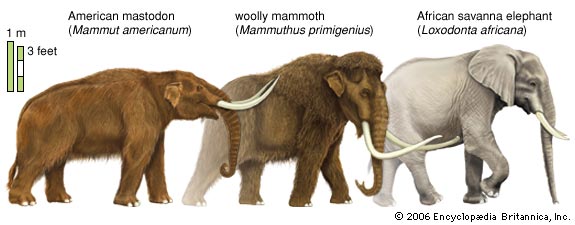
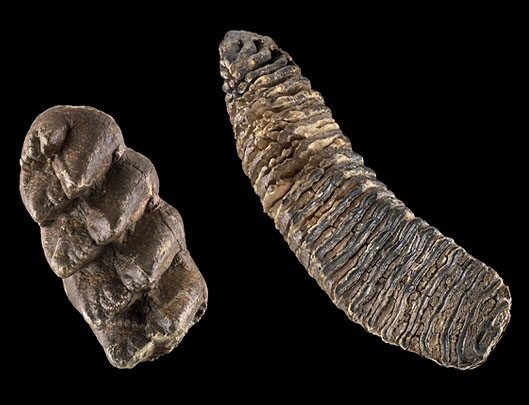
Mammoths, mastodons and elephants are in a larger group of mammals called proboscidians, so named in reference to their big long noses. Mammoths and elephants are actually very similar, in skeletal and in tooth structure. Mastodons have very different looking teeth, which is an important distinction between to two ice-age dwelling proboscidian groups.
Mastodon, Mammoth, and Elephant for comparison
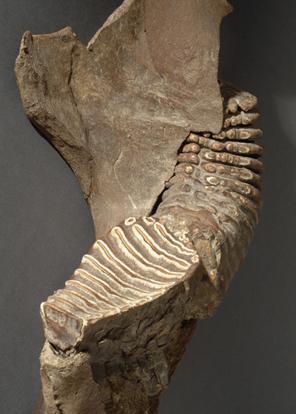
Mammoths (and modern elephants) have teeth composed of a series of plates, that form a washboard-like grinding surface which is perfect for the foods that they eat. Both elephants and Mammoths are (or were) grazing animals (like cattle are today). Mastodon teeth are smaller and have several huge cusps, which aren’t so great for grazing but are good for eating leaves and such. Mastodons were browsers, much like giraffes, for example. Because they had different diets, they were able to coexist.
Asiatic elephant toothMammoth teeth still in the jawMastodon tooth (left) and Mammoth tooth (right)
The structure of the teeth is the easiest way to distinguish between mammoths and mastodons, but their skeletal structures are also distinct. Mammoths tend to be taller in the front end than in the back end, their heads held high – the top of the head being slightly higher than the shoulder. Mastodons are a little stockier, with their head often slightly lower than the shoulder.
Mastodon skeleton (left) and Mammoth skeleton (right)
Types of Mammoths
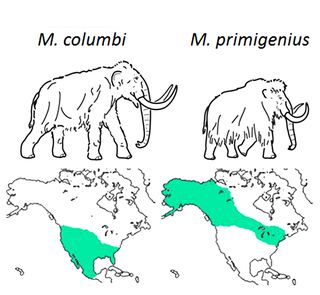
Mammoths in North America fall into two species: the Woolly Mammoth (Mammuthus primigenius) and the Columbian Mammoth (Mammuthus columbi). The woolly mammoth was smaller than the Columbian mammoth, and a lot hairier. Woolly mammoths lived further north, closer to the edges of the great glaciers that once covered much of northern North America. Columbian mammoths stayed further south. Only woolly mammoths would be expected in what is now New York State.
Distribution of Columbian Mammoths (left map) and Woolly Mammoths (right map)
What’s special and unique about mammoths (and mastodons and elephants)?
Several things stand out as interesting about proboscidians. Here are some fun facts:
Mammoths and elephants have only one tooth on each jaw (upper, lower; right, left) in wear at any one time. We have all of our teeth in use all the time.
There are only six teeth in each jaw (upper, lower; right, left) that an elephant or mastodon ever gets. They grow into the mouth one at a time from the back and fall out the front when they’re worn out. Once the sixth tooth is worn out, there’s no more teeth and the mammoth or elephant starves to death.
The pattern of tooth replacement in the jaws of elephants
Mastodons have the same pattern of tooth replacement, but usually have more than one tooth at a time in use. Their teeth don’t wear out as quickly though, because they eat softer food.
Proboscidians are in a larger group of mammals called ‘subungulates’ which are grouped together because they have hoof-like structures on their feet, but they’re not quite hooves.
Some of the closest relatives to elephants, mammoths, and mastodons are manatees! Manatees are also subungulates and have hoof-like structures on their front flippers. They also have the same sort of conveyor-belt tooth replacement, but they aren’t limited to only six teeth.
When and why did they go extinct?
About 10,000 years ago, mammoths and mastodons, plus a lot of other large mammals that live in North America (woolly rhinos, giant ground sloths) went extinct (Wikipedia article). Most of the animals that went extinct were huge, so we refer to them as “Megafauna.” No one is certain why this happened, but it did coincide roughly with the melting back of the continental ice sheets as well as the appearance of humans in North America. It is an interesting point of controversy. There are two main camps here and then a few extra ideas (maybe the lunatic fringe?).
Main hypotheses:
Human overhunting
It is possible – even likely, knowing how we as humans are – that humans might have been responsible for the loss of the mammalian megafauna. We have been known, once in a while, to over-use resources, and it is known that humans actively hunted members of the ice-age megafauna, like mammoths.
Climate change
We also know that climate was changing rapidly then, warming up after the end of the ice-age. The ice sheets melted back and the landscape was changed. Organisms had to adapt, and big animals like the mammoths likely had a hard time adapting.
These both seem like reasonable hypotheses. So which is it? Most scientists straddle the fence on this one: Well humans were hunting a lot, and the animals were already in trouble because of the climate change…
Other ideas:
Meteor impact
Because asteroid impacts have resulted in many extinctions in earth’s history (like the extinction of dinosaurs), it seems sensible that this extinction might also have been caused by an impact. There is some evidence that there might have been an impact, but some things about the extinction event are cause for skepticism. For example, why did ONLY the large mammals go extinct?
Second-order predation
Here the idea is that not only did humans decimate the populations of the prey animals, they also hunted the predator animals (like saber-tooth tigers). Without the primary predators, the prey animals rapidly overpopulated the area, destroying their own resources and thus killing themselves off.
Hyperdisease
Humans coming from another continent would have brought a few ‘friends’ with them. Perhaps the humans brought along their own animals that carried diseases for which the native animals had no immunity. This could very quickly decimate the native population as has been seen when humans and their livestock have populated new places in modern times.
How can we find mammoths?
A common question that people ask of paleontologists like me is “How do you know where to look?” I have a standard answer for that: We look at maps, maps that geologists before us have drawn showing the various rocks exposed in an area, describing those rocks, defining their ages through various means. We look at the maps for rocks that should have the right fossils in them, and then we go out to the rocks in the real world and walk around until we find something.
At times it’s a little more sophisticated than that. We can use remote-sensing/sattelite methods and find the most probable areas using neural networks on computers. Many times though, it’s a whole lot less sophisticated. Sometimes, you just walk across a field and kick something and when you look down, it’s a fossil bone. Mammoths are often found when people bring in backhoes to dig a hole for a new pool. Their digging and suddenly there’s a bone. They were digging a new reservoir in Snowmass, Colorado, and they found what’s now called the “Snowmastodon” Site!
What can geochemistry teach us?
My own research centers on the chemical constituents of tooth enamel in fossil animals. From that, we can learn a lot about extinct species, including what their food preferences were, what the weather was doing while they were alive, and how their teeth might have grown. One of my undertakings is described here. I presented my results at the Society of Vertebrate Paleontology annual meeting a couple of weeks ago, to find out that the project I had done has actually been done before (just never published). My results were quite different, however. Through discussion with other scientists, I think we all understand the source of the differing results. Now if I can just get them to publish their work!
Recent discoveries: Mammoth mummies!
Of late, Siberia has been yielding numerous mummies of mammoths (and other mammals). The far North is a good place to look for mummies of any animal, because the cold temperatures will preserve the animals like a giant ice-box. The ice itself can encase the mummy, keeping it from becoming a meal for modern scavenging animals. YukaBaby mammoth
Cloning of Mammoths
Because of the exquisite preservation of the mummified mammoths, there has been talk of attempting to clone mammoths. So long as the nuclei of cells are not totally destroyed by freezing or decay, a scientist could extract the DNA and create a clone. Will this be done? Should it be done?
I explained in an earlier blog post the significance of the sampling effort that was undertaken to understand the pattern of isotopic values, and how this changed over time, of precipitation coming from Superstorm Sandy as it made its landfall and slowly died over the interior of North America.
I ended my sampling effort on Saturday night after collecting a total of nine samples, one every twelve hours since about the time Sandy made landfall on Monday night, the 19th of October. There was only one span of time – on Halloween – when it did not rain sufficiently for me to collect a sample.
Precipitation samples from Superstorm Sandy collected at my house. Rain water was collected in a bucket (that was strapped down so it wouldn’t blow away!) then poured into vials at approximately twelve-hour intervals. The bucket was dried then set out again.
These nine fine samples are now on their way to the University of Utah where their isotopic values will be measured. But, see, I’m also an isotope geochemist. And I also have a water analyzer in my lab. And I might be just a tad impatient.
So I analyzed the waters before I sent them off.
Our water analyzer, Norm, analyzing the Sandy waters. This is a Los Gatos Liquid Water Isotope Analyzer.
Let’s think back on what I said before, about Rayleigh Distillation. So if a cloud rains, the isotopically heavier water (mass 19 or 20) is more likely to fall (because it’s heavier) than the more common, lighter (mass 18) water. So the rain is isotopically heavier than the cloud. After the rain has fallen, the cloud is isotopically lighter than it was before.
So, what happens when that cloud rains again?
When a big storm (like Sandy) moves inland, the rain causes the cloud to get lighter and lighter. And since the cloud water is getting lighter and lighter, so does the rain coming from the cloud, though it is always heavier than the cloud itself. This leaves a tell-tale pattern of heavier isotopes near the coastlines where the storm first came on land, to lighter and lighter isotopes further inland.
So what pattern would you expect if you did all your sampling in one place and a storm simply passed over? What if a storm parked over your house and rained for days and days? What would that look like?
Think about it. I’ll give you a few minutes. I need a glass of water.
.
.
.
.
.
.
.
Keep thinking. I need to check my e-mail.
.
.
.
.
.
.
.
.
Any ideas?
Well, it would stand to reason, that unless – somehow – heavy water vapor was getting back into the cloud, the isotopic values would get lighter and lighter over time.
So, one might predict that the rainwater that I collected would get lighter and lighter over time.
Let’s see:
Isotopic values from precipitation from Superstorm Sandy collected near Rochester. Blue lines and symbols are hydrogen; Red lines and symbols are oxygen. The patterns are very similar, as they should be. Hurricane Sandy makes landfall on the left side of the graph. Water samples are plotted according to when I collected the sample (at the end of the twelve-hour period). In the final analysis, it’ll probably be plotted by the mid-point of the sample interval.
The pattern we expected to see was completely borne out for the first three collections, from when Sandy made landfall, to when the center of the storm was supposed to be over the Rochester area, where the samples were being collected.
But then what happened? The values start to increase again. Any ideas?
Well, for one thing, Sandy was supposed to pass over Rochester on Halloween, but it didn’t. The bulk of the storm passed to the south. In fact, it didn’t rain at all on Halloween (which made trick-or-treating possible!). Superstorm Sandy swung south and then west of Rochester before becoming too diffuse to know where the core of the storm was.
Something happened. Something changed.
Well, maybe some heavier isotopes did make it into the vapor mass. Perhaps it was the arctic front that was swooping down from the north as Sandy struck from the east that brought the isotopically heavier rain. It definitely cooled off. It was snowing occasionally during those last two sampling intervals. I suppose it’s also possible that the storm picked up some moisture from the Great Lakes as well.
Again, this is the beauty of the larger project and sampling effort. With only one sample site, we can’t be sure. But once we have all the data from the 100+ sampling sites, we’ll be able to map in detail what was happening. It will be obvious of secondary vapor masses (clouds, storms) joined up with the remnants of Sandy. We’ll be able to tell where and when that occurred.
It’ll be a while before all those samples are gone through and analyzed. I sent my own samples off to Dr. Bowen, so he can re-analyze them using his own instrument and add the data to his huge database. In the meantime, I have this one tiny subsample of the data and a lot of excitement for what will be discovered when the entire data set is complete!






 Penny Higgins - Storyteller • Artist • Scientist