Tracks in the snow have a tale to tell

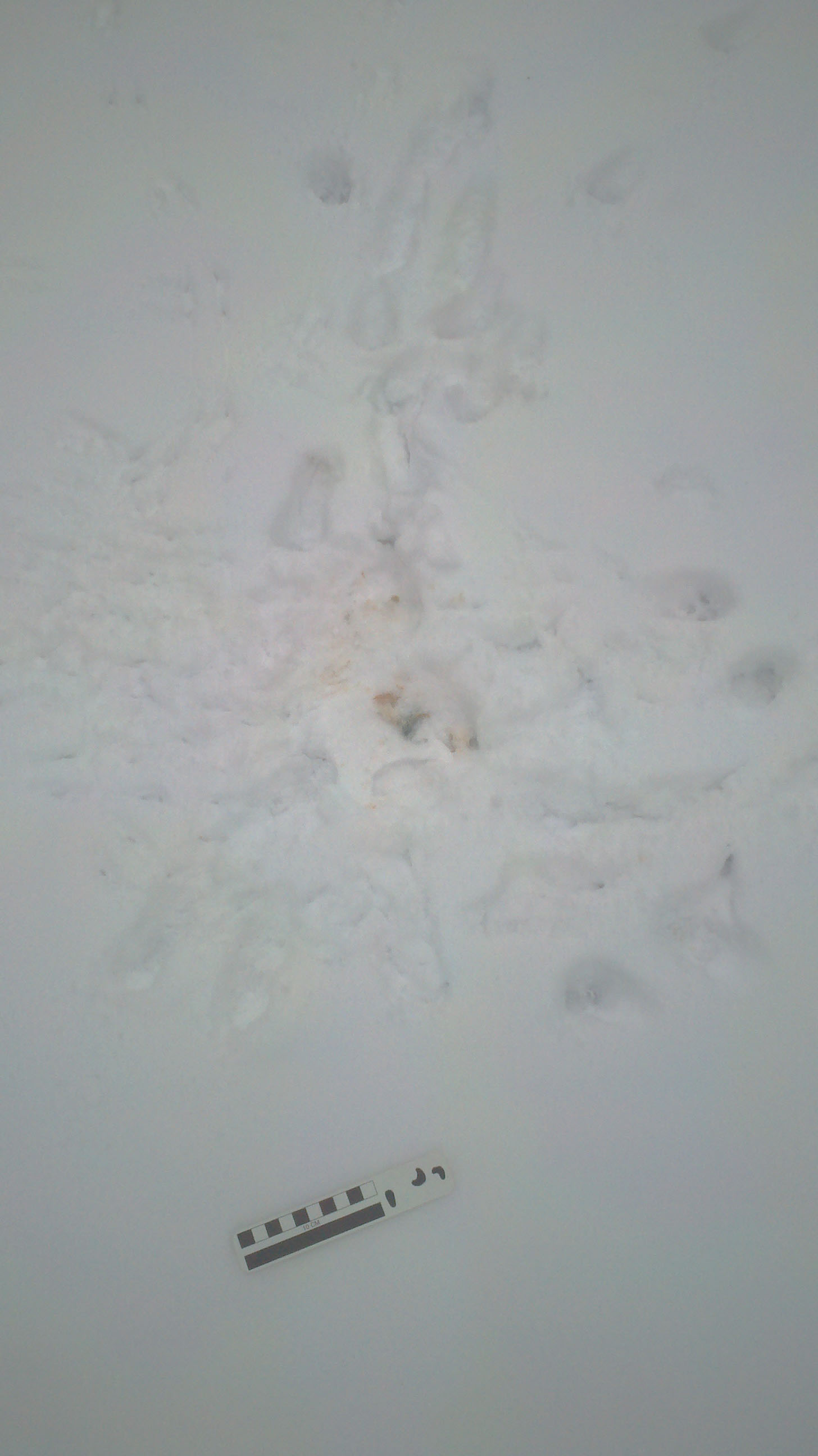
I have lost my muse today, so I just thought I’d post some interesting photos. This morning I saw a bunch of footprints in the snow in front of the kitchen window. Clearly something happened.

A flurry of footprints

Here’s a slightly closer view.

Closer up of the center of the action. I don't know what's in the middle there. I imagine it's what's left  of someone's dinner.
Closer up of the center of the action. I don’t know what’s in the middle there. I imagine it’s what’s left of someone’s dinner.

Here, I’ve labeled the tracks I recognized.

Some of the clearest tracks labeled.

The study of tracks and trackways left by animals is called ichnology. Yes, people make a career of this kind of work. So, put on your ichnologist hat. What do you think the story is here?

Friday Headlines: 2-1-13

Friday Headlines, February 1, 2013

THE LATEST IN THE GEOSCIENCES


TAPEWORM EGGS DISCOVERED IN 270 MILLION YEAR OLD FOSSIL SHARK FECES

Do I really need to say more? It’s an intestinal parasite…

Tapeworm

…in fossil shark poop.

It poopeth!
Fossil shark poop.

Ew.


Two related headlines here:

STUDY REBUTS HYPOTHESIS THAT COMET ATTACKS ENDED 9,000-YEAR-OLD CLOVIS CULTURE

PREHISTORIC HUMANS NOT WIPED OUT BY COMET, SAY RESEARCHERS

Comet, asteroid, and meteor impacts have been blamed for several of the Earth’s greatest extinctions, including the one at the Cretaceous-Tertiary (K-T) Boundary that led to the extinction of the dinosaurs (and later dominance of mammals). It’s only natural then, when an extinction is identified in Earth’s history, to take a moment and look for evidence of an impact.

The Clovis culture disappeared from North America about 9,000 years ago. That’s similar to when many of North America’s ‘megafauna,’ or giant animals, went extinct, like the woolly mammoth and giant ground sloth. For the extinction of the megafauna, most arguments hinge around human over-hunting or climate change, because that was about the same time that humans made it onto North America and it was also the end of the last glaciation.

There are some, however, who argue that an impact event caused the extinction of the megafauna and then also the demise of the Clovis culture. There was even a Nova documentary about it. Alas, the newest and best evidence soundly rebuts this idea. There are no impact craters from that time period (though it’s been argues that the comet hit the ice cap). There’s no shocked minerals either. Minerals take on the appearance of being disrupted (or shocked) due to the force of impacts. Shocked quartz is common from the K-T boundary event, but there is none associated with this 9,000 year old event. No impact occurred.

The downside is that we still don’t know what happened to the Clovis people.

Friday Headlines: 1-25-13

Friday Headlines, January 25, 2013

THE LATEST IN THE GEOSCIENCES


NEW TYPE OF VOLCANIC ERUPTION PRODUCES GLOBS OF FLOATING MOLTEN FOAM


Just when you start to think there’s nothing left for science to discover, they discover a new type of volcanic eruption.

There are two commonly-used categories of eruptions, effusive, when the lava flows calmly out of the volcano, and explosive, which is self-explanatory. Geoscientists have now added a new category to eruption types: tangaroan.

Tangaroan eruptions are slow and result in a very frothy lava to be released. When these eruptions happen underwater, the foamy lava (called blebs) floats up to the water’s surface.

How Tangeroan eruptions work

These eruptions are different than those that form the common floating volcanic rock, pumice, in that pumice is usually formed in explosive eruptions. This new rock doesn’t show the characteristic features of an explosive eruption. The new rock, and the new type of eruption, was clearly much slower than an explosive eruption.


CONFIRMED: THE UMBRARAN STARFIGHTER IS AN APATOSAURUS CERVICAL


Admittedly, I’m not a giant The Clone Wars fan, but I suspect at least a few of you are. And this is just too cool.

Umbraran Starfighters

In the Star Wars universe there are lots of interesting spacecraft. On first looking at the Umbraran Starfighter, Matt Wedel and Mike Taylor and at Sauropod Vertebra Picture of the Week (SV-POW), they suspected it looked a lot like the neck vertebrae of the long-necked dinosaur Apatosaurus (once incorrectly called Brontosaurus).

Apatosaurus ajax Neck vertebra. (Holotype YPM 1860)

As it happens, they were absolutely correct. The concept artist (David Hobbins) took his inspiration from a displayed Apatosaurus neck vertebra back in 2007.

How awesome is that?


MARS CRATER HELD ANCIENT LAKE & POSSIBLY LIFE, NASA PHOTOS SUGGEST


Not everything we learn about Mars needs to come from the fantastical rovers that are crawling over its surface. Some great new bits of information come from satellites orbiting high above the planet.

NASA’s Mars Reconnaissance Orbiter recently took some photos of the McLaughlin Crater. Close examination of the photos provided evidence that although now the crater is completely dry, it was once full of water.

McLaughlin Crater

In addition to giving detailed images of structures on the ground surface, remote imaging from satellites can also provide information about minerals present on the ground, based upon how the light is absorbed and reflected from the surface. In the case of McLaughlin Crater, there is evidence of carbonate and clay minerals which most likely would form in a lake.

The idea that there might have once been liquid water on Mars leads to the corollary that water must still be present on the planet. Scientists suspect that this water would be deep in the subsurface now. This, and all the other recent discoveries on Mars, leads scientists to believe that there Mars may have been habitable to life and my yet harbor life in it’s rocks.

Beware of Movies! Fossils and Paleontology

The Beware of Movies! series is meant to point out some of the scientific inaccuracies of popular movies, specifically in points related to the geological sciences.

This post will point out the major inaccuracies portrayed in movies about the science of paleontology. I’m a paleontologist. This oughtta be good…

Commonly, about two seconds after I tell someone I’m a vertebrate paleontologist, they ask me what I think of Jurassic Park. Then I laugh. It’s either that or they ask me if I carry a whip like Indiana Jones. Then I snarl something about how 1) Dr. Jones was an archaeologist and 2) Indiana was the dog!

Continue reading “Beware of Movies! Fossils and Paleontology”

Friday Headlines: 1-18-13

Friday Headlines, January 18, 2013

THE LATEST IN THE GEOSCIENCES

FLORIDA PALEONTOLOGIST ERIC PROKOPI PLEADS GUILTY TO SMUGGLING PRICY DINOSAUR BONES, FACES 17 YEARS BEHIND BARS

On May 20th of last year, a Tarbosaurus skeleton went up for auction in New York City. Paleontologists familiar with Tarbosaurus (sometimes called Tyrannosaurus, as they are closely related) immediately realized that this specimen, a complete skeleton, could not have come from anywhere but Mongolia. Mongolia does not permit the export of its fossils, and it was clear that this specimen had been removed relatively recently.

Mounted skeleton on exhibit in Cosmo Caixa, Barcelona – by FunkMonk

There was a great deal of argument, and the auction still went ahead, with the Tarbosaurus being sold for $1,052,500. The check was never cashed, luckily, as the case was under investigation.

The result of the investigation was that, in fact, the skeleton was illegally poached. Now the commercial collector, Eric Prokopi, faces up to 17 years in prison for his acts. This particular Tarbosaurus skeleton isn’t the only one out there that Prokopi had a hand in smuggling out of Mongolia. Hopefully the rest will be found.

Read more about it here.


LAKE VOSTOK WATER ICE HAS BEEN OBTAINED

Underneath the massive ice sheets in Antarctica, isolated from the atmosphere for 100,000 years or more exists a lake of liquid water called Lake Vostok. Scientists have drilled through nearly 4000 meters of ice (more than two miles) to reach this remote lake. They wish to study it and see if there is anything living in there, as a potential analogue for the harsh environments of distant planets. On January 10th, the first sample was collected. Research can now commence.

Cross-sectional map of Lake Vostok situation (before drilling was complete) (Credt: National Science Foundation)


STORMS REVEAL IRON AGE SKELETON

Not quite geology, but close to paleontology, so it counts…

Storms reveal iron age skeleton

These sorts of things happen a lot in paleontology, actually. A storm causes a stream bank or cliff to collapse, and suddenly there are bones sticking out of the fresh surface. Given that these were human remains, the police were called initially. Archaeologists later said they thought the bones were as much as 2000 years old. Sadly a second storm caused to bones to be lost.


Beware of Movies! Meteorites and Magnetism – More on the Earth’s Interior

The Beware of Movies! series is meant to point out some of the scientific inaccuracies of popular movies, specifically in points related to the geological sciences.

This blog post will point out the major inaccuracies portrayed in movies about the Earth’s composition and its magnetic field.

Today (January 15, 2013) I presented a Beware of Movies lecture at a local retirement community. The focus was on the Interior of the Earth, and was the topic of an earlier blog post. It was a wonderful experience. (I love doing those things!) In the process of preparing, then delivering, the presentation, I did realize that I left a few critical things out. Hence, a new blog post!

Meteorites — What do they have to do with the Earth’s interior?

One of the big problems that arises with bad geology movies is that they get the composition of the Earth all wrong. There aren’t amethysts in the mantle. Diamonds and rubies would not co-exist. We know that the mantle of the Earth is composed of mafic and ultra-mafic rocks (think back to Bowen’s Reaction Series). That means it’s mostly low-silica, high iron and magnesium rocks down there. Even deeper, we know that the core is composed mostly of iron and nickel.

As we stand on the Earth’s surface, such minerals and rocks are rare. It’s easy to think that most of the rocks of the Earth should be felsic things like granite, with tons of quartz. This is simply not the case.

But why? How can we make the assumption that the mantle is mafic and the core is iron and nickel. We know some of this because there are a few places on Earth where mantle rocks have been exposed at the surface (usually due to tectonic events). We can hypothesize some compositions based upon how seismic waves refract through the body of the Earth (seismic waves travel at different rates through different materials).

We can make some assumptions about the overall composition of the Earth based upon studies of meteorites. We assume that the bits of rock and dust that collected all those billions of years ago to form our beloved planet formed from the same bits of rock and dust that make up meteorites. If you take a meteorite and grind it up, you find it to be of mafic composition, with low silica, and high concentrations of iron, magnesium, and nickel. Some meteorites are almost pure nickel and iron. Others are more rocky. This is assumed to be the starting point for the Earth’s composition.

A Chondrite – a very primitive stony meteorite. Photo by H. Raab
A polished surface of an iron meteorite – photo by Opsoelder

Over millions of years, these mafic pebbles that came together to form the planet fused, and then underwent a process called ‘differentiation,’ which is just a fancy way to say ‘the heavy stuff went to the middle.’ Thus, the nickel and iron are at the core of the Earth, surrounded by the mantle of mafic rocks. Felsic rocks, like granite, tend to be light and naturally ‘float’ to the surface, which is why they are what we usually see in the rocks around us!

Magnetism — The Earth isn’t exactly a giant bar magnet, but it’s similar.

Here’s the neat thing about the core. It’s iron and nickel. Iron is a conductor. If you have an electrical current, you have a magnetic field. And voila! The Earth has a magnetic field.

The core is divided into two parts, the liquid outer and the solid inner. The mantle is also solid. Because the Earth rotates, flow is set up in the Earth’s liquid outer core. With that flow, and a little nudge, an electric current is set up. The flow is thought to be in several isolated cylinders surrounding the solid inner core. This is where the ‘bar magnet’ analogy fails, because each cylinder has it’s own field, and these combine to form the magnetic field of the Earth. This is referred to the geomagnetic dynamo.

Geomagnetic dynamo. All this is happening in the core.

Because of the dynamic nature of flow in the core, the magnetic pole never quite lines up the the Earth’s rotational axis. In fact, the magnetic poles move around quite a bit, sometimes even reversing themselves (though this takes more than a single human’s lifetime). There are lots of questions regarding how the magnetic field forms and how it might reverse itself, and is an active field of research in geophysics.

Beware of movies! The basis of the entire movie “The Core” is that the flow in the liquid outer core has stopped, thus causing the Earth’s magnetic field to fail. If we did lose the magnetic field, there could be repercussions, however, the magnetic field on Earth has gone essentially to zero multiple times in Earth’s history. Every time the magnetic poles reverse themselves, the field goes to zero first. While there is some evidence that this might have caused problems for certain single-celled organisms, large animals have not been affected. The cataclysms that are shown in the movie would not be expected. So don’t worry.

Bad Geology Movies: Dinosaur, 2000

Dinosaur

2000

D.B. Sweeney, Julianna Margulies and Samuel E. Wright

Premise: What would happen if a dinosaur was raised by lemurs?

OK. This is totally a kids’ movie. I won’t say anything about talking dinosaurs. And I know there has to be tons of artistic license. Fine. Nevertheless, there are some things about this movie that are terribly inaccurate.

But I only took two pages of notes, and, admittedly, the pencil was blunt and there were pictures. So there’s not too much.

Dinosaurs that I recognized: Iguanodon (e-K), Carnotaurus (l-K), An Oviraptor (Rinchenia) (l-K), Velociraptor (l-K), Brachiosaurus (l-J), Styracosaurus (l-K), Ankylosaurus (l-K), Parasaurolophus (l-K), Struthiomimus (l-K)

Those funny little parenthetical bits there denote the age of rocks in which each of these animals are typically found. (l-K) means the late Cretaceous, just before the dinosaurs went extinct. Luckily, most of the animals depicted in the movie are from the late Cretaceous. That makes sense. The whole movie begins with an asteroid impact which, presumably, represents the one that killed off the dinosaurs at the end of the Cretaceous.

There are a couple of problems though. For one, the main character is an Iguanodon. Iguanodon lived in the early Cretaceous (e-K). That could be 50-70 million years before the rest of the characters. But if that’s not bad enough, Brachiosaurus is from the late Jurassic (l-J), which is tens of millions of years older than that.

So, these animals never actually co-existed.

Lemurs, or any modern primate did not appear on the Earth until at least ten million years after the dinosaurs went extinct. So that just wouldn’t happen. But fuzzy animals with goofy personalities are great for the show.

There are some other bits that were worrysome: Why are the lemurs on an island separated from the mainland? Why aren’t there dinosaurs on that island? How come the nesting grounds are unaffected by the meteor impact? Why are all the dinosaurs essentially sentient, except for the poor ankylosaur?

That landslide was a little sketchy, too. Where did that rock come from?

Oh, and hey. Why did any dinosaurs survive? After all, didn’t the asteroid wipe them out at the end of the Cretaceous? In the end, this is actually OK. Maybe some relict populations did survive beyond the end of the Cretaceous, but died out soon thereafter. There’s even some evidence that this occurred, though most paleontologists are skeptical. The point is that it is plausible that not everything died immediately after the impact.

Besides, it’s a kids’ movie. What do you want?

Bad Geology Movies: Jurassic Park, 1993

Jurassic Park

1993

Sam Neill, Laura Dern and Jeff Goldblum

Premise: What if we could clone dinosaurs and made a theme park around them?

You were probably waiting for this one. I had to do Jurassic Park. I’m a paleontologist. It’s a rule, right?

When Jurassic Park came out, I was in my fourth year as an undergraduate (I’d been a senior for a while already, and wouldn’t graduate for at least one more year), studying both geology and biology. I was going to be a vertebrate paleontologist, and I was pretty sure I was going to study dinosaurs. (I never have studied dinosaurs, but I did become a vertebrate paleontologist. 50% is pretty good, right?)

I never did see this in the theater. I saw it a year later when it came out on video. I watched it the evening of the day that I took the GRE exams. Yes, exams in the plural. This is back when there were only two dates a year you could take the GRE and it was a hand-written test. I took both the general and the subject exam in one day. I was fried that night. I remember laughing at the cute dinosaurs while my roomates and friends fell on me in terror.

Since then, this movie has been a popular one to watch with the various geology clubs I’ve been associated with. It’s full of problems with both paleontology and biology. I’ll try to stick to the paleontology problems.

The bottom line is this: We’re probably not EVER going to see cloned dinosaurs. Now, maybe we can do some genetic engineering and get dinosaur-like animals from modern birds, but that’s about it.

I’m only planning to review the first Jurassic Park movie. The others are based upon accepting the assumptions from the first, so there’s little point in considering the others (with the possible exception of the character Robert Burke, from the second movie, The Lost World).


PORTRAYAL OF PALEONTOLOGY: Oh, goodness, it’s wrong. Just wrong. The setting, the outcrops, were all right, but what the science looked like is wrong.

Exposing the fossil: 1) I have never been to a fossil locality where a brush was all that was needed to expose a fossil. Additionally, paleontologists tend NOT to expose fossils as they dig. They only uncover enough so that they can determine the exent of the the fossil. Then they trench around the specimen, keeping as much rock as possible in place. Once a trench is dug, and the fossil is still encased in rock but now sitting on a pedestal, paleontologists will jacket the fossil with plaster and take it into a laboratory to fully remove it from the rock. Never, never, never do we do such detailed preparation in the field. The specimens will be ruined, if not by people walking on them (or helicopters landing nearby), but by the elements. It takes time, sometimes years, to get a fossil out of the ground. The more that remains encased in rock, the better.

Seismic: Not that I fully understand how seismic works, but I’m certain that a single shotgun blast isn’t going to yield an image by which a paleontologist can recognize the half-moon shape of the dinosaur’s wrist bone.

The fossil itself: Y’know, sometimes a complete fossil is found in its death pose, but usually even then some of the bones are out of place. To find as single complete specimen is unusual. To find two, both laid out perfectly, is so unlikely that I could not suspend reality to accept that part of the movie. And something as big as the ‘Velociraptor’ that they portray would almost certainly have damage or distortion somewhere.

Science and funding: Apparently Hammond, the creator of Jurassic Park, has been providing Drs. Grant and Sadler with $50,000 a year to fund their research. That might seem like a lot of money to you, but in reality, that’s chump change. Just saying. Research efforts like those are expensive, especially if Sadler and Grant are getting any salary from it. I’ve submitted some ‘cheap’ grant requests for less than $50,000 per year. That covers my research expenses and only two months of my salary. Most programs need much more than that.


THE DINOSAURS: They did pretty good with the dinosaurs, all things considered. I’m glad that Spielberg isn’t going to go all “George Lucas” on these movies and fix them up though…

Velociraptors and the relationship with birds: What Alan Grant in the movie says about the relationship between birds and dinosaurs is mostly true. Most of us in the paleontological community refer to birds as ‘avian dinosaurs.’ We have chickens and I am always calling them my little dinosaurs. What Dr. Grant says about ‘raptor’ meaning ‘bird’ may also be true, but let’s face it, that’s not evidence that birds and dinosaurs are related. If I start calling a donut a banana, does that make the donut fruit? No. (Besides, ‘raptor’ actually means ‘thief’!)

Speaking of Velociraptors: The true ‘Velociraptor’ is a little animal that would stand about hip-high on most adult people. The veolociraptors in the movie were enlarged to make them look cooler. When Spielberg came up with this, paleontologists said, ‘Well, ok. Sure. It’s a movie. Go ahead,’ basically accepting that this was going to be wrong. But at about the time that the movie came out, a huge new species related to Velociraptor was discovered in Utah, and was named Utahraptor. The velociraptors of the movie could be Utahraptors in real life. And the paleontology community breathed a collective sigh.

Inferences about behavior: Velociraptors hunt in packs. Gallimimus ran in herds. This is arm-waving. This is literary license. This is not something that can be inferred directly from the fossil record. We don’t know exactly how these animals interacted. We don’t know how they behaved. We can observe modern birds and assume that dinosaurs might have behaved in similar ways. Nothing more.

Inferences about perception in dinosaurs: Apparently, Tyrannosaurus can’t see you unless you move. Dr. Grant knew this somehow. OK, we don’t actually know this. There are animals that can only see objects if they move quickly, like some frogs, but we can’t possibly know if this is true with dinosaurs. By the same token, we don’t know if velociraptors can stare you down, either. If we’re going to base this inference on their nearest living relatives, however, I’m pretty sure that T. rex could see you even if you were sitting still.

Modern understanding of dinosaurs: If this movie were to be made today, the velociraptors would most likely be completely covered with feathers. The T. Rex would also have feathers, probably. Any of the theropods would be feathered. Now, I’m not sure about the sauropods – the big Brachiosaurus – I’m sure someone else knows.

By the way, Dilophosaurus: Dilophosaurus does not have the neck frill that is shown in the movie, and it didn’t spit poison, either.


Cloning: So this is biology, and a bit of chemistry. 1) DNA wouldn’t last. Over 65 million years it would degrade so much that it would be unrecognizable. 2) Frog DNA? If they were clever, they’d use bird DNA. Seriously, a FROG?! Now if we really wanted dinosaurs, what we need to do is study the anatomy of dinosaurs and compare that with birds as adults and embryonically. Then let’s try to make the embryo of modern birds develop to make a dinosaur-like skeleton and see what we get… This, I think, is within the realm of possibility, but the ‘dinosaur’ we’d get won’t be any dinosaur that ever walked the Earth!


Females turning male: Actually, such things are possible. In many vertebrates, the temperature of the eggs during development will determine the sex of the young when they’re born. Equally possible, though not mentioned, is parthenogenesis, wherein a female simply gives birth or lays eggs without fertilization. The babies are clones of the mother. This is known in many species of lizards. It’s a stretch, but it’s possible.


I could go on. There are several little details in the movie that I found annoying, but these are the big ones (or so I think). I’ve got other movies to watch and review…

Friday Headlines: 1-4-12

Friday Headlines, January 4, 2013

THE LATEST IN THE GEOSCIENCES


FIRST METEOR SHOWER OF 2013 PEAKS THIS WEEK

Quadrantid. Photo by Brian Emfinger in Ozark Arkansas, January 2, 2012

The Quadrantids are a meteor shower that happens in January. They seem to come from an area in the sky between the handle of the Big Dipper and the head of the constellation Draco.

(source: EarthSky Communications, Inc.)

Alas, by the time this is published, the peak will be just past, having been Wednesday night into Thursday morning. Plus, the waning moon (and all the snow where I live) make it difficult to actually observe this meteor shower.

PLANET’S OLDEST FOSSILS FOUND IN PILBARA, EXPERTS SAY


In the Pilbara region of Australia are some of the planet’s oldest rocks, dating back to about 3.4 billion years ago. In these rocks are various evidences for ancient life, including textures (like minute strands connecting to each other in a network similar to that of modern bacteria) and geochemical tracers. Yes, folks, there be isotopes there!

Metabolic processes in bacteria result in an isotopic signature wherein there is more ‘light’ carbon (carbon-12) than ‘heavy’ carbon (carbon-13) than would be expected for a limestone that formed without bacteria present.

Strelley Pool in the Pilbara, where 3.4 billion-year-old fossils have been found. Photo: David Wacey

What’s important is that finding these bacteria in such ancient rocks might suggest that the Earth’s atmosphere had oxygen in it a billion years before we previously thought. Oxygen in the atmosphere has had a profound effect on both the evolution of life on Earth and as well as it’s geologic history.

A GUIDE TO SNOWFLAKES

Snowflake classes

This is just cool. Who knew snowflakes were so complex? In light of all the snow we’ve received of late, this gives me something to look for in the next snowfall.

Bad Geology Movies: 2012, 2009

2012

2009

John Cusack, Chiwetel Ejiofor, Amanda Peet, Oliver Platt, Thandie Newton, Danny Glover, and Woody Harrelson


Premise: What if the end of the Mayan calendar on December 21, 2012 really did mark the end of the world? Could we save ourselves?

Obviously, the world did not end on December 21. The Mayans (modern ones) probably had a good chuckle at the premise of this movie and all the hubbub about the apocalypse. Whatever. In this movie there were some wierd things going on, things that didn’t make sense even within the context of the distorted science of the movie itself. Yeah, it was a disaster movie. A scientific nightmare.

The end of the world has been brought on by excess activity in the sun. Actually, it’s kind of funny because the world will end when the sun finally consumes the planet. But we got a few billion years before we need to worry about that. Anyway, apparently the sun’s activity has brought about a new kind of nuclear particle – a different kind of neutrino that is rapidly heating the Earth’s core, rather like how a microwave heats food from the inside out. This is going to cause the cataclysmic destruction of the Earth as we know it.

Of course, all this is happening because of the alignment of the planets that only happens every 640 thousand years. But wait. 640 thousand years is pretty frequent. Why is there no geologic evidence for this happening? There’s the ‘Nemesis Star,’ but that’s, what, every 26 million years or something? Yeah, I don’t know…

These enormous cracks begin to form along the west coast of North America. But they aren’t due to the action of any tectonic plates (according to one of the characters, the Deputy Geologist of the Office of Science and Technology Policy – which apparently actually exists). Ok, well if it’s not plate tectonic, why aren’t there random cracks elsewhere?

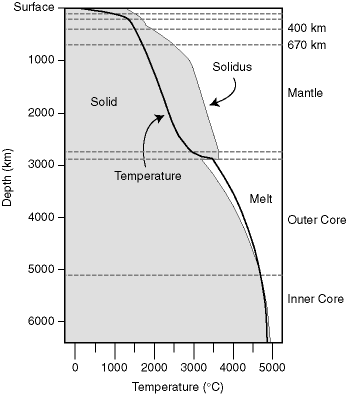
There’s a scene where they’re drilling (or so it seems) into a suddenly-dry lake bed in Yellowstone National Park. Our deputy geologist finds out that the temperature is 2700 degrees C at 40,000 feet deep. First, any real geologist would use meters, not feet. It’s about 12,000 meters or about 12 kilometers. I wonder how long they’d been drilling there. That’s just a gripe. But let’s put this in context. How hot is 2700 degrees C?

The Earth’s geothermal gradient (temperature with depth) compared with the solidus for rocks. If the geotherm is to the left of the solidus, the rocks are not melted.

So we’re looking at mantle temperatures. Not molten rock, mind you. The mantle is solid, but very, very hot. So, under Yellowstone it’s really warm. Well, Yellowstone is also sitting on top of a hotspot, where heat from the mantle (and associated volcanics) make it right to the surface. That’s why Yellowstone is there in the first place. So maybe 2700C isn’t so unexpected?

The other part of the story is that apparently the temperature is increasing by 0.5% every hour in this well at Yellowstone. Well, that’s pretty quick. A few hundred degrees a day or so. That’s substantial. I’d be more worried about that than the absolute temperature.

I guess this phenomenon is occurring at other sites around the Earth as well (in the movie, that is). I wish I knew where. The temperature anomaly at Yellowstone is compelling, but again, it’s a hot spot. It’ll go off again eventually, and we don’t need über-nutrinos to do that. What if the other places on the globe where they’ve been taking measurements are also hot spots. What then?

Regardless, the claim is suddenly made that “The Earth’s crust is destabilizing!” whatever that means, because the “Temperature’s rising with incredible velocity!” Is that even English? Would acceleration be a better word? Can you even use velocity to describe temperature change?

The good news is that crazy Charlie (played by Woody Harrelson) is drinking PBR, which is widely acceptable to geologists globally, for no real clear reason.

Oh yeah, and so you know, there was no major planetary alignment on December 21, 2012. This was just kind of made up…

The Theory of ‘Earth Crust Displacement’ is a big deal in this movie. The idea is that the crust destabilizes (whatever that means) and suddenly the crust rapidly moves around on the earth’s surface. It’s tough to be sure what they mean by this in the movie, as they could be referring to a movement of the crust, or a shift of the Earth’s rotation axis, so that the crust has appeared to have moved relative to the rotation axis. This depends upon a destabilization of the ‘subterranean’ crust and an ‘extreme polar instability.’ I have no idea what these things might mean.

The subterranean crust could be anywhere from just below the surface to 70 kilometers down, so what part are they talking about? Also consider that in the Theory of Plate Tectonics, it’s not just the crust that moves. A real geoscientist would be referring to the lithosphere, which is the crust plus a bit of the underlying mantle. So what’s destabilizing? Maybe it’s the connection between the crust and the mantle that’s destabilized? Wow.

The Theory of Plate Tectonics, does a nice job of explaining how the crust and the rest of the lithosphere, moves about on the surface of the Earth. But the crust isn’t going to rotate 23 degrees to the southwest over the course of a few hours. Sorry folks. Earth Crust Displacement is not a real theory in the Earth Sciences.

So far as ‘extreme polar instability,’ I think this is in reference to the Earth’s magnetic field (the north and south poles), though I can’t be certain. They do discuss the sudden reversal of the Earth’s magnetic field, and that the south magnetic pole is suddenly in Wisconsin. That the Earth’s magnetic field might reverse itself is no big deal. Geoscience has known about this for a while. The magnetic field has gone back and forth many times over the aeons, in an irregular pattern. This pattern has been used to help assign ages to ancient rocks, in fact, in a field of study called magneostratigraphy. That it would happen over night is a little sketchy. The current state of understanding is that it would take at least a thousand years for this to occur, though we’re still working on the details of how the magnetic field is generated. The magnetic pole in Wisconsin is also no big thing, if you’ve rotated all the Earth’s crust by 23 degrees to the southwest. So this is Ok. Sort of.

Earthquakes: This movie suffers from some of the problems of other earthquake movies in that it implies that earthquakes of magnitudes like 10.9 are even possible. Of course, if we can have Earth Crust Displacement, we can have such huge earthquakes, too.

The tsunamis throughout the movie are a real (scientific) disaster. For one thing, just because there’s an earthquake, doesn’t mean that there’s automatically a tsunami. The tectonic situation has to be correct. There needs to be dip-slip displacement along a fault that is underwater. They have these waves arising *poof* out of nowhere!

The other problem is that a 1500 meter tall wave (which is huge, sure) isn’t going to affect a Tibetan monk living at 4000 meters elevation. Unless, of course, Earth Crust Displacement has made the Tibetan Plateau sink. At this point, you see that things only make sense when you suspend all understanding of the current state of science.

Finally, I just gotta say that once again this movie omits the fact that volcanic ash is, by itself,deadly. Movies always portray ash as soft and fluffy and falling like snow. It’s glass folks. They’re inhaling glass shards. And no one is coughing. Sigh.