One of the many projects I work on involves the study of climate change in the fossil record. I’ve put a bit of it on-line here. What I’ve published thus far deals mostly with interpreting general climatic and environmental factors using bulk geochemistry (all isotopes) from rocks and the fossil contained therein. That is to say, I take a big rock or fossil and grind it (or part of it) down into a single sample. I analyze that and call that a ‘average’ for that entire rock layer.
It turns out that clams (and mollusks in general) do a good job of recording environmental signals not just in bulk, but on a fine scale, such that we can see yearly, monthly, even daily records of weather.Continue reading “What Can A Clam Teach Us About Climate Change?”
It sounds like I have a bit of a problem doesn’t it? Two or three days a week I casually announce to the world that it’s time for me to drop acid.Continue reading “On Dropping Acid”
A while ago, I proposed an experiment in which I collected snow at regular intervals during a Lake Effect Snow event. I made some predictions and collected the snow, and have now finally succeeded in analyzing the waters. The results weren’t quite what I expected.
I had predicted that isotopic values in the snow would not change over the course of the event. This was because all the snow would be forming directly off the lake, which is only a few miles away from the collection point. (This is in contrast to other synoptic storms, where we have precipitation coming from a single vapor mass, which will evolve isotopically over time. Read more about that here.) The temperature of the lake water, and its isotopic value would not change consequentially over the course of such a short event.
What I saw instead was an increase isotopic values overnight, and then a decrease the next day.
Results from January 22-23 Lake Effect Snow Event. Click to enlarge.
I compared the isotopic values with measures of air temperature during that period of time. I selected first the air temperature measured at the Rochester International Airport (ROC). Isotopic values do track temperature changes, thus I realized that what is most likely happening is the fractionation of isotopes (the selective evaporation of the heavier versus the lighter water) in both the formation of the water vapor off the lake and more importantly the freezing of that vapor into snow which is changing over time due to temperature.
I realized that ROC is actually sufficiently removed from the lake, that its measured temperatures are likely to be different than those directly adjacent to the lake. Shoreline temperatures are moderated by the warmth of the lake water itself. Temperatures between ROC and the lake shore are known to differ by as much at 20 or 30 degrees. I retrieved data from a WeatherBug weather station right on the lake shore (Forest Lawn Beach, FLB on the plot. Thanks to Parker Zack and Kevin Williams for helping me find this.) as it happens, for this snow event, temperatures at ROC and at FLB track each other quite closely for much of the event, until the event peters out. In either case, isotopic values track air temperatures.
The snow gets isotopically ‘heavier’ during the colder overnight hours. Does this make sense?
Under warmer conditions, more of the heavier isotope will be incorporated into water vapor. In isotopic terms, this means that δ18O and δ2H of the vapor will be more positive when air temperatures are warmer. For freezing (or crystallizing snow), one might expect that more of the heavy isotope would remain in the vapor when the air temperatures are warmer. Or, since we’re measuring snow, warmer air temperatures means isotopically ‘lighter’ snow. If it’s colder, more of the heavy isotopes go into the snow, causing the δ18O and δ2H values of the snow to become more positive.
Oh thank goodness! It does make sense! That is if the changes in isotopic value of the snow is directed by air temperatures during the crystallization of the snow and we assume that air temperatures have minimal effect on the fractionation during evaporation.
Can we make the latter assumption?
I think we can. The temperature of the water is close to freezing (approximately 4 degrees C, data found here). Evaporation stops if the water freezes. The difference in fractionation of evaporating water at 4° C and 0° C is negligible (see article here). We can assume it is essentially the same. Thus any isotopic change we see must be due to changing air temperatures during the freezing of snow.
Other observations
Snow was collected at two sites in Wayne County affected by this Lake Effect event. One site in the Town of Williamson, and one about seven miles further west in the Town of Ontario. Isotopic values of snow from these two sites are essentially the same and follow the same pattern. Thus we can say there is likely to be little lateral isotopic variation in snow isotopic values. That makes sense given that the snow is all coming from evaporation off the same lake.
Further work
If the isotopic value of the original lake water is known, along with air and water temperatures, it is possible to look at the extent of fractionation both during evaporation of the lake water and crystallization of the snow. We were unable to collect a lake water sample at the onset of this event, but we do have one collected from November of 2011, as well as snow measurements also from 2011. Alas, for the November 2011 event, we lack temperature data. But we can make some assumptions and try to look at fractionation. I’m working on those calculations now. And they make my head hurt.
For the next lake effect event, I’m hopeful we can get a sample of Lake Ontario water for a starting point. We will also collect snow from the weather station at FLB to see if there is a gradient in the snow isotopes from nearer the source to farther outboard (like Williamson). Sublimation may be occurring in the clouds, which might cause the snow to be isotopically heavier than ordinary fractionation would predict, in which case we would predict that shoreline snow would have more positive δ18O and δ2H values than snow collected further inland.
The Beware of Movies! series is meant to point out some of the scientific inaccuracies of popular movies, specifically in points related to the geological sciences.
This post will point out the major inaccuracies portrayed in movies about climate change, and how it would affect the Earth.
Climate change is a sensitive topic. It’s become politically charged. It’s now taboo to talk about it in polite company. I’m not here to incite riots. I have my opinions that, though I won’t state them explicitly, they’ll probably be obvious. My objective here is to talk about how we understand climate change, how we can infer that it is happening. I want to demystify all the numbers and data points and graphics that we’re bombarded with every day.Continue reading “Beware of Movies! Climate Change”
I’ve written a few blog posts about what can be done with isotopes from precipitation, and how that might assist us in understanding how to interpret isotopic data collected from ancient rocks and fossils. (Look here and here.) As I live here in western New York state, close to Lake Ontario, I frequently have opportunities to further study how the isotopes from precipitation (in this case Lake Effect snow) are related to the isotopes of the water that originally evaporated to make the clouds that do all the snowing.
Right now, we’re looking at a Lake Effect snow event that’s due to start sometime tomorrow, so I’m throwing together is quick and fun isotopic study that I’ll share with you when the data come in. I’ll describe it here.
As review, let’s think about isotopes in water. First, what do I mean by isotopes? The term worries people, because they immediately think of radioactive isotopes and OMG, we’re gonna die! No, it’s not like that. The word isotope just refers to the fact that some atoms of the same element are heavier or lighter than the others.
Water is composed of hydrogen and oxygen (H2O). Hydrogen comes in two types. Most of it has a mass (think of it as weight) of 1. Some of it has a mass of 2. (The hydrogen with a mass of 2 is called deuterium. It’s one of the few isotopes that has its own name.) So water is mostly made with hydrogen atoms of mass 1, but some water has hydrogen of mass 2. The water with the mass 2 hydrogen is heavier than the water with the mass 1 hydrogen.
Similarly, oxygen comes in two important isotopes. The most common form of oxygen has a mass of 16. A more rare (but not radioactive) form of oxygen has a mass of 18. Either type of oxygen can be in a water molecule, but the water with the mass 18 oxygen is heavier.
With mass spectrometry, we can measure water to see how much of it has the heavier hydrogen and the heavier oxygen. This is what I do for a living.
To get any kind of precipitation (rain or snow), water must first evaporate to make a vapor mass in the atmosphere. You can think of this as just making a cloud or a storm. In the case of Lake Effect precipitation, the water that’s evaporating is the lake itself. When the water evaporates, the lighter water evaporates more than the heavier water because, well, it’s lighter. So the cloud that you get from evaporation is isotopically lighter than the lake it evaporated from.
We measure ‘lighter’ or ‘heavier’ with isotopes using what we call ‘delta notation.’ The numbers we get are given in ‘permil’ (‰) even though they’re not a concentration. What’s important is that more positive delta values means that there’s more of the ‘heavy’ element. More negative values means there’s more of the ‘light’ element. So, if the lake has a delta value of -1‰, then the cloud should have a more negative value, like -3‰. When a cloud rains or snows, the heavier elements fall out first, because they’re heavier. If the cloud has an isotopic value of -3‰, the snow should have a more positive value, like -2‰.
The change between lake and cloud, or between cloud and snow, is called fractionation, and is controlled in part by temperature. (This means that the numbers I just gave you are completely made up.) The fractionation is also different for hydrogen and oxygen, and we measure these separately. (Hydrogen and oxygen isotopes in water do tend to vary together, but it can get pretty complex.)
As a cloud rains, it loses its heavy isotopes. If we take a cloud or storm (or say a hurricane) and take it from its water source (a lake or the ocean) and move it over land, this fractionation will go on. If no more water vapor is added, then the cloud gradually gets isotopically lighter. This means that the precipitation will also get lighter (but will always be heavier than the cloud). This process is called ‘Rayleigh Distillation,’ and is an important assumption in isotope geochemistry. Luckily, it has been shown to be a good model.
All right, let’s get back to Lake Effect snow. We’re looking at a Lake Effect event that is expected to start sometime tomorrow. We can get snow bands off of the lake that make great stripes of snow across the landscape.
What Lake Effect snow from Lake Ontario teach us?
We know that the snow will be forming from water evaporated off of Lake Ontario, so it will be useful to know the isotopic values of that water as a baseline. We have no way of measuring it isotopic values of the water vapor (the cloud) but we can find out the air temperature close to the lake surface and calculate the the isotopic value should be.
Then, we can measure the isotopic value of the snow that falls. We can collect snow that falls right at the lake (that which first forms from the freshly evaporated water) and we can look at snow that falls some distance away. We can make predictions about what patterns we might see.
Predictions:
1) Snow collected near the lake will be isotopically heavier than snow collected further away. Even though it’s only a few miles, Rayleigh Distillation should have some effect.
2) Over time, the snow collected at one location should not change in isotopic value, unless air temperature at the lake varies significantly. Because the cloud will be continuously replenished from Lake Ontario, I don’t expect to see any variability over time. The isotopic value of the lake water should not change consequentially. What can change is the air temperature, which will alter the fractionation of the isotopes (when it’s colder, less of the heavy water will evaporate). Also, colder temperatures could result in freezing of the lake surface, effectively moving the shoreline further into the lake.
It’s a pretty simple thing to test these predictions. I just need to collect some snow samples (and recruit other people to do the same). Specifically, I’ll be collecting every six hours, since I’ll be measuring snow depth at that time interval anyway. Collecting every twelve hours would probably be sufficient. I run a laboratory that has a liquid water isotope analyzer, so analysis will be easy. Once I’ve got the results, then it’ll be a quick write-up that everyone can benefit from here. It’ll be interesting to see how well my predictions hold.
Our water analyzer, Norm, analyzing waters from hurricane Sandy.
If you live nearby and think you might be interested in helping out with this little project, let me know in the comments below. The more the merrier!
UPDATE 1-21-13
After waiting for 24 hours, there has not yet been any snow. But I’m assured it’s on the way!
@paleololigo It’s coming; 1 week from tonight I think you’ll have 1-2′ on ground.Tues PM you will get a foot, Wed, Thu, Fri will see more!
On May 20th of last year, a Tarbosaurusskeleton went up for auction in New York City. Paleontologists familiar with Tarbosaurus (sometimes called Tyrannosaurus, as they are closely related) immediately realized that this specimen, a complete skeleton, could not have come from anywhere but Mongolia. Mongolia does not permit the export of its fossils, and it was clear that this specimen had been removed relatively recently.
Mounted skeleton on exhibit in Cosmo Caixa, Barcelona – by FunkMonk
There was a great deal of argument, and the auction still went ahead, with the Tarbosaurus being sold for $1,052,500. The check was never cashed, luckily, as the case was under investigation.
The result of the investigation was that, in fact, the skeleton was illegally poached. Now the commercial collector, Eric Prokopi, faces up to 17 years in prison for his acts. This particular Tarbosaurus skeleton isn’t the only one out there that Prokopi had a hand in smuggling out of Mongolia. Hopefully the rest will be found.
Underneath the massive ice sheets in Antarctica, isolated from the atmosphere for 100,000 years or more exists a lake of liquid water called Lake Vostok. Scientists have drilled through nearly 4000 meters of ice (more than two miles) to reach this remote lake. They wish to study it and see if there is anything living in there, as a potential analogue for the harsh environments of distant planets. On January 10th, the first sample was collected. Research can now commence.
Cross-sectional map of Lake Vostok situation (before drilling was complete) (Credt: National Science Foundation)
Not quite geology, but close to paleontology, so it counts…
Storms reveal iron age skeleton
These sorts of things happen a lot in paleontology, actually. A storm causes a stream bank or cliff to collapse, and suddenly there are bones sticking out of the fresh surface. Given that these were human remains, the police were called initially. Archaeologists later said they thought the bones were as much as 2000 years old. Sadly a second storm caused to bones to be lost.
Quadrantid. Photo by Brian Emfinger in Ozark Arkansas, January 2, 2012
The Quadrantids are a meteor shower that happens in January. They seem to come from an area in the sky between the handle of the Big Dipper and the head of the constellation Draco.
(source: EarthSky Communications, Inc.)
Alas, by the time this is published, the peak will be just past, having been Wednesday night into Thursday morning. Plus, the waning moon (and all the snow where I live) make it difficult to actually observe this meteor shower.
In the Pilbara region of Australia are some of the planet’s oldest rocks, dating back to about 3.4 billion years ago. In these rocks are various evidences for ancient life, including textures (like minute strands connecting to each other in a network similar to that of modern bacteria) and geochemical tracers. Yes, folks, there be isotopes there!
Metabolic processes in bacteria result in an isotopic signature wherein there is more ‘light’ carbon (carbon-12) than ‘heavy’ carbon (carbon-13) than would be expected for a limestone that formed without bacteria present.
Strelley Pool in the Pilbara, where 3.4 billion-year-old fossils have been found. Photo: David Wacey
What’s important is that finding these bacteria in such ancient rocks might suggest that the Earth’s atmosphere had oxygen in it a billion years before we previously thought. Oxygen in the atmosphere has had a profound effect on both the evolution of life on Earth and as well as it’s geologic history.
This is just cool. Who knew snowflakes were so complex? In light of all the snow we’ve received of late, this gives me something to look for in the next snowfall.
I explained in an earlier blog post the significance of the sampling effort that was undertaken to understand the pattern of isotopic values, and how this changed over time, of precipitation coming from Superstorm Sandy as it made its landfall and slowly died over the interior of North America.
I ended my sampling effort on Saturday night after collecting a total of nine samples, one every twelve hours since about the time Sandy made landfall on Monday night, the 19th of October. There was only one span of time – on Halloween – when it did not rain sufficiently for me to collect a sample.
Precipitation samples from Superstorm Sandy collected at my house. Rain water was collected in a bucket (that was strapped down so it wouldn’t blow away!) then poured into vials at approximately twelve-hour intervals. The bucket was dried then set out again.
These nine fine samples are now on their way to the University of Utah where their isotopic values will be measured. But, see, I’m also an isotope geochemist. And I also have a water analyzer in my lab. And I might be just a tad impatient.
So I analyzed the waters before I sent them off.
Our water analyzer, Norm, analyzing the Sandy waters. This is a Los Gatos Liquid Water Isotope Analyzer.
Let’s think back on what I said before, about Rayleigh Distillation. So if a cloud rains, the isotopically heavier water (mass 19 or 20) is more likely to fall (because it’s heavier) than the more common, lighter (mass 18) water. So the rain is isotopically heavier than the cloud. After the rain has fallen, the cloud is isotopically lighter than it was before.
So, what happens when that cloud rains again?
When a big storm (like Sandy) moves inland, the rain causes the cloud to get lighter and lighter. And since the cloud water is getting lighter and lighter, so does the rain coming from the cloud, though it is always heavier than the cloud itself. This leaves a tell-tale pattern of heavier isotopes near the coastlines where the storm first came on land, to lighter and lighter isotopes further inland.
So what pattern would you expect if you did all your sampling in one place and a storm simply passed over? What if a storm parked over your house and rained for days and days? What would that look like?
Think about it. I’ll give you a few minutes. I need a glass of water.
.
.
.
.
.
.
.
Keep thinking. I need to check my e-mail.
.
.
.
.
.
.
.
.
Any ideas?
Well, it would stand to reason, that unless – somehow – heavy water vapor was getting back into the cloud, the isotopic values would get lighter and lighter over time.
So, one might predict that the rainwater that I collected would get lighter and lighter over time.
Let’s see:
Isotopic values from precipitation from Superstorm Sandy collected near Rochester. Blue lines and symbols are hydrogen; Red lines and symbols are oxygen. The patterns are very similar, as they should be. Hurricane Sandy makes landfall on the left side of the graph. Water samples are plotted according to when I collected the sample (at the end of the twelve-hour period). In the final analysis, it’ll probably be plotted by the mid-point of the sample interval.
The pattern we expected to see was completely borne out for the first three collections, from when Sandy made landfall, to when the center of the storm was supposed to be over the Rochester area, where the samples were being collected.
But then what happened? The values start to increase again. Any ideas?
Well, for one thing, Sandy was supposed to pass over Rochester on Halloween, but it didn’t. The bulk of the storm passed to the south. In fact, it didn’t rain at all on Halloween (which made trick-or-treating possible!). Superstorm Sandy swung south and then west of Rochester before becoming too diffuse to know where the core of the storm was.
Something happened. Something changed.
Well, maybe some heavier isotopes did make it into the vapor mass. Perhaps it was the arctic front that was swooping down from the north as Sandy struck from the east that brought the isotopically heavier rain. It definitely cooled off. It was snowing occasionally during those last two sampling intervals. I suppose it’s also possible that the storm picked up some moisture from the Great Lakes as well.
Again, this is the beauty of the larger project and sampling effort. With only one sample site, we can’t be sure. But once we have all the data from the 100+ sampling sites, we’ll be able to map in detail what was happening. It will be obvious of secondary vapor masses (clouds, storms) joined up with the remnants of Sandy. We’ll be able to tell where and when that occurred.
It’ll be a while before all those samples are gone through and analyzed. I sent my own samples off to Dr. Bowen, so he can re-analyze them using his own instrument and add the data to his huge database. In the meantime, I have this one tiny subsample of the data and a lot of excitement for what will be discovered when the entire data set is complete!
Earlier this week, Hurricane Sandy (an anomalous late-season hurricane) made landfall in the United States near Atlantic City, NJ (also anomalously far North). Because of the timing of Sandy (near Halloween), and it’s coincidence with another strong system moving across North America from the West, the weather event was given the moniker “Frankenstorm”.
This storm was a big deal, and my heart goes out to everyone adversely affected by its aftermath. My own heart broke with each image the popped up on my Twitter-feed that night. Yet there were some heartwarming stories, and certainly some good will come from this unfortunate event.
Much of the discussion of Sandy revolved around how unusual it was and how it might be related to global warming. I even got a call from a local journalist wondering if I would be willing to comment on that. (I said no, because it’s really outside of my realm of expertise, but hopefully might be contacted later regarding ancient episodes of global warming which really are my specialty.) There are plenty of web resources on the topic, which cover that question better than I can. This is one of my favorites.
This is all interesting, but is not why I was kind of excited about Sandy (in the way only a geochemist can be). For me, Sandy provides an opportunity to verify what we think we can learn about ancient weather patterns using chemical tracers in rocks. That is, Sandy is a natural isotopic experiment. I’m not the only person who thought this. Gabriel Bowen of the University of Utah thought of it first. I’ll explain below.
Before you get upset about the term ‘isotope,’ remember that all atoms are isotopes and that not all isotopes are radioactive. Most atoms are ‘stable’ meaning that they don’t undergo radioactive decay. It’s just that the term ‘isotope’ makes people think of nuclear reactors and meltdowns (and somehow Homer Simpson).
So then, what do I mean by an isotopic experiment? I’ll save the details of how isotopes work for a later blog post, and just start with a simpler story of just water. Different isotopes have different masses, or weights. Most water molecules have a weight of 16 atomic mass units. Let’s just say most water has a mass of 18. Some water molecules have a mass of 19, where one of the hydrogen atoms is ‘heavy’ (but stable) and some molecules have a mass of 20, where the oxygen atom is ‘heavy’ (but also stable).
When the mass of the molecule is heavier than most (19 or 20 versus 18) the molecule is, well, heavy! That means that if water evaporates, the lighter (mass 18) molecules evaporate first, because they’re lighter, leaving the heavier water (mass 19 and 20) behind in the puddle. This seems very common-sense, and it is. Vapor that evaporates from puddle is lighter than the water that remains in the puddle and, in fact, the remaining water gets heavier. This process is called fractionation.
Now, if we have a bunch of water vapor, like a cloud for example, and the vapor condenses, the heavier water condenses first and falls as rain (because it’s heavier). The rain is heavier than the vapor in the cloud and the cloud’s water gets lighter and lighter as it rains more. Again, this is fractionation.
When we’re talking about isotopes, we use this crazy delta notation. If we want to say something about the oxygen isotopes in water we use δ18O. For hydrogen, we use δD or δ2H. The number we report is really a ratio, but we tack on the permil symbol (‰) to make the numbers easy to talk about (again, this is something to talk about later). What’s important is that if the delta value is more positive, that means that the water is heavier. If the delta value is more negative, the water is lighter. Everything is measured relative to ocean water which has been assigned a delta value of zero for both hydrogen and oxygen. δ18O = 0‰ and δD = 0‰ for ocean water.
A hurricane, like Sandy, gets all its water from the evaporation of the ocean – so the clouds forming over the ocean will have delta values more negative than zero. As long as the storm is over the ocean rain from the hurricane and falls back on the ocean and new water evaporates keeping the isotopic value of the clouds stable. But once the storm moves over land, the addition of new water vapor from the ocean stops, but lots of water is lost as rain.
The result is that as a storm moves across the landscape, the isotopic value of the cloud gets lighter and lighter over time. The precipitation coming from the cloud also gets lighter and lighter over time, though it’s always heavier than the cloud it came from.
This is called Rayleigh Distillation, and is one of the basic concepts in isotope geochemistry. It seems pretty straight forward and reasonable, and has been used as the basis of isotopic interpretation for many years. But it’s been difficult to test… Until now. With electronic messaging and, more importantly, social media, it is now possible to recruit a fleet of people of a broad geographic area with only a few hours notice to collect rain samples that can then be measured for their isotopic values. We can finally ground-truth this important hypothesis!
This was tried for the first time with a storm called “Snowzilla” (now less creatively called the ‘Groundhog Day Storm’) that happened in 2011. Snow fractionates from clouds just like rain does, so would be expected to show a similar isotopic pattern as rain water. When this huge storm that hit much of the eastern United States, and Gabriel Bowen, then at Purdue University, put out a call for people to collect snow samples and send them to him. The results are detailed here.
The pattern of hydrogen isotopes from the Groundhog Day Storm in 2011. Warmer colors represent isotopically heavier water.
Looking at the figure, we see that the isotopic values shift from more positive in the southeast to more negative in the northwest. From this, it’s easy to see that the vapor moved in from the Gulf of Mexico and Atlantic Ocean.
What might we expect to see from Sandy? Well, this time when the call went out, Dr. Bowen asked participants to collect samples over specified time intervals and to record those times, meaning that it will be possible to make an isotope movie and perhaps watch Sandy move across the continent.
So… Why does this matter? Oxygen isotopes from rain can be preserved in rocks. As rain water is exposed to carbon dioxide and percolates through the soil, it forms carbonate (CO32-)which is then bound into carbonate minerals like calcite. This calcite can form little nodules in the soil or a calcrete layer. The oxygen in the carbonate records the oxygen in the water (with a little more fractionation). Later – as in millions of years later – geoscientists like me can analyze the oxygen from the carbonate and get back to the original distribution of oxygen isotopes in the rain water. From there, we can then figure out ancient air-flow patterns around the world.
With this knowledge, we can start answering other questions. How does the uplift of high mountains (like the Himalayas) affect global air flow? What happens to air circulation when climate changes rapidly, whether it be warming or cooling? We can address these questions and more, which might help us understand what the future might bring if projections of warming bear out.
In the meantime, I’m a participant in the project myself and am still collecting waters. Sandy’s not quite dead, though her destructiveness is well past. We’ll see what the data tell when all is said and done!
***UPDATE***
Here they are: the sample set from my house. I’m done sampling, so the analyses can begin!
Nine rain water samples I collected for the isotopic study of Hurricane Sandy.
Ah! The annual meeting of the Society of Vertebrate Paleontology (SVP)! My favorite thing in the world! Four days of paleontological bliss, where I don’t have to define terms or defend your chosen profession. Where you can escape from the forced isolation of being the only paleontologist in your department, or worse, in your city. Where evolution is accepted and assumed rather than danced about using clever euphemisms. And where you can trot out your *really* bad science puns and everyone laughs.
Overall, this year seemed no different than other years, but some things really stood out to me. Because I chose to live-tweet sessions, I felt more connected to the happenings at the meeting than I ever have before (and got to make some new friends, to boot!) And, incredibly, there was not a single talk that I went to that I felt was poorly executed. Usually, there’s one or two a day that are agony to sit through, for whatever reason, but this year it didn’t happen. Every talk was not only enjoyable, but offered something worth tweeting about. A good chunk of the meeting was Storify-ed by Jon Tennant (@protohedgehog on Twitter), so you can see what we were doing.
The venue was splendid. I enjoyed the convenience of all the sessions being side-by-side, and the posters were less than 3 minutes walk from the oral session. Even better, the hotel (if one chose to stay there) was less than 5 minutes from any of the sessions. And (after a little nudging), there was even free wi-fi! Perhaps the best (or worst) part of the venue was the seats that apparently had whoopie-cushions built in. There was a lot of accidental tooting, which was finally recorded here.
Highlights of presentations included video of a hyena eating a pig neck in about 30 seconds (noting the bone breaking capabilities of hyenas) and several videos of crocodiles and alligators running (including a blooper reel!).
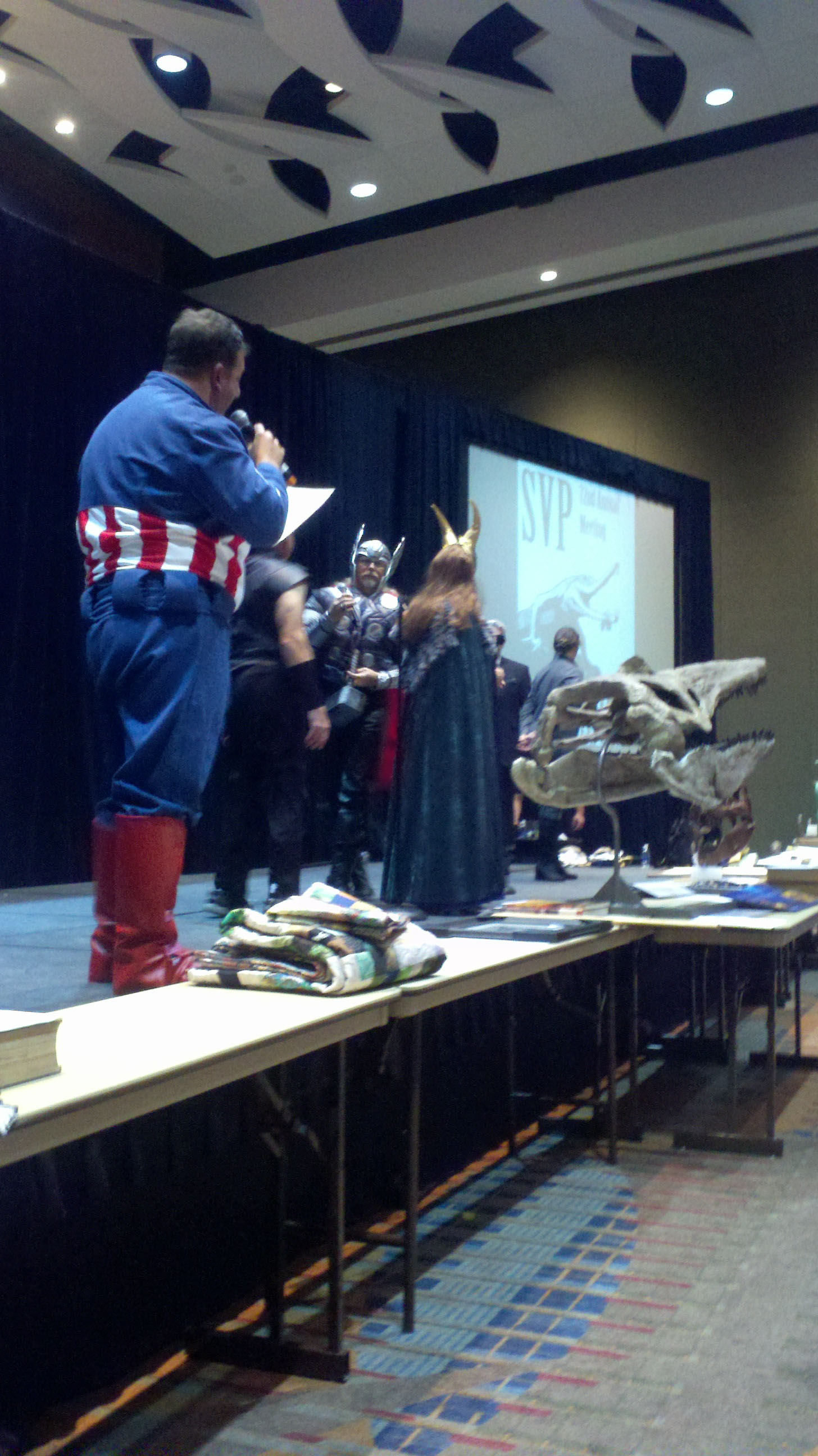
For me, one of the biggest parts of SVP is the annual auction. I’ve helped with the auction ever since I started graduate school and finally became a member of the auction committee sometime soon after getting my Ph.D. At first, it was always just a matter of helping with the set-up, but over the last 10 years, we’ve started dressing in costume with a theme for the live auction each year. Those of us on the committee put a great deal of time and effort (and sometimes money) into constructing our costumes. The theme is usually established sometime during the summer prior to the meeting, and we rush to create our costumes while simultaneously preparing our professional presentations for the meeting as well. This year, the theme was the Avengers. I chose to dress as Mockingbird, who did not appear in the movie, but has been in a few of the comics. I liked the look of her costume, which is why I chose her. She also has a Ph.D., so how can I go wrong?
Auction, Avengers-style.
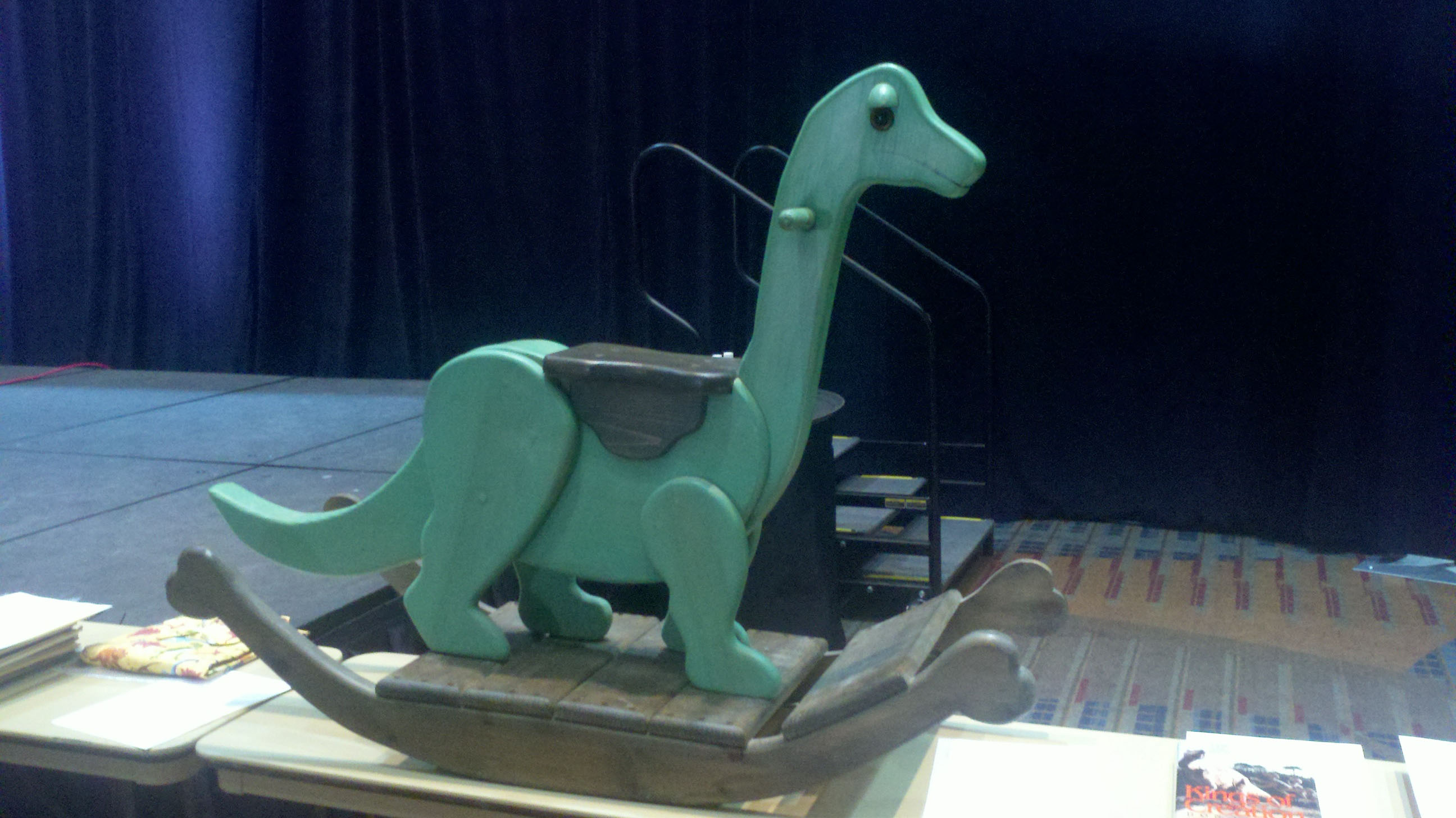
This year, I brought back an item I bought back in 2004: a big wooden rocking dinosaur. My son was an infant then. Now, at eight, he’s not so into the dinosaur. Hopefully, it’s off to make some other kid really happy and the auction winner will bring it back when his child has out-grown it.
The ol’ dino-rocker is off to a new home!
The auction raises money for various programs at SVP that support students. I’m glad to be able to help the society in this way. This year the auction made $22,700!
Dino-Thor?
As usual, I was able to drum up some new work for the lab while I was there, and perhaps start some new collaborations. I’m suddenly thinking an awful lot about microwear on teeth. I found out that what I presented was actually old news — only that the folks who had already done the same project kinda hadn’t bothered to publish it yet. (grumble) All told, this was one of the most productive meetings I have ever had. And somehow, I didn’t get sick during the whole event. I’m still healthy, two days after getting home. How’d that happen?
Well, while the iron’s hot, it’s time for me to attack some old research projects. There’s a short paper burning in me about the problems with the taxa Phenacodus and Tetraclaenodon. Then there’s that huge dataset that I tabulated as a postdoc that still hasn’t seen the light of publication. Yeah, I should get on that. I love this feeling of frantic motivation. I hope it lasts!
If you’re not satisfied with what I have to say about the meeting, then check out what others have said, (below). I’ll be updating this as I hear about other people’s posts.




 Penny Higgins - Storyteller • Artist • Scientist