Adventures in the Field – The High Arctic

Field work – what scientists do to study a certain phenomenon in its natural environment. For geology and paleontology, this means going out and crawling over the ground to find the necessary fossils or rocks.

One of the great mysteries of what I do as a paleontologist is the concept of field work. Last summer, I blogged about my field experiences as they were happening. I did this throughout last year’s 25-day field season. You can look at those posts here.

Now, I’d like to summarize ten days of field work I did in the High Arctic of Canada in 2012. What it’s like. What we’re trying to learn. This will be mostly through pictures.Continue reading “Adventures in the Field – The High Arctic”

Adventures in the Field – Hanna Basin

Field work – what scientists do to study a certain phenomenon in its natural environment. For geology and paleontology, this means going out and crawling over the ground to find the necessary fossils or rocks.

One of the great mysteries of what I do as a paleontologist is the concept of field work. Last summer, I blogged about my field experiences as they were happening. I did this throughout last year’s 25-day field season. You can look at those posts here.

Now, I’d like to summarize ten summers of field work in the Hanna Basin of Wyoming. What it’s like. What we’re trying to learn. This will be mostly through pictures.Continue reading “Adventures in the Field – Hanna Basin”

Field Work Travelogue – Day twenty-five

Today marks the last day of the field season and travel for 2013.

I’ve made it home relatively unscathed. The truck didn’t fare so well (but at least it got me home).

The check engine light has been on the whole trip. Apparently some sensor has gone wonky.

There was that flat tire which we fixed in the field.

image

A fuse was blown that same day, killing the power locks. Was able to fix that, too.

Alas, also that same day, the 4wd on the truck decided to quit working.

Oh yeah, and then there’s the matter of the gaping hole in the exhaust system that makes the truck sound rather ‘masculine.’ It’s so loud that my ears ar ringing now.

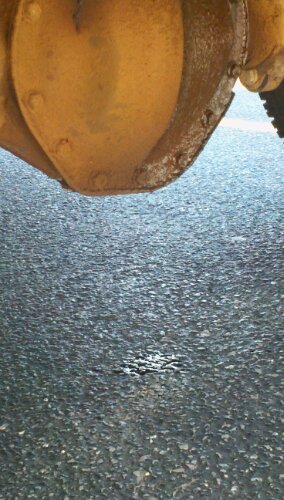
And then, for giggles, the rear end decided to start to leak.

image

And, it seems the right front speaker isn’t working.

But it started every time and the A/C worked like a champ.

And I’m home, so it doesn’t hardly matter any more.

Field Work Travelogue – Day twenty-four

All I can say is this: 586 miles to go. Then I’m home. My own bed.

Got through Iowa and Illinois today. Reconnected with I-90. Feel like I’m practically home.

I know I’m not home, but I will be soon.

In the meantime, last night I uploaded photos from the trip to Flickr, including this photo of the local ponies that roamed in the Uinta Basin.

Ponies 08-11-h

Field Work Travelogue – Day twenty-three

It was a travel day. Day two of four from the Uinta Basin to Rochester.

Today I spent all day driving across Nebraska. 534 miles. That’s a respectable day’s drive. Only 1077 miles to go. Only.

Some Nebraska highlights:

I drove past the Archway again...
I drove past the Archway again…

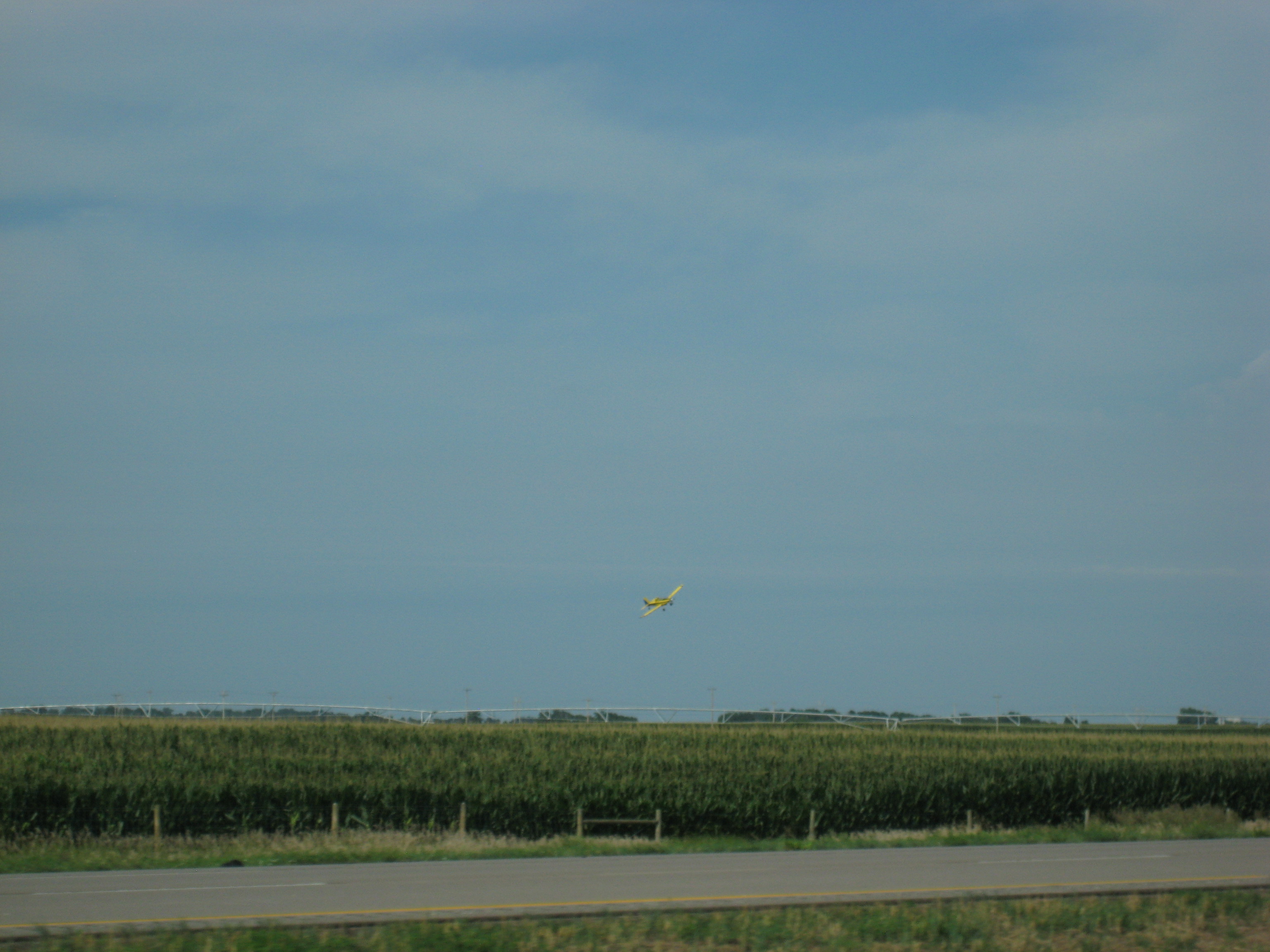
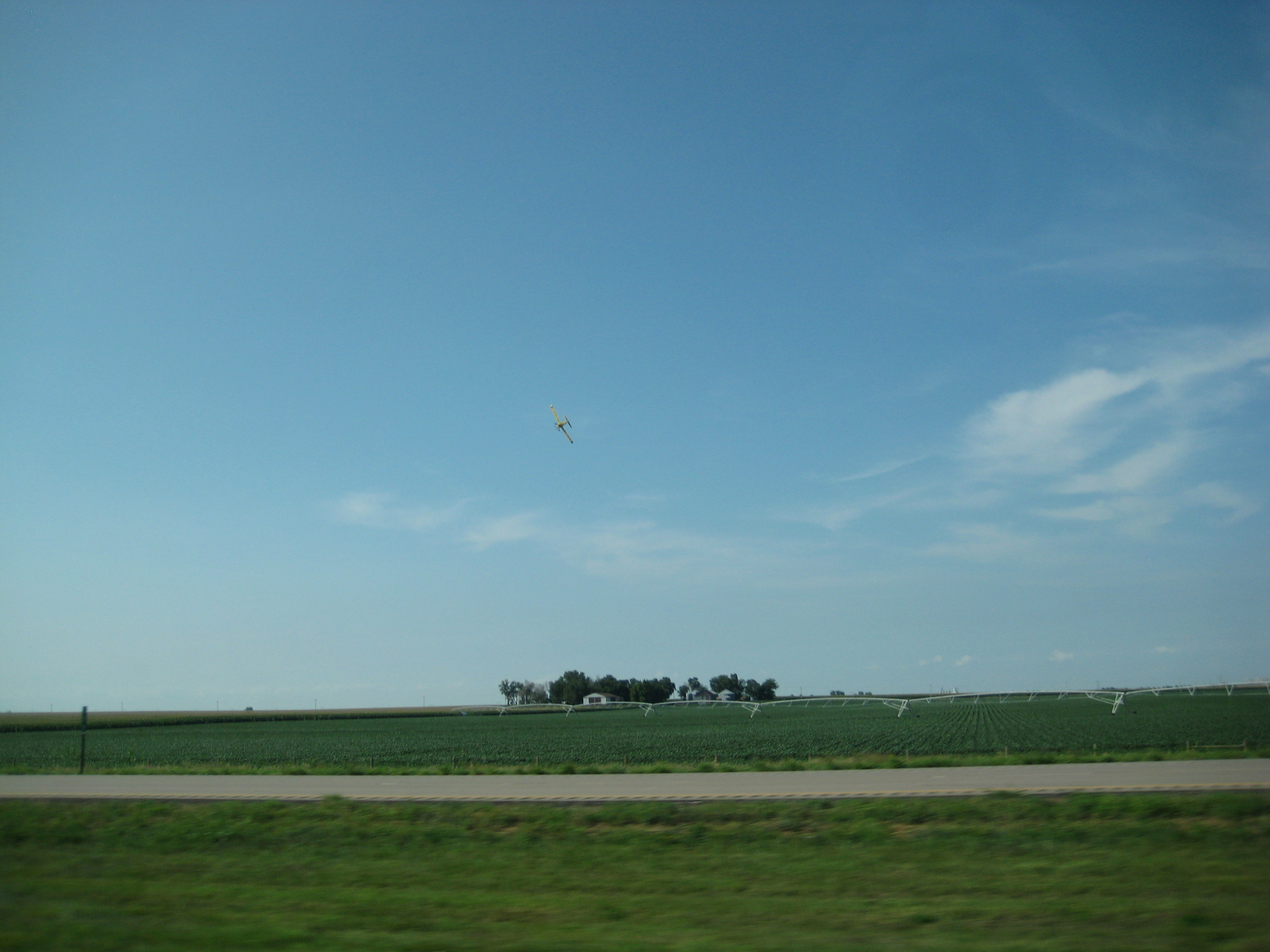
I still am impressed with the skills of cropduster pilots!

Cropduster aerobatics 1
Cropduster aerobatics 2

Tomorrow’s goal: to get past Chicago. Think I can do it? Let’s see!

Field Work Travelogue – Day twenty-two

Erhmahgherd! I need to blergh!

Today we broke camp and began the long voyage home. No photos today. All driving:

Dinosaur, CO
Craig, CO
Steamboat Springs, CO
Rabbit Ears Pass
Winter Park, CO
Berthoud Pass
Realization we missed a turn
Two hours longer than expected and we finally arrived for the night in Wellington, CO.

Now for dinner, an adult beverage, and sleep.

Field Work Travelogue – Day twenty-one

Today was the last day of field work. Only a partial day, but a worthy one.

We got a little lost looking for a locality, so we decided to spend some time prospecting where we were.

I found another fine specimen of Bovisassist primaevus, though not as nice as the one found earlier in the trip.

image

I also found a lovely fossil turtle, that we later jacketed.

image

Now we’ve broken down most of camp and are ready to leave in the morning.

Tonight, we’re having dinner at Vernal’s finest dining establishment, Golden Corral.

Then to bed for an early start in the morning…

Field Work Travelogue – Day twenty

The last full day of field work. Tomorrow is a partial day, then we’ll break camp. It’s kind of sad.

The day started with some difficulty. Apparently I ran over something on the way in last night.

image

Luckily, my colleagues had a tire patch kit and my little power pack was able to pump things all up again.

It was clean up day at our most-visited locality. We filled in some holes from jackets we collected, and quickly trenched and jacketed a couple more things.

image

This trench was a booger to dig. The rock was hard, and naturally the specimen was on a steep slope.

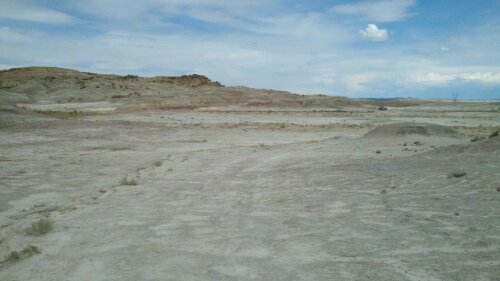
It was a rather desolate place to work, but I’ll miss being there.

image

There are still a few things to find, nevertheless.

image

The evening was wrapped up with cataloging all of the specimens we have collected.

image

And then the work really begins…

Field Work Travelogue – Day nineteen

I’m suddenly acutely aware that the field season is nearly over. Tomorrow is our last full day afield, and it will be filled with wrapping up unfinished business.

Today was fun, however. We visited a locality I hadn’t been to before. I found a big mammal jaw.

image

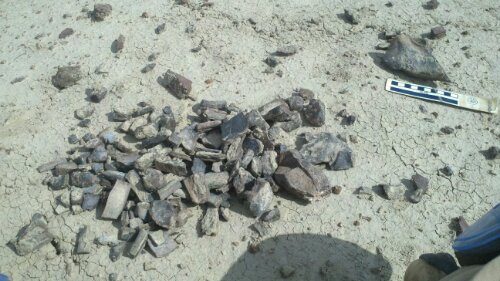
This only part of it. The rest is in this pile, I hope.

image

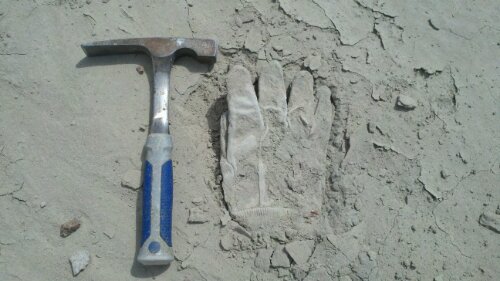
Then I found a fossil of Bovisassist primaevus, a very primitive relative of the Hamburger Helper glove-guy.

image

Then it was back to the same locality we’ve been visiting all this time. Here’s where a turtle (black bits) is exposed lying right on the contact between the lower green muds and upper red sands.

image

Now it’s beer thirty, and nearly time for dinner. Looking forward to tomorrow.

Field Work Travelogue – Day eighteen

Success!

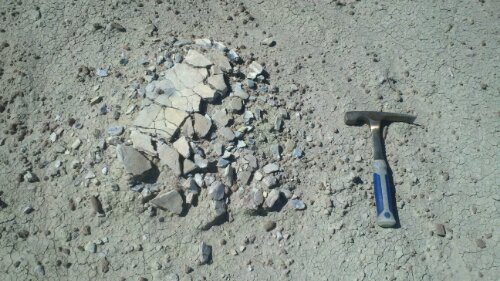
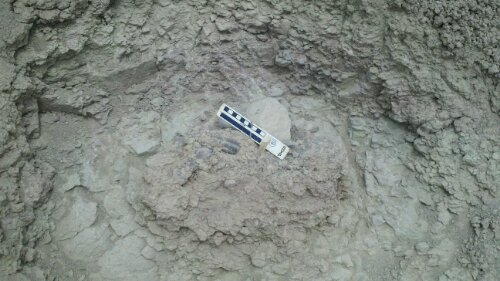
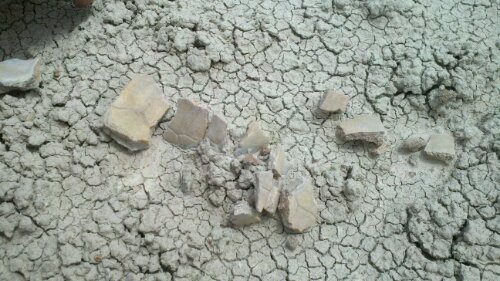
A nagging problem we have had is that we haven’t been able to figure out which layer in this broad locality is the productive layer for fossils. Fossils can be found all over on the surface, but they are almost always broken up and spread out due to processes of weathering.

image

It would be nice to know where the fossils are coming from so that we can collect complete, pristine specimens, rather than bagging up bits of bones that we hope all go together.

Today, we finally pinned it down. Though vertebrate fossils may be found anywhere in the rocks, they are concentrated on the surface between the greenish beds and the reddish beds.

image
It may be hard to see, but the blade of the hammer lies on the contact between the green and white layers. Fossil bone is seen weathering out to the left of the hammer.

In some places there’s little pebbles and sandstone on this contact. Now all we need to do is figure out what that means.

We’ll be going back tomorrow!