The Archaeopteryx that was neither Archaeopteryx nor Pterodactylus – #365papers – 2018 – 2

Foth and Rauhut, 2017, Re-evalutation of the Haarlem Archeopteryx and the radiation of maniraptoran theropod dinosaurs: BMC Evolutionary Biology, v. 17, 236.

What’s it about?

Archeopteryx is a fossil theropod that is known only from limestones of Bavaria, Germany. The Haarlem specimen is incomplete. Initially, it was thought to be a pterosaur, then was later discovered to be a dinosaur and assigned to the genus Archaeopteryx. The authors here show that though it is a dinosaur, it is actually not Archeopteryx and name a new genus, Ostromia.Continue reading “The Archaeopteryx that was neither Archaeopteryx nor Pterodactylus – #365papers – 2018 – 2”

Carboniferous Glaciers of Chad – #365papers – 2018 – 1

Le Heron, 2018, An exhumed Paleozoic glacial landscape in Chad: Geology, v. 46, p. 91-94.

What’s it about?

Rocks of early Carboniferous age (mid-Mississippian, about 340 million years ago) in Chad show evidence of the passage of glaciers. Today, this part of the world is largely desert. This paper discusses the evidence for ancient glaciers and shows that they are not modern features of the wind.Continue reading “Carboniferous Glaciers of Chad – #365papers – 2018 – 1”

Reading, Reading, Science Reading – #365 papers – June 2017

It’s a little difficult to keep up with individual blog posts for every paper I read for #365papers, for for the next three months you can expect one summary post per month, just like this one…

#365papers for June 2017Continue reading “Reading, Reading, Science Reading – #365 papers – June 2017”

Does Anyone Really Know How Many Kinds of Birds There Are? – #365papers – 2017 – 151

#365papers for May 31, 2017

Barrowclough, Cracraft, Klicka, and Zink, 2016, How many kinds of birds are there and why does it matter?: PlosONE, v. 11, e0166307.

What’s it about?

When discussing species diversity, especially in terms of conservation efforts, it’s important to have a good definition of ‘species.’ Here, the authors show that depending on how you define a species, there may be twice as many kinds of birds as we usually think.Continue reading “Does Anyone Really Know How Many Kinds of Birds There Are? – #365papers – 2017 – 151”

How Aluminum in Zircon Can Tell Us What Happened Billions of Years Ago – #365papers – 2017 – 150

#365papers for May 30, 2017

Trail, Tailby, Wang, Harrison, and Boehnke, 2017, Aluminum in zircon as evidence for peraluminous and metaluminous melts from the Hadean to present: Geochemistry, Geophysics, Geosystems, v. 18, p. 1580-1593.

What’s it about?

Zircon is a mineral that forms in igneous rocks. As the rocks erode away, the zircons often survive and can be mixed into younger rocks, including new igneous rocks. Here, the authors use the concentration of aluminum in the zircons to determine the type of igneous rock the zircon originally formed in.Continue reading “How Aluminum in Zircon Can Tell Us What Happened Billions of Years Ago – #365papers – 2017 – 150”

The Magnetic Field and Aurorae of Jupiter – #365papers – 2017 – 149

#365papers for May 28, 2017

Connerney and 21 others, 2017, Jupiter’s magnetosphere and aurorae observed by the Juno spacecraft during its first polar orbits: Science, v.356, p. 826-832.

What’s it about?

With the instrumentation on the Juno spacecraft, scientists can now measure the strength and shape of the magnetic field around Jupiter and explore the planet’s aurorae (like our Aurora Borealis).Continue reading “The Magnetic Field and Aurorae of Jupiter – #365papers – 2017 – 149”

Peeking Under Jupiter’s Clouds – #365papers – 2017 – 148

#365papers for May 28, 2017

Bolton and 42 others, 2017, Jupiter’s interior and deep atmosphere: The initial pole-to-pole passes with the Juno spacecraft: Science, v. 356, p. 821-825.

What’s it about?

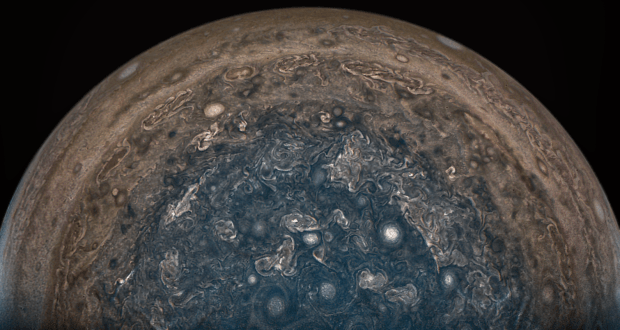
We finally have a spacecraft close enough to Jupiter that we can take photos of the planet’s poles and better understand what is happening below the cloud tops.

Jupiter’s south pole. Credits: NASA/JPL-Caltech/SwRI/MSSS/John Landino

Continue reading “Peeking Under Jupiter’s Clouds – #365papers – 2017 – 148”

Calcium Can Tell Us About Ancient Ecosystem Structure – #365papers – 2017 – 147

#365papers for May 27, 2017

Martin, Vincent, Tacail, Khaldoune, Jourani, Bardet, Balter, 2017, Calcium isotopic evidence for vulnerable marine ecosystem structure prior to the K/Pg extinction: Current Biology, v. 27

What’s it about?

The variations of the amounts of stable isotopes (that is non-radioactive) found in rocks and fossils can be used to help us understand patterns of weather, of vegetation, and of who’s eating whom in modern and fossil rocks, bones, teeth, and shells. Most of the time carbon, oxygen, and nitrogen are used for this.

The authors here show that calcium isotopes can be used to understand tropic level (where organisms are on the food chain) in modern and fossil animals. Their work shows that large marine reptiles likely went extinct at the end of the Permian Period because they all lived at the same trophic level. There was some sort of ecological change that eradicated their food supply and the marine reptiles could not recover.Continue reading “Calcium Can Tell Us About Ancient Ecosystem Structure – #365papers – 2017 – 147”

Extinction in the Permian – #365papers – 2017 – 146

#365papers for May 26, 2017

Lucas, 2017, Permian tetrapod extinction events: Earth-Science Reviews, v. 170, p. 31-60.

What’s it about?

The Permian ended with the largest marine extinction ever to strike the Earth, with 95% of species going extinct. This paper discusses life on land, specifically tetrapods (amphibians and reptiles at that time) and how they went extinct.Continue reading “Extinction in the Permian – #365papers – 2017 – 146”