How Can We Know When The Earth’s Atmosphere Became Oxygenated? – #365papers – 2018 – 31

Eickmann, Hofmann, Wille, Bui, Wing, and Schoenberg, 2018, Isotopic evidence for oxygenated Mesoarchaean shallow oceans: Nature Geoscience, v. 11, p. 133–138.

What’s it about?

Sulfur and iron atoms come in different sizes, called isotopes. The relative amounts of these isotopes can tell us a lot. In this paper, isotopes of sulfur are used to recognize active metabolism of microbes that use sulfur in their metabolic processes. These results, combined with results from isotopes of iron, provide evidence not only of the activities of life, but also show that there was some oxygen in the atmosphere at that time, enough to oxygenate shallow water but not deep water of the ocean.Continue reading “How Can We Know When The Earth’s Atmosphere Became Oxygenated? – #365papers – 2018 – 31”
Sabertooth, Sabertooth, How Do Your Teeth Grow? – #365papers – 2018 – 30

Feranec, 2004, Isotopic evidence of saber-tooth development, growth rate, and diet from the adult canine of Smilodon fatalis from Rancho La Brea: Palaeogeography, Palaeoclimatology, Palaeoecology, v. 206, p. 303-310.

What’s it about?

Sabertoothed mammals are so named because of their massive, elongate canines. A natural question to ask is, how does it get so long? The major ideas are that the teeth grow for a very long time (which would affect how the animals survived before the teeth were fully grown), that they grew very quickly, or some combination.

The author uses isotopes of oxygen from the tooth enamel of some adult sabertooth tigers (Smilodon fatalis) to estimate how long it tooth the tooth to grow. This he compares with known growth rates and timing of development of modern lions and tigers to see how it compares. Continue reading “Sabertooth, Sabertooth, How Do Your Teeth Grow? – #365papers – 2018 – 30”

How Do Hyenas Chew Bones Without Shattering Their Own Teeth? – #365papers – 2018 – 29

Rensberger and Wang, 2005, Microstructural reinforcement in the canine enamel of the hyaenid Crocuta crocuta, the felid Puma concolor, and the Late Miocene canid Borophagus secundus: Journal of Mammalian Evolution, v. 12, p. 379-403.

What’s it about?

Hyenas break bones with their teeth. Mountain lions do not. If a mountain lion tried to break a bone with its teeth, it is likely to break a tooth instead. Evidence for bone breaking in mammal carnivores is seen in the shape of the jaw and the arrangement of jaw musculature. Based on this, it appears that the fossil carnivore Borophagus was also a bone breaker. The authors here discuss evidence from the microstructure of tooth enamel that shows differences between bone crushing and non bone crushing mammals. They compare the structure of the teeth of Borophagus with these differences to show that Borophagus probably was also a bone crushing carnivore.Continue reading “How Do Hyenas Chew Bones Without Shattering Their Own Teeth? – #365papers – 2018 – 29”

Fossilized Burrows Tell an Environmental Tale – #365papers – 2018 – 28

King, Gates, Gingras, Zanno, and Pemberton, 2018, Transgressive erosion expressed as a Glossifungites-bearing woodground: An example from the Blackhawk Formation, Utah: Palaios, v. 22, p. 29-35.

What’s it about?

Animals living in the ground leave traces of their burrows and feeding habits. These traces are called ichnofossils, and speak volumes about the environment in which the organisms lived. In this paper, the authors talk about an ichnofossil called Glossifungites, which are U- or tongue-shaped burrows that were later filled with sediment. The authors discuss how Glossifungites, along side two other trace fossils called Thalassinoides and Teredolites, indicate a region that was eroded off during transgression of an ocean (the movement of the shoreline inland, potentially due to sea level rising).Continue reading “Fossilized Burrows Tell an Environmental Tale – #365papers – 2018 – 28”

Something Something Sulfides Cobbles Granite and Collision – #365papers – 2018 – 27

Whalen, Zagorevski, McNicoll, and Rogers, 2013, Geochemistry, U-Pb geochronology, and genesis of granitoid clasts in transported volcanogenic massive sulfide ore deposits, Buchans, Newfoundland: Canadian Journal of Earth Sciences, v. 50, p. 1116-1133.

What’s it about?

This paper is about some massive sulfide deposits (good places to finding sulfur, zinc, iron, and lead) that occur in the middle of Newfoundland. The deposits come in several forms and are associated with some igneous rocks (granites). The authors explore whether the different forms of deposits and their associated granites all occurred at the same time, from the same original volcanic source, or are from different sources.Continue reading “Something Something Sulfides Cobbles Granite and Collision – #365papers – 2018 – 27”

Those Tracks Really Were Made by Feet – #365papers – 2018 – 26

Qvarnstrom, Szrek, Ahlberg, and Niedzwiedzki, 2018, Non-marine palaeoenvironment associated to the earliest tetrapod tracks: Scientific Reports, v. 8, 1074.

What’s it about?

Ichnofossils – the tracks and traces left by the activities of organisms – are some of the oldest evidence of life and certain activities in the rock record. Foot prints, specifically those made on land by animals with toes, are the first evidence of tetrapods, the land-dwelling vertebrates.

It had been argued that footprints from Zachelmie (middle Devonian) weren’t good evidence for land-dwelling vertebrates because they were made in ocean sediments. The authors here show that the rocks are actually deposits of ephemeral lakes, showing that the ichnofossils do represent real land-dwelling vertebrates.Continue reading “Those Tracks Really Were Made by Feet – #365papers – 2018 – 26”

Clarifying Medusaceratops – #365papers – 2018 – 25

Chiba, Ryan, Fanti, Loewen, and Evans, 2017, New material and systematic re-evaluation of Medusaceratops lokii (Dinosauria, Ceratopsidae) from the Judith River Formation (Campanian, Montana): Journal of Paleontology, doi: 10.1017/jpa. 2017.62.

What’s it about?

Medusaceratops lokii was named in 2010 by Ryan, Russell, and Hartman. This new paper revises the description of Medusaceratops using some new fossil material.  With the new description, the authors then do a new analysis of the evolutionary position of Medusaceratops.

Why does it matter?

This revision helps explain some of the unexpected characteristics of Medusaceratops by showing that Medusaceratops had been mis-categorized in the first place. In order to understand how evolution occurs, it’s important to have the relationships among animals in the right order.

Why did I read this?

I was kind of tired of geochemistry papers, so dinosaurs seemed like a good idea.

BREAKING! How Part of Canada got Stuck to Australia – #ScienceNews

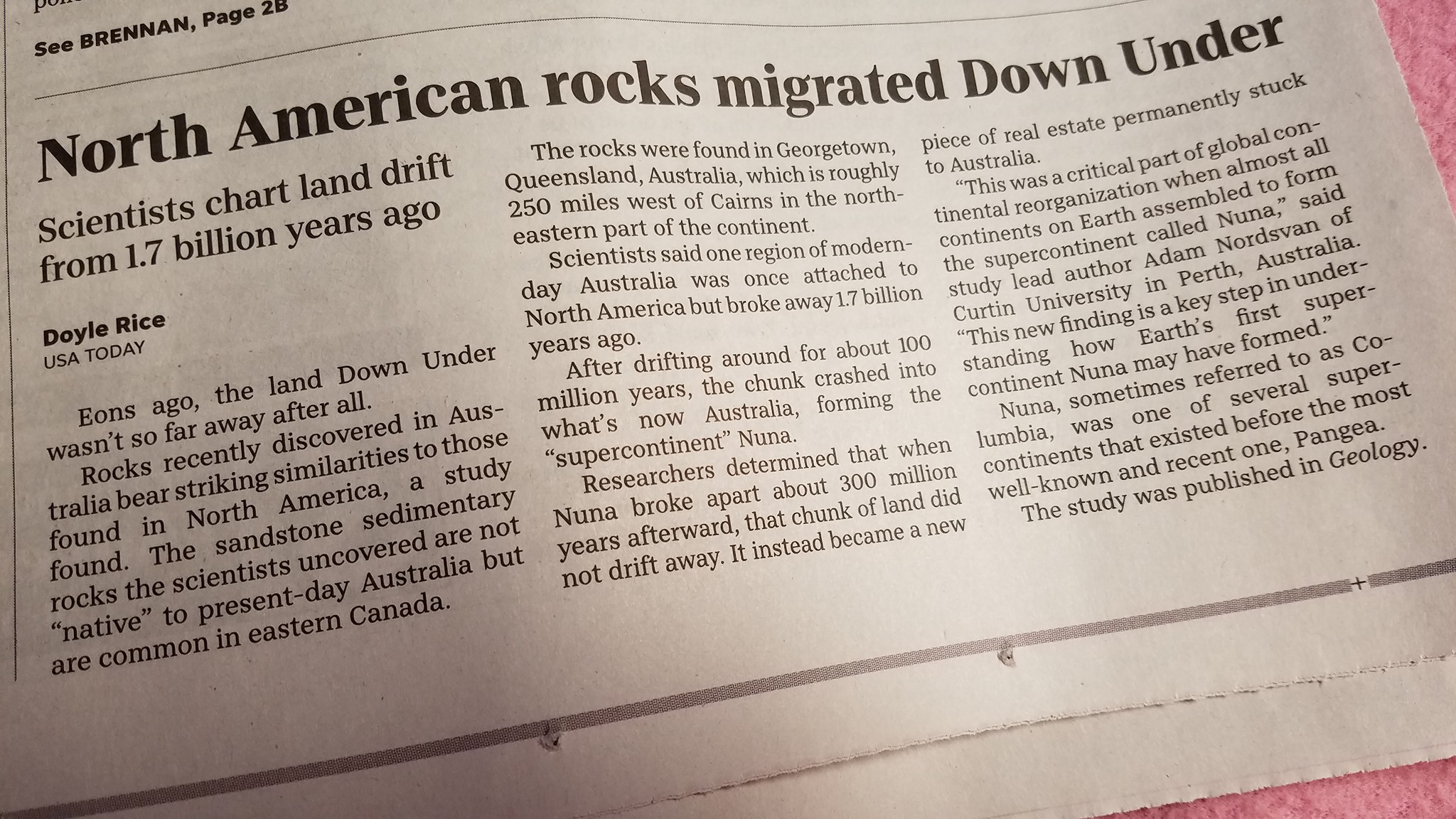
This morning, while reading the newspaper, my eye caught this on the front page:

  Scientists chart land drift from 1.7 billion years ago  Doyle Rice  USA TODAY  Eons ago, the land Down Under wasn’t so far away after all.  Rocks recently discovered in Australia bear striking similarities to those found in North America, a study found. The sandstone sedimentary rocks the scientists uncovered are not "native" to present-day Australia but are common in eastern Canada.  The rocks were found in Georgetown, Queensland, Australia, which is roughly 250 miles west of Cairns in the northeastern part of the continent.  Scientists said one region of modernday Australia was once! attached to North America but broke away 1.7 billion years ago.  After drifting around for about 100 million years, the chunk crashed into what’s now Australia,  forming the "supercontinent" Nuna.  Researchers determined that when Nuna broke apart about 300 million years afterward, that chunk of land did not drift away. It instead became a new piece of real estate permanently stuck to Australia.  "This was a critical part of global continental reorganization when almost all continents on Earth assembled to form the supercontinent called Nuna," said study lead author Adam Nordsvan of Curtin University in Perth, A! ustralia. "This new finding is a key step in understanding ho! w Earth’s first supercontinent Nuna may have formed."  Nuna, sometimes referred to as Columbia, was one of several supercontinents that existed before the most well-known and recent one, Pangea.  The study was published in Geology.
Title reads: North American rocks migrated Down Under.
Photo from the Rochester Democrat and Chronicle.

This naturally piqued my attention.

So I found the original paper.

Nordsvan, Collins, Li, Spencer, Pourteau, Withnall, Betts, and Volante, 2018, Laurentian crust in northeast Australia: Implications for the assembly of the supercontinent Nuna: Geology, doi: https://doi.org/10.1130/G39980.1

Let me distill this in my own way…Continue reading “BREAKING! How Part of Canada got Stuck to Australia – #ScienceNews”

What X-Rays and Absorptions Really Tell Us About Fossilization – #365papers – 2018 – 24

Stathopoulou, Psycharis, Chryssikos, Gionis, and Theodorou, 2008, Bone diagnesis: New data from infrared spectroscopy and X-ray diffraction: Palaeogeography, Palaeoclimatology, Palaeoecology, v. 266, p. 168-174.

What’s it about?

The authors here use two different methods to gain a sense of the changes in the shapes and sizes of crystals of the bone mineral bioapatite due to the process of fossilization. They also consider the various differences in composition (i.e. how much fluorine, hydroxyl, or carbonate) is present in the bioapatite. While this is done nominally to look at the effects of fossilization, it appears to be better at fingerprinting different localities.Continue reading “What X-Rays and Absorptions Really Tell Us About Fossilization – #365papers – 2018 – 24”

Why Can’t We Just Measure Alteration of Bone Due To Fossilization? – #365papers – 2018 – 23

Trueman, Privat, and Field, 2008, Why do crystallinity values fail to predict the extent of diagenetic alteration of bone mineral? Palaeogeography, Palaeoclimatology, Palaeoecology, v. 266, p. 160-167.

What’s it about?

Bones are composed of little crystals of the mineral referred to as bioapatite with organic materials (collagen, blood vessels, and cells that regulate the growth of bioapatite, etc) spread throughout. When an animal dies, the organic materials decay and the bioapatite crystals change their shape and size. There are methods by which we can readily measure the shape and size of the crystals, which, presumably, would tell us just how altered the bones are due to the fossilization process. This would then let us know how accurate any geochemical analyses we do with the bone are.

Only that the shape and size of bone crystals doesn’t actually work as a good measure of the alteration due to fossilization. Continue reading “Why Can’t We Just Measure Alteration of Bone Due To Fossilization? – #365papers – 2018 – 23”