
How Can We Know How Much Global Warming is Responsible for Extreme Weather? – #365papers – 2017 – 115

#365papers for April 25, 2017

Diffenbaugh, Singh, Mankin, Horton, Swain, Touma, Charland, Liu, Haugen, Tsiang, and Rajaratnam, 2017, Quantifying the influence of global warming on unprecedented extreme climate events: Proceedings of the National Academy of Science, doi: 10.1073/pnas.1618082114

What’s it about?

Global warming is an important issue in the modern world. Many people are attributing extreme weather events – hurricanes, droughts, flooding, etc. – to global climate change. This paper is an attempt to assess and quantify how much global warming was an influence for such events.Continue reading “How Can We Know How Much Global Warming is Responsible for Extreme Weather? – #365papers – 2017 – 115”
How Do You Break Down Wood to Make Bioethanol? – #365papers – 2017 – 114

#365papers for April 24, 2017

Grigoras, Stroe, Sintamarean, and Rosendahl, 2017, Effect of biomass pretreatment on the product distribution ad composition resulting from the hydrothermal liquefaction of short rotation coppice willow: Bioresource Technology, v. 231, p. 116-123.

What’s it about?

There are lots of ways to pretreat wood in order to optimize the ability to get ethanol out of it. Here, the authors discuss using water, heat, and alkaline solutions to prepare willow for hydrothemal liquifaction to get ethanol out.Continue reading “How Do You Break Down Wood to Make Bioethanol? – #365papers – 2017 – 114”

Making Ethanol? Grow Black Locust – #365papers – 2017 – 113

#365papers for April 23, 2017

Gonzalez-Garcia, Moreira, Feijoo, and Murphy, 2012, Comparative life cycle assessment of ethanol production from fast-growing wood crops (black locust, eucalyptus and poplar): Biomass & Bioenergy, v. 39, p. 378-388.

What’s it about?

Fast growing wood is a potential source for sugars that can be fermented to alcohols. This paper discusses three of the most commonly grown woods and their relative ‘goodness’ for use as a source for ethanol.Continue reading “Making Ethanol? Grow Black Locust – #365papers – 2017 – 113”

How Best Can We Ferment Sugar and Starch to Make Ethanol? – #365papers – 2017 – 112

#365papers for April 22, 2017

Bai, Anderson, and Moo-Young, 2008, Ethanol fermentation technologies from sugar and starch feedstocks: Biotechnology Advances, v. 26, p. 89-105.

What’s it about?

This paper compares in detail the fermentation capabilities of two different microorganisms, Saccharomyces cerevisiae (yeast) and Zymomonas mobilis (bacteria) for making ethanol from organic materials. Each have their pros and cons, thought it appears that overall Saccharomyces is the better alternative.

The authors also discuss challenges with the fermentation process, especially with obtaining a pure resultant ethanol while maintaining a healthy population of microorganisms.Continue reading “How Best Can We Ferment Sugar and Starch to Make Ethanol? – #365papers – 2017 – 112”

How Best Can We ‘Grow’ Ethanol? – #365papers – 2017 – 111

#365papers for April 21, 2017

Sanchez and Cardona, 2008, Trends in biotechnological production of fuel ethanol from different feedstocks: Bioresource Technology, v. 99, p. 5270-5295.

What’s it about?

This paper a review paper summarizing all the various sources of bioethanol (derived from crops) and the methods for obtaining that ethanol.Continue reading “How Best Can We ‘Grow’ Ethanol? – #365papers – 2017 – 111”

Ethanol Can Help – #365papers – 2017 – 110

#365papers for April 20, 2017

Farrell, Plevin, Turner, Jones, O’Hare, and Kammen, 2006, Ethanol can contribute to energy and environmental goals: Science, v. 311, p. 506-508.

What’s it about?

An important question about producing ethanol from crops is whether or not the energy costs of production outweigh the energy gained from the ethanol produced. The authors here take six previous studies that had very different results and come up with a means to compare them. In doing so, they are able to show where ethanol can, in fact, yield greater energy than it costs to produce.Continue reading “Ethanol Can Help – #365papers – 2017 – 110”

Biofuels for Our Engines – #365papers – 2017 – 109

#365papers for April 19, 2017

Agarwal, 2007, Biofuels (alcohols and biodiesel) applications as fuels for internal combustion engines: Progress in Energy and Combustion Science, v. 33, p. 233-271.

What’s it about?

This lengthy paper is a summary of the types of biofuels (that is liquid fuels produced from crops) that can replace ethanol and diesel in common engines used for transportation and agriculture. It goes into the sources of such fuels, some of the mechanisms to make the fuels, and efficiencies.Continue reading “Biofuels for Our Engines – #365papers – 2017 – 109”

Isostylomys: A Rodent of Unusual Size – #365papers – 2017 – 107

#365papers for April 17, 2017

Rinderknecht, Bostelmann, annd Ubilla, 2017, Making a giant rodent: cranial anatomy and ontogenetic development in the genus Isostylomys (Mammalia, Hystricognathi, Dinomyidae): Journal of Systematic Palaeontology, DOI: 10.1080/14772019.2017.1285360.

What’s it about?

Isostylomys is (was) a giant rodent from the Miocene of Uruguay. By giant, I mean larger than the largest rodent today. I mean huge.

The authors here discuss the status of the genus and its relationships with other rodents. Importantly, they show how it is very possible that some species of South American large rodents might be juvenile forms of giant rodents like Isostylomys.Continue reading “Isostylomys: A Rodent of Unusual Size – #365papers – 2017 – 107”

The Shortest-Necked of the Long-Necked Elasmosaurs – #365papers – 2017 – 108

#365papers for April 18, 2017

Serratos, Druckenmiller, and Benson, 2017, A new elasmosaurid (Sauropterygia, Plesiosauria) from the Bearpaw Shale (Late Cretaceous, Maastrichtian) of Montana demonstrates multiple evolutionary reduction of neck length within Elasmosauridae: Journal of Vertebrate Paleontology e1278608.

What’s it about?

Elasmosaurids were marine reptiles that are considered a sub-group of the plesiosaurs. Distinctive features of elasmosaurids are their very long necks and small heads. Here, a new species of elasmosaurid is described that had a relatively short neck and was also fairly small.Continue reading “The Shortest-Necked of the Long-Necked Elasmosaurs – #365papers – 2017 – 108”

What Really Is Ichthyosaurus? – #365papers – 2017 – 106

#365papers for April 16, 2017

Massare and Lomax, 2017, A taxonomic reassessment of Ichthyosaurus communis and I. intermedius and a revised diagnosis for the genus: Journal of Systematic Paleontology. DOI: 10.1080/14772019.2017.1291116.

What’s it about?

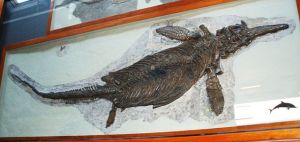
Ichthyosaurus is (or was) a type of marine reptile that looked sort of dolphin-like.

Ichthyosaurus communis from the Natural History Museum in London. Credit Gehdoghedo CC 3.0 By SA
Ichthyosaurus communis life reconstruction.
Credit: Nobu Tamura CC BY 3.0

Here, the authors work to distinguish between three common species of Ichthyosaurus, I. communis, I. intermedius, and I. breviceps. The authors also present a better definition for the genus Ichthyosaurus.Continue reading “What Really Is Ichthyosaurus? – #365papers – 2017 – 106”