Something Something Sulfides Cobbles Granite and Collision – #365papers – 2018 – 27

Whalen, Zagorevski, McNicoll, and Rogers, 2013, Geochemistry, U-Pb geochronology, and genesis of granitoid clasts in transported volcanogenic massive sulfide ore deposits, Buchans, Newfoundland: Canadian Journal of Earth Sciences, v. 50, p. 1116-1133.

What’s it about?

This paper is about some massive sulfide deposits (good places to finding sulfur, zinc, iron, and lead) that occur in the middle of Newfoundland. The deposits come in several forms and are associated with some igneous rocks (granites). The authors explore whether the different forms of deposits and their associated granites all occurred at the same time, from the same original volcanic source, or are from different sources.Continue reading “Something Something Sulfides Cobbles Granite and Collision – #365papers – 2018 – 27”
Those Tracks Really Were Made by Feet – #365papers – 2018 – 26

Qvarnstrom, Szrek, Ahlberg, and Niedzwiedzki, 2018, Non-marine palaeoenvironment associated to the earliest tetrapod tracks: Scientific Reports, v. 8, 1074.

What’s it about?

Ichnofossils – the tracks and traces left by the activities of organisms – are some of the oldest evidence of life and certain activities in the rock record. Foot prints, specifically those made on land by animals with toes, are the first evidence of tetrapods, the land-dwelling vertebrates.

It had been argued that footprints from Zachelmie (middle Devonian) weren’t good evidence for land-dwelling vertebrates because they were made in ocean sediments. The authors here show that the rocks are actually deposits of ephemeral lakes, showing that the ichnofossils do represent real land-dwelling vertebrates.Continue reading “Those Tracks Really Were Made by Feet – #365papers – 2018 – 26”

Clarifying Medusaceratops – #365papers – 2018 – 25

Chiba, Ryan, Fanti, Loewen, and Evans, 2017, New material and systematic re-evaluation of Medusaceratops lokii (Dinosauria, Ceratopsidae) from the Judith River Formation (Campanian, Montana): Journal of Paleontology, doi: 10.1017/jpa. 2017.62.

What’s it about?

Medusaceratops lokii was named in 2010 by Ryan, Russell, and Hartman. This new paper revises the description of Medusaceratops using some new fossil material.  With the new description, the authors then do a new analysis of the evolutionary position of Medusaceratops.

Why does it matter?

This revision helps explain some of the unexpected characteristics of Medusaceratops by showing that Medusaceratops had been mis-categorized in the first place. In order to understand how evolution occurs, it’s important to have the relationships among animals in the right order.

Why did I read this?

I was kind of tired of geochemistry papers, so dinosaurs seemed like a good idea.

BREAKING! How Part of Canada got Stuck to Australia – #ScienceNews

This morning, while reading the newspaper, my eye caught this on the front page:

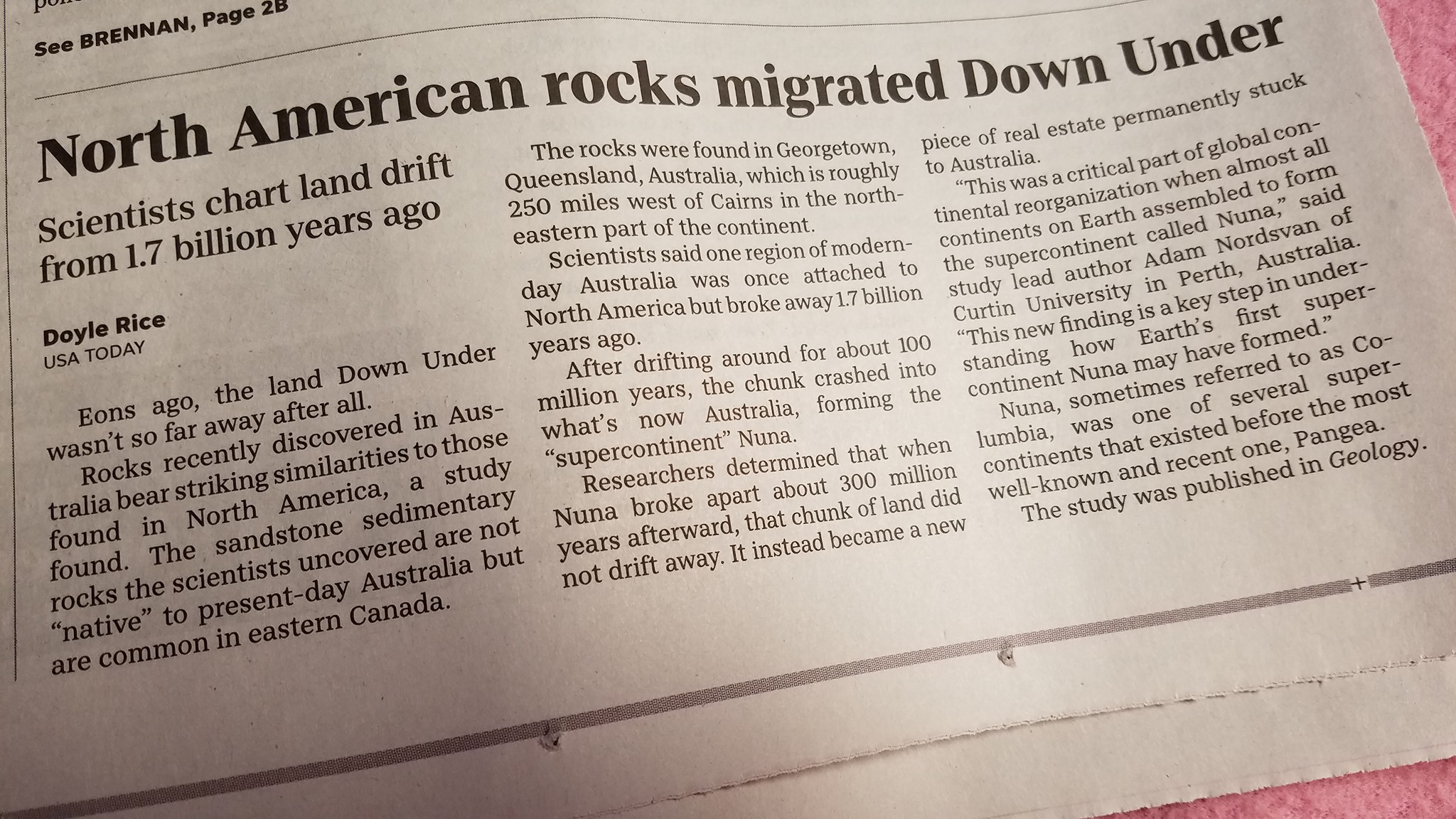
  Scientists chart land drift from 1.7 billion years ago  Doyle Rice  USA TODAY  Eons ago, the land Down Under wasn’t so far away after all.  Rocks recently discovered in Australia bear striking similarities to those found in North America, a study found. The sandstone sedimentary rocks the scientists uncovered are not "native" to present-day Australia but are common in eastern Canada.  The rocks were found in Georgetown, Queensland, Australia, which is roughly 250 miles west of Cairns in the northeastern part of the continent.  Scientists said one region of modernday Australia was once! attached to North America but broke away 1.7 billion years ago.  After drifting around for about 100 million years, the chunk crashed into what’s now Australia,  forming the "supercontinent" Nuna.  Researchers determined that when Nuna broke apart about 300 million years afterward, that chunk of land did not drift away. It instead became a new piece of real estate permanently stuck to Australia.  "This was a critical part of global continental reorganization when almost all continents on Earth assembled to form the supercontinent called Nuna," said study lead author Adam Nordsvan of Curtin University in Perth, A! ustralia. "This new finding is a key step in understanding ho! w Earth’s first supercontinent Nuna may have formed."  Nuna, sometimes referred to as Columbia, was one of several supercontinents that existed before the most well-known and recent one, Pangea.  The study was published in Geology.
Title reads: North American rocks migrated Down Under.
Photo from the Rochester Democrat and Chronicle.

This naturally piqued my attention.

So I found the original paper.

Nordsvan, Collins, Li, Spencer, Pourteau, Withnall, Betts, and Volante, 2018, Laurentian crust in northeast Australia: Implications for the assembly of the supercontinent Nuna: Geology, doi: https://doi.org/10.1130/G39980.1

Let me distill this in my own way…Continue reading “BREAKING! How Part of Canada got Stuck to Australia – #ScienceNews”

What X-Rays and Absorptions Really Tell Us About Fossilization – #365papers – 2018 – 24

Stathopoulou, Psycharis, Chryssikos, Gionis, and Theodorou, 2008, Bone diagnesis: New data from infrared spectroscopy and X-ray diffraction: Palaeogeography, Palaeoclimatology, Palaeoecology, v. 266, p. 168-174.

What’s it about?

The authors here use two different methods to gain a sense of the changes in the shapes and sizes of crystals of the bone mineral bioapatite due to the process of fossilization. They also consider the various differences in composition (i.e. how much fluorine, hydroxyl, or carbonate) is present in the bioapatite. While this is done nominally to look at the effects of fossilization, it appears to be better at fingerprinting different localities.Continue reading “What X-Rays and Absorptions Really Tell Us About Fossilization – #365papers – 2018 – 24”

Why Can’t We Just Measure Alteration of Bone Due To Fossilization? – #365papers – 2018 – 23

Trueman, Privat, and Field, 2008, Why do crystallinity values fail to predict the extent of diagenetic alteration of bone mineral? Palaeogeography, Palaeoclimatology, Palaeoecology, v. 266, p. 160-167.

What’s it about?

Bones are composed of little crystals of the mineral referred to as bioapatite with organic materials (collagen, blood vessels, and cells that regulate the growth of bioapatite, etc) spread throughout. When an animal dies, the organic materials decay and the bioapatite crystals change their shape and size. There are methods by which we can readily measure the shape and size of the crystals, which, presumably, would tell us just how altered the bones are due to the fossilization process. This would then let us know how accurate any geochemical analyses we do with the bone are.

Only that the shape and size of bone crystals doesn’t actually work as a good measure of the alteration due to fossilization. Continue reading “Why Can’t We Just Measure Alteration of Bone Due To Fossilization? – #365papers – 2018 – 23”

Getting A Head: What Makes Vertebrates So Special? – #UREES270 – 2018

Gans and Northcutt, 1983, Neural crest and the origin of vertebrates: A new head: Science, v. 220, p. 268-273.

What’s it about?

One thing that is truly unique among organisms is the concentration of sensory organs in the head of vertebrates. Ancestors of the vertebrates lacked this head. The authors discuss the embryological origins of the complex sensory systems of the vertebrate head.Continue reading “Getting A Head: What Makes Vertebrates So Special? – #UREES270 – 2018”

Not Caring Makes Us More Honest – #365papers – 2018 – 22

Kim, Chiu, and Bregant, 2015, Unskilled and don’t want to be aware of it: The effect of self-relevance on the unskilled and unaware phenomenon: PlosONE, v. 10, e0130309

What’s it about?

This is a follow-up to the paper of Kruger and Dunning (1999), in which it was noted that low-performing individuals tend to overestimate their skill. In this paper, the authors take it one step further and show that this overestimation appears to be magnified when people place personal value or relevance on the results. That is, if individuals performing a task don’t identify with or see value in a task, they are much less likely to either over or underestimate their performance.Continue reading “Not Caring Makes Us More Honest – #365papers – 2018 – 22”

The Shape of Feathers Doesn’t Tell You How Well Birds Fly – #365papers – 2018 – 21

Wang, Nudds, Palmer, and Dyke, 2017, Primary feather vane asymmetry should not be used to predict the flight capabilities of feathered fossils: Science Bulletin, v. 62, p. 1227-1228.

What’s it about?

In modern bird, the primary flight feathers are asymmetrical. That is, if you compare the width of the feather on one side of the thick quill that goes the length of the feather with the width of the feather on the other side of the quill, they’re usually not the same. This asymmetry makes the feather capable of lift (like an airplane wing). This asymmetry is then interpreted to go hand-in-hand with birds being capable of flapping flight. From this, it is often thought that birds that lack asymmetrical feathers could not fly very well, if at all.Continue reading “The Shape of Feathers Doesn’t Tell You How Well Birds Fly – #365papers – 2018 – 21”

Carbon from Bone Mineral and Bone Collagen Tells Us Who’s Eating Whom – #365papers – 2018 – 20

Clementz, Fox-Dobbs, Wheatly, Koch, and Doak, 2009, Revisiting old bones: coupled carbon isotope analysis of bioapatite and collagen as an ecological and palaeoecological tool: Geological Journal, v. 44, p. 605-620.

What’s it about?

“Trophic level” is a term scientists use to describe where an organism lies in the food chain (or food web). Animals of high trophic level are the carnivores, and organisms low in tropic level are the primary producers, like algae, or other plants. In the middle are the herbivores (primary consumers) that eat the primary producers. This paper is a discussion of another means by which one can interpret trophic level of animals, particularly those for which we only have fossil evidence.Continue reading “Carbon from Bone Mineral and Bone Collagen Tells Us Who’s Eating Whom – #365papers – 2018 – 20”