A new species of Rhinograde mammal, Nasoperforator bouffoni, was described last week by a group of researchers at the Muséum d’histoire naturelle, in Paris. This is really exiting news in science, as we often (falsely) think that we’ve found and named all the living mammals that there are.

The Rhinogrades (or more affectionately, the Snouters) were originally described in the book, The Snouters: Form and Life of the Rhinogrades, by Harald Stümpke. The Rhinogrades are a new order of mammals known only from the island Hy-dud-dye-fee in the South Sea archipelago of Hi-yi-yi. They are noted for the incredible adaptations of their noses for locomotion and feeding.
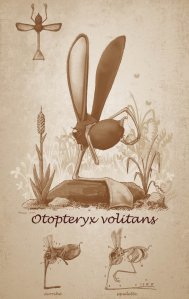
Stümpke proposes a family tree of the Order Rhinogradentia based upon 26 genera of Snouters described in the book. This sort of family tree, more properly called a ‘phylogram,’ is typically based upon a person’s gut feeling about the similarities among different species. It can be based upon a researcher’s experience and can be biased by a scientist’s pre-conceived notions about how things ought to be related. A better, more objective, way to approach relationships among different species is to use cladistic analysis (or cladistics).

If you’re remotely interested in paleontology, then you’ve probably heard of cladistics (or cladograms, or clades). Cladistics is one of those things in the science of paleontology that you have to know about. Some folks spend their entire careers focused on cladistic analysis. Others avoid cladistics vehemently. Nevertheless, there’s no escaping cladistics. If you want to know paleontology, you gotta know cladistics.
So then, what is cladistics if it’s so important? For me, it’s a topic that I took a full semester course on as a graduate student. My notes are in a binder labeled ‘sadistics,’ which goes a long way to describe just how I feel about cladistics. (I actually have two binders labeled ‘sadistics.’ The other one is for a class in which I learned about t-tests, f-tests, means, and standard deviations.)
But seriously, cladistics is a tool by which paleontologists (and biologists and botanists and geneticists) can mathematically determine the ‘relatedness’ of organisms. More generally, cladistics is used to determine evolutionary relationships, so we can determine who evolved from whom. It’s mathematical, and thus reproducible and computerizable, and comes replete with all sorts of statistics (the other sadistics) that can be used to support or refute proposed evolutionary pathways.
Fine.
But it’s also a bit of a nightmare.
The analysis starts by breaking a species down into a bunch of ‘characters’ for which there are, in the purest cladistics, only two states. The states for each character are entered as 0’s and 1’s in a matrix. Examples of well-behaved characters are:
| Character | Character state ‘0’ | Character state ‘1’ |
| Antorbital Fenestra (a skull opening seen in some dinosaurs) | Absent | Present |
| Palatine teeth (having teeth on the roof of the mouth) | Present | Absent |
Presence and absence characters are great. Unfortunately, not all characters can be broken easily into 0’s and 1’s.
| Character | Character state ‘0’ | Character state ‘1’ | Character state ‘2’ |
| Eye color | Blue | Brown | Hazel |
| Femur length (the thigh bone) | 0-10 inches | 12-18 inches | 20-19 inches |
And sometimes, characters obvious in several species are not known from others. For example, eye color is meaningless when considering eye-less animals, but if only one species in your analysis lacks eyes, then you need that character information for the other species. Another problem occurs when (especially in paleontology) an organism is only incompletely known. For example, toe characteristics aren’t helpful when one of the animals in your study is known only from its skull.
In principle, however, one needs only determine all the character states for a suite of characters for each organism in an analysis.
| Organism | Character 1 (hooves) | Character 2 (hair) | Character 3 (warm-blooded) | Character 4 (bones) | Character 5 (scales) | Character 6 (4-chambered heart) |
| Horse | 1 (has) | 1 (has) | 1 (has) | 1 (has) | 0 (doesn’t have) | 1 (has) |
| Cow | 1 (has) | 1 (has) | 1 (has) | 1 (has) | 0 (doesn’t have) | 1 (has) |
| Trout | 0 (doesn’t have) | 0 (doesn’t have) | 0 (doesn’t have) | 1 (has) | 1 (has) | 0 (doesn’t have) |
| Croco-stimpy | 0 (doesn’t have) | 0 (doesn’t have) | 0 (doesn’t have) | 1 (has) | 1 (has) | 1 (has) |
And then you use all the 1’s and 0’s to determine who’s most similar to (and thus more related to) whom. In the above case, if we look only at characters 1-5, one can see that horses and cows are very similar and related to each other, as are trout and croco-stimpies. But add character 6, and you can see that croco-stimpies are more similar to horses and cows than to trout, thus, one could infer that trout evolved into croco-stimpies which then evolved into horses and cows.
You’ve already got a headache, and it hasn’t even gotten complicated yet.
Enter the Rhinogrades.
For years, I’ve been handing my students copies of Stümpke’s book, and asking them to do a cladistic analysis of nine species (of their choice) of Snouters. Next time I’ll have them include the new species. The problem is that the students have to come up with their own characters and character states. Students quickly realize how important it is to choose good characters (and character states), and how difficult it can be to determine character states when all they have is an incomplete description of an organism. So, it’s actually a really great exercise (even if the students claim to hate it). The students turn in a cladogram and a list of characters and character states, and I compare their cladogram with the one I’ve devised based off of Stümpke’s family tree.

And when they’re all done, then I tell them.
It’s a hoax. There’s no Hi-Yi-Yi. No Nasoperforator. But it was fun, wasn’t it?








 Penny Higgins - Storyteller • Artist • Scientist