Blatherings on Mammoths

On Saturday, I’ll be giving an hour-long presentation to some seniors (you know, the over 55 set) on the topic of “Woolly Mammoths in New York State.” Well, it’s a pretty nebulous topic, and I only have an hour, so that means I can direct my presentation in pretty-much any direction I want.

You know some paleobiology is going to go in there. What is the difference between a mammoth and a mastodon, for example. And why are they extinct? Someone’s going to ask why we don’t find dinosaurs in New York. Naturally, I have to talk about geochemistry, too, since I might have done a little work with that (see my other blog post).

I guess the obvious thing for me to start with is to explain what a mammoth is, ‘cause it’s not just a big fuzzy elephant!

What is a mammoth?

Mammoths, mastodons and elephants are in a larger group of mammals called proboscidians, so named in reference to their big long noses. Mammoths and elephants are actually very similar, in skeletal and in tooth structure. Mastodons have very different looking teeth, which is an important distinction between to two ice-age dwelling proboscidian groups.
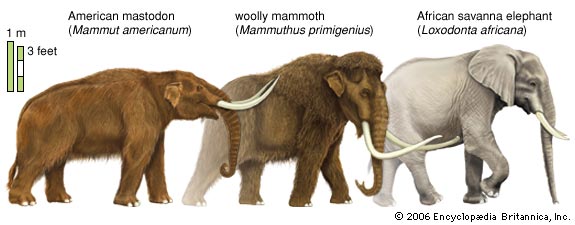
Mastodon, Mammoth, and Elephant for comparison

Mammoths (and modern elephants) have teeth composed of a series of plates, that form a washboard-like grinding surface which is perfect for the foods that they eat. Both elephants and Mammoths are (or were) grazing animals (like cattle are today). Mastodon teeth are smaller and have several huge cusps, which aren’t so great for grazing but are good for eating leaves and such. Mastodons were browsers, much like giraffes, for example. Because they had different diets, they were able to coexist.

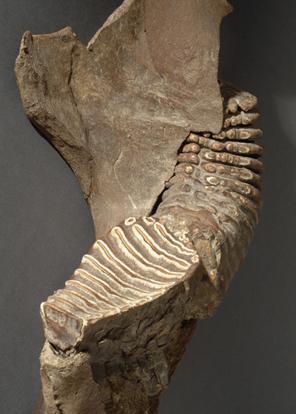
Asiatic elephant tooth
Mammoth teeth still in the jaw
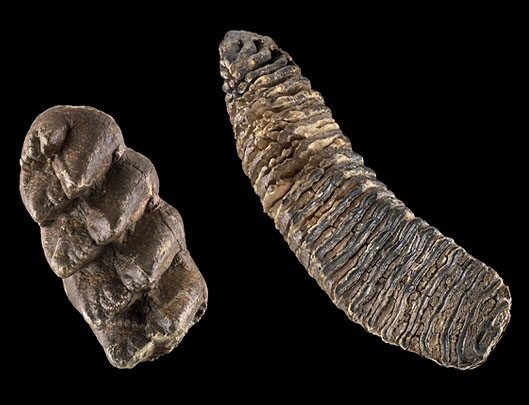
Mastodon tooth (left) and Mammoth tooth (right)

The structure of the teeth is the easiest way to distinguish between mammoths and mastodons, but their skeletal structures are also distinct. Mammoths tend to be taller in the front end than in the back end, their heads held high – the top of the head being slightly higher than the shoulder. Mastodons are a little stockier, with their head often slightly lower than the shoulder.

Mastodon skeleton (left) and Mammoth skeleton (right)

Types of Mammoths

Mammoths in North America fall into two species: the Woolly Mammoth (Mammuthus primigenius) and the Columbian Mammoth (Mammuthus columbi). The woolly mammoth was smaller than the Columbian mammoth, and a lot hairier. Woolly mammoths lived further north, closer to the edges of the great glaciers that once covered much of northern North America. Columbian mammoths stayed further south. Only woolly mammoths would be expected in what is now New York State.
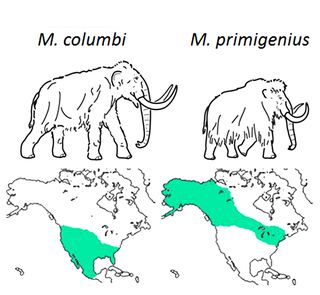
Distribution of Columbian Mammoths (left map) and Woolly Mammoths (right map)

What’s special and unique about mammoths (and mastodons and elephants)?

Several things stand out as interesting about proboscidians. Here are some fun facts:

  • Mammoths and elephants have only one tooth on each jaw (upper, lower; right, left) in wear at any one time. We have all of our teeth in use all the time.
  • There are only six teeth in each jaw (upper, lower; right, left) that an elephant or mastodon ever gets. They grow into the mouth one at a time from the back and fall out the front when they’re worn out. Once the sixth tooth is worn out, there’s no more teeth and the mammoth or elephant starves to death.
The pattern of tooth replacement in the jaws of elephants
  • Mastodons have the same pattern of tooth replacement, but usually have more than one tooth at a time in use. Their teeth don’t wear out as quickly though, because they eat softer food.
  • Proboscidians are in a larger group of mammals called ‘subungulates’ which are grouped together because they have hoof-like structures on their feet, but they’re not quite hooves.
  • Some of the closest relatives to elephants, mammoths, and mastodons are manatees! Manatees are also subungulates and have hoof-like structures on their front flippers. They also have the same sort of conveyor-belt tooth replacement, but they aren’t limited to only six teeth.

When and why did they go extinct?

About 10,000 years ago, mammoths and mastodons, plus a lot of other large mammals that live in North America (woolly rhinos, giant ground sloths) went extinct (Wikipedia article). Most of the animals that went extinct were huge, so we refer to them as “Megafauna.” No one is certain why this happened, but it did coincide roughly with the melting back of the continental ice sheets as well as the appearance of humans in North America. It is an interesting point of controversy. There are two main camps here and then a few extra ideas (maybe the lunatic fringe?).

Main hypotheses:

    • Human overhunting

It is possible – even likely, knowing how we as humans are – that humans might have been responsible for the loss of the mammalian megafauna. We have been known, once in a while, to over-use resources, and it is known that humans actively hunted members of the ice-age megafauna, like mammoths.

  • Climate change

We also know that climate was changing rapidly then, warming up after the end of the ice-age. The ice sheets melted back and the landscape was changed. Organisms had to adapt, and big animals like the mammoths likely had a hard time adapting.

These both seem like reasonable hypotheses. So which is it? Most scientists straddle the fence on this one: Well humans were hunting a lot, and the animals were already in trouble because of the climate change…

 Other ideas:

    • Meteor impact

Because asteroid impacts have resulted in many extinctions in earth’s history (like the extinction of dinosaurs), it seems sensible that this extinction might also have been caused by an impact. There is some evidence that there might have been an impact, but some things about the extinction event are cause for skepticism. For example, why did ONLY the large mammals go extinct?

    • Second-order predation

Here the idea is that not only did humans decimate the populations of the prey animals, they also hunted the predator animals (like saber-tooth tigers). Without the primary predators, the prey animals rapidly overpopulated the area, destroying their own resources and thus killing themselves off.

  • Hyperdisease

Humans coming from another continent would have brought a few ‘friends’ with them. Perhaps the humans brought along their own animals that carried diseases for which the native animals had no immunity. This could very quickly decimate the native population as has been seen when humans and their livestock have populated new places in modern times.

How can we find mammoths?

A common question that people ask of paleontologists like me is “How do you know where to look?” I have a standard answer for that: We look at maps, maps that geologists before us have drawn showing the various rocks exposed in an area, describing those rocks, defining their ages through various means. We look at the maps for rocks that should have the right fossils in them, and then we go out to the rocks in the real world and walk around until we find something.

At times it’s a little more sophisticated than that. We can use remote-sensing/sattelite methods and find the most probable areas using neural networks on computers.  Many times though, it’s a whole lot less sophisticated. Sometimes, you just walk across a field and kick something and when you look down, it’s a fossil bone. Mammoths are often found when people bring in backhoes to dig a hole for a new pool. Their digging and suddenly there’s a bone. They were digging a new reservoir in Snowmass, Colorado, and they found what’s now called the “Snowmastodon” Site!

What can geochemistry teach us?

My own research centers on the chemical constituents of tooth enamel in fossil animals. From that, we can learn a lot about extinct species, including what their food preferences were, what the weather was doing while they were alive, and how their teeth might have grown. One of my undertakings is described here. I presented my results at the Society of Vertebrate Paleontology annual meeting a couple of weeks ago, to find out that the project I had done has actually been done before (just never published). My results were quite different, however. Through discussion with other scientists, I think we all understand the source of the differing results. Now if I can just get them to publish their work!

Recent discoveries: Mammoth mummies!

Of late, Siberia has been yielding numerous mummies of mammoths (and other mammals). The far North is a good place to look for mummies of any animal, because the cold temperatures will preserve the animals like a giant ice-box. The ice itself can encase the mummy, keeping it from becoming a meal for modern scavenging animals. Yuka  Baby mammoth

 Cloning of Mammoths

Because of the exquisite preservation of the mummified mammoths, there has been talk of attempting to clone mammoths. So long as the nuclei of cells are not totally destroyed by freezing or decay, a scientist could extract the DNA and create a clone. Will this be done? Should it be done?

More about Sandy -or- I have data!

I explained in an earlier blog post the significance of the sampling effort that was undertaken to understand the pattern of isotopic values, and how this changed over time, of precipitation coming from Superstorm Sandy as it made its landfall and slowly died over the interior of North America.

I ended my sampling effort on Saturday night after collecting a total of nine samples, one every twelve hours since about the time Sandy made landfall on Monday night, the 19th of October. There was only one span of time – on Halloween – when it did not rain sufficiently for me to collect a sample.

Precipitation samples from Superstorm Sandy collected at my house. Rain water was collected in a bucket (that was strapped down so it wouldn’t blow away!) then poured into vials at approximately twelve-hour intervals. The bucket was dried then set out again.

These nine fine samples are now on their way to the University of Utah where their isotopic values will be measured. But, see, I’m also an isotope geochemist. And I also have a water analyzer in my lab. And I might be just a tad impatient.

So I analyzed the waters before I sent them off.

Our water analyzer, Norm, analyzing the Sandy waters. This is a Los Gatos Liquid Water Isotope Analyzer.

Let’s think back on what I said before, about Rayleigh Distillation. So if a cloud rains, the isotopically heavier water (mass 19 or 20) is more likely to fall (because it’s heavier) than the more common, lighter (mass 18) water. So the rain is isotopically heavier than the cloud. After the rain has fallen, the cloud is isotopically lighter than it was before.

So, what happens when that cloud rains again?

When a big storm (like Sandy) moves inland, the rain causes the cloud to get lighter and lighter. And since the cloud water is getting lighter and lighter, so does the rain coming from the cloud, though it is always heavier than the cloud itself. This leaves a tell-tale pattern of heavier isotopes near the coastlines where the storm first came on land, to lighter and lighter isotopes further inland.

So what pattern would you expect if you did all your sampling in one place and a storm simply passed over? What if a storm parked over your house and rained for days and days? What would that look like?

Think about it. I’ll give you a few minutes. I need a glass of water.

.

.

.

.

.

.

.

Keep thinking. I need to check my e-mail.

.

.

.

.

.

.

.

.

Any ideas?

Well, it would stand to reason, that unless – somehow – heavy water vapor was getting back into the cloud, the isotopic values would get lighter and lighter over time.

So, one might predict that the rainwater that I collected would get lighter and lighter over time.

Let’s see:

Isotopic values from precipitation from Superstorm Sandy collected near Rochester. Blue lines and symbols are hydrogen; Red lines and symbols are oxygen. The patterns are very similar, as they should be. Hurricane Sandy makes landfall on the left side of the graph. Water samples are plotted according to when I collected the sample (at the end of the twelve-hour period). In the final analysis, it’ll probably be plotted by the mid-point of the sample interval.

The pattern we expected to see was completely borne out for the first three collections, from when Sandy made landfall, to when the center of the storm was supposed to be over the Rochester area, where the samples were being collected.

But then what happened? The values start to increase again. Any ideas?

Well, for one thing, Sandy was supposed to pass over Rochester on Halloween, but it didn’t. The bulk of the storm passed to the south. In fact, it didn’t rain at all on Halloween (which made trick-or-treating possible!). Superstorm Sandy swung south and then west of Rochester before becoming too diffuse to know where the core of the storm was.

Something happened. Something changed.

Well, maybe some heavier isotopes did make it into the vapor mass. Perhaps it was the arctic front that was swooping down from the north as Sandy struck from the east that brought the isotopically heavier rain. It definitely cooled off. It was snowing occasionally during those last two sampling intervals. I suppose it’s also possible that the storm picked up some moisture from the Great Lakes as well.

Again, this is the beauty of the larger project and sampling effort. With only one sample site, we can’t be sure. But once we have all the data from the 100+ sampling sites, we’ll be able to map in detail what was happening. It will be obvious of secondary vapor masses (clouds, storms) joined up with the remnants of Sandy. We’ll be able to tell where and when that occurred.

It’ll be a while before all those samples are gone through and analyzed. I sent my own samples off to Dr. Bowen, so he can re-analyze them using his own instrument and add the data to his huge database. In the meantime, I have this one tiny subsample of the data and a lot of excitement for what will be discovered when the entire data set is complete!

Stay tuned!

Election Day Coverage

Here it is. Election Day in the United States. I’ll be so glad tomorrow. Relieved. Who ever wins, I’ll be glad it’s done.

There’s only so much mud-slinging I can take. It seems that all the candidates are concerned about is the character of their opponent. That’s all I see in the ads anyway. You have to dig to find out what their stances are. I’m tired of it.

I’m tired of the endless barrage of candidate names. I’m tired of seeing “So-and-so likes Barack Obama” or “So-and-so likes Mitt Romney” on Facebook. Even though most of my friends on Facebook and Twitter are silent about politics, I am still sick of hearing about it.

I don’t broadcast my political views. I have friends of all creeds and preferences. I don’t want to step on their toes. Any person who spends a moment following my Twitter-feed or reading my blog can probably figure out how I stand, anyway. Well, maybe. I’m a scientist. That should say everything.

Elections are so polarizing. That’s the problem with a two-party system. One side’s gotta win. I hate it. Why can’t we all just get along? What’s a greater problem is that we’re not actually a two-party system. There are multiple parties, just no-one knows about the others until they get their ballot and say “Who the hell are these guys?”

Luckily, this morning’s ballot was pretty simple. No big issues to vote on. Just people. I try when I can to vote for my candidate of choice where he or she is running as the candidate for a party other than the Democrats or Republicans. That way, I still get my candidate, and maybe there’s hope that another party can enter the big scene and participate in the debates and raise money and what ever.

Tomorrow, the sun will rise and it’ll be another day. Maybe we’ll have a new president, maybe we won’t. I just hope there are no hanging chads or similar issues this year. The disruption from Hurricane Sandy is sure to cause someone to cry “liar!” if the election is even remotely close in stricken areas.

In the meantime, I’ll keep my TV off and try to ignore any political or newsy tweets and Facebook posts for the rest of the day. No spoilers, please. I voted. Now leave me out of it. I’ll find out tomorrow.

Peer Review

As a scientist I am frequently asked to review other people’s writing. Typically, it’s a scholarly journal article that I need to read. Other times it’s a textbook that needs a review. These things don’t pay (though sometimes they have perks) and take time, sometimes lots of time. So why bother?

Why should I spend hours and hours reading someone else’s paper when I could be working on my own? My job might depend upon me publishing something scholarly every year. Sometimes more than one paper. And the work I might do on reviews isn’t ‘billable,’ so if you have that kind of job, why waste your time?

Well, here’s some reasons why:

1) You get to read the latest in research even before it’s published.

2) You can keep BAD science from getting published.

3) You can learn the difference between a well-written paper and a poorly written paper, thereby improving your own work.

4) You can help someone make a good paper much, much better.

5) You can save a scientist from accidentally publishing something that has a blaring error.

Really, the peer review process is intended to make sure that anything that makes it to publication is grounded in reality. Published scientific papers should report ‘truth,’ or at least as close to truth that is possible given the current state of knowledge. Peer review is a necessary part of the scientific process. If scientists stop reviewing each other’s papers, science stops. If you’re not willing to review someone’s paper, then I’m not sure you’re doing science right.

So I keep reviewing papers whenever I’m asked. I do the best I can. And when I publish something, I’m grateful to the reviewers who looked at it, whether they remained anonymous or not, or even if their entire review is snarky. That’s okay. I learn something anyway.

And with that… I have a book to review. Cheerio!

Daylight Savings

So this morning we set our clocks back an hour. Well, OK. My phone automatically set itself back, as did all my computers. All these other clocks in the house are now officially one hour off. I suppose I’ll get around to changing them eventually.

I’ve never fully understood the point of the time change. I suppose I could research it, but I’m feeling lazy. It gives us more daylight in the morning, which I guess is nice, but then it gets dark so darn early that it’s impossible to accomplish anything in the evening. And in those darkest months of winter, it doesn’t make any difference at all, because it’s dark when I drive to work and it’s dark when I drive home. It’s just dark all the time.

I’m one of those people whose awake-ness is directly related to the amount of light outside. Actually, most of us are that way, it’s a natural way to be. Just some are better at fighting the natural urge to sleep once it’s dark than others. Once it’s dark, I just want to be in bed. Makes it hard when you’ve got class preparations to do for the next day. Winter is awful because of this. I can’t get anything accomplished. The time change doesn’t make any difference in this regard. It just gives me a temporary jet lag that lasts for a week.

The only nice thing is that one day a year we seem to get an extra hour to sleep. I took advantage of that this morning. I needed to. I’m feeling a little rough this morning. Of course, in the spring we lose that hour. That day sucks. I hate that day, and the whole week that follows.

That is my rant. Have a nice day.

On Learning Swordsmanship

I’ve been fascinated with swordplay for the better part of my life. Heck, I wouldn’t be surprised if as an embryo I was trying it out. Well, OK. Maybe not. I’ve also been intrigued by the martial arts, though not so much that I ever wanted to try them out.

In the last year or so (call it a mid-life crisis or maybe mid-life enlightenment!) I finally that maybe I should pursue this interest and see where it goes. I thought initially that maybe it was little more than a passing fancy. You know the sort: something grabs your attention and you get excited about it. And then you throw a lot of money at it to buy all the equipment. And then, a month later, the interest is gone, and you realize that you’ve wasted your money.

Well, I’m old enough to know that these things can happen (thankfully), so I let my interest simmer in my heart for a while, bought a bunch of books, and after a few months I realized it hadn’t gone away.

So I pondered. I was still interested in swordplay, but I was in bad shape. I knew there was no way I could actually handle a sword. I’d collapse in exhaustion in ten minutes. I started a workout program, and after a few months of that I realized I was in better condition than I had been twenty years earlier, and I was STILL interested in swordplay (and as a bonus, I was also 25 pounds lighter!)

OK, now what? I, of course, had spent a fair amount of time on line during this time idly reading about swordplay and swordsmanship to see what I could learn and came across the web page for the Higgins Armory Museum. Well, shoot! It’s even got my name on it! I found out that they had sword classes and I immediately wanted to participate. However, the museum is a six-hour, one-way drive from my house, so that wasn’t going to happen. They did, however, have a full day symposium called “The Sound and the Fiore” which focused on the knightly martial arts of 15th century fencing master, Fiore dei Liberi. It included a workshop in which participants would be allowed to work with long swords for a quick lesion. I went, naturally, and came home positively chomping at the bit to learn more. I was excited to have learned something about wielding a sword, but I was also excited at the realization that swordplay was part of the “Western Martial Arts.” That is to say, using a sword and being a ‘knight’ was properly a martial art just like karate! This is what I wanted.

Then the search began. I tell you, there is nothing-doing around Rochester in the form of Western martial arts. Someone finally suggested the Society for Creative Anachronism (SCA) as an organization where I might get to learn some swordplay. I’ve met up with the local group and have also gotten involved in what they call “Heavy Weapons,” which is the SCA equivalent to fighting with a broadsword. This has been fun, making armor and bashing on people with sticks. I figured out pretty quickly that despite all my training, I still didn’t have quite enough upper body strength to fight well, but at least I was fighting now!

Something was missing, alas. As much fun as the SCA is, it lacks all the martial aspects of proper martial arts. Plus, while it sort of looks like real swordplay, it isn’t. I renewed my search. This time, I had the benefit of Twitter, on which I seem to spend far too much time. But I do follow some swordsmen who participate in swordsmanship as the martial art that it is. A month or so ago, one of them pointed me toward an instructor nearby who could actually teach me what I want to know!

Today, I made the drive to Ithaca and took a lesson from Adam Crown, Maître d’Armes.  Let me tell you what. It was a great experience, and unlike what I learned at the Higgins Museum, nor anything like SCA heavy weapons practice.

Here’s what was different. The Higgins Museum workshop most likely intentionally put swords in the participants hands knowing that was what participants were paying for. It wasn’t meant to be a lesson. It was a demonstration. It was to give a flavor for true swordsmanship to the participants, and so the most ‘romanticized’ of the weapons, the longsword, is the one that was pulled out and presented. The SCA practice is all about just jumping in and fighting. There isn’t any formal instruction, just short spurts of fighting with occasional stoppages to help explain the SCA rules and SCA fighting styles. And, in the end, it’s pretty basic. The SCA is not about reenactment or historical accuracy, at least in terms of fighting techniques. SCA heavy weapons fighting is not a martial art. I won’t say it’s not fun (because it is), but Western martial arts, it ain’t.

In the class I took today, everything that was done was calm and controlled. Much of it was about footwork and posture. It was a two-hour lesson and no-one even touched a sword until the second hour. I never even put on protective gear. I spent an hour learning how to properly draw a sword and salute my opponent, because you’ve got to get that right before you do anything else.

So what’s next for me? Well, I’ll be going back to Ithaca for lessons as often as I can make it. I’ll continue to meet up the the SCA heavy weapons group too. It’s a fun workout and enjoyable social event for me. However, if ever it comes to a point where the things I do for SCA style fighting interferes with what I’m trying to accomplish with the Western martial arts, well, the martial arts will win.

Frankenstorm and the Isotopes

Earlier this week, Hurricane Sandy (an anomalous late-season hurricane) made landfall in the United States near Atlantic City, NJ (also anomalously far North). Because of the timing of Sandy (near Halloween), and it’s coincidence with another strong system moving across North America from the West, the weather event was given the moniker “Frankenstorm”.

This storm was a big deal, and my heart goes out to everyone adversely affected by its aftermath. My own heart broke with each image the popped up on my Twitter-feed that night. Yet there were some heartwarming stories, and certainly some good will come from this unfortunate event.

Much of the discussion of Sandy revolved around how unusual it was and how it might be related to global warming. I even got a call from a local journalist wondering if I would be willing to comment on that. (I said no, because it’s really outside of my realm of expertise, but hopefully might be contacted later regarding ancient episodes of global warming which really are my specialty.) There are plenty of web resources on the topic, which cover that question better than I can. This is one of my favorites.

This is all interesting, but is not why I was kind of excited about Sandy (in the way only a geochemist can be). For me, Sandy provides an opportunity to verify what we think we can learn about ancient weather patterns using chemical tracers in rocks. That is, Sandy is a natural isotopic experiment. I’m not the only person who thought this. Gabriel Bowen of the University of Utah thought of it first.  I’ll explain below.

Before you get upset about the term ‘isotope,’ remember that all atoms are isotopes and that not all isotopes are radioactive. Most atoms are ‘stable’ meaning that they don’t undergo radioactive decay. It’s just that the term ‘isotope’ makes people think of nuclear reactors and meltdowns (and somehow Homer Simpson).

So then, what do I mean by an isotopic experiment? I’ll save the details of how isotopes work for a later blog post, and just start with a simpler story of just water. Different isotopes have different masses, or weights. Most water molecules have a weight of 16 atomic mass units. Let’s just say most water has a mass of 18. Some water molecules have a mass of 19, where one of the hydrogen atoms is ‘heavy’ (but stable) and some molecules have a mass of 20, where the oxygen atom is ‘heavy’ (but also stable).

When the mass of the molecule is heavier than most (19 or 20 versus 18) the molecule is, well, heavy! That means that if water evaporates, the lighter (mass 18) molecules evaporate first, because they’re lighter, leaving the heavier water (mass 19 and 20) behind in the puddle. This seems very common-sense, and it is. Vapor that evaporates from puddle is lighter than the water that remains in the puddle and, in fact, the remaining water gets heavier. This process is called fractionation.

Now, if we have a bunch of water vapor, like a cloud for example, and the vapor condenses, the heavier water condenses first and falls as rain (because it’s heavier). The rain is heavier than the vapor in the cloud and the cloud’s water gets lighter and lighter as it rains more. Again, this is fractionation.

When we’re talking about isotopes, we use this crazy delta notation. If we want to say something about the oxygen isotopes in water we use δ18O. For hydrogen, we use δD or δ2H. The number we report is really a ratio, but we tack on the permil symbol (‰) to make the numbers easy to talk about (again, this is something to talk about later). What’s important is that if the delta value is more positive, that means that the water is heavier. If the delta value is more negative, the water is lighter. Everything is measured relative to ocean water which has been assigned a delta value of zero for both hydrogen and oxygen. δ18O = 0‰ and δD = 0‰ for ocean water.

A hurricane, like Sandy, gets all its water from the evaporation of the ocean – so the clouds forming over the ocean will have delta values more negative than zero. As long as the storm is over the ocean rain from the hurricane and falls back on the ocean and new water evaporates keeping the isotopic value of the clouds stable. But once the storm moves over land, the addition of new water vapor from the ocean stops, but lots of water is lost as rain.

The result is that as a storm moves across the landscape, the isotopic value of the cloud gets lighter and lighter over time. The precipitation coming from the cloud also gets lighter and lighter over time, though it’s always heavier than the cloud it came from.

This is called Rayleigh Distillation, and is one of the basic concepts in isotope geochemistry. It seems pretty straight forward and reasonable, and has been used as the basis of isotopic interpretation for many years. But it’s been difficult to test… Until now. With electronic messaging and, more importantly, social media, it is now possible to recruit a fleet of people of a broad geographic area with only a few hours notice to collect rain samples that can then be measured for their isotopic values. We can finally ground-truth this important hypothesis!

This was tried for the first time with a storm called “Snowzilla” (now less creatively called the ‘Groundhog Day Storm’) that happened in 2011. Snow fractionates from clouds just like rain does, so would be expected to show a similar isotopic pattern as rain water. When this huge storm that hit much of the eastern United States, and Gabriel Bowen, then at Purdue University, put out a call for people to collect snow samples and send them to him. The results are detailed here.

The pattern of hydrogen isotopes from the Groundhog Day Storm in 2011. Warmer colors represent isotopically heavier water.

Looking at the figure, we see that the isotopic values shift from more positive in the southeast to more negative in the northwest. From this, it’s easy to see that the vapor moved in from the Gulf of Mexico and Atlantic Ocean.

What might we expect to see from Sandy? Well, this time when the call went out, Dr. Bowen asked participants to collect samples over specified time intervals and to record those times, meaning that it will be possible to make an isotope movie and perhaps watch Sandy move across the continent.

So… Why does this matter? Oxygen isotopes from rain can be preserved in rocks. As rain water is exposed to carbon dioxide and percolates through the soil, it forms carbonate (CO32-)which is then bound into carbonate minerals like calcite. This calcite can form little nodules in the soil or a calcrete layer. The oxygen in the carbonate records the oxygen in the water (with a little more fractionation). Later – as in millions of years later – geoscientists like me can analyze the oxygen from the carbonate and get back to the original distribution of oxygen isotopes in the rain water. From there, we can then figure out ancient air-flow patterns around the world.

With this knowledge, we can start answering other questions. How does the uplift of high mountains (like the Himalayas) affect global air flow? What happens to air circulation when climate changes rapidly, whether it be warming or cooling? We can address these questions and more, which might help us understand what the future might bring if projections of warming bear out.

In the meantime, I’m a participant in the project myself and am still collecting waters. Sandy’s not quite dead, though her destructiveness is well past. We’ll see what the data tell when all is said and done!

***UPDATE***

Here they are: the sample set from my house. I’m done sampling, so the analyses can begin!

Nine rain water samples I collected for the isotopic study of Hurricane Sandy.


Character Sketches – Marshall Thomas

Marshall Thomas has an exciting career as an action-adventure star of movies and television. Coming from an acting family, Hollywood life is completely normal to him. He has never really experienced anything but comfort and prosperity. On the outside, he seems a well-adjusted man, but this masks the torment beneath that even he is unaware of. Disconnected, divorced parents left him uncertain how to engage others on an emotional level, which in turn leaves him in his late 40’s still single and unable to form a properly loving relationship with a woman. While considered a perfect gentleman by some, others think of him as a womanizing bad-boy, but the truth is that only once has he caught himself courting two women at once: Allison (his then-fiancee) and Katrine Duncan. His life starts a downward spiral with a car accident, including a DWI arrest, after which his fiancee meets his girlfriend. From there he falls into ever-worsening self-destructive habits, which may wind up costing him dearly.

Marshall is the main character for the novel I’m writing for the National Novel Writing Month (NaNoWriMo) challenge this year. The working title of the book is “The Masters.”

SVP – Scenes written screenplay style

Because I’m weird like that, I decided to write up some bits of the 2012 annual meeting of the Society of Vertebrate Paleontology in a screenplay format.

This would never make a good movie or TV show and here’s why: NO CONFLICT! There’s over 1000 of us there, and we’re all so happy to be there that there is no conflict. Nothing happens! Everyone is happy.

So, it’s a lousy script, but it highlights some of the things that go on at these meetings, in its own special bizarre way…

Some names have been changed to protect the innocent, and things are written mostly how I remember them, which might not be reality. If you think I might be talking about you, well, I might be!

Also, please forgive the formatting errors. They’re there. I couldn’t make it work right. Poo.

By the way, these things really did happen. …mostly.

—–

#2012SVP: The movie

EXT. MAJOR HOTEL – NIGHT

PENNY HIGGINS, middle-aged paleontologist exits an airport shuttle bus. She gathers her belongings, pays the driver and enters the hotel.

INT. MAJOR HOTEL – CONTINUOUS

Penny passes through sliding glass doors and is met by the din of loud discussion. She looks toward the bar and sees a crowd within, the source of the noise. She smiles and nods. She knows the sounds of paleontologists.

PENNY
(to herself)
Paleontology. How I love thee!

INT. DARKENED CONFERENCE ROOM – DAY

Penny is checking Twitter on her phone. A tweet from the host society shows up “Beware the flatulent chairs. Sit carefully.”

Penny raises slightly from her seat and sits back down hard. The chair toots. Penny eyes the person sitting beside her. He’s looking back, eyes wide.

PENNY
Oops! Excuse me!

The man smiles and returns his attention to the speaker.

Another person enters the room and sits in front of Penny, causing his chair to emit a loud farting noise. Penny struggles to contain her laughter and quickly re-tweets the earlier tweeted warning.

INT. CONVENTION CENTER – POSTERS – DAY

The room is arranged with several rows of posters, presenting scientific results. Between the rows are packed hundreds of paleontologists, discussing the posters among themselves and with the authors. The room is a cacophony of voices. Nearly everyone has a drink.

DAN
So tell me your story here.

PENNY
(points to poster)
Well, our data seem to show that this takes about one year. But I’m told you’ve already done this.

DAN
Yes.
(grins sheepishly)
We got our data ten years ago. We just haven’t published it yet.

PENNY
Well, you need to publish it! Your data sound better than mine. And your results make better sense.

DAN
We’ll get to it.

PENNY
I’m gonna e-mail you every week until it’s published

DAN
Maybe you should.

Dan moves on. One of Penny’s friends approaches.

JUDY
How goes it?

PENNY
Yeah. This work’s been done already.

JUDY
What happened?

PENNY
This is what happens when people don’t publish.

JUDY
That stinks.

PENNY
At least it wasn’t an oral presentation – or worse: a rejection from a journal. We move on.

Judy pats Penny on the shoulder.

JUDY
It happens.

INT. DARKENED CONFERENCE ROOM – DAY

A video is playing of a Hyena eating a big chunk of meat and bone. Penny furiously tweets what she is seeing. Numerous other tweets scroll past, highlighting the same thing, each containing the phrases “bone cracking” “hyena” and “pig neck”. Penny grins, relishing the morbidity of her paleontological colleagues.

Someone sits down near Penny, causing the chair to fart. Restraining laughter, Penny heads out to find coffee.

INT. CONFERENCE ROOM – DAY

A silent auction is being set out. Items are spread out over several tables throughout the room. People are running around sorting items and arranging them in an appealing way.

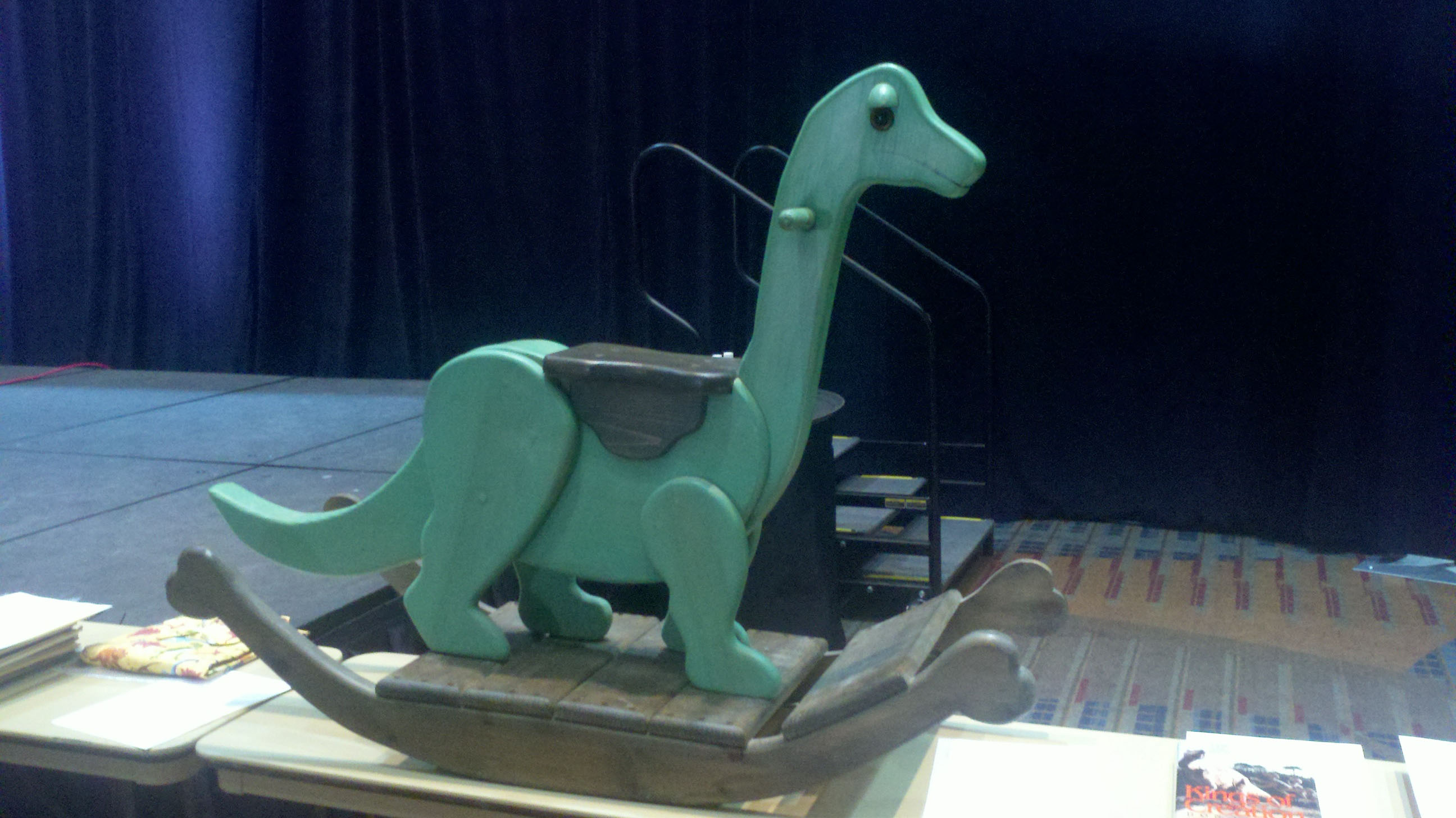
Penny enters lugging a hefty wooden rocking-dinosaur.

PENNY
Yup. This is it. You’re going to a new home.

Penny looks around and finds who she’s looking for.

PENNY
Brent!
(indicates the dinosaur)
Silent or live?

BRENT
Live.

Penny hoists the dinosaur onto a table in front of the stage, where the live auction will take place later in the day.

INT. MEETING ROOM – EVENING

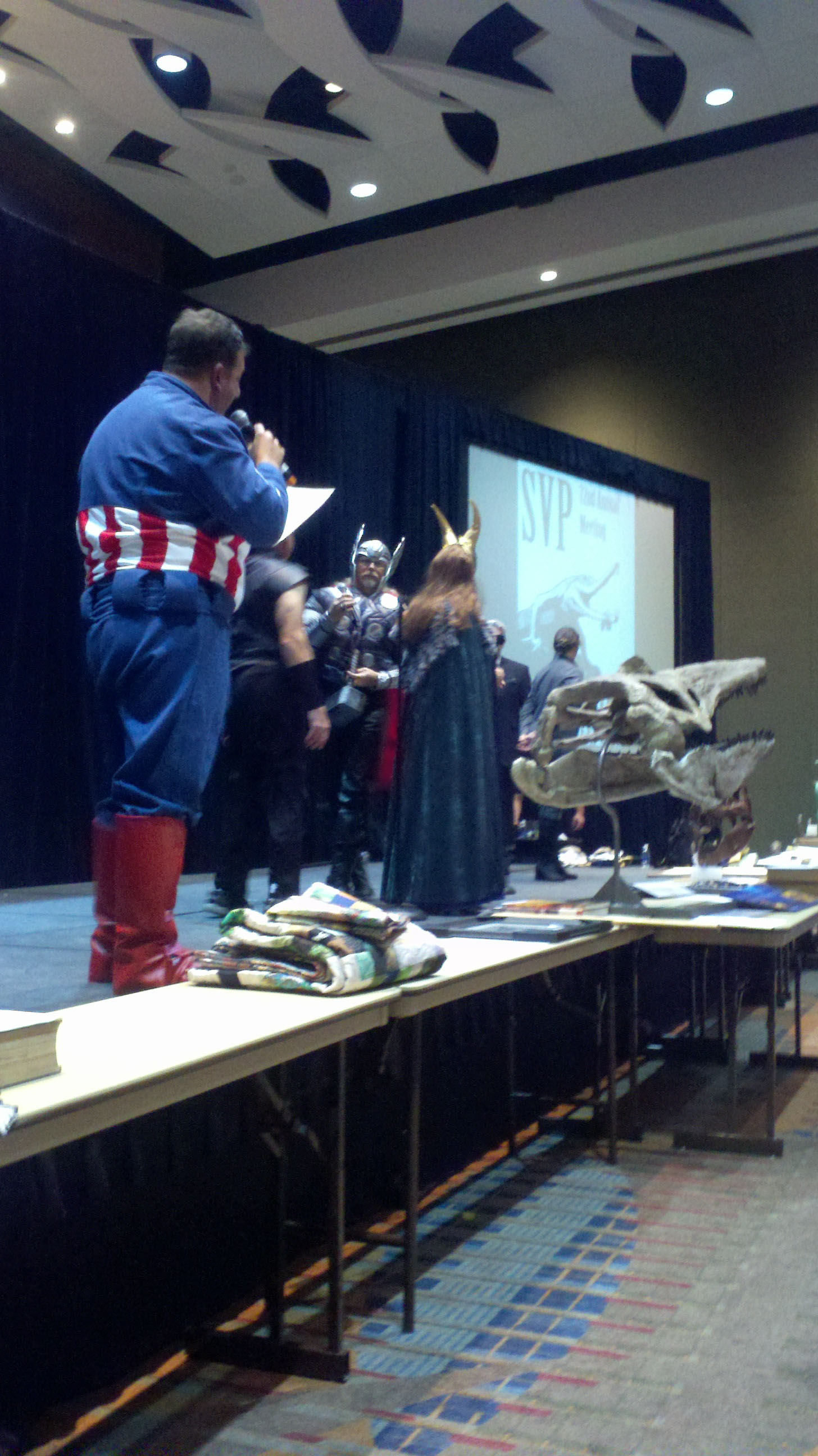
Six people stand around, four of whom are dressed as characters from the movie and comics “The Avengers.”

Penny walks out of a back room in a white and black pleather body suit.

PENNY
I’m gonna cook in this thing!

BECCA
Now, who are you?

PENNY
Mockingbird. From the comics.

Penny dons her long, platinum blonde wig and adjusts it on her head.

BECCA
Do you have an extra hair tie?

PENNY
(laughs)
I only have long hair when I’m wearing a wig!

BECCA
(laughs)
Oh! Oops!

There’s a knock at the door. Thor and Loki have arrived. Tony Stark leaves to set the stage for the entrance of the Avengers.

Becca’s phone bings.

BECCA
It’s time.

THOR
Let’s go.

INT. HOTEL BAR – NIGHT

The Avengers (paleontologists in costume) enter the bar to hoots and congratulations from the other paleontologists there.

Thor, Loki, and Penny approach the bar to get a drink.

THOR
Whatever you want. My treat.

A woman and her husband are seated nearby and are delighted to see the three costumed paleontologists standing there.

WOMAN
Oh, please! Let us buy! We’re so happy to meet you!

The husband nods and turns away, disinterested. The woman continues to gush.

WOMAN
I’m so glad to have met real paleontologists! Y’know, on our beach I’ve found some really interesting fossils!

Loki and Penny look knowingly at each other. Thor moves off into another conversation.

WOMAN
I’ve seen fossils of a baby bird being born.

Penny and Loki feign interest. There is little doubt in either one of their heads that what the woman has seen is not a bird being born.

LOKI
We’re glad you got to meet us. We’re pretty tired, though. We just did a big auction and we’re winding down.

WOMAN
Oh sure! Oh sure! I understand! I just think it’s great that you’re here. It’s like a sign or something!

LOKI
Well thank you for the drinks!

WOMAN
Sure! I hope we can talk more!

Loki and Penny roll their eyes at each other, then join Thor in his conversation.

INT. DARKENED CONFERENCE ROOM – DAY

Penny looks at her phone, checking the conference twitterfeed. A tweet pops up promising a blooper reel at the end of a talk. Penny is intrigued, and leaves quietly.

INT. DARKENED CONFERENCE ROOM – MOMENTS LATER

Penny takes a seat in another conference room (though it looks identical to the one she just left). She settles in, phone in hand, ready to be wowed.

The presentation begins.

SPEAKER
It’s hard to motivate an alligator to run.

The audience laughs. Soon videos are being shown of alligators and crocodiles running in a Plexiglas chute.

Penny looks at the twitterfeed. Multiple people are tweeting about this presentation. Penny smiles.

SPEAKER
And, as promised, the blooper reel.

On the screen are shown video clips of the alligators and crocodiles escaping from the chute and lunging at the camera. The audience laughs. Tweets fly.

INT. BANQUET ROOM – EVENING

Several hundred paleontolgists are gathered for a catered meal and a short awards ceremony. The meal has been eaten and the few remaining plates have been removed. Attention turns to the President of the Society of Vertebrate Paleontology. She announces several award winners. As the evening continues, the awards become more significant.

PRESIDENT
The Colbert Student poster prize goes to Stephanie Crofts.

People rise to give a standing ovation. As all sit down, a series of toots and tweets are heard.

PRESIDENT
And the Romer Prize for student research goes to Jack Tseng!

The crowd rises again, clapping and shouting. With sitting, the chorus of toots and farting noises is louder. There is audible chuckling. Penny looks at her twitterfeed. A new hashtag has arisen: #squeakyseat

PRESIDENT
And the Romer-Simpson Medal goes to Philip Gingerich!

The crowd rises once more, delighted for their long-time colleague. The tooting and farting sounds as people sit are very loud this time. Clearly people are intentionally sitting hard to make the noise louder. Penny is laughing so hard, tears are coming from her eyes.

INT. HOTEL LOBBY – MORNING

Penny walks away from the front desk. She pauses, looking back.

PENNY
(to no one)
Next year. L.A. See you soon.

Society of Vertebrate Paleontology annual meeting wrap-up

Ah! The annual meeting of the Society of Vertebrate Paleontology (SVP)! My favorite thing in the world! Four days of paleontological bliss, where I don’t have to define terms or defend your chosen profession. Where you can escape from the forced isolation of being the only paleontologist in your department, or worse, in your city. Where evolution is accepted and assumed rather than danced about using clever euphemisms. And where you can trot out your *really* bad science puns and everyone laughs.

Overall, this year seemed no different than other years, but some things really stood out to me. Because I chose to live-tweet sessions, I felt more connected to the happenings at the meeting than I ever have before (and got to make some new friends, to boot!) And, incredibly, there was not a single talk that I went to that I felt was poorly executed. Usually, there’s one or two a day that are agony to sit through, for whatever reason, but this year it didn’t happen. Every talk was not only enjoyable, but offered something worth tweeting about. A good chunk of the meeting was Storify-ed by Jon Tennant (@protohedgehog on Twitter), so you can see what we were doing.

The venue was splendid. I enjoyed the convenience of all the sessions being side-by-side, and the posters were less than 3 minutes walk from the oral session. Even better, the hotel (if one chose to stay there) was less than 5 minutes from any of the sessions. And (after a little nudging), there was even free wi-fi! Perhaps the best (or worst) part of the venue was the seats that apparently had whoopie-cushions built in. There was a lot of accidental tooting, which was finally recorded here.

Highlights of presentations included video of a hyena eating a pig neck in about 30 seconds (noting the bone breaking capabilities of hyenas) and several videos of crocodiles and alligators running (including a blooper reel!).

For me, one of the biggest parts of SVP is the annual auction. I’ve helped with the auction ever since I started graduate school and finally became a member of the auction committee sometime soon after getting my Ph.D. At first, it was always just a matter of helping with the set-up, but over the last 10 years, we’ve started dressing in costume with a theme for the live auction each year. Those of us on the committee put a great deal of time and effort (and sometimes money) into constructing our costumes. The theme is usually established sometime during the summer prior to the meeting, and we rush to create our costumes while simultaneously preparing our professional presentations for the meeting as well. This year, the theme was the Avengers. I chose to dress as Mockingbird, who did not appear in the movie, but has been in a few of the comics. I liked the look of her costume, which is why I chose her. She also has a Ph.D., so how can I go wrong?

Auction, Avengers-style.

This year, I brought back an item I bought back in 2004: a big wooden rocking dinosaur. My son was an infant then. Now, at eight, he’s not so into the dinosaur. Hopefully, it’s off to make some other kid really happy and the auction winner will bring it back when his child has out-grown it.

The ol’ dino-rocker is off to a new home!

The auction raises money for various programs at SVP that support students. I’m glad to be able to help the society in this way. This year the auction made $22,700!

Dino-Thor?

As usual, I was able to drum up some new work for the lab while I was there, and perhaps start some new collaborations. I’m suddenly thinking an awful lot about microwear on teeth. I found out that what I presented was actually old news — only that the folks who had already done the same project kinda hadn’t bothered to publish it yet. (grumble) All told, this was one of the most productive meetings I have ever had. And somehow, I didn’t get sick during the whole event. I’m still healthy, two days after getting home. How’d that happen?

Well, while the iron’s hot, it’s time for me to attack some old research projects. There’s a short paper burning in me about the problems with the taxa Phenacodus and Tetraclaenodon. Then there’s that huge dataset that I tabulated as a postdoc that still hasn’t seen the light of publication. Yeah, I should get on that. I love this feeling of frantic motivation. I hope it lasts!

If you’re not satisfied with what I have to say about the meeting, then check out what others have said, (below). I’ll be updating this as I hear about other people’s posts.

What do Vertebrate Paleontologists Talk About, by Bora Zivkovic (@BoraZ on Twitter; Scientific American Blogs)

SVP, you’re so silly, Tarchia (Pseudoplocephalus Blog)