Scientist (Paleontology, Geochemistry, Geology); Writer (Speculative and Science Fiction, plus technical and non-technical Science); Mom to great boy on the Autism spectrum; possessor of too many hobbies.
National Blog Posting Month – December 2012 – Work
Prompt – How hard do you think you work?
—
My first reaction upon reading this prompt was, Ha-ha-ha-ha! I have far too much fun at work to really call it ‘work.’
They say that if you are doing something you love then you’ll never work a day in your life. Well, I do like what I do, so it doesn’t always feel like I’m working very hard at all.
That isn’t to say that there aren’t times that I’m just cursing my to-do list, overwhelmed with the things that I have to do in order to keep myself paid. On those days, I work ridiculously hard, going down the list item-by-item, continuing to work even after I get home in the evening, often into the wee hours of the morning.
Other times, though, I am able to keep hours that would make a banker envious. Once I get a set of analyses started in the morning, unless I have some specific reason to stay in the office, I often bug out, go home, workout. Engage in other projects. Write blog posts. This only works for a few weeks during the summer and during the regular academic breaks, alas.
I do find that whether I feel like I’m working hard (at work-related things) or not, I still am always very, very busy. I seem to like it that way. There is always something to do that is very much worth doing. Sometimes it’s the job I get paid to do that gets priority, and sometimes it’s unrelated things. It’s all about balance, right?
The first in a series of posts about what’s wrong in movies with geology-related themes.
Volcano
1997
Tommy Lee Jones and Anne Heche
Premise: What if a volcano appeared and started erupting under a populated area like Los Angeles?
I guess one could suppose that because there’s a plate tectonic boundary (the San Andreas fault) there along the margin of North America that a volcano might arise. There’s volcanoes all around the margins of the Pacific Ocean – along plate boundaries – which are given the apt name of “Ring of Fire.” The Cascade Mountain Range, including Mount Rainier and Mount Saint Helens are such volcanoes.
One problem: These volcanoes occur along subduction zones, where basically the ocean floor is being drawn under the larger continents. The Pacific Plate (under the Pacific ocean) is being subducted under Alaska (the Aleutian Islands) and under Japan and in lots of other places. Under the Cascades, the Juan de Fuca Plate is being subducted. The Nazca Plate is being subducted under South America, resulting in all the volcanoes associated with the Andes.
Alas, subduction is NOT occurring in California. There, the Pacific Plate is moving northward with respect to the continent of North America. The San Andreas fault is what is called a “transform” fault, where the rocks slide past each other, not where some rocks override others (like in a subduction zone). Because of this, we can’t expect huge volcanoes like we see in the Cascades. Usually, if there are volcanoes along transform faults, they’re pretty small. They’re not completely impossible, so the possibility exists.
Of course, the explanation provided by the geologist in the movie, Dr. Amy Barnes (played by Anne Heche) is not like this at all. And in the end, they get a new mountain out of the deal, which is highly unlikely. We’ll just ignore that…
There are lots of things that bug me about this movie, from the stance of a geologist – the likelihood of a volcano in LA aside.
1) I really don’t think the K-rails are going to do much to block flowing lava. And dousing it with water? Well, I guess they do these sorts of things elsewhere with some success. But the movie makes it out like they stopped the flow of lava completely. I suspect that in the real world, the best outcome in such a situation is a diversion of the flow. That stuff’s hot! And there’s a lot of it! Let’s send it somewhere else and we’ll be OK – which is what they did in the end. (And how come no one except for the geologists had any idea what ‘lava’ was?)
2) A greater problem is that they should have all died of massive bleeding in the lungs before they even had a chance to try to block the flow of lava. Ash is basically fine shards of glass. No one was wearing masks, so they were basically inhaling glass. For hours. Not one cough. No sneezing. No gasping. Right.
3) The news report at the end made me facepalm. ‘The volcano is shutting down,’ the reporter said. ‘The lava is subsiding.’ Volcanoes don’t just ‘shut down,’ and lava doesn’t ‘subside.’ Once the lava’s on the ground, it’s solid. There is no subsiding. Maybe they were referring to magma deep within the Earth. Anyway, the idea that a volcano can just turn on and off like that is extremely sketchy, though mightily convenient for a movie.
4) Dr. Barnes mentions that the bible verse Matthew 7:26, “And every one that heareth these sayings of mine, and doeth them not, shall be likened unto a foolish man, which built his house upon the sand,” is very popular among geologists. Strangely, I’ve never heard that one before. Just saying.
I won’t go into the other gripes and hilarious things that happen in the movie, as they are not related to geology. I will say that the movie was clearly pre-9-11, and I loved the giant cell phones. I did get into the story sufficiently that I was engaged with the main characters and glad that everyone came out OK. It’s not the worst ‘bad geology movie’ I’ve ever seen.
National Blog Posting Month – December 2012 – Work
Prompt – Do you enjoy teaching others? Talk about a time you taught someone how to do something.
—
It should be obvious from some of my blog posts (here and here) that I truly adore teaching. I love any form of teaching, from the formal class room, to putting up a table at a career fair, to preparing talks for senior citizens at retirement communities. I love it all.
For all the teaching that I’ve done, it’s tough to narrow down this topic to just one time I taught someone how to do something. The specific phrase “how to do something” means that there was some actual step-by-step training involved. It’s not just teaching someone to distinguish between igneous and metamorphic rocks, for example, as you might in a traditional lecture-style class. The prompt is asking about something that was perhaps a bit more involved.
One of the things I get to teach (though I use the term ‘train’ in this case) regularly is how to run analyses on the mass spectrometer. Every graduate student who’s going to run more than a couple dozen samples in our lab goes through this training, so they can run their own samples (on evenings and weekends) and I can focus on contract work (to keep the lab running).
This is not without great trials and tribulations. It’s nice to have students run their own samples. It saves me a lot of time. But running a mass spectrometer is complex. A good student will be able to gain the skills they need to independently run the mass spectrometer in about four days (or four sets of analyses). The first day, they watch me and take copious notes. The second and third days, they do everything, with me observing directly. On the fourth day, I let them do everything when I’m not in the room, but I come in and check things in between steps. If they’ve gotten most of everything right (and haven’t done anything wrong that would compromise the mass spectrometer), then I give them permission to run analyses whenever they want.
This process can be insanely time consuming. I need about four hours to get a set of analyses going. When I have to train someone, there goes the whole day. And it’s terrifying too. One wrong push of a button and BAMMO! I’ve got to replace $1000 worth of parts. Usually, the training period goes through the “Day 4” step for several analysis days. “Day 1” is also often repeated.
Occasionally, I have students that really struggle with all of it. There really is a ton to remember. It’s a bit like patting your head and rubbing your belly. And hopping on one foot. Even more rarely, I have a student who just ‘gets’ it immediately. That’s always a little disconcerting, because it makes me wonder what I left out.
And it doesn’t matter whether the trainee is a undergraduate student, a graduate student, or a post-doctoral researcher. That has nothing to do with who’s going to have the most success. I do find that most undergraduates are general so afraid to break anything that they follow my instructions to a T (which is good). Postdocs also tend to follow my instructions carefully, I think that’s because they have enough experience with breaking things by then that they also take my word as law. Grad students tend to be a mixed bag. The mix of low (or no) experience and high confidence (having survived an undergraduate degree) can result in them ‘trying’ things that they shouldn’t do. Or hesitating when they don’t need to.
By now, I’ve gone through this process so many times, they’ve all blurred together. There is a certain satisfaction in knowing I’ve trained so many students. By providing them this skill, they have something to market as they’re moving forward with their lives. And though it’s highly unlikely that whatever future job they have will entail using the exact same instrument for the exact same purpose, just knowing what is involved with such analyses and that they can do it should give them some confidence and a step up above students that might not have been provided the same opportunity.
National Blog Posting Month – December 2012 – Work
Prompt – Do you feel most comfortable being a leader, a follower, or a collaborator?
—
This is an interesting prompt. Truth is, I’m not comfortable being a leader, though I have done it, successfully, on many occasions. I know this is because I have an anxiety disorder – social anxiety – that makes me kind of flip out when all eyes are on me. Years of therapy and medications have helped me a long ways. Now I know that it’s a disorder and that it’s not just that I’m shy, for example. Turns out, I’m actually very extroverted (which everyone who knows me believes), but that I have this annoying disorder that causes me to freeze in social situations. Luckily, I know this now and can (most of the time) fight past it and get on with what needs to be done. But the end result is that I have a difficult time with leadership. I do it, but I’m happy when it’s over.
But the extroversion makes it really hard to just sit back and be a follower as well. I’ll follow happily enough when something is new to me; my anxiety keeps me quiet. But once I feel competent at something, I lose interest in merely following. The extrovert comes out and sometimes I wind up taking charge. And then the anxiety comes back because I worry that I’ve offended someone or something. It’s a nuisance, really.
I really enjoy collaborating with others. The joy there is that I am treated as equal, but that someone else has to make to phone calls, and get all the permissions that may be needed (say for a grant proposal) and I can just sit back and wait until they ask me to do something. I lend my expertise where it’s needed and am present when needed, and keep out of it otherwise. It’s a nice balance.
The only problem is that when there’s something I really want done, I have a hard time rallying the troops (as it were) to collaborate with me. I’ve submitted a few grant proposals as Principal Investigator and it’s been really, really hard to do it, generally because I can’t get the rest of the team on board adequately and my (stupid) anxiety causes me to not be quite pushy enough to keep everyone motivated.
Thankfully, I’m in a place where people are seeking me out now for potential collaborations (see yesterday’s post). I have a skill that few others have, that is in demand. Not high demand mind you, but in demand enough that I can keep busy and paid.
So does it matter which of these terms (leader, follower, collaborator) are most comfortable to me. I know myself. I’m making it work. I’m happy. That’s all that’s needed.
National Blog Posting Month – December 2012 – Work
Prompt – What do you consider yourself a “pro” at?
—
It seems strange to ever consider myself a “pro” at anything. I’m ‘good’ at a lot of things, and feel like I’m pretty well-rounded as a person and a scientist, to say “pro” makes me hesitate.
However, there is one topic (work-related, of course) that about which it appears that I am considered a world expert. I get sufficient requests from entities globally each year to corroborate that conclusion. On that one thing, I will – still reluctantly – call myself a “pro.” That topic is the analysis of light stable isotopes from bioapatites.
In English, this is basically the geochemical analysis of tooth enamel. I work mostly with the teeth of fossil mammals. The data collected from such analyses can be used to interpret ancient environments and habits and dietary preferences of extinct animals. From that, we can study things like climate changes that occurred millions of years ago. That’s my schtick.
There are lots of scientists actually that work with such data. By lots, I mean maybe a few hundred, so still a small number but greater than zero. What makes me unique is that I’m one of the very, very few who actually knows how to operate the instrumentation to do the analyses. It’s one thing to understand how to interpret the data. It’s quite another to know how to get the data. Not only can I run the analyses, I can replicate my results, which is actually much harder than it sounds.
I always giggle a bit when I get an e-mail that says something to the effect of “I’ve heard you’re the best at this, so here’s some samples, can you run them?” My first thought is, Clearly these people haven’t met me. But I get these requests from all over the world, with projects pending and running from Australia, Brazil, Uruguay, and Siberia, not to mention the stuff happening in the United States, so there must be something to it.
So that’s what I’m a “pro” at, I guess. Isotopic analysis of bioapatites. I’ll put that on my resume.
The holidays are always a little strange around our household. There are several reasons for us to dislike the holidays, and if you already know me well, you know some of the big ones. For one thing, both my husband and I don’t buy into the whole religiosity of the season, so we wind up trying to make it a celebration of the solstice, which, in truth is worth celebrating. Usually about this time of year I’m cursing the short days. BRING BACK MY DAYLIGHT! But that’s a tough sell to the boy and the rest of the family, and to the community at large.
What troubles me most about the holidays these days is the materialism of the whole Christmas thing and that usually it involves me having to deal with members of my family that I’d rather not deal with. It seems that I am endlessly trying to make the Christmas holiday something that we – in our small family group of Mommy, Daddy, and Boy – can all celebrate together, that is a fitting celebration of the season, and not some gross get-as-much-stuff-as-you-can and jam-your-family-down-your-throat event that serves no useful purpose. I go through cycles of complete disinterest in the holiday, where none of the decorations go up and the gift-giving is pretty meager. The only reason why gift-giving occurs at all in those years is due to pressure from the rest of the family. Other years, I go crazy with all the decorating and really get into it, only to discover it was a lot of work and little return. (The boy gets his toys. The extended family whines more than I want to hear. I get to clean up .)
This year is shaping up to be one of those indifferent years. I find that I’m not even trying, despite the excited pleas of the boy to put up the decorations and the tree. I suppose the tree will ultimately go up. The M-I-L will most likely be at our house for Christmas, so I’ll be obligated. (And don’t say ‘It’s your house. Do what you want.’ It don’t work like that.) *sigh*
There is one thing that I want to try to do this year. I read the idea here. The idea is that rather than having an Advent calendar to count down the days, why not give the boy a book each day? I’ve bought him a bunch of new books, some are age-appropriate novels, some are activity books, others are Christmas themed. I’ll scrounge around for some older books that we already have to round out the collection of 24 books needed for the Christmas count down. My hope is that the boy will enjoy getting a new book every day. My hope is also that I’ll find the time to read or do something with him every day as well. So far it’s not looking so good, but this is a first attempt. We’ll see.
But other than this, I am completely apathetic about the holidays this year. I could use some help getting motivated. Or maybe I just need someone to tell me that my indifference is perfectly OK. I’m open to suggestions. Does anyone else have thoughts about how to get the family more involved and interested in the holiday? Maybe something that involves them doing something and not just me? Anyone? Anything? Maybe I’ll just go to bed.
I don’t know about you-all, but I had a pretty awesome day today. Today I ‘officially’ took the first step my journey toward mastery of the Western Martial Arts, that is the ‘Knightly Arts of Battle.’ Naturally, there’s a ton to learn, and if I can master it in my lifetime (or even have a good grip on it in the next ten years), I think I’ll be doing pretty good.
In an earlier post, I discussed my journey to get to this point. Today, I took the long drive to Ithaca, NY from my home (about 2 hours, one way), for 2.5 hours of classical fencing training. The first two hours were two, one-hour foil classes that are offered by the Classical Fencing School, In Ferro Veritas. After that, I receive 20-30 minutes of individual instruction from Adam Crown, Maître d’Armes. The individual training will ultimately focus on the use of the small sword, but for today it focused on footwork, which makes sense as I explain below.
It’s a pretty heavy workout for one day, but it makes the long drive worthwhile. Plus, I can’t make that trip every weekend, so it makes sense to pack in as much as I can whenever I can make the trip.
One might think that to learn swordplay, one would be holding a sword much of the time. But that’s not how it works at all. You see, what I’m learning is a martial art, not just let’s-go-out-and-bash-on-each-other games. Like any art, one must learn the foundations first. Of those 2.5 hours of practice today, I held a practice foil for about half an hour – and that wasn’t during the individual training. Almost the entirety of the other two hours were spend focused on footwork. Because without a strong foundation, whatever you do with the sword is wasted.
It’s not just having a good stance, although it is important to get your legs to bend in those strange, unnatural ways, and to have them do that automatically. You’ve got to be able to move around, remain balanced, stay out of the way of your opponent’s weapon, and be in a position to perform any number of actions with which you hope to defeat your opponent.
So there’s the en garde position, wherein you’re standing still, poised to move.
There’s advancing and retreating. Sound’s simple enough. It ain’t. Just trust me on this one.
Then thrust and lunge. All right. Isn’t this the quintessential fencing position?
The lunge
Then there’s all the other stuff that I’m currently racking my brain to remember, and of course the names of them all are *poof* gone from my memory.
Lunge, back off, then lunge again. Lunge, then sneak a step forward while still lunging. That’ll get ‘em!
There’s that dodge to the one side. Oh, and now the dodge to the other side. Ooh! How about advancing with the other leg? Wait, what? I can’t bend like that, can I?
Oh yeah, and it all has to be fluid and you’ve got to keep your head up, your shoulders down, your back straight and you hips tucked. And where are your feet? Yeah, don’t forget about those. Now go! Fast! Ok, you can slow down now. Go!Go!Go! Slow down.
Ah, well, suffice it to say, I’m tired now. But excited too. Next lesson in two weeks! I can’t wait.
There is, I suppose, the slightest chance that you’ve wondered why my blog is called ‘Paleopix.’ Perhaps you’ve ventured so far as to visit Paleopix.com and have been a little surprised by what you saw.
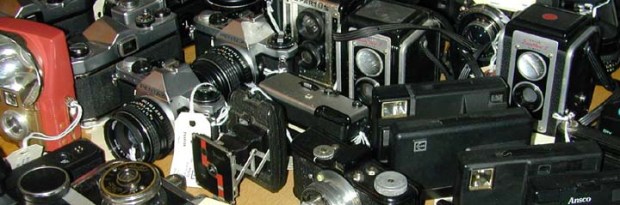
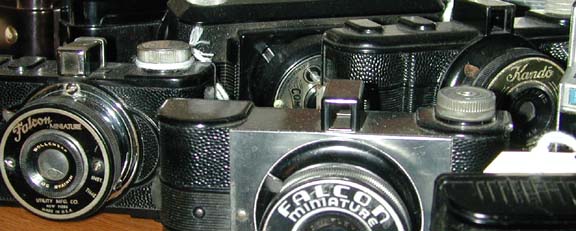
When my husband and I first married (in fact it might have been before we married), we started collecting antique cameras. We collected over 600 older film cameras, the oldest being from the late 1800’s and the newest being one that we bought about the time we got married. The collection we have is neither his nor mine, it is ours.
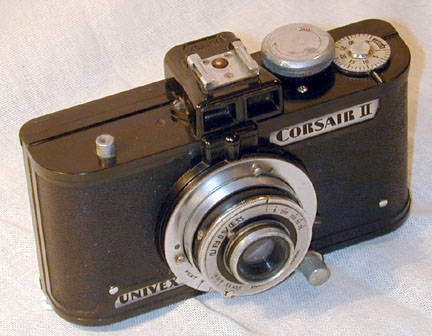
It all started with one camera we found at a yard sale, the Univex Corsair II. I think we bought it for $7. It fascinated us both, and it teases us on many levels. It’s mechanical (and there’s nothing battery-powered about this camera), which caught the interest of my husband. It’s very Art Deco, with is an aesthetic that my husband and I share, with all the glossy black and silver. It’s a camera and we both enjoyed taking pictures. We do have our favorites, however. I’m a big fan of the older bakelite cameras. The husband likes the 1960’s-1980’s SLR cameras.
Univex Corsair II – our first camera
We put together a Microsoft Access database (which is how I learned to use Access), and cataloged and tagged each camera (well at least the first 500 or so), and would spend hours cleaning them and trying to make them work. For each camera that still worked and for which there was film available, we’d shoot a roll and get them developed. We have thousands of photos. We were glad when we were later able to just get the photos on CD.
But then we had our son, and the camera collection and web page development had slowed. OK, it’s pretty-much stopped. But the boy is older now, and I’m starting to think about getting back into the collection and working more on the website. In the meantime, here’s a few photos of some of our cameras!
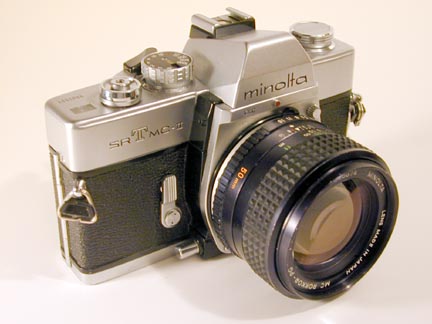
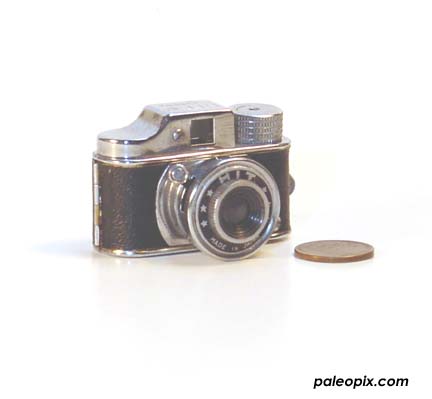
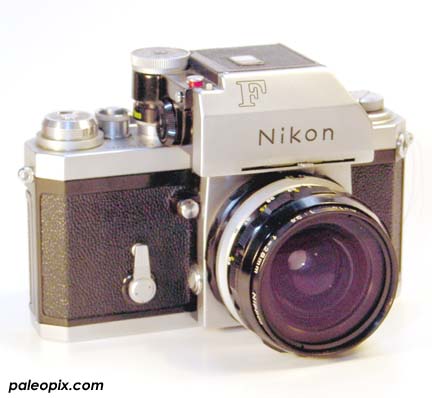
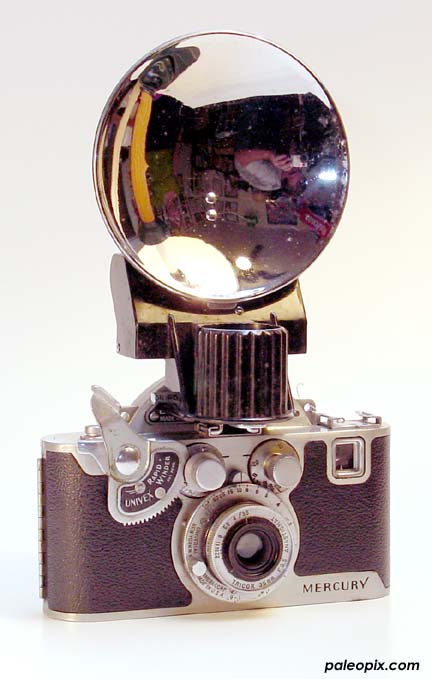
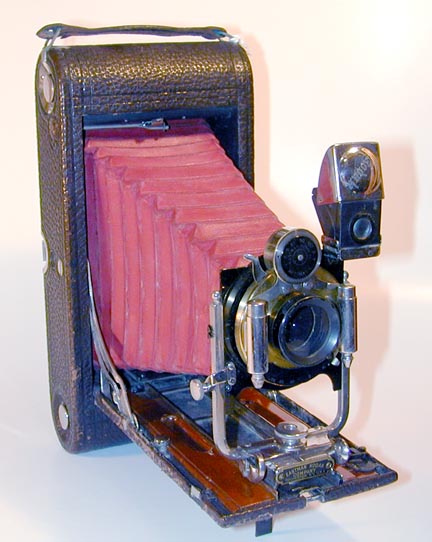
Minolta SRT-MC-II – My first camera. Actually, it was my dad’s camera, but I borrowed it for so long he finally replaced it…Our oldest cameraA Minolta SLR camera for 110 cartridge film. It was a little like taking photos with a sandwich.This is one of our littlest cameras, called a ‘HIT’ camera. That’s a penny for scale. Yes, it worked (though we’ve never tried it).The Nikon F – one of the original Nikon SLRs. Still works. It’s lenses work on our new Nikon digital SLRs.The Univex Mercury – a half-frame camera (took 48 photos on a 24-exposure roll). This was just post WWII. It had a rotary shutter, hence the funny dome on top.Another Univex Mercury. Same vintage, but had flash and rapid-winder. I’ve shot a roll through this one.Bolsey camera – one of the first to take the ‘standard’ (yet now extinct) 35mm film cartridge. We put a roll through this too.Winpro cameras were made near here in Webster NY. Pretty cheap plastic.A Voightlander twin-lens-reflex camera. These take 120 film which is still available (or was when we bought the camera). We never tested this one.Falcon – one of my favorite cheap plastic/bakelite cameras.The Royal Reflex – another cheap plastic/bakelite camera. This one is a twin lens style.A Kodak 3A folding pocket camera – we have lots of bellows cameras. This one’s nice because the bellows are red and intact. It took postcard-sized plates.
There’s a few more, but you can visit the website to see them. Obviously, we have far less than 600 cameras photographed and posted. Some of them, maybe several hundred, are not really worth photographing, but we have some treasures as well. Maybe we’ll get around to posting them all… soon.
I don’t know if I’ve ever mentioned that we have chickens. But…we have chickens. I love them (and hate them). They do provide some entertainment and lots of eggs, but they can stick a bit, and be noisy (and down-right dangerous if you make them mad).
In the paleontological community, there is very little debate that modern birds are direct descendents of the dinosaurs. And if you sit and watch the chickens for a while, you can believe it.
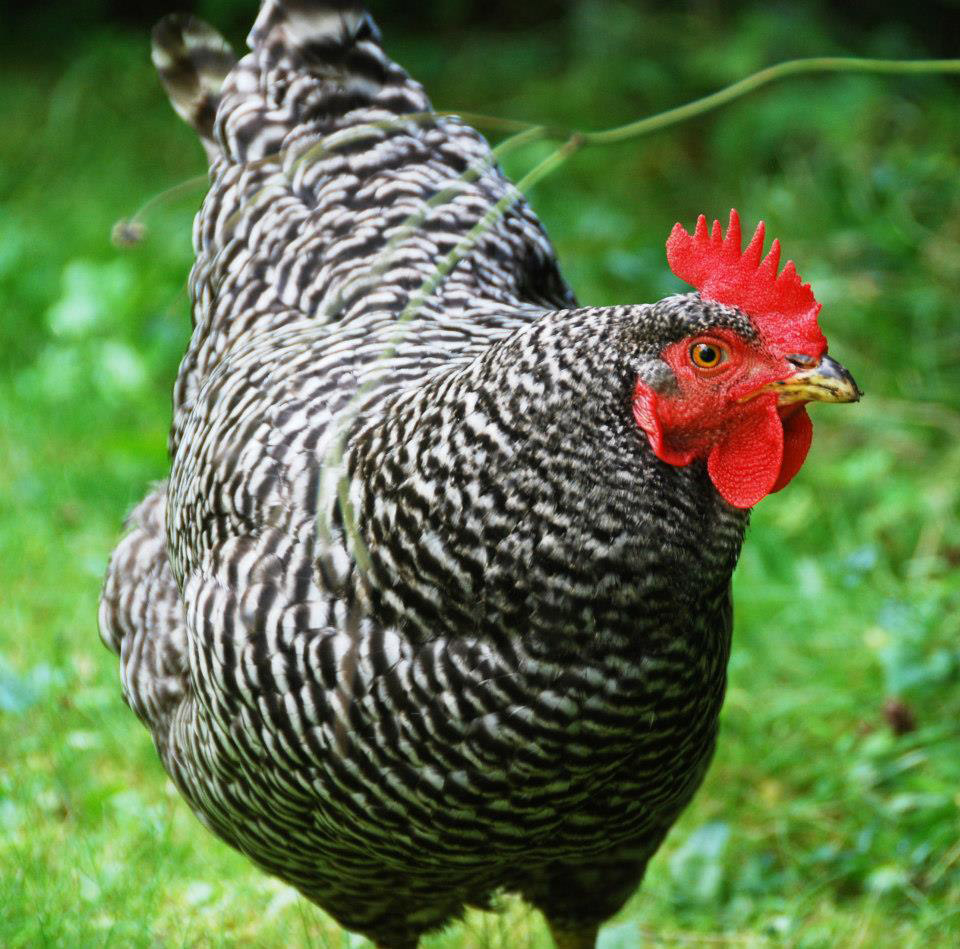
So, we have dinosaurs in our backyard. We like them. Turns out they’re pretty hard to photgraph, but I think I got decent shots of most of them anyway. Here are some photos.
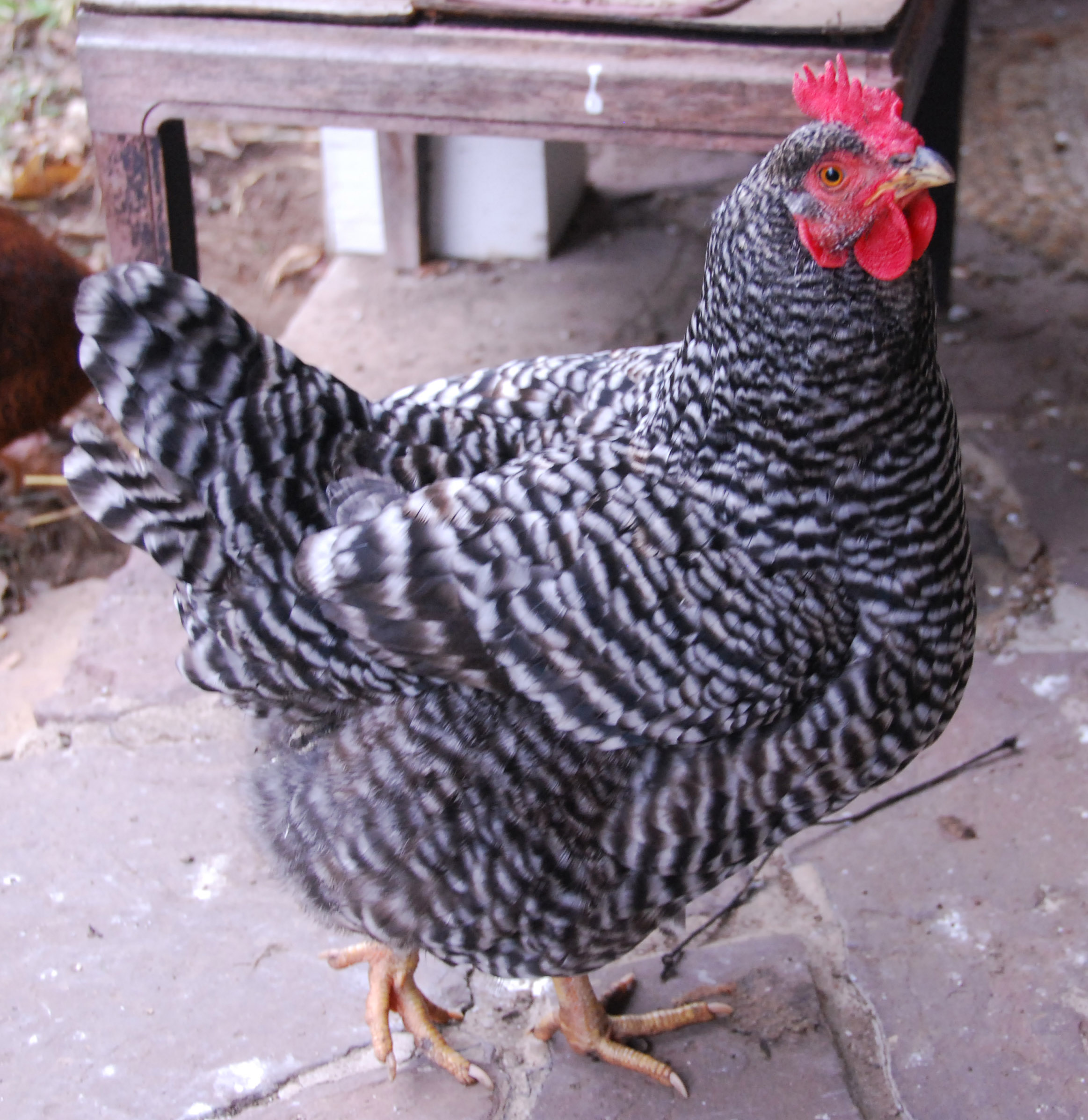
Rosey is the matriarch. She’s the oldest, having already survived one winter here.
Rosey – A Barred Plymouth RockAnother shot of Rosey
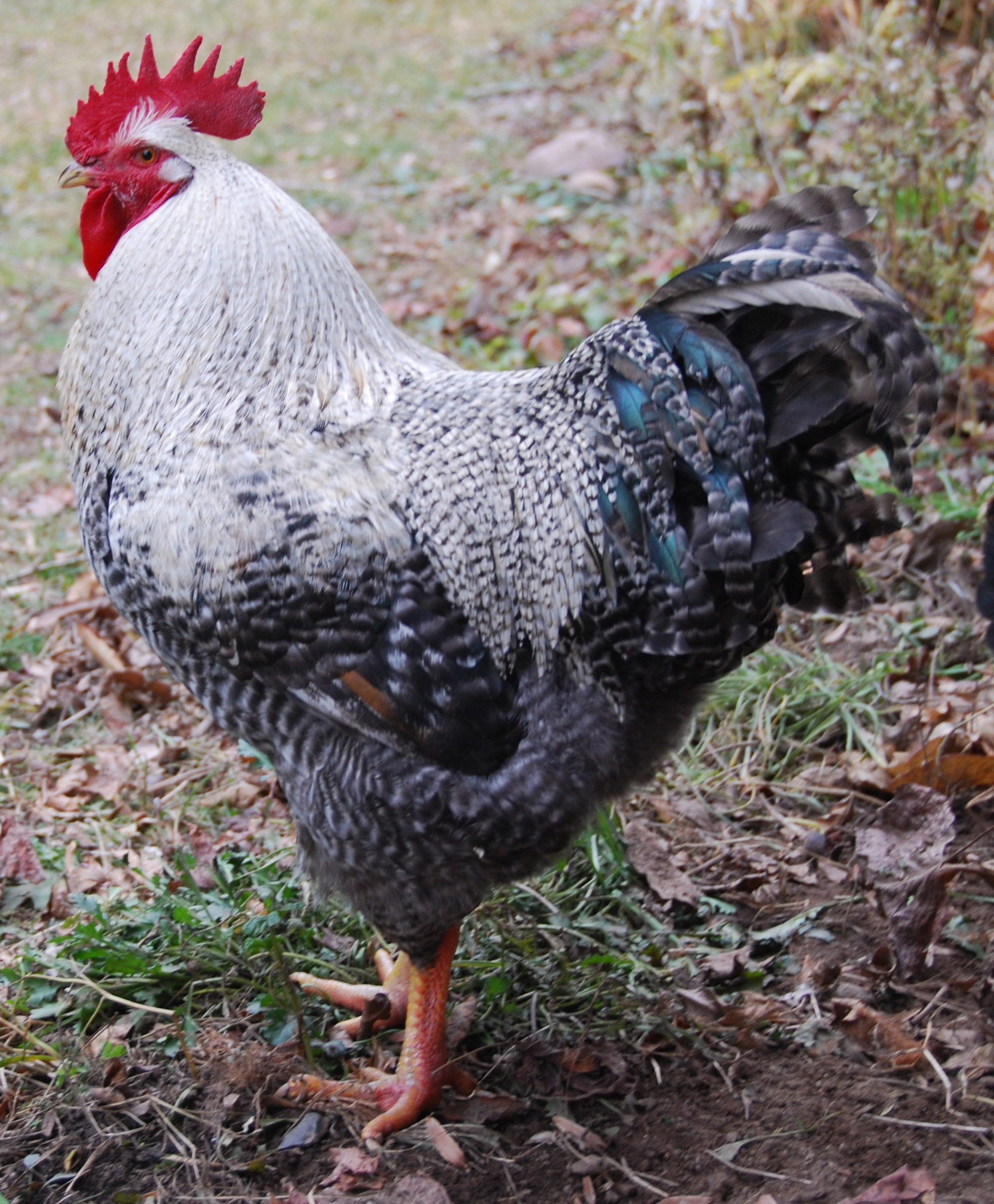
We have a couple of roosters, Bruce and Rocky:
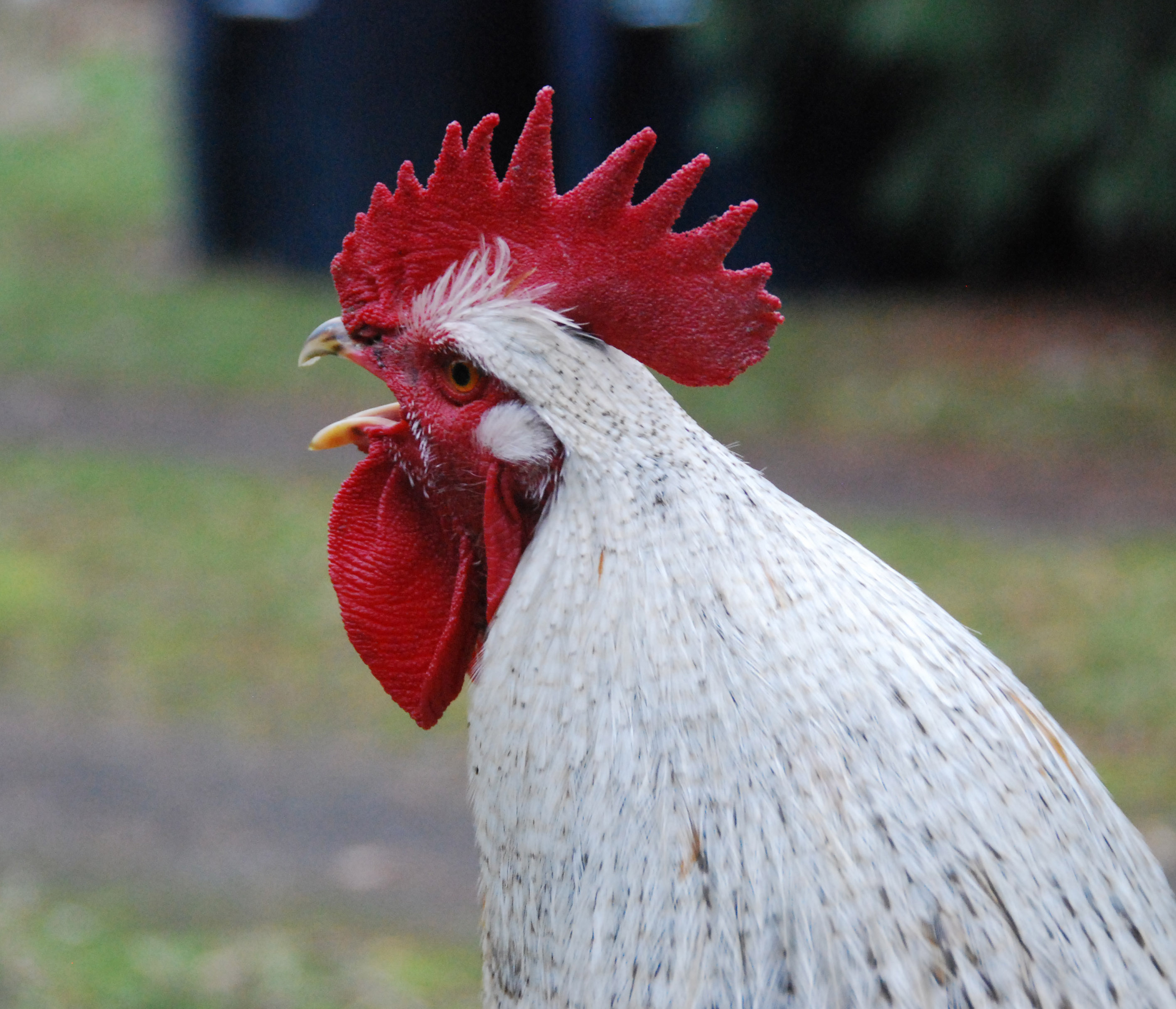
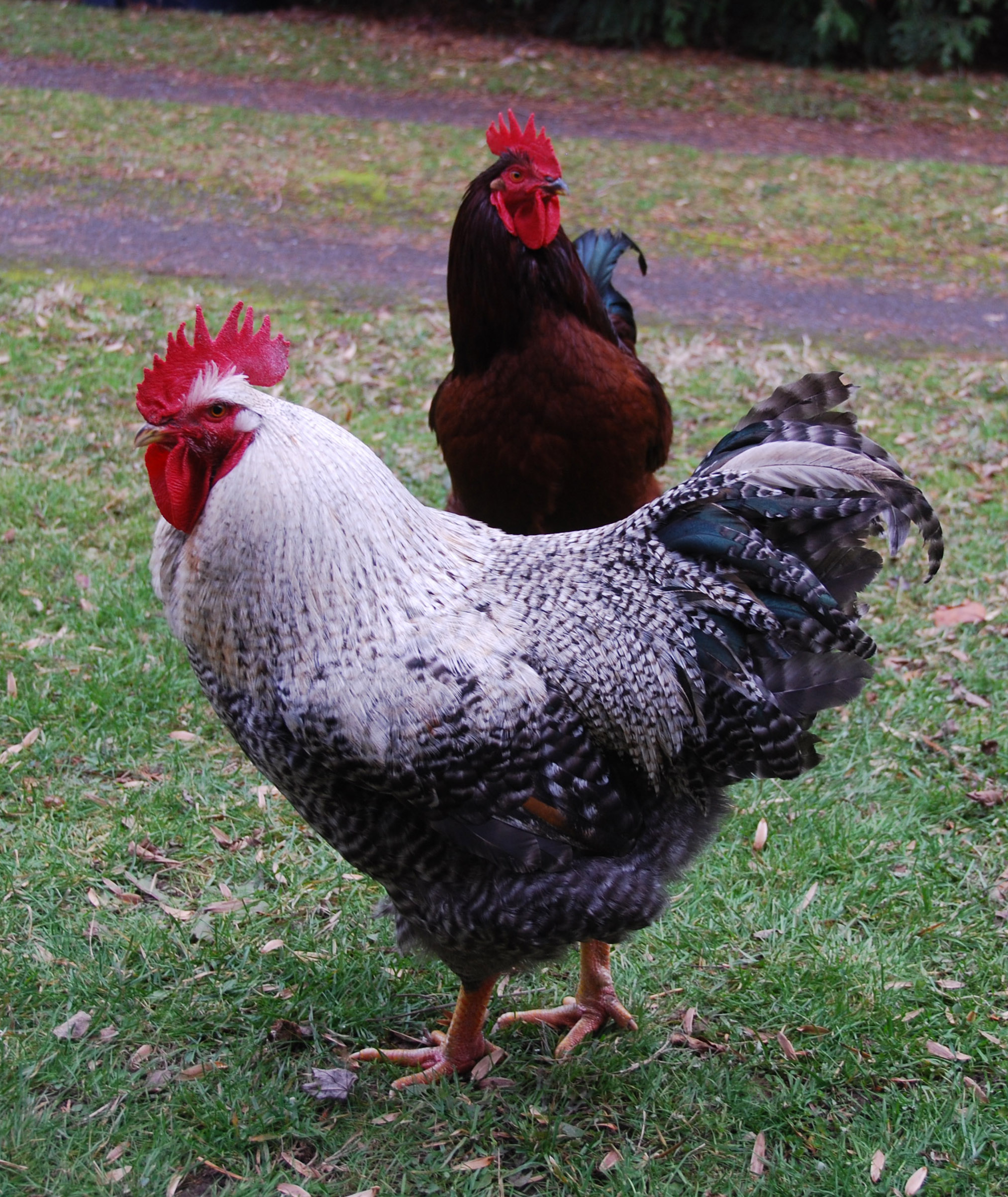
Bruce – A “Black Sex Link” a cross between a Rhode Island Red sire and a Barred Plymouth Rock dam.Bruce crowingRocky – Rhode Island RedBruce and Rocky get along…mostly
And a few of our hens:
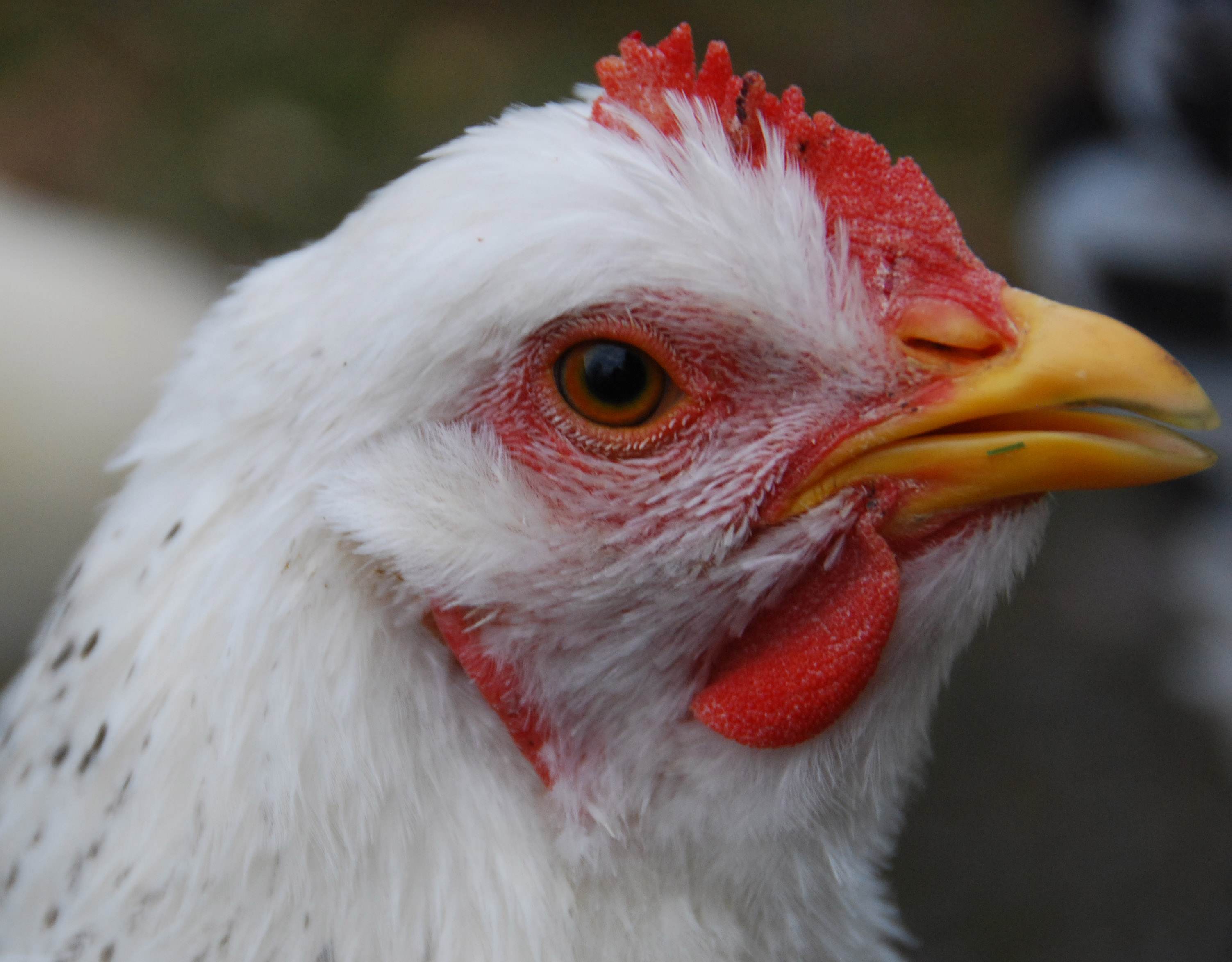
Two Partridge Chanticlers. I haven’t named these two. I can’t tell them apart.Red – a Red ChanticlerBrahma Mama – a Light Brahma.Della, ready for her close-up – a DelawareWynona and Bruce – Wynona is a Silver-Laced Wyandotte
We also have a Buff Chanticler (Buffy) and a White Leghorn (Leggy). Yes, sometimes the naming isn’t all that creative. I couldn’t get anything but blurry photos of those girls, so I didn’t include any. Maybe I will at a later date.
In the meantime, now you’ve met most of our dinosaurs. They’re silly little birds, but we enjoy them. And they can be rather pet-like. This is what happens whenever I walk past the group:
Chicken entourage. You hear the clicking of nails on pavement and look back. There they are, following you!
I’ve only just become aware “The Accretionary Wedge,” a geological blog carnival! It’s basically a monthly amalgamation of the thoughts of geoscientists world wide in reference to an earth-science related prompt.
What a fun concept.
This month, the prompt was for ‘dream geology classes.’ You know, the ones you really wish were offered back in your undergrad days. There are a few that I’ve always wished were taught, some of which I see are already touched upon in the responses to the call for posts. I’ll just talk about one.
FIELD METHODS -or- Rock-breaking 101
One class that I’ve noticed is sorely missing from almost all geology programs is a “Field Methods” class. It could be that the geosciences are heading more and more into the laboratory or onto computers, but it seems that field geology is suffering. A person can actually get a degree in the earth sciences without doing more than a day or two of field work ever!
*gasp*
I was fortunate that where I did my undergraduate (Fort Lewis College), they actually offered a one-semester field methods class. This wasn’t field camp, that was different. This was a full semester course on how to read maps and use compasses. It taught you haw to take notes and how to deal with the geologist’s ‘laboratory,’ where it could rain on you while you’re working. It was ‘field-camp-mini,’ but it put those of us who later took a formal field camp (also offered by my school) at a huge advantage over our less-skilled classmates. (I’m glad to see that Fort Lewis still offers the field methods class, though it looks like field camp might have gone by the wayside.)
I loved that class. I learned in that class that I had what I needed to become a real geoscientist.
The only thing that the class lacked that I wished were in there was specific training on how to collect a hand sample. Seriously, I wanted to learn how to break a rock with a hammer. Over the years, I’ve gotten pretty good at it. There’s a finesse – a certain amount of skill – needed to break off the perfect chunk of rock, completely dependent upon the equipment you have and the type of rock. A two-hour lab exercise would have been effective to teach that.
That’s the class I think needs to be offered in every department at every school. I know I benefited greatly from having it, and I’m certain that students of the geosciences would benefit as well.












 Penny Higgins - Storyteller • Artist • Scientist