Beware of Movies! Earthquakes and Tectonics

The Beware of Movies! series is meant to point out some of the scientific inaccuracies of popular movies, specifically in points related to the geological sciences.

This post will point out the major inaccuracies portrayed in movies about earthquakes, and the mistakes that are made regarding how the important theory of Plate Tectonics works.


Let’s start with earthquakes. Earthquakes are shaking of the earth, typically due to motion along a fault. There are other things that can cause earthquakes, but we won’t worry about those here. Not yet, anyway.

FAULTS

So, what’s a fault?

Most of us have a general sense of what a fault is. It’s a big crack in the Earth’s crust, across which motion (or slip) can occur. Americans usually think of the San Andreas Fault, which cuts California from the northwest to the southeast.

There are tons of misconceptions about faults, some of which are carried into the movies and TV that we watch. Let’s first talk about how faults work, and then address these misconceptions.

TYPES OF FAULTS

Faults are divided into to main types: Strike-slip and dip-slip. Strike slip faults are those where the rocks on each side of the fault slide past each other in a horizontal fashion, to the right or to the left. Dip-slip faults occur when one side of the fault moves up or down relative to the other.

The San Andreas Fault is a strike-slip fault. The rock on the west side of the fault is moving northward with respect to the rock on the east side. If you stood on the Sierra Nevada mountains and looked to the West, across the fault, it would look like the west side was moving to the right. Hence, the San Andreas fault is a right-lateral strike-slip fault.

A right-lateral strike slip fault. The dark band was once continuous across the fault. The cat is wondering how is food bowl moved
A right-lateral strike slip fault, similar to the San Andreas Fault. This is looking down on the fault from above. The dark band was once continuous across the fault. The cat is wondering how is food bowl moved

Beware of Movies: In the TV movie “10.5” (and in other movies like the original “Superman”), it was portrayed as if activation of the San Andreas fault would cause California to sink into the ocean. In fact, lots of people still seem to think this. The truth is that more likely, western California would slide up the western edge of North America and collide with Alaska. But don’t worry. That would take millions of years!

A left-lateral strike slip fault. This is looking down on the fault from above. The dark band was once continuous across the fault. The cat is wondering how is food bowl moved

Many other faults in western North America are dip-slip faults. The fault surface or plane on dip-slip faults tends to be tilted, rather than vertical as in a strike-slip fault. If one were to open up such a fault and try to climb up it, on one side, a person could walk up and on the other a person would need ropes to hang off it. For this reason we call one side of a dip-slip fault the ‘footwall’ and the other side the ‘hanging wall.’

For a dip-slip fault, the motion of the hanging wall relative to the footwall is how we know what caused the fault to form. In faults where the hanging wall moved up with respect to the footwall, we know that compression caused the faulting. This is called a ‘reverse’ fault. If the hanging wall moves down with respect to the footwall, the faulting was caused by stretching, and the fault is called a ‘normal’ fault.

A reverse fault. The cat is standing on the hanging wall. The dark band was once continuous across the fault. The hanging wall has moved up relative to the footwall.

The Wasatch Fault, that runs through Salt Lake City, for example, is dip-slip. It is an example of a normal fault that formed as the continent of North America was stretched out on the west side. All of the mountains of the Basin and Range in the West are bounded by normal faults.

A normalfault. The cat is standing on the footwall. The dark band was once continuous across the fault. The hanging wall has moved down relative to the footwall.
A normal fault. The cat is standing on the footwall. The dark band was once continuous across the fault. The hanging wall has moved down relative to the footwall.

Reverse faults are common in big mountain belts like the Rocky Mountains and the Appalachians. These mountains formed by tremendous forces of compression. There is a special category of reverse faults called ‘thrust’ faults.  Thrust faults are very low angle (close to horizontal) and can slip for hundreds of kilometers. Thrust faults can stack on top of each other (called duplexing) and take up tremendous amounts of shortening of the Earth’s crust.

A thrust fault, a special case of a reverse fault. The cat is standing on the hanging wall. The dark band was once continuous across the fault. The hanging wall has moved up relative to the footwall.

These terms for faults are general. It is important to be aware that most faults don’t fall exactly into one of these categories. For example, there is a little bit of compression that occurs across the San Andreas Fault. The Wasatch Fault has a bit of horizontal motion. Faults are categorized by the type of faulting (strike-slip versus dip-slip) that dominates the motion. If a fault’s motion is between strike-slip and dip-slip (it has components of both kinds of slip), a fault might be called oblique-slip. One such fault might be described as “normal right-slip.”

EPICENTER/HYPOCENTER

When there is an earthquake along a fault, the whole fault doesn’t move at once. Parts of it move, while other parts remain stationary. A fault will remain stationary for a long time as stress builds up across it, then SNAP! It goes.

Earthquakes have epicenters, which most people understand to be where the quake originated. More specifically, the epicenter is the spot on the surface of the land directly above the part of the fault that actually moved. There’s a similar term, hypocenter, which refers to the actual spot, deep under the surface, where the fault moved.

To find the epicenter and hypocenter, a geoscientist looks at the seismic waves from the earthquake as recorded by at least three independent seismic stations. There are several types of waves generated by earthquakes, most importantly p- and s-waves. p-waves are “primary” waves, and arrive at seismic stations first. These are compressional waves. s-waves (“secondary waves”) arrive next. s-waves are shear waves, so they won’t pass through liquids. The separation in time between the s- and the p-waves tells the geoscientist how far away the earthquake happened, but not what direction. With several seismic stations, the actual point (the epicenter) of the earthquake can be found.

Beware of movies: The movie “10.5” had all sorts of gems about epicenters, hypocenters and seismic waves. One quote was “the s-waves are off the chart!” which is interesting because it’s not the p- or the s-waves that are the big sweeping squiggles on a seismogram. The big squiggles are from the surface waves, which come much later. The characters also became excited as they looked at seismograms shouting about side-by-side motion. Honestly, I don’t even know what that is. The characters were delighted that the hypocenter was deeper than they could measure (“sub-asthenosphere” even), which is bizarre. Read on about that.

EARTHQUAKE INTENSITY

Intensity of earthquakes is usually measured on the Richter scale, where greater numbers mean a bigger quake. The Richter scale is logarithmic, meaning that a magnitude 5 quake is 10 times as powerful as a magnitude 4 quake. It is measured in reference to how large the surface waves generated by the quake actually are. The first surface waves are usually the biggest, and then they taper off. The fault moves one time – suddenly – then stops. Aftershocks (renewed motion) might occur, but each of those come with their own seismic signature with p-waves, s-waves, and intensity.

Beware of movies: Here’s the thing: Magnitude of a quake is calculated after the quake is over. In 10.5, they’re measuring (somehow) the intensity of a quake as it is happening. What’s more, the intensity of the quake (in the movie) increases over time. That does not happen with real earthquakes!

WHY ARE THERE FAULTS AT ALL?

Obviously, something has to be driving all this compression and stretching and shearing that causes faults to exist at all. The theory of Plate Tectonics provides the best explanation for the existence of faults and the forces that drive their motion.

As mentioned in a prior Beware of Movies! post, the Earth’s surface (lithosphere – down to about 100 km depth) is broken into several plates, which move around. These plates can be divided into two categories depending upon their thickness and composition. Oceanic plates are under the oceans. They are much thinner but are made of very dense material. Continental plates are the continents, and are thicker but not all that dense (as rocks go). Some plates, like the North American plate, have parts that are continental (all of North America) and parts that are oceanic (the North American plate extends halfway across the Atlantic Ocean).

Major tectonic plates of the world.

TYPES OF BOUNDARIES BETWEEN PLATES

There aren’t gaps between the plates, so something has to happen so that the plates can move. There are three general types of plate boundaries: convergent, divergent, and transform. Convergent boundaries exist where two plates are coming toward each other. Divergent boundaries occur where plates are moving apart. When plates slide past each other, we have transform boundaries.

Three types of plate boundaries.

Convergent boundaries involve compression, so it’s no surprise that faults associated with such boundaries are usually reverse faults. The nature of the boundary itself is dependent upon whether the convergence is between two continental plates, or if oceanic plates are involved. If two continental plates are converging, there will be a collision, just like when India hit Asia millions of years ago resulting in the Himalayas. The Appalachian Mountains of North America are remnants of an ancient collision between Africa and North America (which have since moved apart).

An oceanic plate can sink under another plate, resulting in subduction, where one plate overrides another. A subduction zone is like a colossal reverse fault, though we don’t generally call it as such. Subduction also results in mountain ranges, like the Rocky Mountains and the Andes. Subduction is also associated with volcanoes. The volcanoes of the Cascades and of the Andes are related to subduction.

When plates move apart, stretching and thinning of the plates occurs, along with lots of normal faults. The lithosphere gets so thin that magma comes up from the mantle (below the lithosphere) causing a line of volcanoes. When such stretching begins, especially in the middle of a continent, it is called ‘rifting.’ The East African Rift system is a prime example of this.  Lake Victoria sits in the depression caused by the rifting.

At some point the rift becomes so deep that it is filled with ocean water. New oceanic crust is formed by the volcanic eruptions. This is happening in the Red Sea today. As this continues, a whole new ocean forms. The entirety of the Atlantic Ocean was once just a little rift between North and South America and Europe and Africa.

When plates slide past each other, we get transform faults. These are strike-slip faults. Sometimes there’s a bit of volcanism associated with these but usually the big activity there is earthquakes. The San Andreas Fault is a transform boundary between the Pacific plate and the North American plate.

Beware of Movies: The movie “Volcano” is based on the premise that the plate boundary between the Pacific Plate and the North American plate could spawn a new volcano, similar to those in the Cascades. The problem is that there is no subduction along the San Andreas Fault. There is subduction below the Cascades, but it’s not the Pacific Plate that’s being subducted. It’s the small Juan de Fuca Plate. The Juan de Fuca plate is a remnant of a once much larger plate (the Farallon) that has been completely subducted under North America.

WHERE DO FAULTS OCCUR?

Plate tectonics explains that most faults occur due to motions of the lithospheric plates, resulting in a limitation of where faults might be seen on the Earth’s surface. Faults also are limited to the lithosphere, or the upper 100 km or so of the Earth. The lithosphere – the crust especially – tends to deform in a brittle fashion. That is to say, if you put pressure on the rock, it will likely crack and snap. Below the lithosphere, heat and pressure are so high that rock (though it is still solid rock) deforms in a ductile or plastic fashion. It bends slowly or flows, due to individual motions of atoms. Big cracks and fissures do not exist below the lithosphere.

Beware of movies: In the made-for-TV movie “10.5,” the geologist claims that the massive earthquakes are being caused by faults existing 700 km down. Not only is that below the lithosphere, it’s in the lower mantle! Faulting cannot exist at such a depth.

The take-home message here is that earthquakes do not occur willy-nilly all over the surface of the Earth. They are most often associated with plate tectonic boundaries or mountains. There are a few that pop up in unexpected places. Some are even devastating, like the New Madrid earthquake that hit the mid-western United States in 1812. In that case, the earthquake resulted from the re-activation of an extremely ancient fault system that is no longer active, but had accumulated some stress over millions of years. I hasten to mention that the New Madrid fault is still in the crust!

Beware of movies: We don’t know where every fault is. We can’t predict earthquakes. Don’t believe it when characters in movies (like “Earthquake” or “10.5”) claim to be able to do so. It can’t be done. Not yet, anyway.
It’s The Shining!!

National Blog Posting Month – December 2012 – Work

Prompt – Agree or disagree: All work and no play makes you a dull girl.

In the case of this prompt, it’s important to define what is meant by ‘work.’ Work could be defined as that which a person does to earn a paycheck, whether they enjoy the work or not. Alternatively, work could be defined as any task which requires mental and/or physical effort, again whether for pleasure or by requirement.

For me, I distinguish between work and not-work based upon the level of effort required (i.e. the second definition). Thus, watching “America’s Got Talent” is not work, writing a blog post about everything geologically incorrect about the movie “The Core” is work. Going for a two mile run is work. Power-shopping at the mall is not work. Writing this blog post while I’m in the office is work, even though it’s not what I’m actually getting paid for.

Play also needs to be defined better. For me, play is anything you derive pleasure from, whether paid or unpaid. Using these definitions, an activity can be simultaneously work and play – and I do a lot of that. I actually enjoy my job, so I often feel like I’m playing while I’m at work.

All this said, it is important to remember that play, by itself, is necessary for any person to maintain their sanity. If all I ever did was work, or work-play, I think I might lose my mind. That’s why I do watch TV and I do occasionally go power shopping. Without that mental and physical escape, I think I might explode!


For 12-17-12

Geology Movies: John Carter, 2012

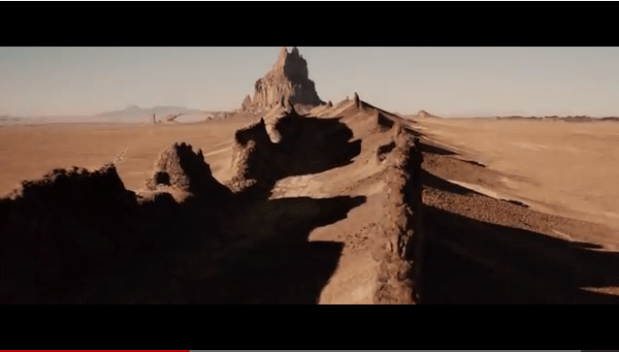
John Carter isn’t about geology at all, so it’s really not a “Bad Geology Movie.” However, it’s worth inclusion here because it was filmed in a place that has some really darn awesome geology.

Those aren’t (all) matte paintings folks. That stuff is real! Features might have been added, but the settings are real.

Shiprock
Shiprock. Learn more about this here.

This is the area where I studied geology, all those years ago. Watching John Carter took me home. If you want to see some spectacular geology while watching a movie, you should check out this movie!

Thoracic Park

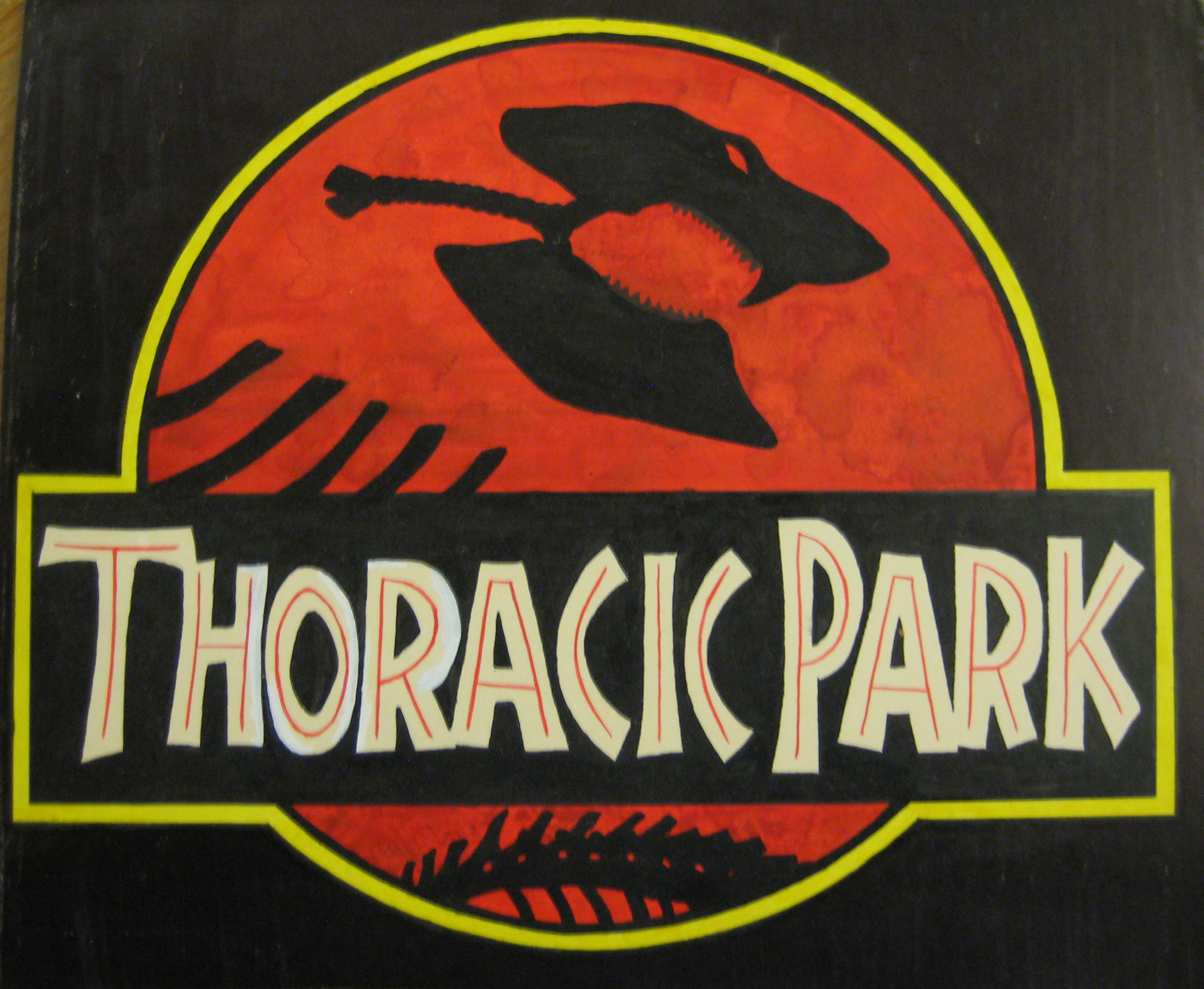
Because I’m on this movie kick (and I need to be off to watch another one), I share with you this painting that I did as an undergraduate, at about the time Jurassic Park came out.

The original painting of the logo for "Thoracic Park"
The original painting of the logo for “Thoracic Park”

The idea originated in my vertebrate comparative anatomy course. As I recall, we were in the middle of dissecting a dogfish shark, and we started joking about Thoracic Park, and how we needed to make a department T-shirt. I did this painting probably within 24 hours, but it never became a T-shirt. We suddenly became worried about licensing issues and it got back-burnered, then forgotten.

But it’s back.

And because George Lucas can do it, here it is again, enhanced with modern technology (aka Photoshop):

"Thoracic Park" logo, with a little Photoshop improvement.
“Thoracic Park” logo, with a little Photoshop improvement.


Friday Headlines: 12-14-12

Friday Headlines, December 14, 2012

THE LATEST IN THE GEOSCIENCES


LAND CREATURES MIGHT NOT HAVE COME FROM THE SEA

Well, this is a little deceptive. What this headline conjures in the imagination is the traditional vision of the fish, dragging itself onto land, developing legs, and ultimately becoming human.

What’s being discussed here, however, is life before vertebrates. Life before bones. The oldest types of multi-cellular life, more than twice the age of that fish that crawled onto land. This new finding (probably pay-walled) is in reference to the Ediacara Fauna, which is thought to have been ancestral to modern organisms, vertebrate and invertebrate. It appears that the organisms of the Ediacara Fauna lived on land, not under water.

Ediacaran fossils are among the most bizarre looking fossils out there, causing paleontologists to scratch their heads for years. They seem to be soft-bodied animals that have been considered potentially related to primitive worms, or jellyfish, or maybe molluscs, all of which presumably would have lived in the ancient ocean.

In the new paper, Greg Retallack argues that the rocks that the fossils are found in are paleosols – which is a fancy term for a fossilized soil. Soils do not form under water. They are a land phenomenon. Retallack used many lines of evidence to support that he was looking at paleosols rather than a sea floor, including the rock texture (it looks more like wind-blown silt than ocean-floor clay), cracks from drying (definitely wouldn’t happen underwater), carbonate nodules (which are common in soils), and stable isotopic evidence.

This new interpretation affects how we think about the origins of multicellular life, because suddenly the earliest multi-cellular forms of life were already on land. It also affects how we interpret the lifestyles of the Ediacaran fossils. Suddenly, they’re not floating around any more and that changes the kinds of things an organism can do.

An important thing to think about here is that this does not mean that life originated on land. It also does not mean that multi-cellular live originated on land. What it means is that the earliest fossils of multi-cellular life that we have on Earth were land organisms. The earliest life-forms were all soft-bodies creatures. They don’t fossilize well, which is why we don’t have much of a record. Hard parts came about in Cambrian times (after the Ediacaran Fauna), and that’s when we suddenly have a great fossil record. There probably were soft-bodied organisms living in the oceans at the same time as the Ediacaran organisms – they just weren’t preserved.


BRILLIANT GEMINID METEOR SHOWER PEAKS TONIGHT (December 13)

The Geminids are a meteor shower that seems to radiate from within the Constellation Gemini. This meteor shower comes every year in early-to-mid December. We’re in luck this year, as it seems we’ll have a new moon, making the sky nice and dark and the meteors especially visible.

The Geminids are cool because they apparently arise from an asteroid (named Phaethon) rather than a comet like most other meteor showers. The orbit of Phaethon is much more like that of a comet than of a typical asteroid. Here’s a cool Java applet that shows its orbit. We know it’s not a comet because it lacks important features, like a tail, that comets have.

The Geminids will be just past their peak when this post goes live, but they should still be evident for a few more nights. Hopefully the skies will be clear so we can all go out and look for a while.

I gotta be me!

National Blog Posting Month – December 2012 – Work

Prompt – Do you think you’re yourself at work, or do you think your co-workers don’t know the “real” you?

One thing that I do know for certain is that the person that I am in the office is the same person that I am at home. I’m fortunate to have a job where I’m not expected to conform to some particular behavior. I’m grateful to have a job where there is no specified dress code. I’m glad to be in academics where it’s more important what you do than what you look like.

In academics, even social skills are optional, which is one of the reasons why I’m glad I don’t have to go to faculty meetings.

All this isn’t to say that I don’t care at all about my appearance or what others think of me, I just don’t concern myself with these things any more than I would if I were going to the grocery store. I wear jeans to work most every day, but that’s for practical reasons: I’m regularly crawling on the floor of my laboratory. A skirt or nice slacks would be destroyed in no time. I do wear T-shirts some days, but I actually prefer to wear something a little nicer. Maybe something that buttons or has a collar, but still always something practical that will keep me warm in my 62-degree office and also not get caught on anything in the lab.

My co-workers know me well, at least my quirks. I’m notorious for meowing greetings to people. They know that I’m learning swordplay. They know that I like to sew medieval clothing. If I were trying to hide the ‘real’ me, I suspect no-one would know these things about me.

I’ve got nothing to hide. I like me. I think I’m interesting. And being ‘me’ in the office doesn’t hinder my ability to do my work, nor the abilities of others to do their work. The me of the office is the me of the world. I’m glad I don’t have to change personalities every morning as I drive into work!

For 12-14-12

Introducing Friday Headlines

Friday Headlines is something I do in my introductory geology course to make Fridays more interesting and to keep the topic of the course relevant to the students. I put together a short PowerPoint presentation (10 minutes max) and tell them about two or three events in the geological sciences that have happened in the last week.

These events can be global happenings, like an earthquake or volcanic eruption; they could be the interesting findings of a freshly-published paper; or they could be some grand new discovery from NASA, like ice on Mercury or organic material on Mars. I’ve talked about global warming, peak oil, the arrest of geoscientists for incorrectly predicting earthquakes, and the Anthropocene.

What ever I choose, it is something interesting to the general public (thus, my students) and relevant to the geological sciences. My goal is to show students that things happen in the geosciences all the time, so that they understand that what I’m teaching them is actually useful in the real world.

Friday Headlines also make coming to class on Friday a bit more interesting. Students seem to like it for the change, as do I. A standard lecture every day can be pretty dull, even for the instructor.

I’ve enjoyed doing Friday Headlines during the fall semester for the last three years now. I’ve decided to take the concept a bit further and make it a recurring post in my blog. It’ll ensure at least one blog post per week (with the only possible exception being during the field season when I might not be near a computer), and should help me and my followers stay on top what’s happening in the geosciences and remember why geosciences matter.

Tomorrow I’ll post my inaugural Friday Headines article. I hope you’ll enjoy them as much as I do!

All Work and No Play…

National Blog Posting Month – December 2012 – Work

Prompt – Are you happier when you’re working or when you’re relaxing?

Some days I have serious doubts that I can relax. I get nervous during idle time, with the constant nagging suspicion that there is something that I ought to be working on.

I think it’s a remnant of being a graduate student. We called it “grad student guilt” then. Basically, if you were conscious, you needed to be working if you had any illusions about graduating on time. I still feel this way.

Relaxing is stressful to me. I have a hard time just kicking back, enjoying a beer, and watching a movie. Lately, I’ve been watching lots of movies, but I’m only able to do that as I’m working on a blog series about bad geology movies. See? It’s work, so I’m doing a good thing.

When I’m working, even if it’s not related to my paying job, I feel like my energies are going to good use. I feel like my efforts will be beneficial in the long run. I (almost) never feel that way when I’m relaxing – though rationally, I know that there are important benefits to taking a break from time to time.

So, am I happier when I’m working or when I’m relaxing? Usually happiest when I’m doing a lot of work and being highly productive. Relaxing can wait until I am no longer capable of working…

For 12-13-12

Bad Geology Movies: Earthquake, 1974 – can we even predict earthquakes?

Earthquake

1974

Charlton Heston, Ava Gardner

Premise: What would happen if a massive, magnitude 7.0 or greater, earthquake hit Los Angeles?

I bought this movie for cheap somewhere, assuming that it would be an excellent “Bad Geology Movie.” I couldn’t imagine that Hollywood would get an earthquake right.

It turns out that this movie is a typical 1970’s disaster film with an all-star ensemble cast. There was very little attempt at real science in the movie, so I don’t have a lot to say.

I do have one major point to make about this film, regarding the prediction of earthquakes. The film opens with a graduate student accurately predicting two foreshocks of the massive quake that takes out L.A. In fact, the student predicts the enormous quake as well. By some strange miracle, the mayor of L.A. is willing to mobilize the National Guard based on this prediction. The earthquake happens and chaos ensues.

This would be an amazing scenario. It would be fantastic if we could accurately predict earthquakes. But the fact is that we cannot. Not even close.

What’s worse, is that because of the political climate, even if a scientist thought he or she could predict earthquakes, they would be reluctant to say anything. It’s a miserable situation.

The characters in the film note that an incorrect prediction could be disastrous to people’s faith in science. You don’t want to cry wolf, as it were. Equally, a prediction of no earthquake, followed by a violent quake would be just as bad. People would demand to know why they weren’t warned. So what do we, as scientists, do?

For one thing, we always include probabilities on our predictions. Perhaps we only raise warnings if we think there’s a greater than 50% chance that an earthquake will happen. But even if the probability is only 10%, a quake could still happen. What then?

We also have to consider the evidence that we’re using to make these predictions. Often they’re based on historic data (how often have earthquakes happened in the past) with a little bit of new geophysical data (like sensitive GPS systems). We really don’t have enough adequate data at this point to make accurate predictions at all.

Still, people are rational, right? They understand that such predictions are impossible, right? We like to think that, but the truth is, most people don’t understand this. And the likelihood that people will be sympathetic to the plight of the scientist after a huge, unpredicted earthquake is pretty small.

Such is what happened in 2009 near L’Aquila, Italy. Italy is a tectonically active region, frequently hit with small earthquakes. There were a few strong earthquakes leading up to a magnitude 6.3 quake that hit on April 6th of that year. The town of L’Aquila was leveled and 309 people died.

Though there had been strong foreshocks in the area prior to the main quake, local geoscientists contended that the chances for a major quake were small, and the town was warned but not evacuated. After the earthquake, 6 geologists and 1 government official were put on trial for involuntary manslaughter, for not having adequately warned the citizens of L’Aquila, which resulted in the large death toll. In October of 2012, all seven men were sentenced to six years in prison.

Well, if this is what happens when you try to make any predictions in geology or the earth sciences, then I’m going to stay mum if there’s been any natural disasters. When Hurricane Sandy hit, I got a call from a local reporter who wondered if I would comment about how the hurricane related to global warming. I said no, in part because I didn’t really feel qualified to do so, but also because I don’t want to be held liable for making an incorrect prediction. It seems ridiculous, but it’s true.

I didn’t sign on to be a scientist to be held accountable for predicting earthquakes or hurricanes. I signed on so I could learn more about our world – with the hope that what I learn might just benefit others in unexpected ways. I’m certain that’s how those geoscientists in Italy felt as well. They were just doing their job to the best of their ability with the resources and data they were provided.

I think this whole episode has given many scientists pause to think about what they should or should not say publicly. I know I’m not alone.

The Hardest Job Ever

National Blog Posting Month – December 2012 – Work

Prompt – What do you think would be the hardest job for you to do?

There are two ways I can approach this question. I know that the hardest job I have ever done is being a parent. Of course, like all parents, I am grossly underpaid. And there’s no vacation. No days off. I’m still a parent, even if I’m sick. It can kinda suck. On the other hand, once in a while the boy says “I love you, Mom,” which basically negates all the bad things. It’s a hard job. The hardest. I feel horribly underqualified. Yet I do it every day and both boy and mom seem to be doing all right.


Now, if I were thinking of career style jobs, the hardest job I could have is any in which I was required to make a ton of phone calls. I think I’d be sick everyday. You see, I have social anxiety (though most people who know me find that hard to believe). For all the years of therapy and medications the one thing I still can’t do without overwhelming terror is make a stupid flipping phone call.

I do make phone calls, of course, and sometimes with little to no anxiety. But if I have to cold-call someone, say for example a program director at the National Science Foundation, or a land owner who’s land I’d like to work on, I flip. This may be one of the reasons why my current job suits me. I don’t have to make those calls. I call vendors from time to time to ask for parts (which can still be difficult). Most everything else I need to do can be done with e-mail. I can handle e-mail – most of the time.

So retail jobs would be a nightmare for me. Secretarial jobs, panic city.

Sitting in an interior laboratory with no windows, just me and the mass spectrometer, just fine. I’ll stick with what I got.

For 12-12-12