Noises off!

National Blog Posting Month – December 2012 – Work

Prompt – Can you get work done with background noise or do you need the room silent?

Everyone has there preferences, but for myself, I generally need silence or white noise in order to keep my thoughts from wandering too far. Sometimes I can work to old, familiar music, but most often, silence.

Noise distracts me constantly. I hate extraneous sounds. I like quiet. The noise in this room right now is disturbing me.

Sigh.

For 12-24-12

Beware of Movies! Volcanoes

The Beware of Movies! series is meant to point out some of the scientific inaccuracies of popular movies, specifically in points related to the geological sciences.

This post will present some basic information about volcanoes and how they work, and point out the major inaccuracies portrayed in movies about volcanoes.

What is magma? How is that different from lava?

It’s a good question. We’ve all heard the terms before, magma and lava, and probably you’ve got a general sense of what they mean, but do you know the specific definitions.

Magma and lava are both words for molten rock. Liquid rock. Very hot. This distinction is that magma is below the surface of the Earth and lava is what you call it when it’s on (or above) the Earth’s surface.

 Types of magma

Molten rock is not all created equal. When you look at rocks, you realize that they’re of all different kinds. So if you melt that rock, it’s going to be of different compositions reflecting the rock that was melted.

To discuss the composition (or types) of magma, we refer back to Bowen’s Reaction Series. Magma can be felsic (high silica, high calcium, aluminum, and potassium) or mafic (low silica, high iron and magnesium), or anything in between. These compositions affect the behavior of the molten rock. Silica tends to polymerize (make chains) in molten rock, which means that a more felsic magma tends to be more viscous (or that it doesn’t flow very well). The high levels of iron and magnesium in mafic magma makes it more dense. Also felsic rocks melt (to make a felsic magma) at much lower temperatures than mafic rocks.

From this discussion, one might gather (and rightfully so), that the composition of a magma is determined by the type of rock that melted to make the magma. There are other ways to change the composition of a magma (which will serve to explain why we have different compositions of rocks in the world)

 Changing the composition of magma

1) The composition of the parent rock (the rock that melted to form the magma) – If you melt a mafic rock, you get a mafic magma. This is the most straightforward means to change or determine the composition of a magma.

2) Assilimation – If a magma body incorporates another rock, which then melts, unless the incorporated rock is of the exact same composition of the magma, the composition of the magma will change. As magma rises through the crust, it ‘eats’ through the rock above it (country rock), melting and incorporating the country rock, changing the composition of the magma body.

3) Magma mixing – Two separate magma bodies while moving together may wind up coming in contact and mixing. Unless the two magma bodies have the exact same composition, a new magma will result with a composition in between the original two magmas.

4) Partial melting of rock – As noted earlier, felsic rock melts at a lower temperature than mafic rock. When any rock melts, the first minerals to melt are the most felsic minerals. Over time, as the rock heats up, the more mafic minerals begin to melt. But a rock doesn’t always completely melt over time. If a rock only partially melts, and the melted rock (magma) moves away, the magma is more felsic than the original rock and the remaining rock is more mafic than the original rock. Thus, through partial melting, a magma may become more felsic.

5) Fractional crystallization – As a magma cools, the first minerals to crystallize are the most mafic ones, causing the remaining magma to become more felsic. These newly-formed mafic minerals might settle out, leaving behind a more felsic magma to continue on its way toward the Earth’s surface.

 Intrusive or extrusive

Not all magma makes it to the surface. If it does, you get an eruption and a volcano. Lava erupts onto the surface to cool and form what we call extrusive igneous rocks. The magma that doesn’t make it to the surface will crystallize below the surface, and is called intrusive igneous rock, or just an intrusion.

Since we’re talking about volcanoes, we’re going to talk only about extrusive igneous rocks formed from lava.

 What comes out of volcanoes?

Lava is the molten rock that comes out of volcanoes, but there is much more that comes out. The opening out of which the lava flows is called a vent. But it isn’t always lava flows that come from vents. There is also ash and other pyroclastic debris. So what does that mean?

The stuff that flies out of volcanoes is called volcaniclastics or pyroclastics. The root ‘clastic’ refers to little bits and pieces that get deposited together. The volcani- part refers to volcanoes (obviously), and pyro- refers to fire. So the words mean bits and pieces of rock coming from volcanoes or coming from fire.

Those bits and pieces have specific names depending upon their size and shape:

Ash – tiny glass shards that form when the lava crystallizes almost instantaneously.

 Beware of movies: It seems that in almost every movie (for example, Dante’s Peak and Volcano), there’s always a ton of ash snowing down upon the main characters of the story. This ash is glass shards! If you inhale this, it will cut your lungs to bits and you will die a miserable death. Yet, somehow, in movies this is never an issue. In paleontology, some of the best fossil assemblages came to be when an eruption occurred and the ash killed the animals in just this way. Then the ash buried the animals and perfectly preserved the animals for geoscientists to later discover.

Lapilli – pea to plum sized fragments that can be streamlined from flying through the air.

Blocks and bombs – apple to refrigerator sized fragments that are shot from a volcano. Blocks are bits of rock that were already cool when they were shot, whereas bombs were molten when they were shot and often are streamlined in flight.

The deposits left behind are also given special names, depending on how they formed:

Ignimbrites (or pyroclastic flows) – avalanches composed of ash or ash plus lapilli. These things can go very fast, riding down the slope on a cushion of air, just like a snow avalanche.

Lahars – a rapid slurry of volcaniclastic material in water (like a mudflow), most often caused when snow caps suddenly melt off of volcano peaks during an eruption.

 Beware of movies: In Dante’s Peak, there was ample opportunity for good pyroclasic flows and lahars, but there weren’t many. There should have been. And the ones that they did show were too slow and did not flow far enough. It was pretty weak, honestly.

 Lava flows and types of eruptions

Different compositions of magma (lava) behave differently as they flow out of a volcano. Because of the polymerization of silica, felsic lavas tend to flow more slowly and in a more ‘chunky’ form than does mafic lava. Mafic flows can move much greater distances than can felsic flows.

Eruptions of fast-moving, low-viscosity mafic lavas are often what we call ‘effusive,’ or characterized by huge flows and lava lakes. Other eruptions like that of Mount Saint Helens in May of 1980 (or of Dante’s Peak), are ‘explosive’, which characterizes eruptions of intermediate to felsic lava.

Magma (and lava) often contains dissolved gasses, which must escape when the lava erupts. If the gas can escape easily, an eruption will be more effusive, but if the gas cannot escape, eruptions may be very explosive.

The interaction of eruptions with water also effects whether and eruption will be explosive or effusive. If a volcano erupts under water (or lava flows into water), the results can be explosive.

 What kinds of volcanoes are there?

The types of flows coming from a volcano (and therefore, the composition of the erupting lava) determines the shape of the volcano.

Shield volcanoes are huge, flat (shield-shaped) volcanoes that result from dominantly mafic flows that are effusive in character. The Hawaiian Islands are all enormous shield volcanoes.

Stratovolcanoes (also called composite volcanoes) are tall, pointed volcanoes, often associated with explosive eruptions and felsic to intermediate compositions of lava. Such volcanoes tend to be composed of repeated layers of flows and pyroclastic depositis. Mount Saint Helens and Mount Rainier are two prominent examples of stratovolcanoes.

 Where do we find volcanoes?

Volcanoes tend to be in specific places throughout the world, not just stuck willy-nilly where ever they seem needed. For example, you don’t find volcanoes in the middle of continents.

The positions of volcanoes on the Earth is almost entirely dictated by plate tectonics. Volcanoes arise do to the interactions of tectonic plates, and thus tend to be at or very near plate boundaries. Additionally, plate tectonics dictates what kind of volcano might be found where.

To review, there are three important types of plate tectonic boundaries: divergent (spreading centers, or mid-ocean ridges), convergent (including subduction zones and collisions), and transform (where plates slide past each other).

Volcanoes are not common along transform faults, and usually only on those that have a slight component of spreading across them. In those cases, some mafic eruptions might occur, but they tend to be very small.

Beware of movies: In the movie Volcano, a volcano forms from the La Brea Tar Pits in the middle of Los Angeles, California. This is along a transform boundary, but not one that would be a candidate for a volcano. This transform boundary has a slight component of convergence, so if anything there should be mountain building, not volcanoes occuring.

Spreading centers, being the place where new crustal material is being formed from eruptions linked right to the mantle, tend to have large, mafic volcanoes. There has been little opportunity for the magma that forms these volcanoes to undergo any of the processes that would make them more felsic.

Convergent boundaries, especially subduction zones, usually have large stratovolcanoes associated with them. Much of the margin of the Pacific Ocean is characterized by stratovolcanoes and subduction zones, and is called the “Ring of Fire” because of it. The magma formed at subduction zones forms as the subducted plate melts. The magma slowly rises through the crust, changing its composition as it goes due to assimilation and fractional crystallization, so that when it erupts it is generally intermediate or felsic in composition.

Beware of movies: in the movie Dante’s Peak, the subject volcano is a stratovolcano in the Cascades. This is perfectly reasonable, as the Cascade Mountains are the result of the subduction of the Juan de Fuca plate under the North American plate. The one mistake that is made in the film is that it depicts rapidly-flowing, presumably mafic flows coming from the volcano, which do not make sense given the type of volcano they’re dealing with.

Not all volcanoes are associated with plate boundaries, however. There are a few exceptions that form due to what are called “hot spots,” or heated plumes of magma that (so far as we know at this time) form at the core-mantle boundary and get all the way to the Earth’s surface. These volcanoes can appear anywhere on the Earth’s surface, two good examples being the Hawaiian Islands and the Yellowstone hotspot. Because the Hawaiian hotspot is in the middle of oceanic crust, the eruptions tend to be mafic, resulting in shield volcanoes. The magma for the Yellowstone hotspot passes through continental crust, resulting in highly explosive, intermediate or felsic eruptions.

 Can we predict volcanic eruptions?

I’ve already discussed at great length that earthquakes cannot be predicted. Is the same true for volcanic eruptions? Actually, the story isn’t as dismal for volcanoes. We do often get some manner of advanced warning of an impending eruption, though the warnings might be months or only hours ahead of an eruption, or they might be false alarms.

The movement of magma below the Earth’s surface, toward vents for example, are detectable by seismometers. In fact, the direction in which the magma flows below the Earth’s surface is even measurable if an appropriate seismometer network is in place. Outgassings, and temperature and pH changes of water bodies can also provide evidence of a possible eruption, similar to what was seen in Dante’s Peak. And, since we tend to know where volcanoes should exist and we know how they are formed, we have some hints about what to look for if an eruption may be immanent.

There’s hope for predicting volcanic eruptions. But to know exactly when or how intense an eruption might be, is elusive.
Friday Headlines – 12-21-12

Friday Headlines, December 21, 2012

THE LATEST IN THE GEOSCIENCES


GRAIL MOON MISSION ENDS WITH A BANG

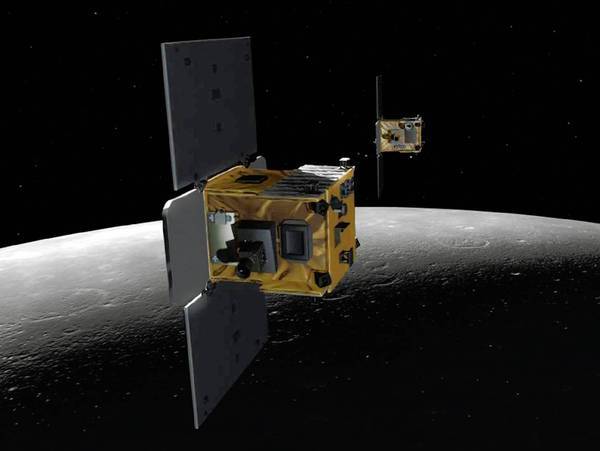
In September of 2011, NASA sent two small spacecraft into the orbit of the Moon. Nicknamed Ebb and Flow, these two tiny craft shared the same orbit, and remained in continuous contact with each other. The mission was called GRAIL (Gravity Recovery and Interior Laboratory), and the purpose was to measure minute fluctuations of the Moon’s gravitational field by precisely measuring changes in the relative velocities of the two spacecraft.

The two GRAIL satellites, Ebb and Flow. This is an artist’s depiction.
Bulk Density of the Lunar Highlands – courtesy of GRAIL

The mission ended on Monday, December 17, 2012, when Ebb and Flow were purposely sent to impact the Moon near its north pole. The craft were no longer at a sufficient altitude to continue scientific study and had not fuel remaining to gain the needed altitude. The impact site was named after the late astronaut Sally K. Ride, who was America’s first woman in space.

I think Sarcastic Rover said it all when the impacts were confirmed and the mission was officially over:


Speaking of things flying through space (and somehow appropriate given the recent reviews I’ve written about asteroid impact movies):

HUGE ASTEROID’S EARTH FLYBY CAUGHT ON VIDEO

The asteroid is called 4179 Toutatis, and was ‘videoed’ when it passed by Earth on December 12 and 13 at a distance of about 4.3 million miles (or 18 times farther than the Moon).


An image of Toutatis

The images were generated using radar images from NASA’s Deep Space Network antenna in Goldstone, CA.

The final headline for 12-21-12:

THE WORLD IS NOT GOING TO END TODAY.

It’s already tomorrow in some places. I don’t think we need to worry.

Or maybe we should:


The only place success comes before work is in the dictionary – Lombardi

National Blog Posting Month – December 2012 – Work

Prompt – Do you think some people achieve easily, or do you agree with Lombardi that “the only place success comes before work is in the dictionary”?

I suppose that for every little quote like this, there is a notable exception. The problem arises when people assume that they are the exception, and so don’t apply the wisdom provided.

If you want to be successful, you ought to expect to work. That is all there is to say about that. The most successful people, like actors or football players, actually put in some brutally long hours. They also get paid well and get some fantastic benefits, but that’s beside the point. No, actually, that is the point.

We all want to get paid well and we want the fantastic benefits. But we don’t consider that the people who are already in those positions are working their hind ends off to stay where they are. Once one of these highly successful individuals falls out of the adoring spotlight of the world’s population (for whatever reason), often then fades their success. (How many times have we heard of the once affluent person who is destitute later in life, after their fame faded.)

For this reason it is important to work up to achieve success, and to keep working to maintain that success. We can’t take a break and assume that momentum will carry us comfortably through the rest of our lives.

And on that note… I’ve got some work to do!

For 12-21-12

Bad Geology Movies: Dante’s Peak, 1998

Dante’s Peak

1998

Pierce Brosnan, Linda Hamilton

Premise: What if a seemingly dormant volcano in the Cascades suddenly exploded back into life?

As “Bad Geology Movies” go, Dante’s Peak is not the worst. It has some errors, but at least it gets quite a few things right:

1) The Cascades is a great place to have a volcano suddenly go off, because it is volcanically active and it has had volcanoes (relatively) suddenly explode. Mount Saint Helens, in 1980, only gave a few months of warning before it blew its top. Other volcanoes have been known to go from dormant to exploding in even shorter time frames.

2) The killing of plants and fish by carbon dioxide emitted from vents originating from deep magma bodies is also known to happen. But this does not always mean eruption is imminent.

The movie was not without its errors however.

1) I found it troubling that the volcanologist, played by Brosnan, seemed not in the least bit alarmed by a pH of 3.58 in the mountain lake. That’s a pretty low number, which means it’s pretty acid. With a pH so low, the fish in the lake would surely have been affected in some obvious way (especially since the carbon dioxide had already killed trees). I wouldn’t go in that lake.

2) When the volcano first went off, there was a severe lack of lahars. Lahars are fast-moving slurries of ash, mud, and water that tend to take out towns at the bases of volcanoes. Usually, the water comes from the sudden melting of the snow and ice capping the previously quiet volcano. Dante’s Peak had a significant snowcap, but there were no lahars, at least not right away. There finally were some lahar-like flows toward the end of the movie, but I felt like they needed to be earlier on.

3) Brosnan’s character shouts during an earthquake, “They weren’t tectonic! They were magmatic,” suggesting that somehow, by the way the Earth shook he could tell that the earthquake was not from motion on a fault, but from the movement of magma below the surface. In real life, a person experiencing an earthquake first-hand is not going to be able to make such a distinction.

4) The flows! Ah, the flows! They’ve mixed their flows! An eruption such as this is most likely to only have magma (lava once it erupts) of a single composition. The composition of a magma (how much silica, iron, and magnesium it has, for example) dictates how it flows. One of the earlier eruptions of the volcano has smooth, fast-flowing, ropey magma (known as pahoehoe), indicative of what’s called “Mafic” magma. Later, the characters are stopped by a slow-moving, lumpy flow, similar to what we call A’a’. This type of flow is more expected of “intermediate” to “Felsic” magmas. The truth is that one would not expect mafic magma from a volcano in the Cascades. If I recall, I laughed out loud when I saw that fast flow chasing down the main characters. The slow-moving, lumpy flow is more of what we would expect from a volcano in the Cascades.

5) Whatever the composition, it must be said that one would never, ever be able to drive a truck across an active lava flow. The heat would be so intense that the vehicle and its occupants would begin to burn almost immediately. The main characters should have been incinerated. But it’s Hollywood, so that’s ok.

6) Speaking of characters being killed, there were two more ways in which the entire cast should have died. First, inhaling all that ash that was snowing down would be lethal. It’s nothing more that microscopic shards of glass. Any animal inhaling that would die of massive hemmoraging in the lungs. As it happens, this is how some of the most spectactular fossil localities that we have were formed. Second, when they all stopped to look back and watch the volcano explode, they weren’t far enough away to be safe. The ash and debris would have buried them, if a mudslide hadn’t of taken them out.

But all told, the premise of the movie was realistic – much moreso than others I have watched of late. There is definitely some Hollywoodization taking place, but it has to be there.

I liked the movie and only cringed a few times because of bad science.

If you want a different insight into the film, check out this website.

The harder I work, the luckier I get. – Samuel Goldwyn

National Blog Posting Month – December 2012 – Work

Prompt – Do you think this thought by Samuel Goldwyn is true? “The harder I work, the luckier I get.”

When a person says they are ‘lucky,’ that means that fortunate events seem to happen to them. But luck isn’t some supernatural phenomenon. Luck comes from two sources, and maybe more.

First, how lucky you feel depends to a great degree upon how you relate and react to your world and events around you. If you are a naturally negative person, nothing good ever seems to happen to you (that you are aware of), and you consider yourself unlucky. If you’re a naturally positive person, then almost everything that happens can be seen in a positive light and you see yourself as lucky.

The other part of luck is putting yourself in a position where beneficial events can happen to you. When you work hard to promote yourself (directly) or your work, you increase the likelihood that someone might take notice and present you with an opportunity. If you tend to prefer to be hidden in your office or lab (or den), feverishly working on things that you’ll never share outside of your immediate family or work environment, it’s hard for ‘lucky’ things to happen to you.

This is why, over the last year, I’ve stuck my neck way out by using Twitter more and by posting frequently on and promoting my blog. And people have started to take notice. I don’t expect a book deal tomorrow. I hope maybe to get a book contract within the next few years, perhaps. But I don’t think any of that would be possible if I wasn’t out doing the cyber-legwork.

So, luck is what you make of it, I guess. But lucky situations seldom arise if we just sit back and wait for them. If I keep working hard, I think my luck will improve.

For 12-20-12

Nothing will work unless you do. – Maya Angelou

National Blog Posting Month – December 2012 – Work

Prompt – Discuss this quote by Maya Angelou: “Nothing will work unless you do.”

This quote falls along the likes of what I often say, that few things worth doing are easy. The point here is that the easy route usually fails (though occasionally you luck out). If you want to succeed, you have to do some work. You’ve got to pay your dues, as it were. For most people, work is a requirement for success.

This isn’t to say that hard work is a guarantee of success, but no work is basically a guarantee of no success. Even people who seem to get lucky breaks work hard to put themselves in situations where they might get noticed.

That’s why it’s important to keep working toward goals, even if they seem impossible, because when you stop working, success is not possible.

It’s an unfortunate circumstance that (here in the U.S. at least) this lesson is lost on many. We have a great sense of entitlement in our culture (and I won’t get into the discussion of why) in which we all assume that if we’ve been working scut jobs for so long, we suddenly deserve to get paid more and have wonderful living conditions. And when that fails… well, it’s bad news.

We’re a society of getting a prize for trying, not for winning, which has resulted in a whole generation of people who think they should get something just for being there: entitlement. It can’t work that way, though. Not for adults. Some cope with that just fine. Others sometimes go off the deep end, with potentially disasterous results.

Yes, we need to teach this lesson to our kids: You don’t get something for nothing. You’ve got to work for the things that you want. Nothing worth having is easily attained. “Nothing will work unless you do.”

For 12-19-12

Confucius say…

National Blog Posting Month – December 2012 – Work

Prompt – Discuss this quote by Confucius: “Choose a job you love, and you will never have to work a day in your life.”

This seems like a bit of a “Well, duh!” kind of quote. Of course you should do something you love. It definitely makes it a lot easier to get out of bed in the morning.

The problem is, and maybe it’s just because this is how our society works (and by that, I’m referring to my own experience of working in the United States), there is no way to have a job that doesn’t at some point include doing something you really don’t want to do.

For me, I love my job and the results of my labors, but I sure wish I didn’t feel obligated to put in eight full hours a day. And there are some days when I have to make a bunch of phone calls, or I have to fix an unruly instrument, when I really question how much I actually like my job. In the end, I’m happy. I know I could have a significantly crappier job, one that would make every day a misery, rather than just one out of fifteen.

So, yeah, it’s a good idea to seek a job that you love. Most days won’t be drudgery – you’ll be having fun. And those few miserable days, won’t seem so awful after they’re over.


For 12-18-12

Bad Geology Movies: Deep Impact, 1998

Deep Impact

1998

Robert Duvall, Téa Leoni, Elijah Wood, Morgan Freeman

Premise: What if a comet was discovered that would strike the Earth in one year’s time? What would we do?

The truth is I really thought this would be ‘bad’ in ways similar to have Armageddon was ‘bad,’ but it wasn’t. Deep Impact is much more a human-interest movie than a science movie. The writers glossed over a lot of the scientific details to get to the story. Since I fancy myself a writer, I appreciate this. In truth, a movie or book or whatever can get itself into trouble by trying to be too realistic or accurate when such accuracy isn’t necessary.

On the whole, I liked the movie (except for that it made me cry a little). Nothing in the science made me groan because they omitted most of the science. I’m all right with that.

One thing I did enjoy, however, is at the beginning, when the journalist played by Téa Leoni discovered the meaning of E.L.E. (Extinction Level Event) on the Internet. She found herself on the UC Berkeley Department of Paleontology website. And you know, I think I’ve been there. More than once.

Yay! A nod to the science of paleontology.

That’s really all I have to say.

Bad Geology Movies: 10.5, 2004

10.5

2004

Kim Delaney, Beau Bridges


Premise: What if there were a whole series of mega-deep faults under the western coast of the United States that could trigger a magnitude 10.5 earthquake in Los Angeles?


This was a television miniseries with two episodes, presumably each of two hours duration. This movie has some of the most absurd instances of pseudoscience that I have ever observed. It was bad. I don’t even know where to begin. So I’ll begin at the beginning.

The show opens with a massive earthquake in Washington state. I admit I wasn’t paying attention to where the seismologists were, but what I do remember is this:

1) Somehow the magnitude of the earthquake – a single earthquake, mind you – increased over time. That doesn’t happen. One earthquake comes from a single rupture/break/motion on a fault. The shaking starts, then it tapers off. Now if other earthquakes were triggered, well, they’d be separate earthquakes and have their own magnitudes.

2) You can’t measure magnitude while the earthquake is happening. This is measured after the fact, using the complete seismographic record. You need to know the timing of all the various seismic waves generated by the earthquake and their magnitudes. You can do that pretty quickly after the quake is over, but not while it’s happening.

3)Speaking of seismic waves, you’d never have “s-waves off the chart!” as exclaimed by one of the movie’s characters in reference to this first quake. S-waves tend to be pretty small compared to the surface waves (which are the ones that do all the damage). Maybe the writers thought that s-waves and surface waves were the same thing… Not.

4)The claim is made by the main character that the earthquake hypocenter (the point in the Earth’s surface where the fault movement is actually taking place) is ‘sub-asthenosphere.’ She later asserts that the earthquake hypocenter must be about 700 kilometers down. Rocks at that depth do not fracture and form cracks or faults. It is solid rock (part of the lower mantle), but temperatures and pressures are so high that the rock will stretch, atom-by-atom, rather than actually fracture and form a fault.

As the movie progressed, there were still references that baffled me.

1) The main character talked about side-to-side motion from the earthquake, later getting excited when she realised it wasn’t side-to-side, bu lateral-skip. Seriously, I have no idea what that is…

2) They made measurements of the magnetic field, for radon gas, and collected soil samples to “prove” these 700-km-down faults. I have no inkling of how that would work. I mean, maybe a magnetic anomaly is something that could happen. Actually, no. I don’t think so. And what about those ruptured pockets of poisonous gasses? Where are those coming from? No idea.

3) There were these wierd thermal activity maps (or something) with which they were identifying the stresses building up prior to a quake. From this, they were predicting earthquakes heading south down the west coast. Again, I have no idea what that was. No such thing exists. And we can’t predict earthquakes.

The funniest part of the movie is when they proposed to fuse the San Andreas Fault using nuclear warheads. Why must all the ‘bad geology movies’ involve nuclear weapons? Anyway, you can’t fuse a fault. You can’t. You can relieve some stress, and maybe mitigate a potential earthquake, but you can’t fuse a fault. Sorry.

The second episode was nearly as funny as the first. (I don’t think it was supposed to be funny, by the way.)

They were drilling their seven (or was it five, or six) perfect holes for the nuclear warheads. The director of FEMA was overseeing each one (why?!). The drilling was slow though. You know why? “Solid layers of rock, all the way down.” What did they expect? Caves? Marshmallows? Of course, the drill they used was also ridiculous, but we’ll let that go.

There’s this river that changes direction after a massive earthquake. I questioned our seismologist’s cognitive abilities after she suggested that a magnetic field could have caused the river to change directions.

The climax of the film is where the San Andreas fault opens up – complete with crazy gas fissures – causing part of southern California to become an island. This follows the misconception that activity along the San Andreas fault will cause part of California to slip into the sea. That’s simply not true. The San Andreas slips such that western California will simply move northward along coast of North America until if finally hits Alaska. It is not going to sink into the sea!

Nor would any fault (even one rooted in the mantle, 700 km down) suddenly open into a vertical-walled chasm over the course of only a few minutes. Though I suppose it does make for good TV. Provided you know NOTHING about geology.

Sigh.

There are other glaring errors and weirdnesses in the movie, but I think I’ll stop there. This movie has its problems. Of all the recent movies (1990’s and newer) I’ve watched and reviewed thus far, this one seems to have the most scientific errors. I think I was actually yelling at my computer as I watched it. It was that bad. Maybe the personal stories in the movie were cute and touching, but I couldn’t get to that, because the science was so awful. That’s my curse.

By the way, there’s a sequel to this: 10.5 Apocalypse. I won’t be seeing that.