Fossil Soils – #Paleontology Field Work 2018 – Days 7 and 8

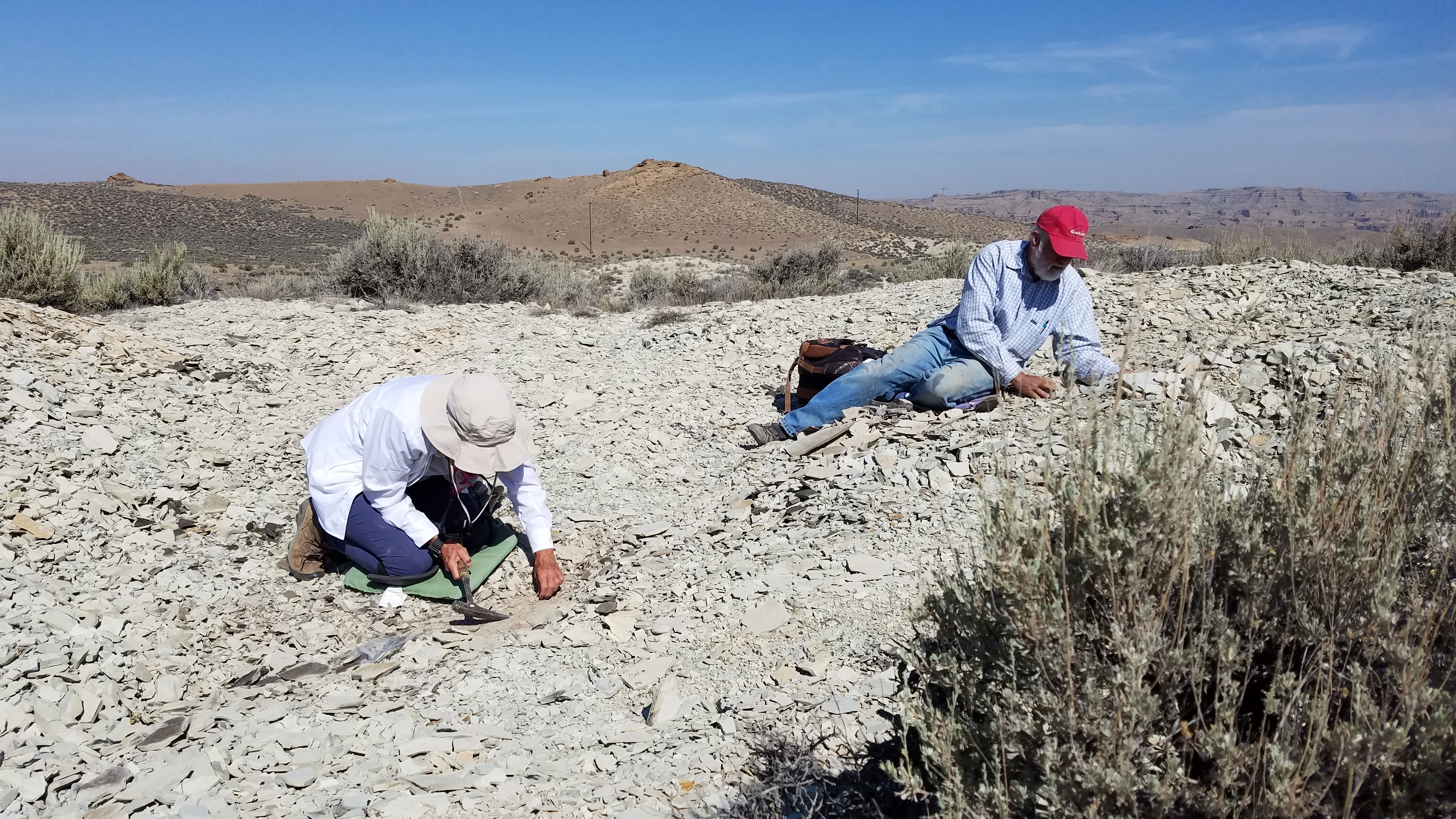
The past two days have been all about soils Paleosols. Fossil soils.

Soils, as they develop, often concentrate calcium carbonate (calcite) nodules as they mature. These paleosol carbonates preserve geochemical evidence for ancient climate and vegetation, so when I find these little nodules, I collect them for analysis.

So, while my friends dig for bones, I walk about and find nodules wherever I can.

Paleosols can be lovely…

Looking up at the bottom of the Duchesne River Formation. The maroon rocks are an ancient soil.

Continue reading “Fossil Soils – #Paleontology Field Work 2018 – Days 7 and 8”
The Eocene – #Paleontology Field Work 2018 – Day 6

I didn’t post last night because I was tired. But now this morning I have some energy, so I will post about yesterday.

Yesterday was my first day in the field in the Uinta Basin this year. We decided, just for giggles, to bop down to a rock unit lower than our study area because there are abundant leaves and bugs and other things to be seen. The unit is called the Green River Formation, and is famous elsewhere for yielding beautiful fish fossils.

Happiness is collecting fossils with friends!

Continue reading “The Eocene – #Paleontology Field Work 2018 – Day 6”

There and Back Again – #Paleontology Field Work 2018 – Days 3, 4, and 5

The past three days, I’ve caught myself in a wireless signal vacuum, which is why I’m only now writing something.

Two days ago (day 3, for those counting), I drove through the rest of Nebraska and into Wyoming until my stopping point at the Virginian Hotel in Medicine Bow, Wyoming. There I met up with colleagues and spent the evening drinking beers and talking about the Paleocene-Eocene Boundary. Continue reading “There and Back Again – #Paleontology Field Work 2018 – Days 3, 4, and 5”

Miles and Miles – #Paleontology Field Work 2018 – Day 2

Well, I was going to write a clever post about the ‘joys’ of driving three days to get to the field, but then the completely expected happened.

Today is my first ‘work’ day out of the office. So naturally, the mass spectrometer decided to – um – yeah: stop working right.Continue reading “Miles and Miles – #Paleontology Field Work 2018 – Day 2”

The Voyage Begins – #Paleontology Field Work 2018 – Day 1

Here it is. Day one. The day I leave the house and begin the three-day drive to my old stomping grounds near Laramie, Wyoming.

Oh, but the getting there. But I’m ready.

Meet Christine, our new (to us) Volvo, now outfitted for proper paleontological expeditioning.

Christine is ready to hit the trails!

Continue reading “The Voyage Begins – #Paleontology Field Work 2018 – Day 1”

Where Did the Bony Fishes Come From? – #UREES270 – 2018

Friedman and Brazeau, 2018, A reappraisal of the origin and basal radiation of the Osteichthyes: Journal of Vertebrate Paleontology, v. 30, p. 36-56

What’s it about?

The authors look closely at the characteristics that distinguish osteichthians from other jawed fishes. They then review materials from fossil groups of fishes, in particular the Acathodii, and score them for the same characters. The result of their analysis is that they place the Acathodii as basal osteichthians, a sister group to the crown osteichthian groups, the Actinopterygii and the Sarcopterygii.Continue reading “Where Did the Bony Fishes Come From? – #UREES270 – 2018”

When Two Species Merge into One – #365papers – 2018 – 60

Kearns, Restani, Szabo, Schoder-Nielsen, Kim, Richardson, Marzluff, Fleisher, Johnsen, and Omland, 2018, Genomic evidence of speciation reversals in ravens: Nature Communications, v. 9, 906

What’s it about?

The authors describe how what were once two distinct lineages of ravens (the Californian and the holarctic) have merged into what we now refer to as the common raven in the western United States. Using evidence from mitochondrial DNA, the authors show that not only is the common raven the result of the fusion of two lineages, but that the Chihuahuan raven, that lives alongside the common raven, is a descendant of the Californian raven.Continue reading “When Two Species Merge into One – #365papers – 2018 – 60”

Bringing Up Baby (Mountains) in Western North America – #365papers – 2018 – 59

Yonkee and Weil, 2015, Tectonic evolution of the Sevier and Laramide belts within the North American Cordillera orogenic system: Earth-Science Reviews: v. 150, p. 531-593

What’s it about?

This paper is a wonderful, yet highly technical, summary of the tectonic events leading to the Rocky Mountains as we know them today.Continue reading “Bringing Up Baby (Mountains) in Western North America – #365papers – 2018 – 59”

Pharyngeal Denticles and the Placoderms – #365papers – 2018 – 58

Johanson and Smith, 2005, Origin and evolution of gnathostome dentitions: a question of teeth and pharyngeal denticles in placoderms: Biological Reviews, v. 80, p. 303-345

What’s it about?

This paper presents a detailed discussion of tooth development in fishes. In particular, the authors review the state of knowledge of tooth development in placoderms, among the first of the jawed fishes and now extinct. They also make observations about denticles, tooth-like bumps, on the gill arches of many fishes, including jawless forms, and how the development of these relate the development of teeth and external scales in early fishes. With these details, the authors propose a hypothesis for the origins and development of teeth in placoderms and in modern fishes.Continue reading “Pharyngeal Denticles and the Placoderms – #365papers – 2018 – 58”

What if We’re Wrong About Placoderms? – #365papers – 2018 – 57

Zhu, Yu, Ahlberg, Choo, Lu, Qiao, Qu, Zhao, Jia, Blom, and Zhu, 2013, A Silurian placoderm with osteichthyan-like marginal jaw bones: Nature, v. 502, p. 188-193

What’s it about?

I reported on another paper with Zhu as lead author sometime last week. That paper provided evidence that certain dermal bones (the dentary and maxilla), traditionally viewed as synapomorphies for the crown osteichthyes may also be present in placoderms. This is the first paper in which Zhu reported this observation.Continue reading “What if We’re Wrong About Placoderms? – #365papers – 2018 – 57”