Society of Vertebrate Paleontology annual meeting wrap-up

Ah! The annual meeting of the Society of Vertebrate Paleontology (SVP)! My favorite thing in the world! Four days of paleontological bliss, where I don’t have to define terms or defend your chosen profession. Where you can escape from the forced isolation of being the only paleontologist in your department, or worse, in your city. Where evolution is accepted and assumed rather than danced about using clever euphemisms. And where you can trot out your *really* bad science puns and everyone laughs.

Overall, this year seemed no different than other years, but some things really stood out to me. Because I chose to live-tweet sessions, I felt more connected to the happenings at the meeting than I ever have before (and got to make some new friends, to boot!) And, incredibly, there was not a single talk that I went to that I felt was poorly executed. Usually, there’s one or two a day that are agony to sit through, for whatever reason, but this year it didn’t happen. Every talk was not only enjoyable, but offered something worth tweeting about. A good chunk of the meeting was Storify-ed by Jon Tennant (@protohedgehog on Twitter), so you can see what we were doing.

The venue was splendid. I enjoyed the convenience of all the sessions being side-by-side, and the posters were less than 3 minutes walk from the oral session. Even better, the hotel (if one chose to stay there) was less than 5 minutes from any of the sessions. And (after a little nudging), there was even free wi-fi! Perhaps the best (or worst) part of the venue was the seats that apparently had whoopie-cushions built in. There was a lot of accidental tooting, which was finally recorded here.

Highlights of presentations included video of a hyena eating a pig neck in about 30 seconds (noting the bone breaking capabilities of hyenas) and several videos of crocodiles and alligators running (including a blooper reel!).

For me, one of the biggest parts of SVP is the annual auction. I’ve helped with the auction ever since I started graduate school and finally became a member of the auction committee sometime soon after getting my Ph.D. At first, it was always just a matter of helping with the set-up, but over the last 10 years, we’ve started dressing in costume with a theme for the live auction each year. Those of us on the committee put a great deal of time and effort (and sometimes money) into constructing our costumes. The theme is usually established sometime during the summer prior to the meeting, and we rush to create our costumes while simultaneously preparing our professional presentations for the meeting as well. This year, the theme was the Avengers. I chose to dress as Mockingbird, who did not appear in the movie, but has been in a few of the comics. I liked the look of her costume, which is why I chose her. She also has a Ph.D., so how can I go wrong?
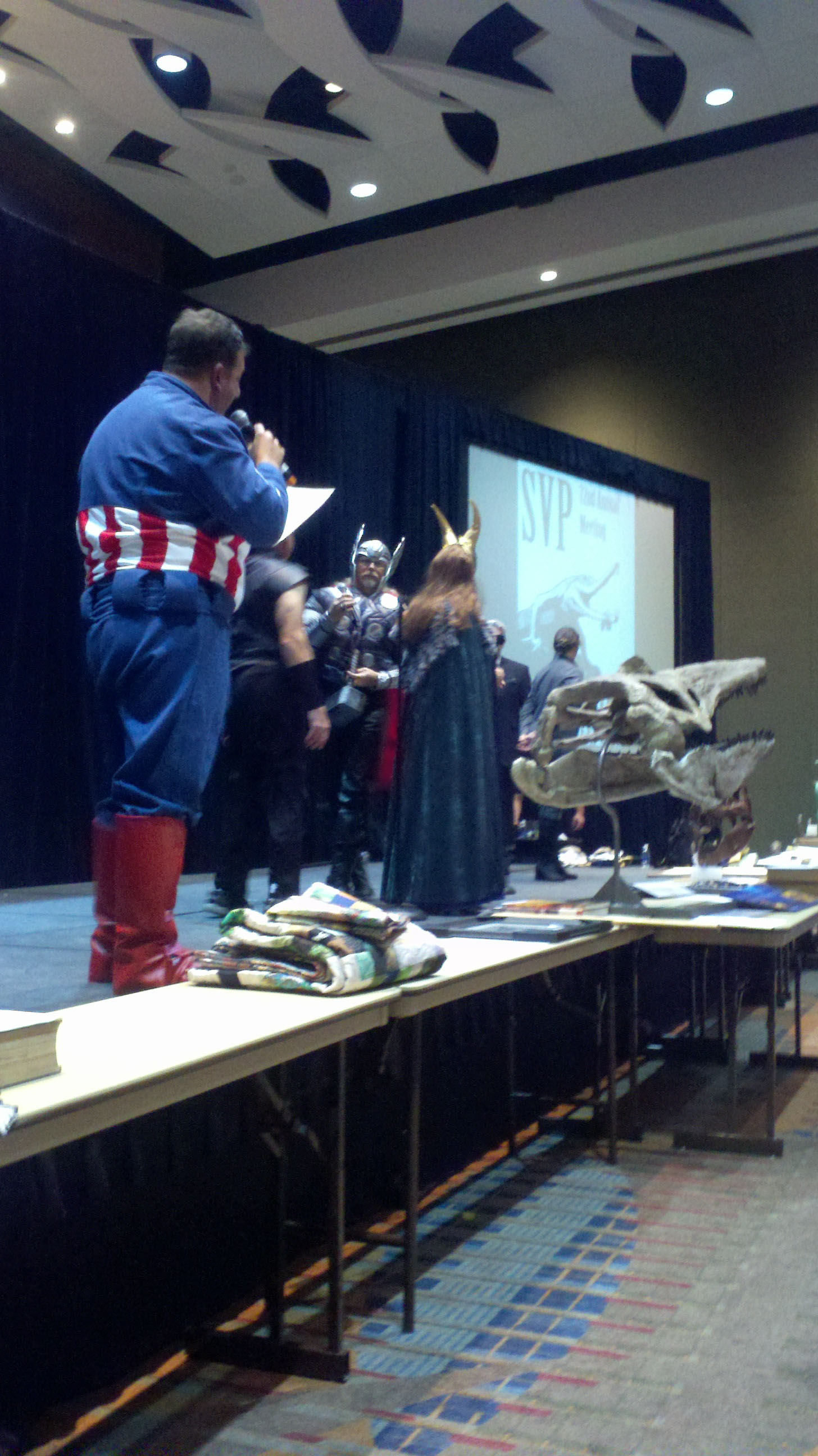
Auction, Avengers-style.

This year, I brought back an item I bought back in 2004: a big wooden rocking dinosaur. My son was an infant then. Now, at eight, he’s not so into the dinosaur. Hopefully, it’s off to make some other kid really happy and the auction winner will bring it back when his child has out-grown it.
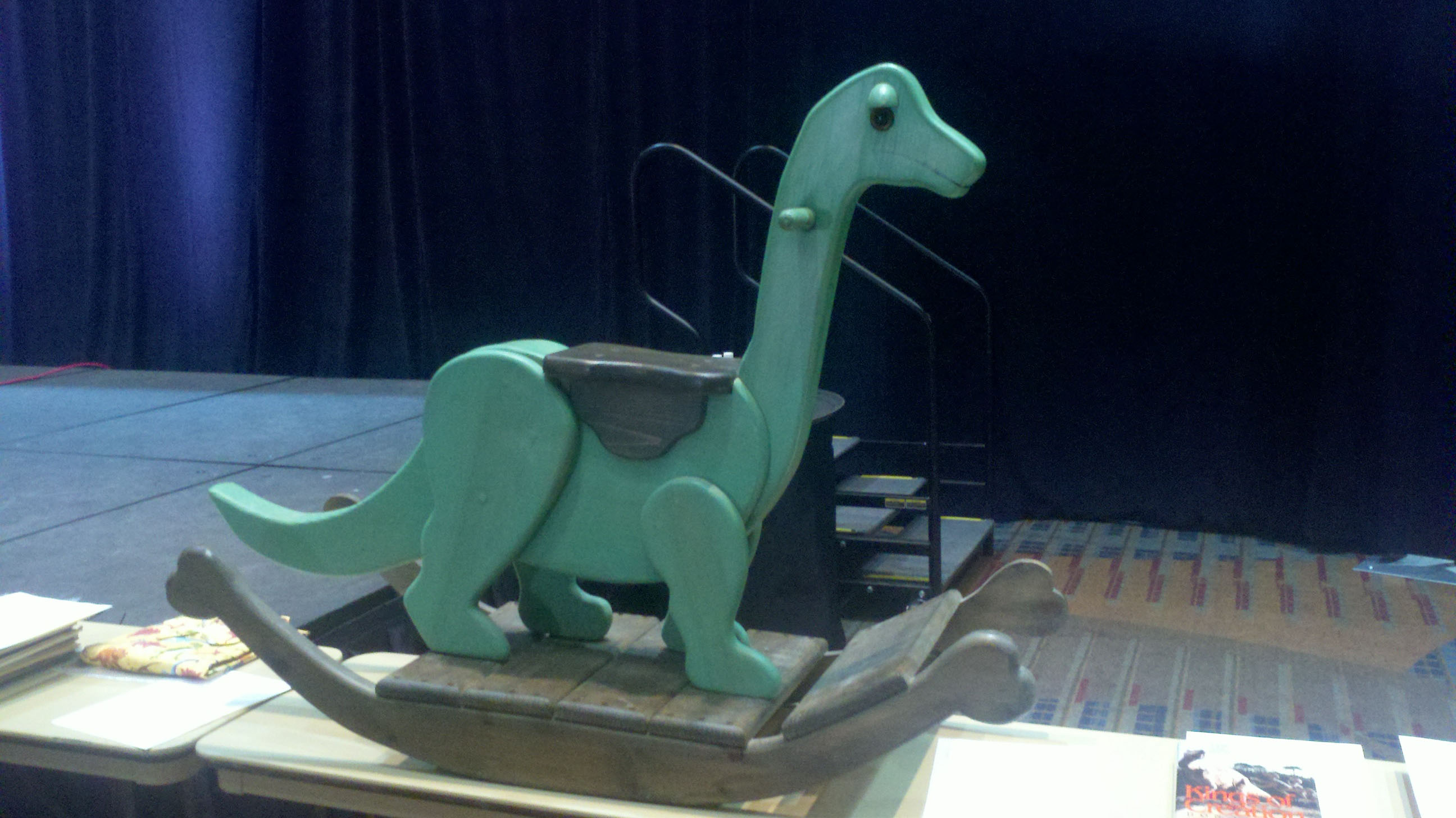
The ol’ dino-rocker is off to a new home!

The auction raises money for various programs at SVP that support students. I’m glad to be able to help the society in this way. This year the auction made $22,700!

Dino-Thor?

As usual, I was able to drum up some new work for the lab while I was there, and perhaps start some new collaborations. I’m suddenly thinking an awful lot about microwear on teeth. I found out that what I presented was actually old news — only that the folks who had already done the same project kinda hadn’t bothered to publish it yet. (grumble) All told, this was one of the most productive meetings I have ever had. And somehow, I didn’t get sick during the whole event. I’m still healthy, two days after getting home. How’d that happen?

Well, while the iron’s hot, it’s time for me to attack some old research projects. There’s a short paper burning in me about the problems with the taxa Phenacodus and Tetraclaenodon. Then there’s that huge dataset that I tabulated as a postdoc that still hasn’t seen the light of publication. Yeah, I should get on that. I love this feeling of frantic motivation. I hope it lasts!

If you’re not satisfied with what I have to say about the meeting, then check out what others have said, (below). I’ll be updating this as I hear about other people’s posts.

What do Vertebrate Paleontologists Talk About, by Bora Zivkovic (@BoraZ on Twitter; Scientific American Blogs)

SVP, you’re so silly, Tarchia (Pseudoplocephalus Blog)
 

On Literary Genre

One of the crazy things about working on the Herongarde novels is having to think about genre. I chuckle a bit to myself, because the story doesn’t exactly fit into the “typical” genres like romance, mystery, fantasy, historical fiction, speculative fiction, science fiction, or thriller. It really includes aspects of many of these genres, which perhaps is a reflection of the interdisciplinary nation of my life as a whole. After all, I could call myself a “biogeochemist, and have degrees in biology, chemistry, and geology. I know what it is to not fit any category properly.

So what genre is a book that takes a 21st century woman and thrusts her into a parallel universe (or maybe back in time), to a place much like medieval Europe once was? It’s not historical fiction, exactly. OK, so it’s speculative fiction, sort of. Let’s try “speculative historical fiction.” That sounds good, but what about the parallel universe bit. That’s science fiction, right? Well, it’s not that important to the story, so we’ll forget about it. Maybe it can be called “alternative history,” because the place is like medieval Europe, but not exactly…

And! Oh, wait. Hey! It’s a love story. So maybe it’s “romantic speculative historical fiction.” Naw that’s no good.

Well, I need to figure this out, because literary agents want to know the genre of your book. It helps them decide on a first, very rough pass, whether they want to even read the rest of your query letter, much less the synopsis or any part of the manuscript.

So, what is the genre for Herongarde? Pop over here [Herongarde – the pitch] to read an older (but still accurate) synopsis. Oh, hey. Look. I call it “medieval speculative fiction” there.

Comment your thoughts below or on my Facebook author website.

Reflections on Paleontology

As I prepare for the first of two field excursions this summer, I reflect upon what it is to be a paleontologist.

Truly, there are days when I wonder why I do this. Now that I’m married and a parent, the whole leaving-for-a-month thing no longer has the same charm. And on the eve of my first departure to the Canadian High Arctic, I find myself wracked with anxiety. I’m trying to figure out whence it stems.

Being a paleontologist is a delight, most of the time. With younger kids, it’s especially fun to introduce myself, since they generally actually know what a paleontologist is. But in all cases, once we’ve established what I do, the conversation is enjoyable.

Of course, one of the first things I get asked is about the ‘coolest’ thing I ever found. Uh, yeah. I feel like I got nothing. I mean, I named a new species once. A multituberculate mammal, based upon one and a half teeth. Then I have to explain what a multituberculate is and how one can name a new species using only one tooth.

Ooh, wait. There was that turtle skull I found once. Hmm. No idea what species it was. Kinda botched prepping it myself. Not so cool.

Really, I can’t think of anything ‘cool’ that I’ve ever found. Maybe it’s just a matter of perspective.

Then I’m asked where I’ve gone to do paleontology. Well, I have gone some cool places. Bolivia has been fun. Uruguay. Wyoming, a lot. And now the High Arctic.

I hope I find something cool in the Arctic.

In the meantime, I’m still anxious. I’ll miss my son and my husband, and the creature comforts of home. Of course, I won’t miss my office and that darn mass spectrometer.

I think the anxiety stems from my usual wound-uppedness about traveling, and my general worries about my son, who is on the Autism spectrum. There will be essentially no way for me to know what is happening back home. I’ll probably have one of those horrible nightmares early on about something terrible happening to the boy. It’ll have me in knots.

It’s moments like this that I start to seriously reconsider the necessity of fieldwork. But I do it anyway because I know that once I’m on the ground, I’ll enjoy myself. I find it rejuvenating. And really, what kind of idiot would I be to turn down a chance to go to the Arctic? I’ll be all right once I’m there.

In the meantime, I think I might just explode!

Sigh.

I hope I find something cool in the Arctic. That’d be nice.

Adventures in Mass Spectrometry

For the most part, I quite enjoy what I do. Running a lab, working with students, and learning about the ancient past using a select few molecules is really, really interesting!

But there’s a downside. See, I have to run a lab, and when things break, I have to fix them. The most important thing for which I am responsible is a $350K mass spectrometer. Anytime something breaks, or runs out, or whatever, I crack out the lab checkbook and spend a thousand dollars or so to get it going again – on the assumption that I can figure out what went wrong.

There are common problems: The filament might burn out or acid might get drawn into the system. Then there are less common problems – the ones where I scratch my head wondering why it’s not working. I had one of those recently.

It started as a simple problem: The filament burned out. Cool, I can fix that in about an hour, and the instrument is out of commission for a day. Well, gee, since I had to shut it down anyway, I decided to perform the annual maintenance on the mass spectrometer. I cleaned the source (size of my fist, ~80 parts including little wires and screws). No problem. I changed out a vacuum pump. No sweat. Turned it on again, pumped everything down. Looks great! Turned on the source. Got the three beams I’m supposed to have. The whole thing couldn’t have been smoother. I left the lab to do something else.

Then, something happened.

When I returned a few minutes later, my beams were gone. Weird. I shut off the source and turned it on again. (Funny that mass spectrometers can be a little like computers. “Did you try shutting it down and turning it on again?”)

BBZZZT. No beams.

I shut it off. I tried again.

BBZZZZZZTTTTT! No beams. And definitely not a sound you ever want to hear coming from a mass spectrometer. That’s 3000 volts I was turning on, and BZZZT is BAD!

I shut the whole system down again and re-cleaned the source. I probably had a wire crossed, right?

Yeah. Two days later I had the system all together again and tried to turn on the source: BBBZZZZZZZTTTT – Sizzle-sizzle.

Uh. Yeah.

Head scratching. The electronics were the culprit, obviously. I don’t do electronics. I do vacuum. I do glass capillaries. I do 100% phosphoric acid. I’ll even do hydrofluoric acid (sometimes). I don’t do electronics.

Now here’s the fun part. Thankfully, this wound up being a great experience. Oftentimes, electronics issues become a nightmare of chasing around charred components. I braced myself for a long and difficult process, and expected that the whole thing would cost the lab at least $4000 dollars. Ugh!

It was suggested to me by an engineer from the manufacturer of the mass spectrometer that I should find a local electronics shop. (A great suggestion! Thanks Roger!) As it happens, we have an electronics shop here at the University, and the guys over there really like getting out of their office once in a while. They came over to look at the electronics (on which I could find no evidence of damage). It was a field trip to them, and it wound up being great comic relief for me.

Picture this: Two adult men kneeling in front of a circuit board that handles 3000 volts of electricity. We all know something is wrong, but we don’t know where.

“OK, turn it on,” says the first.

Click. Pause. BZZZZTTTTT!

“Ooh! Cool!” says the second.

“There it is,” says the first.

“Yeah, shut it off.”

Click. Silence.

The two men crown in and start touching things. Wiggling things. Then cleaning things.

“Turn it on again.”

Click. Pause. BZZZZZTTT!

“Ooh! Wow.”

“Turn it off.”

Wiggle, wiggle. Prod, prod.

“Turn it on again.”

Click. Pause. BZZZZZTTTT!

Me: “Should I shut it off?”

“Oh, yeah, probably.”

Seriously, they looked like they were having the time of their lives. Meanwhile, I’m flipping out a bit about 3000 volts arcing across a circuit board. They were completely nonchalant about it.

Now, I do realize that their comfort has everything to do with their experience, and that my own discomfort is the reason why I’ve said since the beginning that I won’t screw with electronics. Undoubtedly, I do the same thing to students and other lab users when I threaten them with bodily harm if they break anything on the mass spectrometer, then I proceed to pound on it with my fist. It’s all about experience.

I just found it completely humorous.

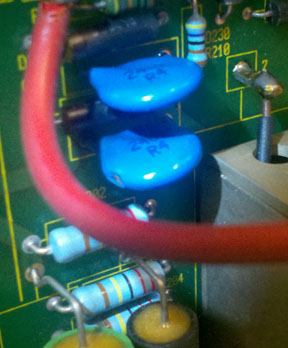
Well, they found the problem. A little capacitor I’ve named Sparky. The next day, they came over and traded Sparky for another capacitor. It took them all of an hour, and that included us socializing afterwords.

Sparky. The lower blue capacitor with the hole in the side. Capacitors shouldn’t have holes in them!

The next day, I tried turning on the source again, bracing myself for another round of BBBZZZTT.

Nothing.

But hey! Beams!

It was fixed!

We’re running again!

I asked the guys from the electronics shop what we owed them. Their response: Nothing. They had the parts on hand, and it was a fun escape for them.

So what I thought would be a $4000 job wound up costing exactly nothing. And I made some new friends. (Thanks Bob and Wade!) AND the mass spectrometer is running GREAT!

I wish all repairs went like this.

25 Days of Writing – Day 21

Day 21: FREE DAY! Write any scene you want!

——

The clashing of swords had stopped. Trey looked around and saw Orrin standing unsteadily, with blood soaking the front of his tabard. The wound to Orrin’s neck was deep, and bled freely, but was not fatal. Trey moved to Orrin quickly, to catch the man before he collapsed. Donnal moved with Trey and they both caught Orrin as he dropped to his knees.

“Orrin,” said Trey and the bleeding man leaned onto him.

“My Lord,” murmured Orrin, his eyes closed with exhaustion.

“Lie you down, Orrin,” instructed Donnal. “I shall attend to this,” Donnal said to Trey.

“Hanna—,” started Orrin.

“Aye, Hanna,” agreed Donnal. He looked at Trey. “How fared she?”

Trey’s face paled and he began to look around. “I know not,” he said absently. His eyes fell upon Balayn and Dean, who were bent over looking at someone. Dean was blocking Trey’s line of sight. When Dean stood abruptly, Trey suddenly recognized the dress of the person who lay there.

“Dear God,” Trey whispered as he rose. “Hanna?” He strode toward the group. Balayn looked up.

“My Lord,” spoke Dean. Trey ignored him. He saw that Hanna was not moving. Balayn was stroking her bloodied face.

“Hanna?” Trey said louder. Suddenly he was running. “Hanna!” he screeched. He raced to her side, falling to his knees beside her.

“Hanna?” Trey’s voice shook as he stroked her face. “Darling?”

Balayn studied Trey’s face. He watched tears form in Trey’s eyes and run down his cheeks and drip from his nose. Tears rose in his own eyes. Balayn knew that Hanna lay there now because she took her attention from her own attackers to fell a man who would have killed him. That moment of inattention was an opportunity capitalized upon by one attacker who smashed her face with the pommel of his sword.

Another tear dripped from Trey’s nose, splatting on Hanna’s cheek. She flinched slightly and her lips moved. “Hanna?” said Trey. “Please, wake.”

Balayn turned his attention back to Hanna. He saw her moving slightly. “Hanna,” he said. “Wake, wake.”

Dean leaned in to observe. The three men crowded over her, speaking encouragingly. Her eyes moved and flashed open for a moment. She seemed to try to speak, her lips moving but no sound came out. She opened her eyes again for a moment, her gaze pausing for a moment on Trey before she closed her eyes again. Her mouth stretched into a grimace and she cried softly.

Trey bend in, stroking her cheek. “It’s all right. It’s all right,” he murmured.

“Hurts,” Hanna hissed back between subdued sobs.

“I know. I know,” spoke Trey.

Donnal leaned in, putting a hand on Trey’s shoulder. “We’ll put her in my wagon. She can rest there, aye.”

Trey looked up, startled. He hadn’t heard Donnal approach. “Wagon?”

“Balayn. Dean. We’ll make a litter for her, aye?” ordered Donnal. Balayn and Dean moved off quickly to their work.

Trey continued to stroke Hanna’s cheek, once again oblivious to Donnal’s continued presence. Trey whispered to her and she responded with little nods and noises. Donnal wasn’t sure what was being said, but he knew love when he saw it. Donnal smiled. Trey had suffered long enough.

“I’m sure she’ll be fine, Trey,” Donnal spoke into Trey’s ear. Trey looked at him, again startled. Donnal was smiling. Donnal looked at Hanna and stroked her cheek with his own hand. “Aye, Hanna. You’ll be fine.”

Donnal returned his attention to Trey. “We’ll get her comfortable in my wagon and we’ll depart this place. Tis best we move on, aye?”

Trey looked at Donnal for a moment, then looked around, remembering the situation. “Aye, Donnal. We would not wish to spend much more time here.”

“I’ll watch over her myself, Trey. You have other responsibilities.”

“I wish not to impose thus on you, my Lord,” said Trey. He looked back to Hanna sadly. Her eyes were shut again, but her face wore a weak smile. “Though there is no other I would trust her to more.”

Donnal leaned close to Trey, speaking in a low voice. “I know you love her.”

Trey felt embarrassed. He felt his face burning. “Not a day goes by that I do not think of Rose.”

Donnal smiled. “And Rose loved you. And I loved you both.” Trey looked at Donnal sadly. “We must all move on, aye?” Donnal paused. “So long as you live, my Rose lives on. That you might love another is not offense to me or to her.”

Donnal gripped Trey by the shoulders, commanding his attention. “Cherish her, aye? Love her. You deserve such happiness.” He looked at Hanna, who was watching him wearily. “And I shall love her, too.”

Translating Science into English


TL;DR summary: In my opinion, every scientist should be required to write a plain-language summary of each professional publication that they write, so that everyone else in the world can understand the point and importance of the research. This is especially important where publications aren’t open access!

===========================================================

I’m a ‘real’ scientist. That is to say, that I work in a lab, read the ‘primary’ literature, and occasionally publish professional papers in peer-reviewed, globally available journals.

Most people that I might meet randomly at the grocery store or a bar don’t know that I’m a ‘real’ scientist, and are often surprised when I reveal the truth. Yup, I have a Ph.D. Yup, some days I wear a white lab coat. Yup, not only have I read and understood that new paper on the feathered Tyrannosaur, I know some of the authors.

I’ve had people make comments to the effect of ‘you don’t look like a scientist,’ or better (or worse, depending on how you think about it), ‘I wouldn’t have expected a scientist like you to be so nice.’

What this has driven home to me is that there is a huge disconnect between the people doing science and everyone else in the world. This touches on the whole stereotype that scientists sit in their ivory towers and look down upon the common people. No! Really, we’re just ordinary people, but with a different type of education, experience, and often world view.

Some folks are working hard to dispel this stereotype. One of my favorite blogs to visit is “This is What a Scientist Looks Like”.  (Here’s my entry, if you’re wondering.) Most scientists are just goofy people like the rest of the world’s population.

Fundamentally, however, I think the disconnect between ‘scientists’ and everyone else is about language. And I would add that this problems goes both ways. We just don’t talk the same. We have our jargon – there’s no avoiding it – and since we spend far too long in laboratories or out in the field either alone or with other science types, we forget that we’re different. And even when we make the most concerted effort to remember how it was before we started our more scholarly pursuits, we actually forget what we didn’t know. Admittedly, a lot of the greatest dynamos in science don’t make such concerted efforts, they’re too absorbed in their science.

What is important here is that scientists are scientists because they’re passionate about what they do. The hard part is that we don’t express it very well. Even I’ve learned that in certain company, I’m best off just keeping my mouth shut, because I stand out as so ridiculously different. But at least I step away from the lab from time to time, and when the opportunity arises, I do advocate for the sciences in general (and that’s when I get comments like those above).

I’m not that different from everyone else in the scientific community or otherwise.

  • I have a job that I’d like to keep
  • I have a house that I’d also like to keep
  • I have a husband that most of the time I’d like to hang onto
  • I have a special needs son that I love very much
  • I have pets
  • I have hangnails (those I could do without)
  • I like to sew
  • I enjoy a good ale
  • I like going to movies
  • And occasionally, I do a little writing

In the absence of the knowledge that I work at a university and spend my days turning knobs on a mass spectrometer, you’d think I was just like any other person. And in ordinary conversation, you still might not notice anything special. But if topics turn to science (like global warming, or evolution), I turn into the scientist, and people are usually a little surprised that I’m actually kind of an expert on those things. ‘But you’re so nice.’

So one of my motivations for working on this blog is to try in my own little way to dispel the rumors that scientists are all creepy angry lab lurkers who think they’re smarter than everyone else.

Since I believe that one of the barriers we face is that of language, I am making an effort to take things that are familiar science to me, but woefully mis-understood outside of my field, and translate them into ordinary language (as best I can, anyway). There’s a lot of stuff out there that I could ‘English-ify,’ an overwhelming amount, in fact, so naturally I have to limit myself.

I will focus on my own research and also on the science of geology. I am a paleontologist and I could blog on paleontology, but there are many bloggers out there who do a worthy job of that. I’ll leave that to them.

As it happens, my own research may be of broad interest anyway. I do a lot of research on ancient climate change. There seems to be a lot of discussion about climate change in the news lately, so I think there might be some interest. However, I know that my professional publications on that topic, though openly accessible, would be a semantic nightmare for the casual reader. As my dad once told me, ‘I’ve read all your papers. I don’t know what you’re talking about, but you sound really smart!’

So I’ll write a plain English summary of my own papers, at least. That way everyone can get from the work the important lessons. I hope that other scientists would consider doing the same.

Greetings

We’re just getting this blogging thing sorted out, so bear with us.

Here, you’ll find information about cameras and photography, as well as musings about our other interests, which include: paleontology, mechanical engineering, geochemistry, green energy, global warming, and saving the world in general.