Geology in the Movies: John Carter, Shiprock, and Geo-Farts

Sometimes in movies, the scenery is so fantastical that it clearly must be something spawned from the imagination of an artist. One thing I love about being a geologist is the knowledge that some of these places really do exist. Sometimes they’re as fantastic as they appear to be in the movies, and sometimes, it’s all about clever shooting angles. Either way, it’s always a great opportunity to introduce people to some of the geologic wonders of our world.
John Carter Logo
John Carter (from Mars)

A lot of the movie John Carter was shot in the deserts of the southwestern United States. This is the place where I learned geology, so I smiled a lot through the film as I recognized several of the vistas. Every time I recognized a place, my brain instantly pulled up the old files on the geologic history of that place.

One such place, Shiprock (which only makes a momentary appearance), gave me an audible chuckle. My introduction to Shiprock as a student was one of the things that solidified in my mind that to be a geologist was what I wanted to do.

Shiprock in John Carter

Now, when I was an undergraduate, Shiprock actually appeared in almost every single geology textbook (and it still does, really). It was almost always described as a ‘volcanic neck’ or ‘volcanic plug,’ or that which remains after most of a volcano has eroded away, leaving only the core of the volcano behind. This was supposed to be the original channel through which the magma flowed prior to erupting at the earth’s surface.

Well, one of my professors wanted to set that straight. Clearly those idiots writing the textbooks had never actually visited the place. Shiprock is no volcanic neck, he announced. It was better described as a ‘geo-fart.’ Well, this made an impression on me and my classmates, and to this day, I can’t look at a photo of Shiprock without thinking about geo-farts and giggling a little bit.

It is actually a rather apt description to call it a geo-fart. The technical term is ‘diatreme,’ which is a ‘breccia-filled volcanic pipe that was formed by a gaseous explosion.’ Well that’s a mouth full. In regular English, that means that there was a big gaseous eruption – explosive or fart-like, if you will – where lots of angular bits of rock were shot out of a pipe-like structure in the Earth. Rocks fell back in. Things were hot. Some rocks were melted. The end result is this structure, like a volcanic neck, but that is full of jumbled up bits of formerly molten rocks and other bits and pieces all stuck together. (The word ‘breccia’ [pronounced brech-a] refers to a rock composed of angular bits of other rocks all jumbled and fused together.) When the exploding is done, all the softer rock surrounding the newly filled pipe-like structure erodes away, leaving a huge rock that looks a little like a Spanish galleon.

Shiprock, New Mexico
Shiprock, New Mexico. Photo by Bowiesnodgrass

So it must have been a pretty exciting day when Shiprock formed, though it certainly didn’t look much like it does today. It’s really no surprise that something like a geo-fart occurred in the Southwest. There’s volcanic activity everywhere, a lot of which involved lots of gaseous urping and the tossing in the air of lava bits. That’s how all those cinder cones out there formed. (As an aside, one such cinder cone is called SP Crater. Google it and have a chuckle with me!)

Cinder Cone
Cinder Cone
SP Crater
SP Crater, Arizona

OK, but what about those ‘walls’ coming off of Shiprock? Those are real and they formed at or around the same time that Shiprock itself formed. In geology, we have a term for these. We call them dikes (or dykes, depending upon which side of the Atlantic you live on). Dikes are basically walls of volcanic material cut through existing rock layers. You can imagine that while the pipe that later became Shiprock was busy blowing up, that there would be some cracks extending from it. These cracks filled up with volcanic material, forming the dikes. Since the dikes (and volcanic material in general) are more difficult to erode than the softer sandstones that they cut through, they wind up standing like walls and towers after some erosion has taken place. Later, these walls make a great backdrop for a great movie!
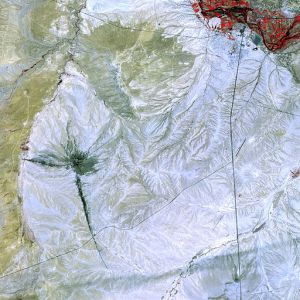
Shiprock from ASTER
Shiprock from ASTER

OK, so there it is, the first installment of “Geology in the Movies.” Next time you’re watching John Carter, I hope you giggle when Shiprock appears, just as I did. And when the person next to you asks what’s so funny, you can tell them that you just saw a geo-fart.
On Introspection and Writing

This last year has brought a lot of change into my life. Call it a mid-life crisis if you want, but certainly I am changed over who (or where) I was last year.

In April of last year one of the most significant events of my life occurred. That was when my son received the diagnosis of PDD-NOS. What’s that, you ask? In a nutshell, it means that the boy has autism (or is autistic, or whatever is politically correct). He’s a high-functioning autistic, but does not quite fit the diagnosis of Asperger Syndrome.

Anyway, what’s important here is that this diagnosis, while disappointing and sometimes difficult to cope with did help me accept that my child’s strange behavior is not due to any failure of my own. My parenting is fine. The boy is just different. I hadn’t realized it, but the feeling that the boy’s ‘differentness’ was somehow my fault had been weighing so heavily on me that it affected everything. I was depressed. I gained weight. I faltered at work. I faltered at home, with my marriage, and everything. I felt like a failure all the way around.

Everything changed with the boy’s diagnosis. I did go through an initial stage of mourning: the boy would never be the person that I had originally thought he might be. But once I got past that, things improved.

I suddenly dropped fifteen pounds of weight. I just quit eating as much. Apparently, I am a comfort-eater. Yeah, I am. Yum. Candy. This then turned into me beginning a regular fitness program. At this point, I have lost nearly thirty pounds, and am fitter than I was even as an undergraduate athlete.

My relationship with my husband also improved. Sure we still have some rocky moments, but that’s natural. We celebrated ten years of marriage last year. And we still like each other. That’s pretty good.

Somehow, the boy’s diagnosis enabled me to allow myself to take time for my own interests. I discovered that I really like sewing, and have now made for myself, my husband, and the boy several costumes with at 14th century flair. I’m working on new costumes for the Ren-Faire circuit this summer.

What’s perhaps the most substantial revelation I’ve gotten in the last year is that I actually like to write. Yeah, who new. I’ve hated writing for years, or so I’ve thought. The truth is, I hate technical writing. It’s stale and stunted. It’s all posturing and jargon. (And I’m not the only one who’s realized this!) It’s not my natural mode of communication.

Last November, I joined the National Novel Writing Month (NaNoWriMo) and started, for the first time ever, to write and share with others one of the many stories I’ve had drifting around in my head. Well, I easily met the 50k word goal of NaNoWriMo, but the book was (and still is) hardly complete. With this writing, I discovered that I absolutely loved writing. Just not technical writing.

Well, I’m still working on the book (Knights of Herongarde), and still costuming, and feel great for it. Recently, a blog post inspired me to do more writing. It seems that there is a call for scientists to start making their work accessible to others, and blogging seems to be the best way to do this. So, I’ve started adding blog posts about my research. I hope that readers here have enjoyed them. There will be more.

I’m about to embark on another project that will involve a lot of writing. Writing in my preferred style, not the stunted, formal style of technical journals. It was suggested to me while in California that there does not exist a popular-press book on the basics of geology. Given my preferred style of writing, I might be the person to prepare such a book.

There are books on the geology of specific places, but nothing like “Geology for the masses,” semi-technical books that a person could grab and take with them anywhere where rocks are exposed and get something useful from it. Well there are a few out there, most notably one in the “For Dummies” series. Many are geared toward children, and far too many (the prettiest and glossiest and the ones that are on top of the Google search for “Geology book”) are creation science books touting the 6,000 year-old Earth. *gasp*

This is in marked contrast to books on dinosaurs, for example, where you can choose from any number of great titles, written at a level accessible to both children and adults, all written by prominent authors and scholars. These books mix technical jargon with pretty pictures and fantastic facts that attract scholars at all levels. I myself have several of these books on my own shelves and refer to them when teaching about dinosaurs in my own classes.

So why don’t such books exist for the science of geology? Maybe because it is a very broad topic? Maybe because most geologists don’t consider promoting their science to the general populace necessary? Maybe because the average person thinks that there’s not much to geology, so a whole book devoted to it would be pointless.

Well, that last person is missing out on a fantastic science. A lot of people are. So I’ve decided to take on this project. And I think my personal style of writing and the use of this blog lend themselves to the greater project. My goals in doing this work are the same as they are when I teach “Introduction to the Geological Sciences”:

1) To leave the reader/student with basic knowledge that *wherever* they go, whether rocks are exposed or not, there will always be something geological for them to recognize and enjoy.

2) To turn the reader/student into an informed citizen. Far too often, geology is given short-shrift in the media, and the average person is entirely unaware that within geology are important answers to questions related to climate change or other environmental disasters (like the Deepwater Horizon oil spill, or last year’s earthquake in Japan). My goal is to demonstrate the relevance, so that when policy decisions must be made, people can choose appropriately.

The ‘book’ will be written section by section, topic by topic, where each section is sufficient for a single blog post. In the end, the book will be put together by stitching each of the sections together in the correct order.

This accomplishes two things. One, it lets me take my time writing the book. I can write a section or two a week, but a whole book in a year is a little daunting. Two, by using the blog it allows some peer review and more importantly, open access, which is a huge topic in the sciences these days. Read about it. Maybe I’ll blog about it. Eventually.


Eye-Tracking the Geological Experience

One question that is often asked, especially in advertising, is is “what draws the attention of the consumer?” More basically, we sometimes wonder what people are looking at, anywhere. Twenty people can look at the same scene and notice different things about it. What captures a person’s attention?

Such questions are often addressed using a technique called eye-tracking. This involves two cameras, usually worn by the subject. One camera takes a picture of the scene that the person is observing and the other films the motions of the subject’s eye. With careful calibration, it is then possible to project upon the image of the scene, the actual point at which the subject is looking.

Eye-tracking technology has changed over the years. Originally, eye-trackers were cumbersome and seldom left the laboratory. Recently, eye-tracking has become portable, and new questions can be asked and answered. I’ve been fortunate to be associated with (as a participant and as an assistant) a different type of eye-tracking study.

This study goes beyond simply asking what people look at. Instead, the goal is the understand how geologists learn their trade, and the distinction between what a novice geologist (an early-career student) and an expert observer (a professional geologist) notices when looking at an unfamiliar landscape. The study is investigating what’s called “perceptual learning,” and is a joint venture between geologists, brain and cognitive scientists, and imaging technologists at the University of Rochester and Rochester Institute of Technology.

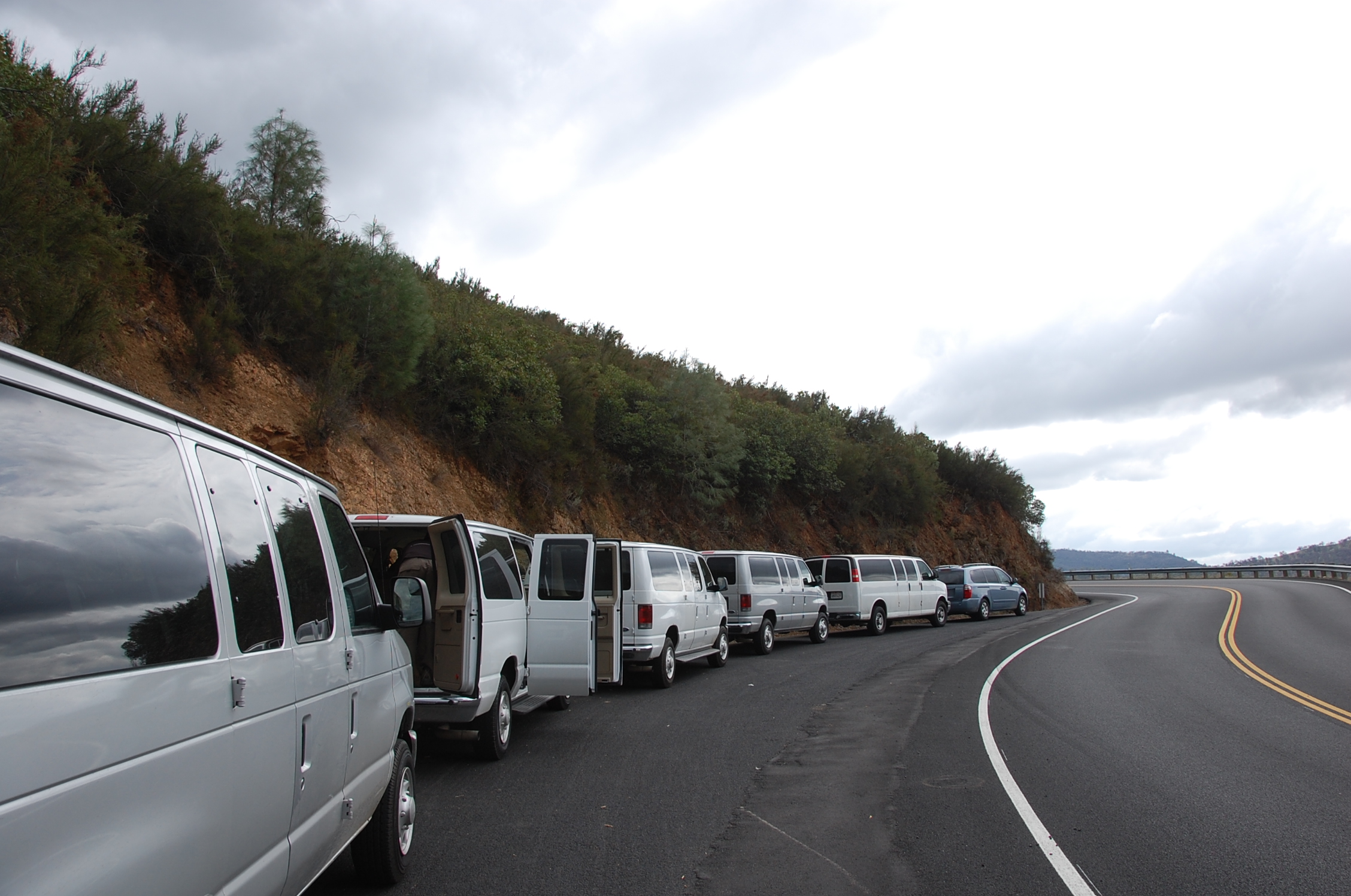
The result is a nine-day Spring Break field trip to California for about 20 students and researchers. In many regards it’s a typical geology field trip involving a caravan of 12-passenger vans stopping regularly at convenient road cuts and scenic overlooks where everyone piles out of the vehicles and the instructor shows the students what is significant about that particular place. Then the students take a bunch of photos and everyone climbs back into the vans and off they go again.

A typical geology field trip caravan


Lecture on the rocks

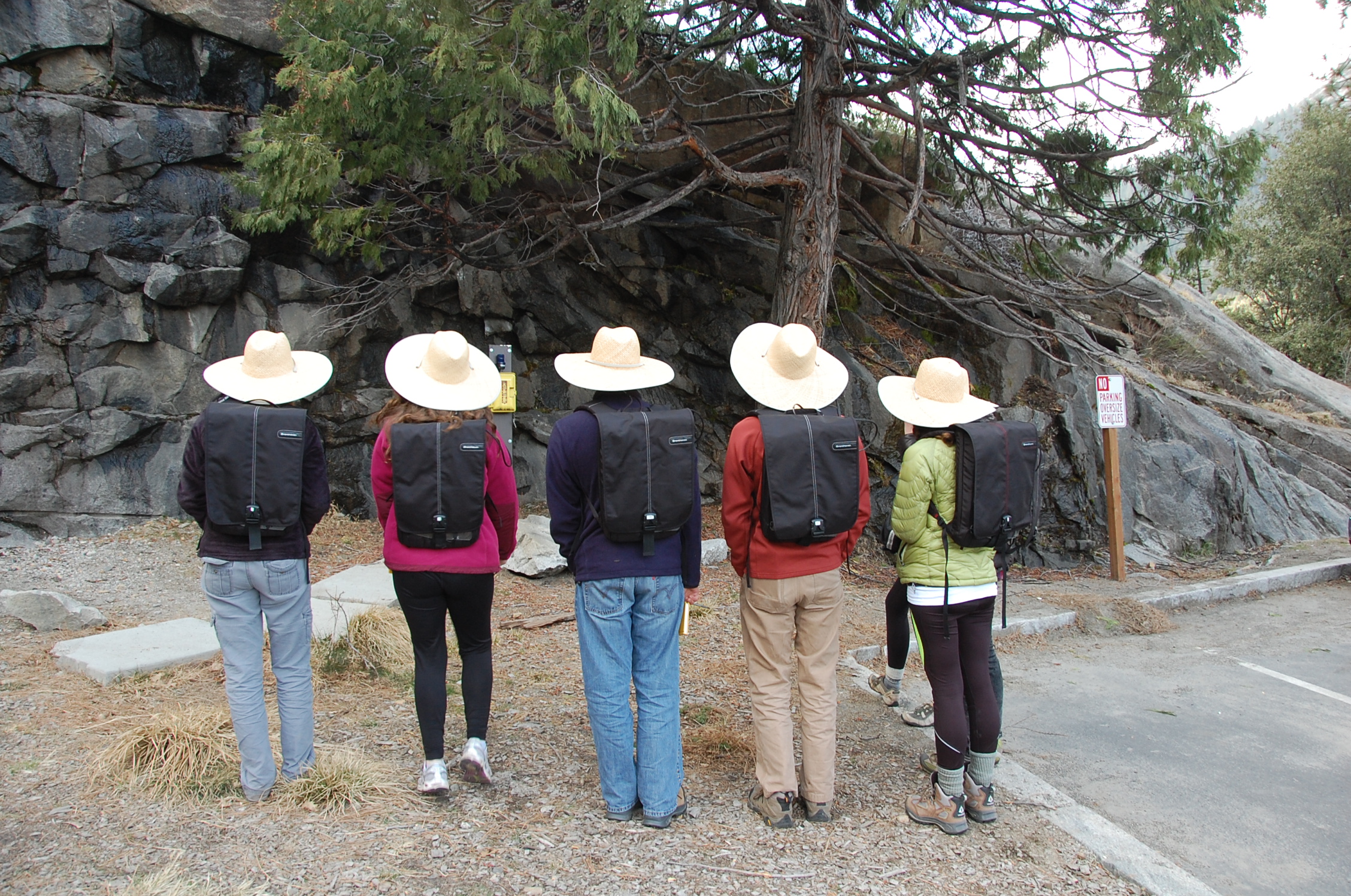
But this trip is different as well. At two to four of each day’s stops, the eye-trackers come out. By the end of the trip, it takes about 15 minutes to suit up. All the students mill around, intentionally ignoring the scenery around them, waiting for the go-ahead to finally look around. Sometimes, they’re forced to face a wall, waiting for everything to be in order. When all is ready, the students are led to a spot, lined up, and asked to observe the scene looking for evidence of geologic events, specified by the instructor. They look around for a minute or two, then the stop becomes like any other: Question and answer, followed by a detailed explanation offered by the trip leader. Then the students take their photos, the eye-trackers come off, and the caravan moves on.

Adjustments


Adjustments and Calibration


Calibration


Facing the wall, waiting for permission to peek.


Tracking...


Post-tracking discussion


This eye-tracking, geology-spotting venture has been going on for three years now. I myself have been on two of the trips, once as an “expert,” and once as a driver/wrangler. As yet, no major publications have come from the work. It seems that the study has generated so much data, that new methods had to be developed to deal with the data. But conclusions are beginning to arise. For example, we’ve learned that it matters how the question is asked, as to whether or not the students begin looking in the right places. There’s a difference, you see, between “look in the valley” and “look around the valley.” Who knew.

For me, I just think it’s damn cool!

For more photos of the shenanigans that is the California field trip, visit my Flickr sets for 2010 and 2012.