Published: Global Warming 55 Million Years Ago

This is the first installment of my attempt to convert a scientific paper (my own) into plain language that is accessible to everyone. Feel free to ask questions in the comments. I’ll respond there, or with additional blog posts.

Climate change at the Paleocene-Eocene boundary: New insights from mollusks and organic carbon in the Hanna Basin of Wyoming.

By Penny Higgins

Published in PalArch’s Journal of Vertebrate Palaeontology

v.9 n. 4, p. 1-20

Link to the complete technical version: PDF

INTRODUCTION

There is a lot of interest in climate change these days, especially global warming. Especially if that global warming can be blamed on increasing amounts of carbon dioxide in the atmosphere. The problem is that it’s hard to know if the trend toward warmer temperatures (at least the global average) is due to natural cycles of the Earth or due to increases in atmospheric carbon dioxide because of the burning of fossil fuels by us, or if there is even a relationship between increasing carbon dioxide and warming (maybe increases in both are coincidence, but not not due to some causal relationship).

This paper doesn’t make any arguments to support or refute any ideas about modern global warming. However, it is relevant because it explores a past episode of rapid global warming. This ancient event took place about 55 million years ago. Global average temperatures might have increased by as much as 10 degrees, and did so relatively rapidly (over about 10,000 years). It is suspected that this rapid warming was due to the release of massive amounts of carbon dioxide into the atmosphere.

So the warming of 55 million years ago seems similar to modern warming in being rapid (though not as rapid as in the modern scenario) and being potentially blamed on increased carbon dioxide in the atmosphere. In this paper, we assume that the warming at 55 million years ago did happen, lasted about 150 thousand years, then things cooled back down to more-or-less where they had been before. For the sake of this paper, it doesn’t matter what caused the warming, only that it was.

This warming event began at the boundary between two epochs on the geologic time scale: the Paleocene and the Eocene. We call this event the Paleocene-Eocene Thermal Maximum, or the PETM.

The Paleocene-Eocene boundary is actually defined based upon the onset of warming, as identified by a big change in the relative amounts of two isotopes of carbon (13-C and 12-C) in the atmosphere, and consequently in all organic material that was deposited at that time. How we measure these amounts and what the actual numbers mean are the topic of another paper or blog post. What’s important is that these relative amounts, or isotopic ratios, are presented in what we call the ‘delta notation’ (like δ13C, δ15N, and δ18O) in units of permil (‰). When delta values are more negative, there’s relatively more 12-C in a sample; when delta values are more positive; there’s more 13-C in a sample. The PETM, then, is recognized by a negative carbon isotope excursion (CIE), where the delta values suddenly drop by three to five permil. The PETM ends when carbon delta values go back to what they had been before the CIE started.

Much of what’s known about the climate change at the PETM, and the Earth’s subsequent recovery, is known from cores of rock and sediment collected from the ocean floors. Naturally, we’re interested in what would happen to us – those of us stuck on land. In the Hanna Basin, in south-central Wyoming, there is a sequence of rocks that began to be deposited before the PETM started, and continued to be deposited during the PETM and after the PETM. These rocks were deposited on land and are sediments from lakes and floodplains. In these lakes and small rivers were living lots of organisms, in particular, mussels. There was also a lot of organic material being deposited – so much so that now it is represented by many thick coal seams that are actively mined.
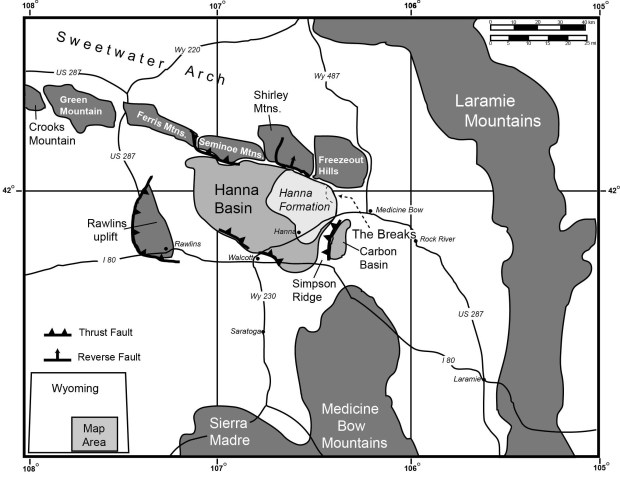
Location Map showing where the Hanna Formation lies

This sets up a scenario where we can use the organic carbon (from the coals) to identify the CIE, and therefore the Paleocene-Eocene boundary and the PETM in a terrestrial rock sequence. Then, we can look at the fossil mussels, and other things, to examine the environmental changes that happened during and after the PETM. The main questions, and ones that are relevant to modern concerns about climate change, are:

1) after the warming ended, did the environment go back to its original state or was it forever changed?

2) what effect did climate change have on the organisms that lived through it?

FINDING THE PETM

First, let’s look at the rocks. The Hanna Formation, the rock unit I’m studying, is about three kilometers thick (or about two miles). The part we care about is in the top half. The bulk of the Hanna Formation is composed of sediments deposited on floodplains, with little shallow streams that wound around (called fluvial). There are two parts of the Hanna Formation that have lake beds in them (called lacustrine), cleverly called the upper and lower lacustrine units (ULU and LLU). The focus of this study is on the upper and lower lacustrine units and some fluvial rocks in between them. I had reason to suspect, when I started this study that the Paleocene-Eocene boundary lies between the lacustrine units. This is borne out in this paper.

The Hanna Formation – its total thickness and where the study section is

It turns out that is wasn’t very easy to identify the CIE (and therefore the Paleocene-Eocene boundary) in the Hanna Formation. The delta values from the coals and other organic materials jump around a lot, probably because the organic carbon I was looking at comes from lots of different types of plants, all of which are slightly different isotopically. One conclusion of this study is that we need to do more ‘compound-specific’ work. That is to say, if we can isolate specific organic molecules and analyze them separately from everything else, that should make the carbon isotope values less variable. Unfortunately, the type of instrument and laboratory that’s needed to do that isn’t present here at the University of Rochester. I’m working on it.

Nevertheless, in general where the values are more negative than -26‰, you’re in the CIE. To help make it more clear, I used a three-point running average of the raw carbon isotope data. This tends to smooth out the line, while keeping the big jumps visible. The first major jump into more negative values occurs at about 2500 meters, which coincides with estimations made using mammal fossils and fossil mollusks by others who have worked in the Hanna Formation before.

When I compared this overall pattern with other published patterns of carbon isotope variability (some from ocean cores and some from terrestrial sections), things matched up pretty nicely. Using pattern matching, I placed the top of the CIE (and the end of the PETM) at about 2650 meters, which is in the lower part of the upper lacustrine unit. This means that the 150 thousand years of the PETM are represented by about 150 meters of rock in the Hanna Formation, or that a meter of rock was laid down every 100 thousand years. This is actually reasonable – no one in the geological sciences is bothered by this rate of deposition.
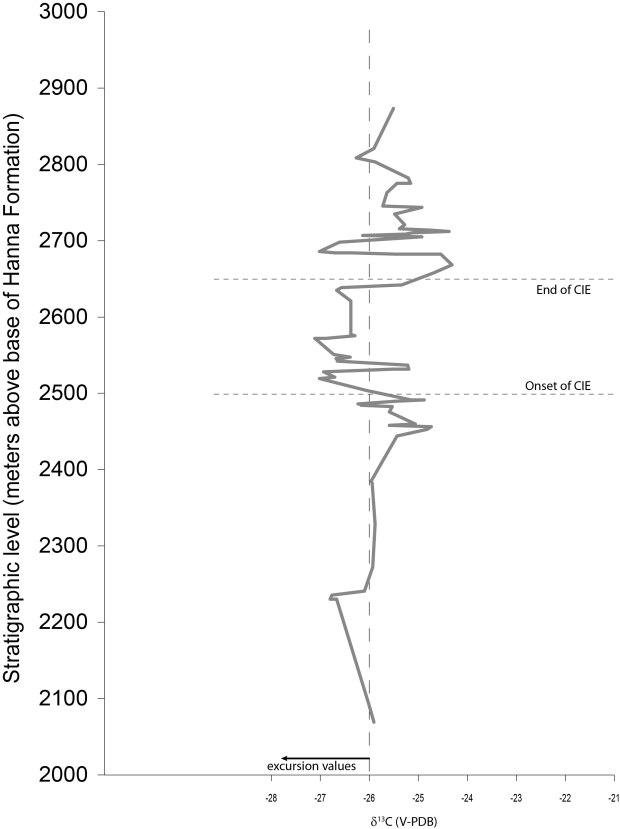
Carbon Isotopes from the Hanna Formation, showing the CIE and the location of the LLU and ULU

ENVIRONMENTAL CHANGE

Now that the CIE is identified, I could begin to address the environmental changes that might have occured during that period of warming. I approach this in two ways:

1) Looking at isotopes of nitrogen – which gives us information about the organisms from which the organic matter is coming (e.g. we can distinguish between a stagnant pond or a lively lake).

2) Looking at isotopes of carbon and oxygen in the mussels that have been collected – which can give us information about annual changes in the environment that the mussels lived in.

NITROGEN

Most of the organic molecules that go into coal also have nitrogen in them, though not as much nitrogen as carbon. Usually, when looking at fossil organic carbon, the amount of carbon is so low that there essentially is no measurable nitrogen in the samples. In the case of the Hanna Formation, though, we have coal, which is basically ALL organic carbon-bearing molecules. That means that there’s some hope of finding measurable nitrogen, and that’s what I did.

So really, this part of the study was basically done for giggles – just to see if I could do it. And once I had data, well, I had to interpret it.

There are two ways to think about nitrogen. One is to simply compare how much nitrogen there is relative to carbon (C/N ratios). A second is to look at the ratios of two isotopes of nitrogen, 14-N and 15-N. C/N ratios give us information about the origin of the organic molecules (from algae or land plants, for example) and the isotopic ratios tell us about status of lake, whether it be full of actively photosynthesizing plants or if it is stagnant.

Using the combination of C/N ratios and nitrogen isotopes, it seems that for the most part the organic carbon in the lakes of the Hanna Formation is dominated by land plants. So these are leaves and litter that were washed into the lakes. One interesting isotopic data point sits at the bottom of the CIE. From this point, it seems that there was might have been drying of the lake at the beginning of the PETM. That would make sense, assuming that warming could cause greater evaporation.

MUSSELS

The work with the mussels is actually been the topic of two undergraduate senior theses that I’ve advised. They’ve been doing some great work to look at the annual changes in isotopes by collecting multiple samples from single shells, following growth lines, to put together a picture of environmental changes that happened during the individual animals’ lives. I don’t say much about that work in this paper. That’ll be published later. What I do talk about is trends. I’ve taken the averages from individual shells and used those to look at how the isotopes of carbon and oxygen from the shells change over time. I also talk about how carbon and oxygen isotopes change relative to each other within a single shell.
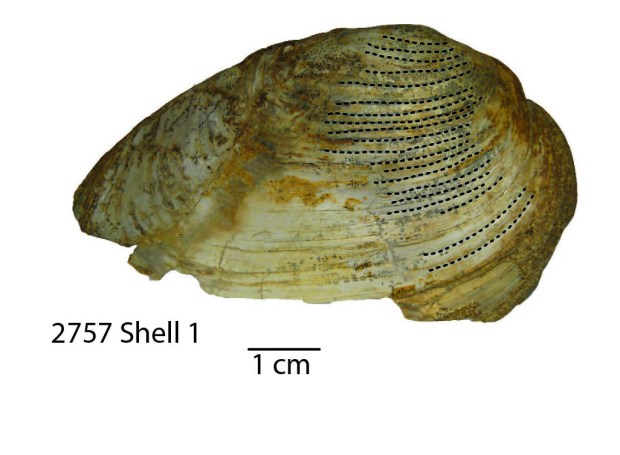
Mussel Shell – dashed lines show where isotopic samples were collected

So, how are carbon and oxygen in the shells of mussels, you ask? Mollusk shells are made of calcium carbonate (CaCO3) which contains one carbon and three oxygen atoms. We collect powdered bits of the shells by using a dental drill and take this powder and put it into the mass spectrometer. The calcium carbonate is converted to carbon dioxide (which is easily measured by the mass spectrometer) by reacting the powders with acid. You put acid on the calcium carbonate, it fizzes, making carbon dioxide, which is drawn into the mass spectrometer and – wango! – we have carbon and oxygen data.

Carbon in mussel shells is thought to be derived mostly from carbon dioxide that has been dissolved in the water, and so should track the isotopic value of atmospheric carbon dioxide. Atmospheric carbon dioxide, as mentioned earlier, gets more negative during the CIE then returns to the pre-CIE values. The average values from the shells seem to follow this trend, so there’s no surprises.

But now we’re talking about yet another isotope: Oxygen. The isotopes that we measure are 16-O and 18-O. Isotopes of oxygen are a big topic of discussion when dealing with climate change. That’s because oxygen is an important component of water, and water is an important component of climates. For example, climates can be described as arid or humid. There can be rainy seasons or monsoons. Precipitation can take the form of rain or snow. All of these processes affect the isotopes of oxygen in water. Temperature also affect oxygen isotopes. Unfortunately, isotopes of oxygen in water are a very complex system, and would best be discussed in a separate blog post. What is important is that there isn’t any obvious trend in the average values of oxygen from the shells over time, either.

Since oxygen is affected by climate, one would expect that there should be some change if there’s been a significant climate change. However, because oxygen is so complicated, the changes in oxygen isotopes by changing one part of climate (the time of year when it rains, for example), might be offset by other changes (like a change in average temperature). The fact that there isn’t any obvious trend or change in oxygen isotopes over time doesn’t mean that there wasn’t any change in climate.

And we do see a difference when we compare the variations in carbon and oxygen within a single shell. Carbon and oxygen in shells from the lower lacustrine unit (before the PETM) tend to change in opposite directions (or are negatively correlated). When oxygen isotopic values get more positive, carbon isotopic values get more negative. Shells in the upper lacustrine unit show the opposite pattern. Carbon and oxygen values change in the same direction (are positively correlated), so when oxygen gets more positive, so does carbon. From this, it’s possible to infer that before the PETM there was a lot of vegetation and photosynthesis going on around the lakes, whereas during the PETM, photosynthesis might have slowed down during the warmer months and bacteria might have dominated life in the water. This seems reasonable since in the upper lacustrine unit there are also huge fossilized bacterial mats called stromatolites.

CONCLUSION

So that’s what this paper is about. We see some evidence of environmental change due to warming at the Paleocene-Eocene boundary. Particularly, we have the one really positive nitrogen isotopic value near the base of the CIE and we see a change in the relationships between carbon and oxygen isotopes in individual mussel shells during the PETM as compared to pre-PETM.

One thing that hopefully is obvious however: there is more work to be done.

The work with nitrogen isotopes started with a shot in the dark. More samples should be analyzed. There’s definitely more work to be done there.

My students’ work on the mussel shells will greatly contribute to this as well. Since I wrote this paper, there have been more shells collected and more samples analyzed. That work needs to be wrapped up and published soon.

We really need to do that ‘compound-specific’ work I mentioned earlier to help clarify the CIE. It’ll also help clear up what sorts of plants were around at that time, so we can better interpret the nitrogen data.

Also, though not discussed at all in the paper, is the fact that there are paleobotanists out there looking at fossil leaves and pollen. There’s a story to be told there, and someone’s getting a Ph.D. For their efforts. I can’t wait until that work is done!


The Snouters and Teaching Cladistics

A new species of Rhinograde mammal, Nasoperforator bouffoni, was described last week by a group of researchers at the Muséum d’histoire naturelle, in Paris. This is really exiting news in science, as we often (falsely) think that we’ve found and named all the living mammals that there are.

Drawing of the head of Nasoperforator bouffoni

The Rhinogrades (or more affectionately, the Snouters) were originally described in the book, The Snouters: Form and Life of the Rhinogrades, by Harald Stümpke. The Rhinogrades are a new order of mammals known only from the island Hy-dud-dye-fee in the South Sea archipelago of Hi-yi-yi. They are noted for the incredible adaptations of their noses for locomotion and feeding.

Illustration of Otopteryx volitans

Stümpke proposes a family tree of the Order Rhinogradentia based upon 26 genera of Snouters described in the book. This sort of family tree, more properly called a ‘phylogram,’ is typically based upon a person’s gut feeling about the similarities among different species. It can be based upon a researcher’s experience and can be biased by a scientist’s pre-conceived notions about how things ought to be related. A better, more objective, way to approach relationships among different species is to use cladistic analysis (or cladistics).

Stümpke's phylogram of the Snouters

If you’re remotely interested in paleontology, then you’ve probably heard of cladistics (or cladograms, or clades). Cladistics is one of those things in the science of paleontology that you have to know about. Some folks spend their entire careers focused on cladistic analysis. Others avoid cladistics vehemently. Nevertheless, there’s no escaping cladistics. If you want to know paleontology, you gotta know cladistics.

So then, what is cladistics if it’s so important? For me, it’s a topic that I took a full semester course on as a graduate student. My notes are in a binder labeled ‘sadistics,’ which goes a long way to describe just how I feel about cladistics. (I actually have two binders labeled ‘sadistics.’ The other one is for a class in which I learned about t-tests, f-tests, means, and standard deviations.)

But seriously, cladistics is a tool by which paleontologists (and biologists and botanists and geneticists) can mathematically determine the ‘relatedness’ of organisms. More generally, cladistics is used to determine evolutionary relationships, so we can determine who evolved from whom. It’s mathematical, and thus reproducible and computerizable, and comes replete with all sorts of statistics (the other sadistics) that can be used to support or refute proposed evolutionary pathways.

Fine.

But it’s also a bit of a nightmare.

The analysis starts by breaking a species down into a bunch of ‘characters’ for which there are, in the purest cladistics, only two states. The states for each character are entered as 0’s and 1’s in a matrix. Examples of well-behaved characters are:

Character Character state ‘0’ Character state ‘1’
Antorbital Fenestra (a skull opening seen in some dinosaurs) Absent Present
Palatine teeth (having teeth on the roof of the mouth) Present Absent

Presence and absence characters are great. Unfortunately, not all characters can be broken easily into 0’s and 1’s.

Character Character state ‘0’ Character state ‘1’ Character state ‘2’
Eye color Blue Brown Hazel
Femur length (the thigh bone) 0-10 inches 12-18 inches 20-19 inches

And sometimes, characters obvious in several species are not known from others. For example, eye color is meaningless when considering eye-less animals, but if only one species in your analysis lacks eyes, then you need that character information for the other species. Another problem occurs when (especially in paleontology) an organism is only incompletely known. For example, toe characteristics aren’t helpful when one of the animals in your study is known only from its skull.

In principle, however, one needs only determine all the character states for a suite of characters for each organism in an analysis.

Organism Character 1 (hooves) Character 2 (hair) Character 3 (warm-blooded) Character 4 (bones) Character 5 (scales) Character 6 (4-chambered heart)
Horse 1 (has) 1 (has) 1 (has) 1 (has) 0 (doesn’t have) 1 (has)
Cow 1 (has) 1 (has) 1 (has) 1 (has) 0 (doesn’t have) 1 (has)
Trout 0 (doesn’t have) 0 (doesn’t have) 0 (doesn’t have) 1 (has) 1 (has) 0 (doesn’t have)
Croco-stimpy 0 (doesn’t have) 0 (doesn’t have) 0 (doesn’t have) 1 (has) 1 (has) 1 (has)

And then you use all the 1’s and 0’s to determine who’s most similar to (and thus more related to) whom. In the above case, if we look only at characters 1-5, one can see that horses and cows are very similar and related to each other, as are trout and croco-stimpies. But add character 6, and you can see that croco-stimpies are more similar to horses and cows than to trout, thus, one could infer that trout evolved into croco-stimpies which then evolved into horses and cows.

You’ve already got a headache, and it hasn’t even gotten complicated yet.

Enter the Rhinogrades.

For years, I’ve been handing my students copies of Stümpke’s book, and asking them to do a cladistic analysis of nine species (of their choice) of Snouters. Next time I’ll have them include the new species. The problem is that the students have to come up with their own characters and character states. Students quickly realize how important it is to choose good characters (and character states), and how difficult it can be to determine character states when all they have is an incomplete description of an organism. So, it’s actually a really great exercise (even if the students claim to hate it). The students turn in a cladogram and a list of characters and character states, and I compare their cladogram with the one I’ve devised based off of Stümpke’s family tree.

My Snouter cladogram - based only on Stümpke's phylogram

And when they’re all done, then I tell them.

It’s a hoax. There’s no Hi-Yi-Yi. No Nasoperforator. But it was fun, wasn’t it?

Geology in the Movies: John Carter, Shiprock, and Geo-Farts

Sometimes in movies, the scenery is so fantastical that it clearly must be something spawned from the imagination of an artist. One thing I love about being a geologist is the knowledge that some of these places really do exist. Sometimes they’re as fantastic as they appear to be in the movies, and sometimes, it’s all about clever shooting angles. Either way, it’s always a great opportunity to introduce people to some of the geologic wonders of our world.

John Carter Logo
John Carter (from Mars)

A lot of the movie John Carter was shot in the deserts of the southwestern United States. This is the place where I learned geology, so I smiled a lot through the film as I recognized several of the vistas. Every time I recognized a place, my brain instantly pulled up the old files on the geologic history of that place.

One such place, Shiprock (which only makes a momentary appearance), gave me an audible chuckle. My introduction to Shiprock as a student was one of the things that solidified in my mind that to be a geologist was what I wanted to do.

Shiprock in John Carter

Now, when I was an undergraduate, Shiprock actually appeared in almost every single geology textbook (and it still does, really). It was almost always described as a ‘volcanic neck’ or ‘volcanic plug,’ or that which remains after most of a volcano has eroded away, leaving only the core of the volcano behind. This was supposed to be the original channel through which the magma flowed prior to erupting at the earth’s surface.

Well, one of my professors wanted to set that straight. Clearly those idiots writing the textbooks had never actually visited the place. Shiprock is no volcanic neck, he announced. It was better described as a ‘geo-fart.’ Well, this made an impression on me and my classmates, and to this day, I can’t look at a photo of Shiprock without thinking about geo-farts and giggling a little bit.

It is actually a rather apt description to call it a geo-fart. The technical term is ‘diatreme,’ which is a ‘breccia-filled volcanic pipe that was formed by a gaseous explosion.’ Well that’s a mouth full. In regular English, that means that there was a big gaseous eruption – explosive or fart-like, if you will – where lots of angular bits of rock were shot out of a pipe-like structure in the Earth. Rocks fell back in. Things were hot. Some rocks were melted. The end result is this structure, like a volcanic neck, but that is full of jumbled up bits of formerly molten rocks and other bits and pieces all stuck together. (The word ‘breccia’ [pronounced brech-a] refers to a rock composed of angular bits of other rocks all jumbled and fused together.) When the exploding is done, all the softer rock surrounding the newly filled pipe-like structure erodes away, leaving a huge rock that looks a little like a Spanish galleon.

Shiprock, New Mexico
Shiprock, New Mexico. Photo by Bowiesnodgrass

So it must have been a pretty exciting day when Shiprock formed, though it certainly didn’t look much like it does today. It’s really no surprise that something like a geo-fart occurred in the Southwest. There’s volcanic activity everywhere, a lot of which involved lots of gaseous urping and the tossing in the air of lava bits. That’s how all those cinder cones out there formed. (As an aside, one such cinder cone is called SP Crater. Google it and have a chuckle with me!)

Cinder Cone
Cinder Cone
SP Crater
SP Crater, Arizona

OK, but what about those ‘walls’ coming off of Shiprock? Those are real and they formed at or around the same time that Shiprock itself formed. In geology, we have a term for these. We call them dikes (or dykes, depending upon which side of the Atlantic you live on). Dikes are basically walls of volcanic material cut through existing rock layers. You can imagine that while the pipe that later became Shiprock was busy blowing up, that there would be some cracks extending from it. These cracks filled up with volcanic material, forming the dikes. Since the dikes (and volcanic material in general) are more difficult to erode than the softer sandstones that they cut through, they wind up standing like walls and towers after some erosion has taken place. Later, these walls make a great backdrop for a great movie!

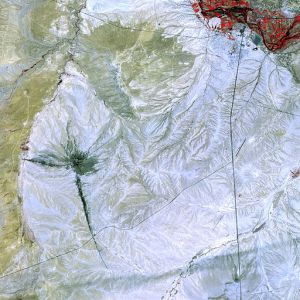
Shiprock from ASTER
Shiprock from ASTER

OK, so there it is, the first installment of “Geology in the Movies.” Next time you’re watching John Carter, I hope you giggle when Shiprock appears, just as I did. And when the person next to you asks what’s so funny, you can tell them that you just saw a geo-fart.

On Introspection and Writing

This last year has brought a lot of change into my life. Call it a mid-life crisis if you want, but certainly I am changed over who (or where) I was last year.

In April of last year one of the most significant events of my life occurred. That was when my son received the diagnosis of PDD-NOS. What’s that, you ask? In a nutshell, it means that the boy has autism (or is autistic, or whatever is politically correct). He’s a high-functioning autistic, but does not quite fit the diagnosis of Asperger Syndrome.

Anyway, what’s important here is that this diagnosis, while disappointing and sometimes difficult to cope with did help me accept that my child’s strange behavior is not due to any failure of my own. My parenting is fine. The boy is just different. I hadn’t realized it, but the feeling that the boy’s ‘differentness’ was somehow my fault had been weighing so heavily on me that it affected everything. I was depressed. I gained weight. I faltered at work. I faltered at home, with my marriage, and everything. I felt like a failure all the way around.

Everything changed with the boy’s diagnosis. I did go through an initial stage of mourning: the boy would never be the person that I had originally thought he might be. But once I got past that, things improved.

I suddenly dropped fifteen pounds of weight. I just quit eating as much. Apparently, I am a comfort-eater. Yeah, I am. Yum. Candy. This then turned into me beginning a regular fitness program. At this point, I have lost nearly thirty pounds, and am fitter than I was even as an undergraduate athlete.

My relationship with my husband also improved. Sure we still have some rocky moments, but that’s natural. We celebrated ten years of marriage last year. And we still like each other. That’s pretty good.

Somehow, the boy’s diagnosis enabled me to allow myself to take time for my own interests. I discovered that I really like sewing, and have now made for myself, my husband, and the boy several costumes with at 14th century flair. I’m working on new costumes for the Ren-Faire circuit this summer.

What’s perhaps the most substantial revelation I’ve gotten in the last year is that I actually like to write. Yeah, who new. I’ve hated writing for years, or so I’ve thought. The truth is, I hate technical writing. It’s stale and stunted. It’s all posturing and jargon. (And I’m not the only one who’s realized this!) It’s not my natural mode of communication.

Last November, I joined the National Novel Writing Month (NaNoWriMo) and started, for the first time ever, to write and share with others one of the many stories I’ve had drifting around in my head. Well, I easily met the 50k word goal of NaNoWriMo, but the book was (and still is) hardly complete. With this writing, I discovered that I absolutely loved writing. Just not technical writing.

Well, I’m still working on the book (Knights of Herongarde), and still costuming, and feel great for it. Recently, a blog post inspired me to do more writing. It seems that there is a call for scientists to start making their work accessible to others, and blogging seems to be the best way to do this. So, I’ve started adding blog posts about my research. I hope that readers here have enjoyed them. There will be more.

I’m about to embark on another project that will involve a lot of writing. Writing in my preferred style, not the stunted, formal style of technical journals. It was suggested to me while in California that there does not exist a popular-press book on the basics of geology. Given my preferred style of writing, I might be the person to prepare such a book.

There are books on the geology of specific places, but nothing like “Geology for the masses,” semi-technical books that a person could grab and take with them anywhere where rocks are exposed and get something useful from it. Well there are a few out there, most notably one in the “For Dummies” series. Many are geared toward children, and far too many (the prettiest and glossiest and the ones that are on top of the Google search for “Geology book”) are creation science books touting the 6,000 year-old Earth. *gasp*

This is in marked contrast to books on dinosaurs, for example, where you can choose from any number of great titles, written at a level accessible to both children and adults, all written by prominent authors and scholars. These books mix technical jargon with pretty pictures and fantastic facts that attract scholars at all levels. I myself have several of these books on my own shelves and refer to them when teaching about dinosaurs in my own classes.

So why don’t such books exist for the science of geology? Maybe because it is a very broad topic? Maybe because most geologists don’t consider promoting their science to the general populace necessary? Maybe because the average person thinks that there’s not much to geology, so a whole book devoted to it would be pointless.

Well, that last person is missing out on a fantastic science. A lot of people are. So I’ve decided to take on this project. And I think my personal style of writing and the use of this blog lend themselves to the greater project. My goals in doing this work are the same as they are when I teach “Introduction to the Geological Sciences”:

1) To leave the reader/student with basic knowledge that *wherever* they go, whether rocks are exposed or not, there will always be something geological for them to recognize and enjoy.

2) To turn the reader/student into an informed citizen. Far too often, geology is given short-shrift in the media, and the average person is entirely unaware that within geology are important answers to questions related to climate change or other environmental disasters (like the Deepwater Horizon oil spill, or last year’s earthquake in Japan). My goal is to demonstrate the relevance, so that when policy decisions must be made, people can choose appropriately.

The ‘book’ will be written section by section, topic by topic, where each section is sufficient for a single blog post. In the end, the book will be put together by stitching each of the sections together in the correct order.

This accomplishes two things. One, it lets me take my time writing the book. I can write a section or two a week, but a whole book in a year is a little daunting. Two, by using the blog it allows some peer review and more importantly, open access, which is a huge topic in the sciences these days. Read about it. Maybe I’ll blog about it. Eventually.


Eye-Tracking the Geological Experience

One question that is often asked, especially in advertising, is is “what draws the attention of the consumer?” More basically, we sometimes wonder what people are looking at, anywhere. Twenty people can look at the same scene and notice different things about it. What captures a person’s attention?

Such questions are often addressed using a technique called eye-tracking. This involves two cameras, usually worn by the subject. One camera takes a picture of the scene that the person is observing and the other films the motions of the subject’s eye. With careful calibration, it is then possible to project upon the image of the scene, the actual point at which the subject is looking.

Eye-tracking technology has changed over the years. Originally, eye-trackers were cumbersome and seldom left the laboratory. Recently, eye-tracking has become portable, and new questions can be asked and answered. I’ve been fortunate to be associated with (as a participant and as an assistant) a different type of eye-tracking study.

This study goes beyond simply asking what people look at. Instead, the goal is the understand how geologists learn their trade, and the distinction between what a novice geologist (an early-career student) and an expert observer (a professional geologist) notices when looking at an unfamiliar landscape. The study is investigating what’s called “perceptual learning,” and is a joint venture between geologists, brain and cognitive scientists, and imaging technologists at the University of Rochester and Rochester Institute of Technology.

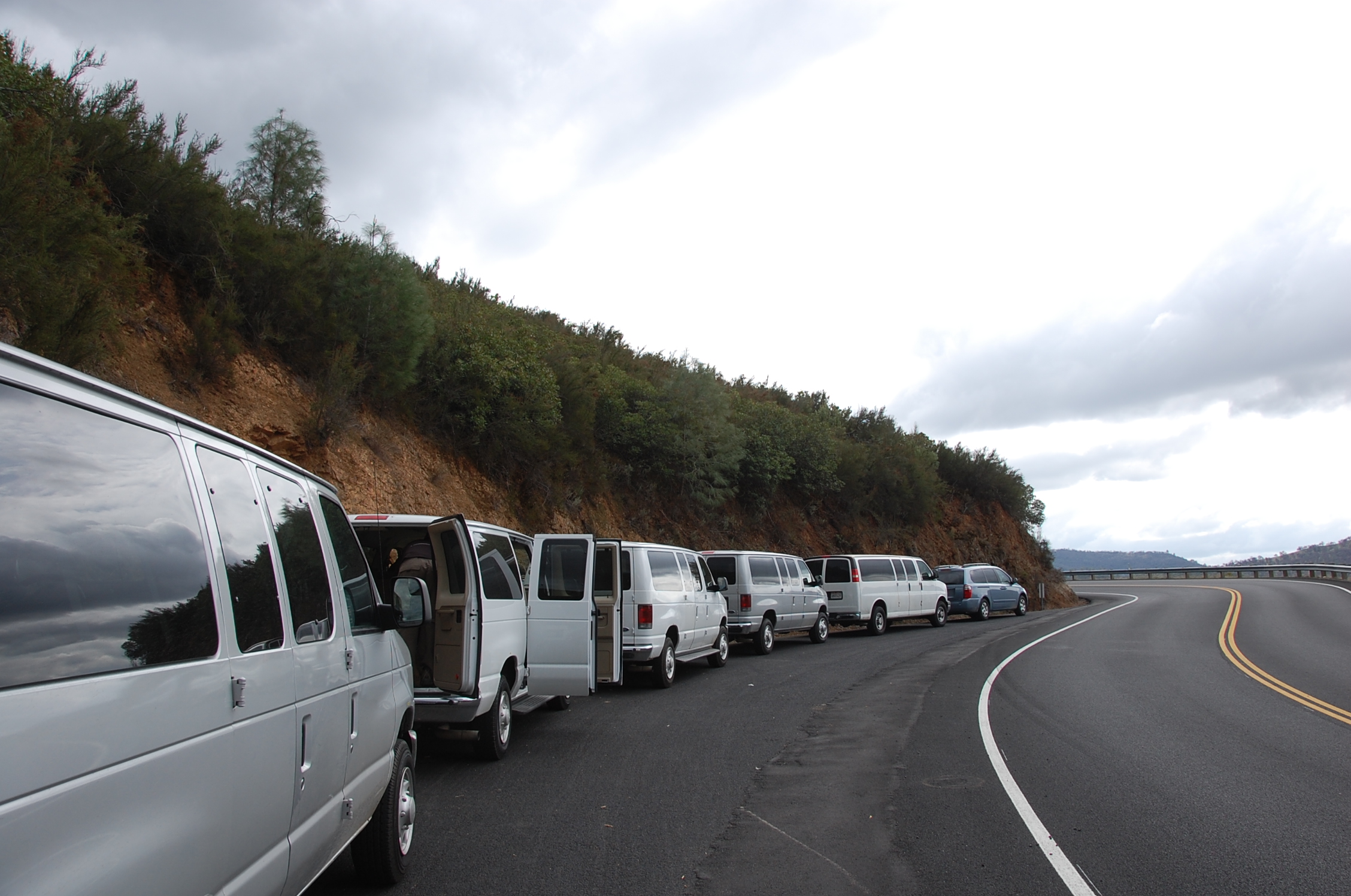
The result is a nine-day Spring Break field trip to California for about 20 students and researchers. In many regards it’s a typical geology field trip involving a caravan of 12-passenger vans stopping regularly at convenient road cuts and scenic overlooks where everyone piles out of the vehicles and the instructor shows the students what is significant about that particular place. Then the students take a bunch of photos and everyone climbs back into the vans and off they go again.

A typical geology field trip caravan


Lecture on the rocks

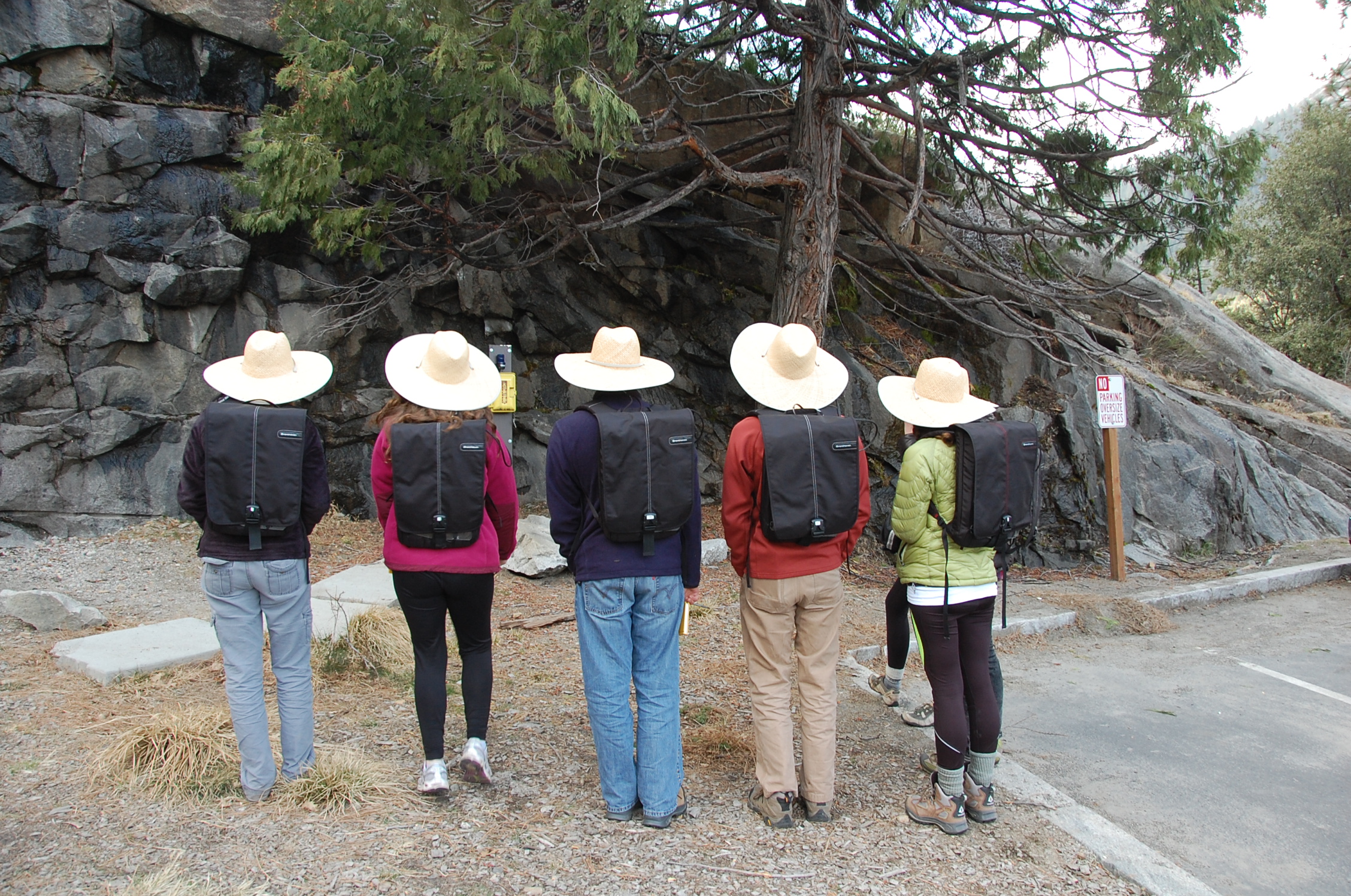
But this trip is different as well. At two to four of each day’s stops, the eye-trackers come out. By the end of the trip, it takes about 15 minutes to suit up. All the students mill around, intentionally ignoring the scenery around them, waiting for the go-ahead to finally look around. Sometimes, they’re forced to face a wall, waiting for everything to be in order. When all is ready, the students are led to a spot, lined up, and asked to observe the scene looking for evidence of geologic events, specified by the instructor. They look around for a minute or two, then the stop becomes like any other: Question and answer, followed by a detailed explanation offered by the trip leader. Then the students take their photos, the eye-trackers come off, and the caravan moves on.

Adjustments


Adjustments and Calibration


Calibration


Facing the wall, waiting for permission to peek.


Tracking...


Post-tracking discussion


This eye-tracking, geology-spotting venture has been going on for three years now. I myself have been on two of the trips, once as an “expert,” and once as a driver/wrangler. As yet, no major publications have come from the work. It seems that the study has generated so much data, that new methods had to be developed to deal with the data. But conclusions are beginning to arise. For example, we’ve learned that it matters how the question is asked, as to whether or not the students begin looking in the right places. There’s a difference, you see, between “look in the valley” and “look around the valley.” Who knew.

For me, I just think it’s damn cool!

For more photos of the shenanigans that is the California field trip, visit my Flickr sets for 2010 and 2012.

Creating one’s personal brand…

We were on a long ride today, and for some reason, I was thinking about this concept.  I mean, do I have a personal brand? What is it? What do I want it to be? Do I even want one?

Let’s see what components of my brand that I think most people would agree about:

  • One who laughs a lot.
  • Maker of bad puns.
  • Tweaker of unruly mass spectrometers.
  • Purveyor of paleontological geochemistry to the masses.
  • Educator.
  • Parental-type person.
  • Athletic (-ish)
  • Artist (as in drawing, mostly).
  • Occasional writer.
  • Possessor of far too many hobbies.

So then, does that make a brand? If so, what?

Molars of Mammoth Proportions

Have you ever looked at an elephant molar? I mean, really looked?

African Elephant molar, Loxodonta africana (length=205 mm)

It’s a pretty funky thing to observe. They’re usually comprised of a series of plates – nothing like the teeth we’re more familiar with (i.e. our own) – with roots hanging down, seemingly one root per plate. Well, that’s kind of bizarre. To make matters even stranger, elephant teeth aren’t all in use at the same time. That is to say, usually it’s one or two teeth in use at one time in the mouth in each of the four quadrants (upper right, upper left, lower right, lower left) , while over the span of the elephant’s life there are a total of six or so adult teeth in each quadrant. They come in one at a time, conveyor-belt style, from back to front, falling out the front when they’re too worn to be of any use any more. Aged elephants can die from starvation, when the last of their molars (the M3) falls out and they have no teeth left.

We more-or-less know how the more ‘normal’ teeth of mammals form, like our own teeth. They start to mineralize at the crown (the chewing end), and lengthen incrementally toward the roots. The roots themselves are the last part to form (and in animals with ever-growing teeth, the root never forms, the tooth just keeps growing). People like me take advantage of this pattern of tooth growth because it records the body chemistry of the mammal over the period of time that the tooth mineralized. Sometimes this represents several months to years (and that’s the topic of another blog post). But how does an elephant tooth, comprised of all these plates, form?

Well, since that’s what I’m working on RIGHT NOW, I thought maybe I’d put out some information on what we (being me, and some of the folks at the Mammoth Site in Hot Springs, South Dakota) think might be the case. Then maybe I can tell you about how we’re planning to answer that question.

So there I was, at the Mammoth Site during the summer of 2011. I was given the opportunity to work with the molars of a mammoth, whose skull, unfortunately, had taken a bad fall, but had thereby released its teeth. I was presented with an M3 (still mineralizing) and an M2 (in wear).

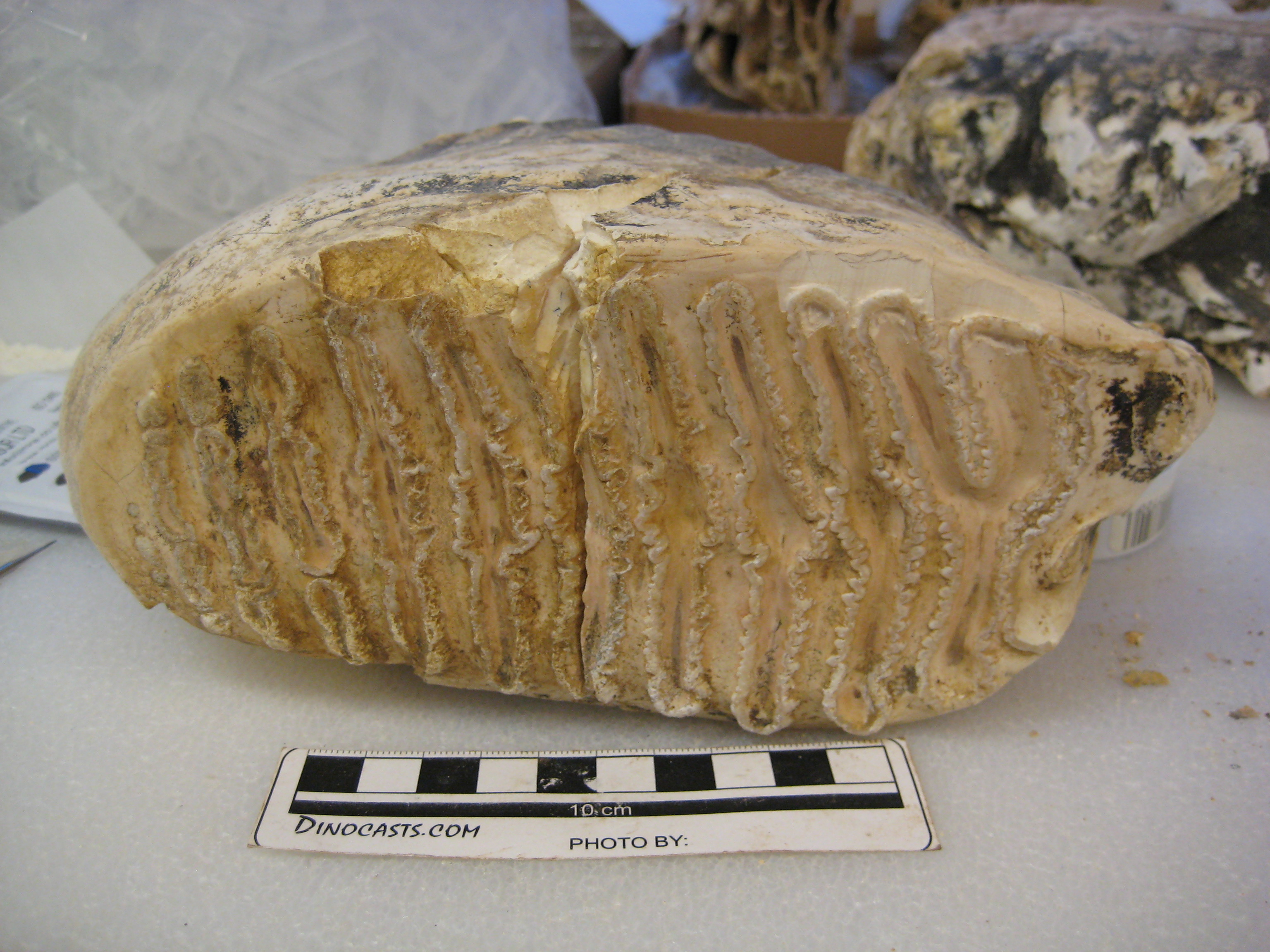
Mammoth M2 - occlusal surface
The crown (grinding surface) of the M2. Individual plates are visible.
Mammoth M3 - side view
Side view of the incompletely mineralized M3 of the mammoth. The individual plates are obvious and the roots are open.

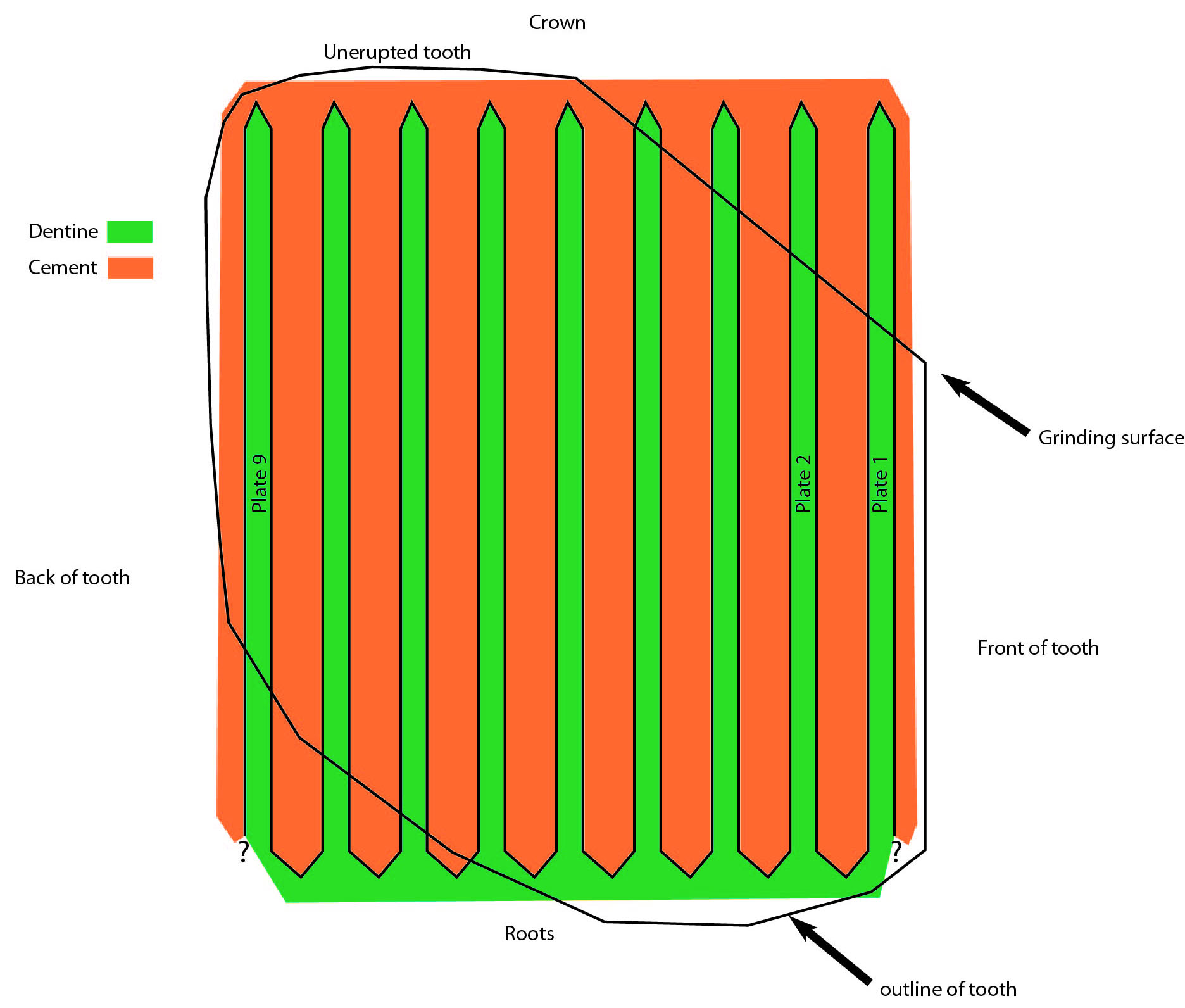
Mammoth teeth are a lot like modern elephant teeth. They grow in plates and have roots to accompany each plate. If one were to draw a schematic of the tooth in cross section (which conveniently, I have), it would look like this:

Schematic of a fully-mineralized mammoth tooth
The green is dentine; the orange is cementum. Note the relationship between the grinding surface and the plates. Also note the relationship between the roots and the plates.

So here’s the crazy thing. I started clearing the cementum off of the M2 to expose the dentine (as seen in the picture below), and discovered that it is not one-root-per-plate, but that the roots, once closed, span between two plates (see the schematic above).

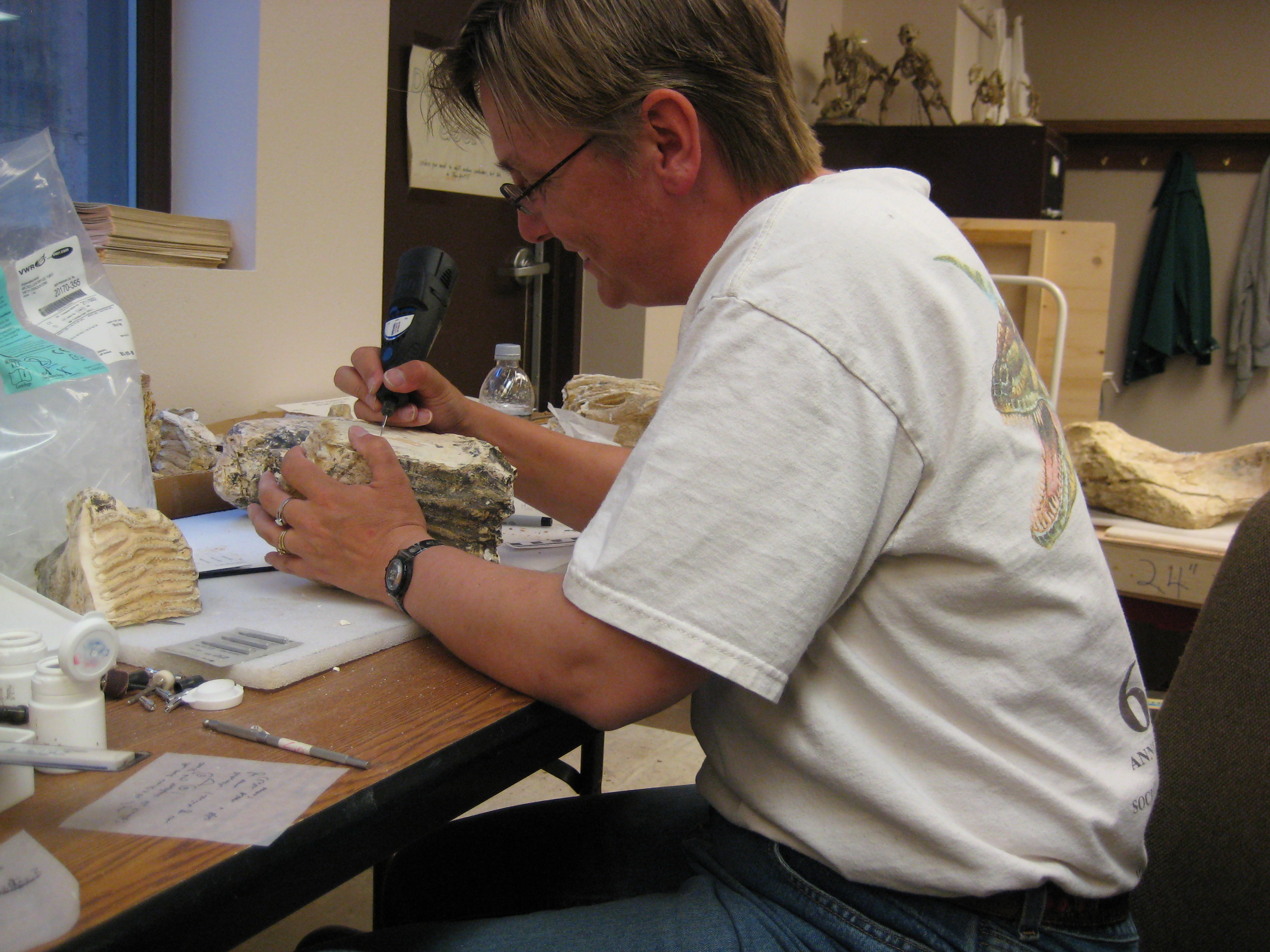
Penny doing work
Penny preparing the M2 for sampling.

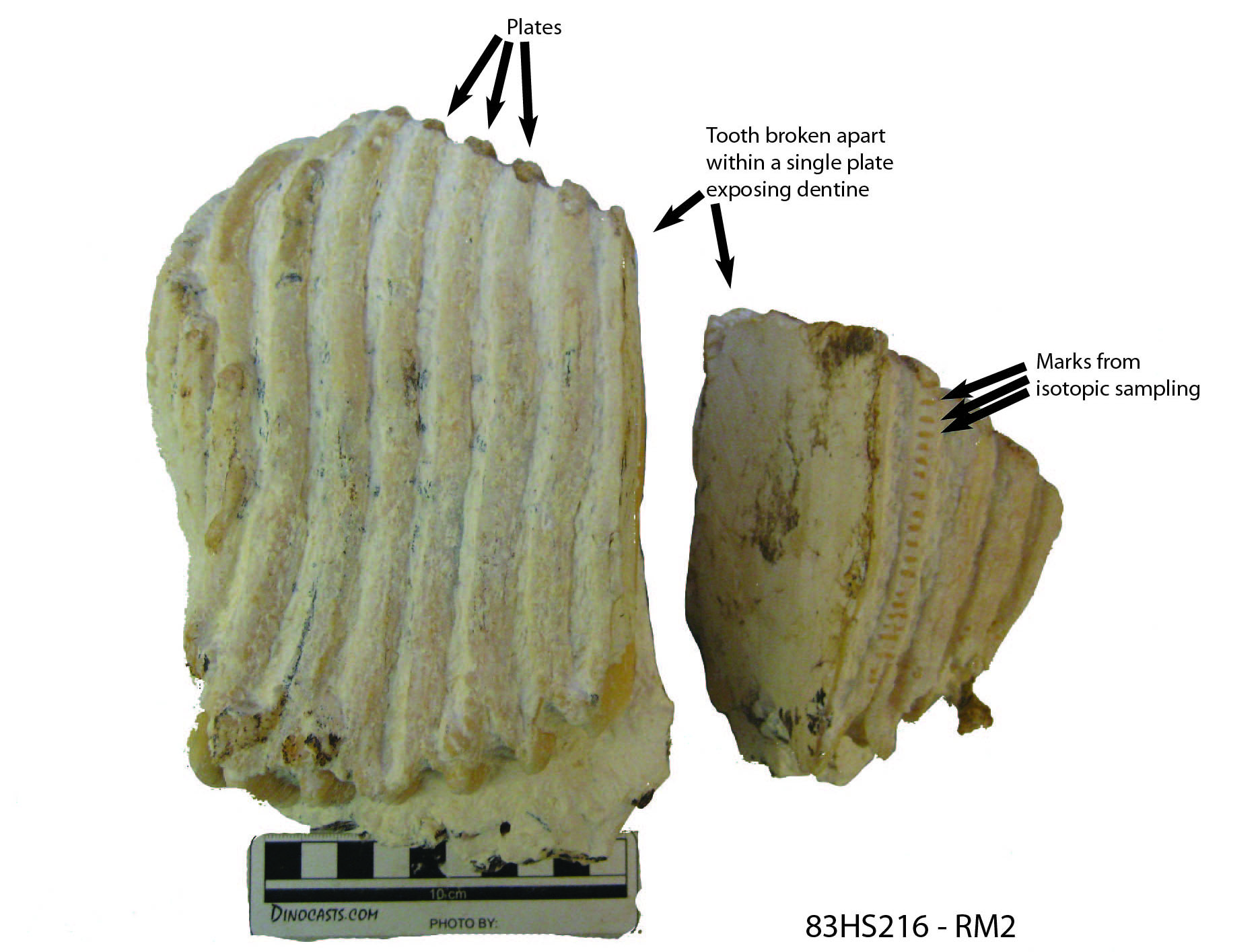
Our collective reaction was a resounding “Huh?” So we cleared all the cementum off of one side of the tooth to make sure we weren’t losing our minds. And this is what we saw:

Mammoth M2 - cementum removed
Once the cementum was removed, the relationship between the roots and the plates became obvious.

OK, so we’re still not much closer to understanding how mammoth – or elephant – teeth mineralize. But, using this M2, newly cleared of its cementum covering, we have begun the process of more detailed analysis. In the picture above, I’ve pointed out some sample pits for isotopic analysis. Well, remember what I said about the incremental growth of most ordinary mammal teeth. From crown to root, I said. Well, if that is true for this tooth, then we should see annual changes in the isotopic (geochemical) composition of the plate enamel as we move from crown to root. We see this in all other mammal teeth (and, like I said, I’ll explain that better in a later post). A correlary to that, is that we should see the SAME pattern from crown to root on EVERY plate if the mineralization pattern is always crown to root.

But what if it’s different? Since these teeth come in conveyor-belt fashion, and begin to wear at one end first, then maybe they mineralize one plate at at time, starting at the front. In that case, we wouldn’t expect to see any geochemical change from crown to root on any given plate, but might see a change from plate to plate. And of course, there’s the third hypothesis, that the mineralization front is at some angle with respect to the plates – maybe aligned with the grinding surface itself.

How do we do this? Lots and lots of isotopic samples. When that photo (above) was taken, I had only sampled plate 5. Now I’ve sampled plates 5, 6, 7, and 8, and I continue to sample whenever I can (usually while watching episodes of the Tudors on Netflix). Analyses are on-going. The results so far are interesting, but I can’t say much more. Stay tuned…

**************

Added August 30, 2012:

The conclusions of this study will be presented at the Society of Vertebrate Annual Meeting, in Raleigh, South Carolina on October 18, 2102:

Penny Higgins, Olga Potapova, and Larry Agenbroad: MINERALIZATION OF MAMMOTH MOLARS

Presented THURSDAY afternoon, OCTOBER 18, 2012

Poster session 2, Poster number 6

And now for something completely different…

This recent post reminds me that I ought to be using this blog for good, not just for shameless self-promotion (although self-promotion can be fun). I need to promote science, its importance and utility. And, of course, how fun it is!

So I think I’ll start adding blog entries about my current research, what it is, and why it matters. Anyone interested?

Current projects include:

  • Body temperature in giant ground sloths. (You can do that?)
  • Paleobiology and dietary preferences of giant (1000 kg) rodents in South America. (Yes, Rodents of Unusual Size do exist!)
  • Tooth mineralization patterns and their relationship to diet in notoungulates (extinct endemic mammals from South America).
  • Continental environmental change associated with rapid global warming at the Paleocene-Eocene boundary (55 million years ago).
  • Late Cretaceous vertebrates from Axel Heiberg Island. (yeah, in the Arctic)
  • Less-is-more: Using bulk isotopic analysis from tooth enamel of fossil mammals to predict yearly patterns of temperature and precipitation.
  • Mid-Paleocene mammals and reptiles, and species turnover due to climate change 60-ish million years ago
  • Cheek tooth (molar) mineralization patterns in mammoths. (Everyone uses tusks! <eyes rolling>)

If you’re interested in any of these things, let me know, and I’ll write about them. I can also write about day-to-day life as an non-tenure-track isotope geochemist, in a rigorous research-heavy earth-sciences department.

Let me know!

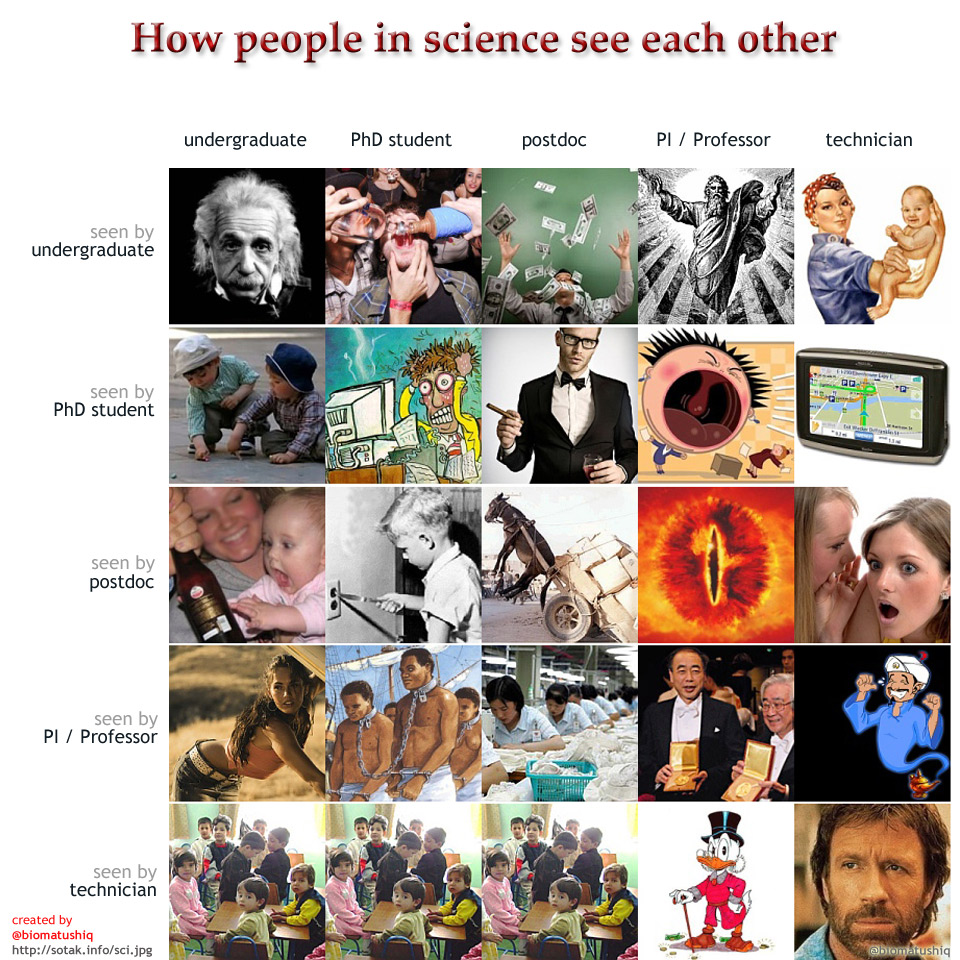
How Scientists See Each Other

This image has turned up in several places now. I first saw it on Facebook, linked to PZ Myers’ blog, Pharyngula. The thing of it is, this portrays quite well how we in the sciences look on each other. The best part, though, is Chuck Norris. You see, I’m in the category of ‘Technician,’ and that is totally how I view myself!