Not All Joints Are Flexible – #365papers – 2017 – 89

#365papers for March 30, 2017

Bailleul and Holliday, 2017, Joint histology in Alligator mississippiensis challenges the identification of synovial joints in fossil archosaurs and inferences of cranial kinesis: Proceedings of the Royal Society B, v. 284: 20170038

What’s it about?

In the past, when paleontologists have observed joints between bones, especially in the skull, that possess smooth surfaces, an assumption as been made that these joints are flexible. Flexible joints in the skull result in cranial kinesis, where the head can be deformed as exemplified by modern snakes as they consume prey much larger than their own heads. The authors show, through study of modern alligator skulls, that smooth joint surfaces don’t necessarily mean that a joint was movable, and that detailed study of the structure of the bone itself is needed to know if a joint could bend or not.Continue reading “Not All Joints Are Flexible – #365papers – 2017 – 89”

Telling the Boys from the Girls in Fossils – #365papers – 2017 – 88

#365papers for March 29, 2017

Mallon, 2017, Recognizing sexual dimorphism in the fossil record: Lessons from nonavian dinosaurs: Paleobiology, DOI:10.1017/pab.2016.51

What’s it about?

In paleontology, we define species by what they look like. This can be problematic if males and females of one species look markedly different from one another. Some authors have claimed to see sexual dimorphism, the difference in shape between males and females in a species, based on size. Here, the author shows that it is essentially impossible with the fossil record to make such determinations.Continue reading “Telling the Boys from the Girls in Fossils – #365papers – 2017 – 88”

When Water Stopped the Dinosaurs – #365papers – 2017 – 87

#365papers for March 28, 2017

Getty, Aucoin, Fox, Judge, Hardy, and Bush, 2017, Perennial lakes as an environmental contol on theropod movement in the Jurassic of the Hartford Basin: Geosciences, v. 7, doi:10.3390/geosciences7010013

What’s it about?

This is a paper about dinosaur tracks. Specifically, it discusses how dinosaur tracks, when they all seem to go in the same direction, are used as evidence that dinosaurs traveled in herds. Here, they show that the reason why the dinosaurs were all going the same way has to do with a lake near by, and not that the dinosaurs were all traveling together.Continue reading “When Water Stopped the Dinosaurs – #365papers – 2017 – 87”

Reading the Fossil Record: Look at the Rocks – #365papers – 2017 – 86

#365papers for March 27, 2017

Matthews, Liu, and McIlroy, 2017, Post-fossilization processes and their implications for understanding Ediacaran macrofossil assemblages; in Brasier, McIlroy, and McLoughlin, eds, Earth System Evolution and Early Life: a Celebration of the Work of Martin Brasier: Geological Society, London, Special Publication 448, 19 pp.

What’s it about?

Ediacaran fossils represent the oldest fossils of multicellular life, from between 580 and 541 million years ago (the Ediacaran Period). This paper discusses how the preservation of the fossils – the rock processes of deposition, erosion, deformation etc – affect our interpretations of the organisms.Continue reading “Reading the Fossil Record: Look at the Rocks – #365papers – 2017 – 86”

Some New Mammals from Ancient New Mexico – #365papers – 2017 – 85

#365papers for March 26, 2017

Williamson, Brusatte, Secord, and Shelley, 2016, A new taeniolabidoid multituberculate (Mammalia) from the middle Puercan of the Nacimiento Formation, New Mexico, and a revision of taeniolabidoid systematics and phylogeny: Zoological Journal of the Linnean Society, v. 177, p. 183-208.

What’s it about?

This paper discusses a group of large multituberculates that lived during the Paleocene (approximately 66 – 55 million years ago). Multituberculates, alas, are extinct, but resembled rodents in many ways. They were distinguished by their multi-cusped teeth (that looked a little like Legos) and blade-like premolars.

The right upper fourth premolar of Ptilodus gnomus. Notice the rows of pointed cusps, characteristic of multituberculates.
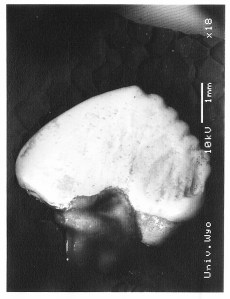
SEM image of the type specimen of the multituberculate Fractinus palmorem UW 27063 from locality V-90043. This is the blade-like tooth that is also common to multituberculates.

Taeniolabidoids would have been squirrel to marmot sized – as a group much larger than most other multituberculates.Continue reading “Some New Mammals from Ancient New Mexico – #365papers – 2017 – 85”

Evolving Teeth with Single Genes – #365papers – 2017 – 84

#365papers for March 25, 2017

Harjunmass, Seidel, Kakkinen, Renvoise, Corfe, Kallonen, Zhang, Evans, Mikkola, Salazar-Ciudad, Klein, and Jernvall, 2017, Replaying evolutinary transitions from the dental fossil record: Nature, v, 512, p. 44-48.

What’s it about?

This paper considers the complex shape of rodent molars. They show through gene manipulation how the complex rodent tooth came from a simpler, basic mammal shape. All that was required was to change the timing and duration of a single gene.Continue reading “Evolving Teeth with Single Genes – #365papers – 2017 – 84”

Who Did It First? Sponges or Comb Jellies? #365papers – 2017 – 83

#365papers for March 24, 2017

Simion, Philippe, Baruain, Jager, Richter, Di Franco, Roure, Satoh, Queinnec, Ereskovsky, Lapebie, Corre, Delsuc, King, Worheide, and Manuel, 2017, A large and consistent phylogenomic dataset supports sponges as the sister group to all other animals: Current Biology, http://dx.doi.org/10.1016/j.cub.2017.02.031

What’s it about?

There is interest in which, of the most simple multicellular animals that live today, were the first to appear. Which are the most primitive? Which are ancestral to all other multicellular animals? Sponges and comb jellies are the simplest, most primitive animals alive today. Which came first? This paper provides new results suggesting sponges came first.Continue reading “Who Did It First? Sponges or Comb Jellies? #365papers – 2017 – 83”

Are Photos Enough to Name a Species – #365papers – 2017 – 82

#365papers for March 23, 2017

Garraffoni and Frietas, 2017, Photos belong in the taxonomic Code: Science, v 355, p. 805

Gutierrez and Pine, 2017, Specimen collection crucial to taxonomy: Science, v. 355, p. 1275.

What’s this about?

The International Code for Zoological Nomenclature lays out the requirements for naming a new species of animal. Included in this this the requirement of a preserved specimen Ithe type) to be kept at a museum for reference. Garraffoni and Frietas argue that for specimens that don’t preserve well (that is, they break down and can’t be effectively studied after preservation), that a photograph or photographs should stand in instead of a preserved specimen. Gutierrez and Pine argue back that even if a specimen is reduced to goo, it should still be required if only for the possibility of DNA preservation.Continue reading “Are Photos Enough to Name a Species – #365papers – 2017 – 82”

Everything You Know About Dinosaurs Is Wrong – #365papers – 2017 – 81

#365papers for March 22, 2107

Baron, Norman, and Barrett, 2017, A new hypothesis of dinosaur relationships and early dinosaur evolution: Nature, v. 543, p. 501-506.

What’s it about?

Every person who has learned much about dinosaurs knows that dinosaurs are divided into two groups: the saurischians (lizard-hipped) and the ornithischians (bird-hipped). They also know that modern birds are actually saurischians dinosaurs, not ornithischians like you would think.

Now, based on what these authors have found, every person who knows the above things are now WRONG.Continue reading “Everything You Know About Dinosaurs Is Wrong – #365papers – 2017 – 81”

Birth of the Amazon River – #365papers – 2017 – 80

#365papers for March 21, 2017

Hoorn, Bogota-A, Romero-Baez, Lammertsma, Flantua, Dantas, Dino, Carmo, and Chemale, 2017, The Amazon at sea: Onset and stages of the Amazon River from a marine record, with special reference to Neogene plant turnover in the drainage basin: Global and Planetary Change.

What’s it about?

The authors of this paper use data from an ocean core collected in the delta of the Amazon River to determine when the Amazon River began to deposit sediments into the ocean and also when it began to carry sediments all the way from the Andes Mountains.Continue reading “Birth of the Amazon River – #365papers – 2017 – 80”