
How Best Can We Ferment Sugar and Starch to Make Ethanol? – #365papers – 2017 – 112

#365papers for April 22, 2017

Bai, Anderson, and Moo-Young, 2008, Ethanol fermentation technologies from sugar and starch feedstocks: Biotechnology Advances, v. 26, p. 89-105.

What’s it about?

This paper compares in detail the fermentation capabilities of two different microorganisms, Saccharomyces cerevisiae (yeast) and Zymomonas mobilis (bacteria) for making ethanol from organic materials. Each have their pros and cons, thought it appears that overall Saccharomyces is the better alternative.

The authors also discuss challenges with the fermentation process, especially with obtaining a pure resultant ethanol while maintaining a healthy population of microorganisms.Continue reading “How Best Can We Ferment Sugar and Starch to Make Ethanol? – #365papers – 2017 – 112”
How Best Can We ‘Grow’ Ethanol? – #365papers – 2017 – 111

#365papers for April 21, 2017

Sanchez and Cardona, 2008, Trends in biotechnological production of fuel ethanol from different feedstocks: Bioresource Technology, v. 99, p. 5270-5295.

What’s it about?

This paper a review paper summarizing all the various sources of bioethanol (derived from crops) and the methods for obtaining that ethanol.Continue reading “How Best Can We ‘Grow’ Ethanol? – #365papers – 2017 – 111”

Ethanol Can Help – #365papers – 2017 – 110

#365papers for April 20, 2017

Farrell, Plevin, Turner, Jones, O’Hare, and Kammen, 2006, Ethanol can contribute to energy and environmental goals: Science, v. 311, p. 506-508.

What’s it about?

An important question about producing ethanol from crops is whether or not the energy costs of production outweigh the energy gained from the ethanol produced. The authors here take six previous studies that had very different results and come up with a means to compare them. In doing so, they are able to show where ethanol can, in fact, yield greater energy than it costs to produce.Continue reading “Ethanol Can Help – #365papers – 2017 – 110”

Biofuels for Our Engines – #365papers – 2017 – 109

#365papers for April 19, 2017

Agarwal, 2007, Biofuels (alcohols and biodiesel) applications as fuels for internal combustion engines: Progress in Energy and Combustion Science, v. 33, p. 233-271.

What’s it about?

This lengthy paper is a summary of the types of biofuels (that is liquid fuels produced from crops) that can replace ethanol and diesel in common engines used for transportation and agriculture. It goes into the sources of such fuels, some of the mechanisms to make the fuels, and efficiencies.Continue reading “Biofuels for Our Engines – #365papers – 2017 – 109”

Isostylomys: A Rodent of Unusual Size – #365papers – 2017 – 107

#365papers for April 17, 2017

Rinderknecht, Bostelmann, annd Ubilla, 2017, Making a giant rodent: cranial anatomy and ontogenetic development in the genus Isostylomys (Mammalia, Hystricognathi, Dinomyidae): Journal of Systematic Palaeontology, DOI: 10.1080/14772019.2017.1285360.

What’s it about?

Isostylomys is (was) a giant rodent from the Miocene of Uruguay. By giant, I mean larger than the largest rodent today. I mean huge.

The authors here discuss the status of the genus and its relationships with other rodents. Importantly, they show how it is very possible that some species of South American large rodents might be juvenile forms of giant rodents like Isostylomys.Continue reading “Isostylomys: A Rodent of Unusual Size – #365papers – 2017 – 107”

The Shortest-Necked of the Long-Necked Elasmosaurs – #365papers – 2017 – 108

#365papers for April 18, 2017

Serratos, Druckenmiller, and Benson, 2017, A new elasmosaurid (Sauropterygia, Plesiosauria) from the Bearpaw Shale (Late Cretaceous, Maastrichtian) of Montana demonstrates multiple evolutionary reduction of neck length within Elasmosauridae: Journal of Vertebrate Paleontology e1278608.

What’s it about?

Elasmosaurids were marine reptiles that are considered a sub-group of the plesiosaurs. Distinctive features of elasmosaurids are their very long necks and small heads. Here, a new species of elasmosaurid is described that had a relatively short neck and was also fairly small.Continue reading “The Shortest-Necked of the Long-Necked Elasmosaurs – #365papers – 2017 – 108”

What Really Is Ichthyosaurus? – #365papers – 2017 – 106

#365papers for April 16, 2017

Massare and Lomax, 2017, A taxonomic reassessment of Ichthyosaurus communis and I. intermedius and a revised diagnosis for the genus: Journal of Systematic Paleontology. DOI: 10.1080/14772019.2017.1291116.

What’s it about?

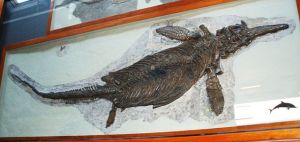
Ichthyosaurus is (or was) a type of marine reptile that looked sort of dolphin-like.

Ichthyosaurus communis from the Natural History Museum in London. Credit Gehdoghedo CC 3.0 By SA
Ichthyosaurus communis life reconstruction.
Credit: Nobu Tamura CC BY 3.0

Here, the authors work to distinguish between three common species of Ichthyosaurus, I. communis, I. intermedius, and I. breviceps. The authors also present a better definition for the genus Ichthyosaurus.Continue reading “What Really Is Ichthyosaurus? – #365papers – 2017 – 106”

Body Size, Metabolic Rate, and Body Temperature in Giant Sloth Evolution – #365papers – 2017 – 105

#365papers for April 15, 2017

Toldeo, Bargo, Vizcaino, Iuliis, and Pujos, 2017, Evolution of body size in anteaters and sloths (Xenarthra, Pilosa): phylogeny, metabolism, diet and substrate preferences: Earth and Environmental Science Transaction of the Royal Society of Edinburgh, v. 106, p. 289-301.

What’s it about?

Modern sloths are tiny, tree-dwelling herbivores that dangle below the branches and move very, very slowly. However, in the past, there were enormous sloths that ranged across the landscape.

This paper discusses both anteaters and sloths, the modern components of which have adaptations for eating diets of low nutrition. The fossil record of both closely related groups are studied, and the relationships between great size and inferred metabolic rate and diets are considered.Continue reading “Body Size, Metabolic Rate, and Body Temperature in Giant Sloth Evolution – #365papers – 2017 – 105”

Who (or What) is Procerberus – #365papers – 2017 – 104

#365papers for April 14, 2017

Clemens, 2017, Procerberus (Cimolestidae, Mammalia) from the latest Cretaceous and earliest Paleocene of the northern western interior, USA: Paleobios, v. 34.

What’s it about?

Procerberus is a genus of mammal that lived mostly just after the extinction of the dinosaurs. There is some confusion about the distinctions among the several species of Procerberus and the relationship of this genus to other groups of mammals. This paper is about sorting that all out.Continue reading “Who (or What) is Procerberus – #365papers – 2017 – 104”

Air Sacs and Uniquely Hollow Bones in a New Sauropod – #365papers – 2017 – 103

#365papers for April 13, 2017

Ibiricu, Lamanna, Martinez, Casal, Cerda, Martinez, and Salgado, 2017, A novel form of postrcranial skeletal pneumaticity in a sauropod dinosaur: Implications for the paleobiology of Rebbachisauridae: Acta Palaeontologica Polonica.

What’s it about?

In birds, dinosaurs, and some other archosaurs (includes crocodilians) there are often hollow spaces in bones that are connected to the respiratory system. The hollowness of bones is called pneumaticity. The authors here describe the bones of a recently described species Katepensaurus goicoecheai. Katepensaurus shows a style of pneumaticity that is not seen in any other dinosaurs.Continue reading “Air Sacs and Uniquely Hollow Bones in a New Sauropod – #365papers – 2017 – 103”