Studying mammal teeth is an interesting process. Mammals are unique in that many species can be identified by the shape of the teeth alone. Continue reading “Working with Mammal Teeth”
Category Archives: Paleontology
The Breaks local fauna and North American Land Mammal “ages”
Many years ago, I wrote a dissertation. That was the final step toward my ultimate goal of becoming a ‘real’ paleontologist. My research was strictly biostratigraphy: putting rocks and fossils in order by age from oldest to youngest. Specifically, I was looking at mammal fossils from the middle of the Paleocene, about 60 million years ago.Continue reading “The Breaks local fauna and North American Land Mammal “ages””
Friday Headlines: 3-8-13
Friday Headlines, March 1, 2013
THE LATEST IN THE GEOSCIENCESContinue reading “Friday Headlines: 3-8-13”
Friday Headlines: 3-1-13
Friday Headlines, March 1, 2013
THE LATEST IN THE GEOSCIENCESContinue reading “Friday Headlines: 3-1-13”
Friday Headlines: 2-22-13
Friday Headlines, February 22, 2013
THE LATEST IN THE GEOSCIENCES
The Paleocene-Eocene Thermal Maximum – Is Modern Global Warming Anything to Worry About?
There are lots of names for it, some good, some bad: Climate Change, Global Warming, Climate-gate, The Climate Hoax. Unless you’ve had your head in the sand, you’ve heard at least one of these things. You know that there is a lot of talk about how every year seems to be warmer than the last – “the warmest on record” – and that there have been a lot of wacky weather phenomena of late, including Hurricane Sandy, heat waves in Australia and Europe, massive wildfires in the western United States. Some reports are pretty alarmist, while others claim that these are merely coincident anomalies that we only know of due to more complete modern measuring techniques and records. Some say that the Earth is warming at an alarming rate and we need to prepare for a “The Day After Tomorrow” type scenario, while others say that we have no need to worry and that it’s all hype. And really, how bad can one or two degrees of temperature increase be?
If you’ve read other posts of mine, you probably know where I stand on this. For this post, my views on the legitimacy of modern global warming are irrelevant. What I want to address here is not whether warming is occurring, but what would happen if those noisy scientists are right and we are heading toward a warmer Earth? What could the possible outcomes of a few degrees of warming be? There are models, of course, all mathematical and computerized, that show where things will get wetter or drier and such, but let’s think about something more real.
What if the hype is correct and we are warming? What will happen if we do nothing to mitigate it?
The fossil record provides an opportunity to look at past climate changes and see what effects these changes had on the animals that were alive during that time. The fossil record shows that there have been multiple episodes of global warmth in Earth’s history, much warmer than is projected as a possible outcome of today’s warming. But being warm and warming rapidly are two different things. Gradual warming occurs slowly enough that organisms can adapt. But modern warming is occurring within a single to just a few generations of animals, much too quickly for adaptation to occur. What happens then?
Does the fossil record capture any past episodes of rapid global warming? If so, what happened?
The short answer is ‘yes,’ and it was bad news for many animal groups.
The specific example I will use is the Paleocene-Eocene Thermal Maximum (PETM). This is an episode of global warming that occurred about 55 million years ago (about 10 million years after the dinosaurs went extinct). The entire PETM lasted 150,000 to 200,000 years, with the warming occurring over the span of about 10,000 years. Depending on what you read, the warming was between 5-9° Celsius (9-16° F). Compare that with modern projections of warming of 4° Celsius (or more) in a few hundred years. Warming rates are much faster today than they were at the PETM, and rates at the PETM were much, much faster than most other rates of climate change recorded in the rock record.
The warming associated with the PETM is particularly interesting for two reasons. 1) It’s thought that the warming was due to an increase in carbon dioxide in the Earth’s atmosphere, much like today’s warming. 2) Mammals were around then, and the dominant large-bodied animals living on land. We can look at the record of change in mammals at the PETM as an analogue for what might happen if modern global warming is ‘true.’
So, what happened?

The chart above shows a lot of things. It was published in 2003 in Geological Society of America Special Paper 369. It is available here, from Philip Gingerich’s personal web page focusing on his research on the PETM. I suggest reading the entire paper to get the full context, but for the sake of this post focus only on the columns on the right hand side. There are two columns labeled ‘stable isotopes,’ and a series columns (some highlighted in green and others in red) that represent the stratigraphic ranges of specific vertebrate groups. The heavy red line marks the Paleocene-Eocene boundary, and the box in the stable isotope column encloses the isotopic evidence of the PETM – a negative spike in carbon isotopes and a positive spike in oxygen isotopes. It is the positive spike in oxygen that provides the evidence of warming. The negative spike in carbon provides information about the source of the warming (carbon dioxide in the atmosphere). The details of how the isotopes provide such information is a topic for a different blog post.
Focus now on the highlighted vertebrate groups. In green are the Plesiadapidae. Plesaidapids are a group of mammals thought be closely related to modern primates. They go extinct at the Paleocene-Eocene boundary. Modern primates, highlighted in red, appear after the Paleocene-Eocene boundary. It’s possible, then, the the PETM, was responsible for the extinction of the the plesiadapids and appearance of modern primates. Perhaps one evolved into the other, we are not sure at this point, but the loss of one and appearance of the other coincides with the PETM.
You also see, highlighted in red, the first appearance of the groups Perissodactyla and Artiodactyla. These are all the modern hoofed mammals. (Perissodactyla includes horses, rhinos, and tapirs. Everything else is in the Artiodactyla.) It is the appearance of the first perissodactyl, Sifrippus (also called Hyracotherium or Eohippus) that defines the beginning of the Wasatchian North American Land Mammal “age” which is thought to be coincident with the Paleocene-Eocene boundary. Prior to the PETM, there were no true hoofed mammals, though it’s though that the ancestors to perissodactyls and artiodactyls could be found in a group of mammals loosely called the condylarths. Condylarths dwindled after the PETM, to be replaced by the recognizable, modern groups of mammals.
Thus it’s possible that rapid global warming at the Paleocene-Eocene boundary resulted in the rapid evolution of mammalian species, resulting in the loss of many groups that had previously been dominant, and their replacement with new groups. This is a big change. This is not an example of just a few species going extinct. We’re talking about entire orders of mammals here, including the Order Primates, of which we are a member.
Now consider again that warming at the PETM took place over several thousands of years. Modern global warming is occurring over several hundreds of years. If warming at the PETM forever altered mammalian history, what would modern global warming do? Perhaps we should think about this before we say that there’s no need to be concerned.
***UPDATE***
This post has been translated into Spanish by Jorge Moreno-Bernal, a student at the University of Nebraska-Lincoln. See the translation here. How cool is that?
An Interview with… me!
I was recently interviewed by Gary Vecchiarelli for a lovely website called Jersey Boys Hunt Dinosaurs. He was particularly interested in my take on the science of paleontology from the perspective of a geoscientist.
It was a fun little interview, and might be of interest to any budding paleontologists or folks just interested in what my scientific world is like. Read the interview here.
You should visit the Jersey Boys Hunt Dinosaurs website and/or follow them on Twitter.
Thanks Gary! That was fun!
What Does the Fossil Record Say About How Speciation Happens?
Below are the answers to a series of questions asked of me by a friend from way back in high school. His questions were interesting enough, that I thought I’d post the answers here. Other folks might be interested, too.
These answers come off the top of my head. I did not research them, so I might have a few details wrong. But the overall story should be about right.
—–
Could you give me an example of a lineage with an abundant fossil record that stretches over a very long period?Continue reading “What Does the Fossil Record Say About How Speciation Happens?”
Friday Headlines: 2-8-13
Friday Headlines, February 8, 2013
THE LATEST IN THE GEOSCIENCES
RICHARD III DIG: DNA CONFIRMS BONES ARE KING’S
The skeletal remains of King Richard III were found under a parking lot in Leicester.

They were identified in part by DNA (comparing it with known descendents of the King) and by skeletal features (Richard was known to have had scoliosis, resulting in a deformity of the backbones).

Of course all this resulted in a bunch of jokes, too.
Richard III officially announced as “1485 Hide and Seek Champion”
“Someone said they were going to build a carpark in Leicester. I said ‘over my dead body'” Richard III’s last words.
COMMON ANCESTOR OF MAMMALS IS PLUCKED FROM OBSCURITY
This title is a little mis-leading, in that what’s been found is thought to be the common ancestor of placental mammals – the mammals that are not marsupials nor egg-layers. Mammals, as fuzzy animals with three bones in the middle ear, had been around for millions of years before this common ancestor of placentals arose just after the Cretaceous-Tertiary extinction that wiped out the dinosaurs.
But that’s ok. We’re still talking about a little shrew-ish mammal that is ancestral to whales, elephants, squirrels, and man. It’s still an important critter.

The beast is called Protungulatum donnae. It’s called ‘obscure’ because it’s a rare little mammal that doesn’t have the ‘coolness’ factor to have even a colloquial or common name. I guess I deal in obscurities because I’ve known of Protungulatum for nearly 20 years. Gasp.
What makes this study unique is that the scientists involves used modern genetic information, plus morphological information to determine what, most likely, the common ancestor of placental mammals would be like. This study used 4500 different characters (traits, if you will, whether genetic or the presence or absence of a specific structure on a bone)! Such studies are difficult with 50 characters. 4500 means that they’ve covered their bases. It’s an impressive piece of work!
Tracks in the snow have a tale to tell
I have lost my muse today, so I just thought I’d post some interesting photos. This morning I saw a bunch of footprints in the snow in front of the kitchen window. Clearly something happened.

Here’s a slightly closer view.
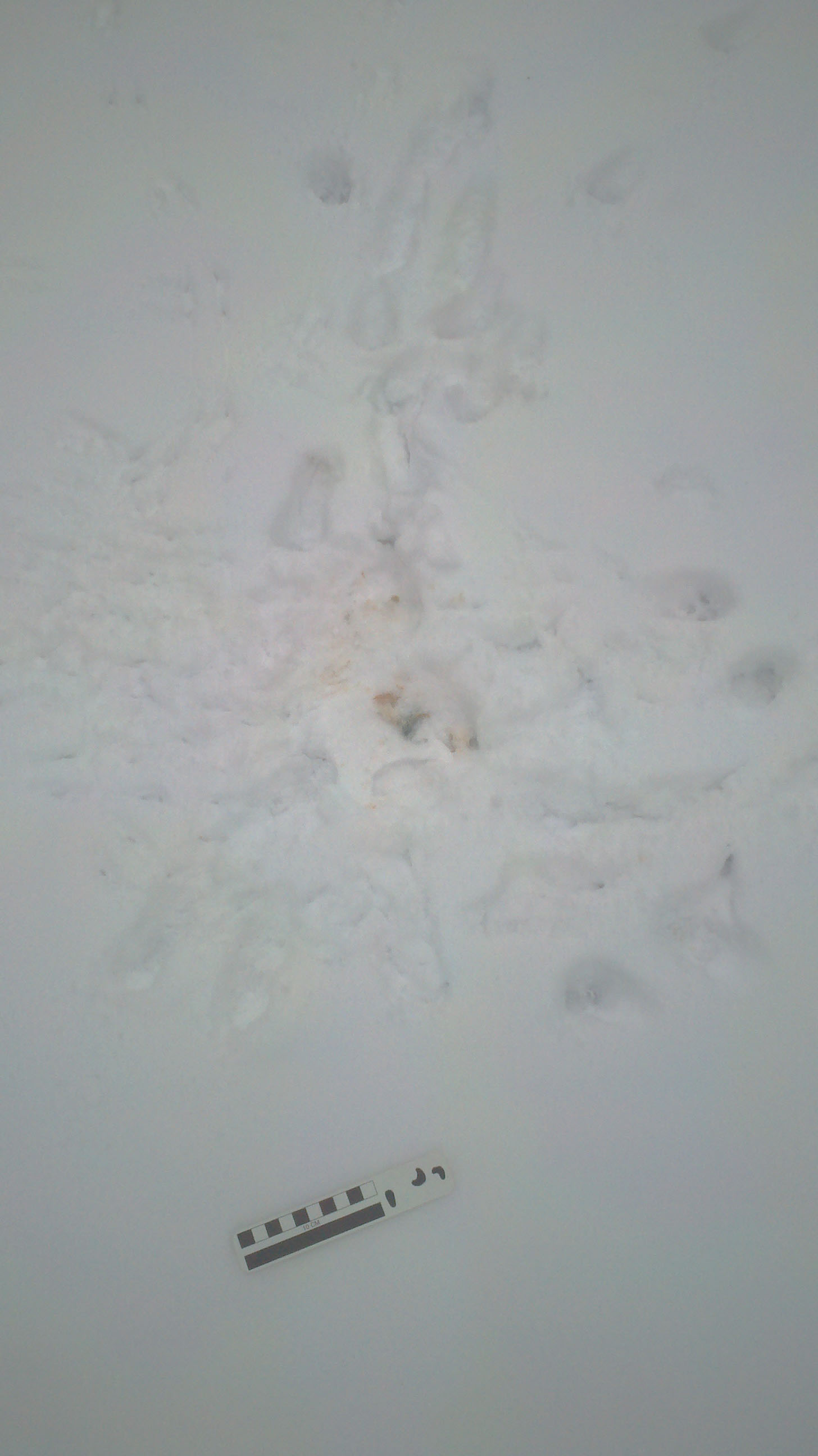
Here, I’ve labeled the tracks I recognized.

The study of tracks and trackways left by animals is called ichnology. Yes, people make a career of this kind of work. So, put on your ichnologist hat. What do you think the story is here?
 Penny Higgins - Storyteller • Artist • Scientist