After the Disaster: Ecological Succession 555 Million Years Ago – #365papers – 2017 – 100

#365papers for April 10, 2017 — The 100th paper for 2017!

Reid, Garcia-Bellindo, Payne, Runnegar, and Gehling, 2017, Possible evidence of primary succession in a juvenile-dominated Ediacara fossil surface from the Flinders Ranges, South Australia: Palaeogeography, Palaeoclimatology, Palaeoecology, v. 476, p. 68-76.

What’s it about?

The oldest fossils of multicellular organisms on Earth come from the Ediacara biota (575-541 million years ago). Such fossils are found globally, but were first described from the Flinders Ranges of South Australia.

The authors here describe a new locality in the Flinders Ranges that have many well-preserved Ediacaran fossils. Most of these fossils are smaller than the same species found at other localities. There is also an unexpected dominance of one species, Dickinsonia. This combined evidence suggests that this locality preserves an ecosystem that was developing not long after some environmental catastrophe. Thus, this is a primary successional fauna.Continue reading “After the Disaster: Ecological Succession 555 Million Years Ago – #365papers – 2017 – 100”

What’s in a Name? When Forstercooperia is Really Uintaceras – #365papers – 2017 – 99

#365papers for April 9, 2017

Holbrook and Lucas, 1997, A new genus of rhinocerotoid from the Eocene of Utah and the status of North American “Forstercooperia: Journal of Vertebrate Paleontology, v. 17, p. 384-396.

What’s it about?

A new genus of rhino-like mammal (Uintaceras) from the Eocene of the Uinta Basin is named. Previously, specimens from the Uinta Basin species have been called Forstercooperia, which is otherwise known from Asia. The authors describe a complete skull of Uintaceras which is clearly different from the Asian Forstercooperia. The molar teeth from both Forstercooperia and Uintaceras are not easily distinguished, which is why the Uinta Basin species was called Forstercooperia for so long.Continue reading “What’s in a Name? When Forstercooperia is Really Uintaceras – #365papers – 2017 – 99”

Highs and Lows of the Rocky Mountains in the Middle to Late Eocene – #365papers – 2017 – 97

#365papers for April 7, 2017

Fan, Constensius, and Dettman, 2017, Prolonged high relief in the northern Cordilleran orogenic front during middle and late Eocene extension based on stable isotope paleoaltimetry: Earth and Plantery Science Letters, v. 457, p. 376-384.

What’s it about?

The Rocky Mountains have been around for a long, long time. This study focuses on a part of the Rockies that was still growing between about 46 to about 34 million years ago. Through the study of fossil soils and fossil snails, the authors show that the difference between the lowest basins and the highest mountain peaks was around 4 km – which is a lot!Continue reading “Highs and Lows of the Rocky Mountains in the Middle to Late Eocene – #365papers – 2017 – 97”

G is for Grangeria – #AtoZChallenge – 2017 – Uintan Mammals

G is for Grangeria.

Grangeria is a large hoofed mammal closely related to horses that lived during the middle Eocene. Whether or not Grangeria is a valid name, or that members of Grangeria are better called Eomoropus is a topic of discussion in paleontology.

Nevertheless, Grangeria is a member of a group called chalicotheres, which were unusual hoofed mammals in that their front legs were proportionately very long, and they may have knuckle-walked like modern anteaters.

F is for Forstercooperia – #AtoZChallenge – 2017 – Uintan Mammals

F is for Forstercooperia

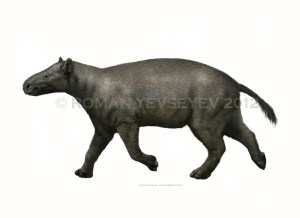
Forstercooperia is a rhinocerotid (a hoofed mammal closely related to rhinos) from the Eocene of Asia. Originally, this name was applied to a similar mammal from the Uinta Formation of Utah, but the Utahn specimens have since been renamed Uintaceras (“Uinta horn”)

Forstercooperia by Roman Yevseyev (on DeviantArt)

E is for Epihippus – #AtoZChallenge – 2017 – Uintan Mammals

E is for Epihippus.

Epihippus is a fossil horse. You know it’s a horse because of the ‘hippus’ in its name, which means ‘horse.’

These horses were smaller than modern horses and possessed four hoofed toes on its front legs and three hoofed toes on its back legs.

Epihippus gracilis. Credit: U.S. National Park Service.

A Little Giant from John Day – #365papers – 2017 – 96

#365papers for April 6, 2017

Mihlbachler and Samuels, 2016, A small-bodied species of Brontotheriidae from the middle Eocene Nut Beds of the Clarno Formation, John Day Basin, Oregon: Journal of Paleontology, v. 90, p. 1233-1244.

What’s it about?

This is a description of a new species of brontothere, giant rhino-like mammals from the middle Eocene (about 44 million years ago). This new species, Xylotitan, is actually small, as brontotheres go – only about the size of a modern tapir.Continue reading “A Little Giant from John Day – #365papers – 2017 – 96”

Tall Teeth and Grazing Diets – #365papers – 2017 – 94

#365papers for April 4, 2017

Feranec and Pagnac, 2017, Hypsodonty, horses, and the spread of C4 grasses during the middle Miocene in southern California: Evolutionary Ecology Research, v. 18, p. 201-223.

What’s it about?

Modern horses have very tall (hypsodont) teeth. This is thought to be an adaptation for grazing, because chewing grass wears down teeth faster than chewing the leaves off a tree.

A fossil horse tooth from Natural Trap Cave. The grinding surface is on the left. Only about 1/5 of this tooth stuck above the gum line.

Paleontologists use the height of the tooth (its hypsodonty) to distinguish animals that grazed from those that ate bushes, shrubs, and trees (called browsing).

Isotopically, grasses look different from leaves from bushes. This chemical difference gets recorded into teeth.

The authors use isotopes from early horses that are hypsodont to show that tall teeth are related to doing more grazing.Continue reading “Tall Teeth and Grazing Diets – #365papers – 2017 – 94”

D is for Diplobunops – #AtoZChallenge – 2017 – Uintan Mammals

D is for Diplobunops.

Diplobunops is a small hoofed mammal related to pigs. The group of mammals that contains Diplobunops and other related species is loosely referred to as oreodonts.

Diplobunops matthewi (Peterson, 1919) – fossil mammal skeleton from the Eocene of Utah, USA. (CM 11801, Carnegie Museum of Natural History, Pittsburgh, Pennsylvania, USA)

C is for Colodon – #AtoZChallenge – 2017 – Uintan Mammals

C is for Colodon.

The genus Colodon made its first appearance in the Uintan. It is a type of hooved mammal most closely related to modern tapirs.

You can read more about Colodon here:

Colbert, 2005, The Facial Skeleton of the Early Oligocene Colodon (Perissodactyla, Tapiroidea): Palaeontologia Electronica, v. 8.