M is for Macrotarsius – #AtoZChallenge – 2017 – Uintan Mammals

M is for Macrotarsius

Macrotarsius is a fossil primate closely related to and similar in appearance to modern tarsiers.

Philippine Tarsier (Carlito syrichta), one of the smallest primates. This one is about 5 inches long with a tail longer than its body. Photo taken in Bohol, Philippines. Credit: mtoz CC 2.0 By SA

Modern tarsiers are unique in the structure of their back foot, specifically the ankle bones (the tarsals), hence their common name of ‘tarsier.’


L is for Leptotragulus – #AtoZChallenge – 2017 – Uintan Mammals

L is for Leptotragulus

Leptotragulus was a hoofed mammal that would have roughly looked like a deer, but were more closely related to camels and llamas. They were a member of a group called the Protoceratidae, that were unique in having horns on their snouts.

Here is a relative of Leptotragulus, Synthetoceras:

Synthetoceras tricornatus. Credit: Nobu Tamura CC 3.0 By


Who (or What) is Procerberus – #365papers – 2017 – 104

#365papers for April 14, 2017

Clemens, 2017, Procerberus (Cimolestidae, Mammalia) from the latest Cretaceous and earliest Paleocene of the northern western interior, USA: Paleobios, v. 34.

What’s it about?

Procerberus is a genus of mammal that lived mostly just after the extinction of the dinosaurs. There is some confusion about the distinctions among the several species of Procerberus and the relationship of this genus to other groups of mammals. This paper is about sorting that all out.Continue reading “Who (or What) is Procerberus – #365papers – 2017 – 104”

Air Sacs and Uniquely Hollow Bones in a New Sauropod – #365papers – 2017 – 103

#365papers for April 13, 2017

Ibiricu, Lamanna, Martinez, Casal, Cerda, Martinez, and Salgado, 2017, A novel form of postrcranial skeletal pneumaticity in a sauropod dinosaur: Implications for the paleobiology of Rebbachisauridae: Acta Palaeontologica Polonica.

What’s it about?

In birds, dinosaurs, and some other archosaurs (includes crocodilians) there are often hollow spaces in bones that are connected to the respiratory system. The hollowness of bones is called pneumaticity. The authors here describe the bones of a recently described species Katepensaurus goicoecheai. Katepensaurus shows a style of pneumaticity that is not seen in any other dinosaurs.Continue reading “Air Sacs and Uniquely Hollow Bones in a New Sauropod – #365papers – 2017 – 103”

Skulls and Brains of Early Mammalian Ancestors – #365papers – 2017 – 102

#365papers for April 12, 2017

Araujo, Fernandez, Polcyn, Frobisch, and Martins, 2017, Aspects of gorgonopsian paleobiology and evolution: insights from the basicranium, occiput, osseous labyrinth, vasculature, and neuroanatomy: PeerJ 5:e3119; DOI:10.7717/peerj.3119

What’s it about?

Gorgonopsians were land-dwelling vertebrates that existed early on along the lineage that eventually gave rise to mammals and to us. They did not yet possess classically mammalian features, in particular the structure of the middle ear, but they did share in common with us a skull shape called synapsidy. This feature distinguishes all mammals and their ancestors from other ‘reptiles’ like dinosaurs, lizards, snakes, and turtles, as well as birds.

The authors of this paper used Propagation Phase Contrast Synchrotron Radiation-based micro-Computed Tomography (a technique a little like a CAT-scan or an MRI) to examine two fossil gorgonopsian skulls. With this method, they were able to essentially take apart the bones of the skull and study their relationships. They were also able to look at the shape of the brain itself, as well as determining where the major blood vessels went and examine the structure of the inner ear.Continue reading “Skulls and Brains of Early Mammalian Ancestors – #365papers – 2017 – 102”
Before Long Snouts: An Early Phytosaur – #365papers – 2017 – 101

#365papers for April 11, 2017

Stocker, Zhao, Nesbitt, Wu, and Li, 2017, A short-snouted, Middle Triassic phytosaur and its implications for the morphological evolution and biogeography of Phytosauria: Nature Scientific Reports, 7:46028, DOI:10.1038/srep46028

What’s it about?

Phytosaurs are crocodile-looking marine reptiles from the Miocene. They are unique in having a long snout with the nares (nose openings) on the top of the skull, rather than on the tip of the snout. Here, a new phytosaur is described that has a short snout and the nares aren’t on the top of the head. It’s definitely a phytosaur due to other diagnostic skeletal features of the skull and limbs, and appears to represent an early stage of evolution where the characteristic snout and nostril position are not yet developed.Continue reading “Before Long Snouts: An Early Phytosaur – #365papers – 2017 – 101”

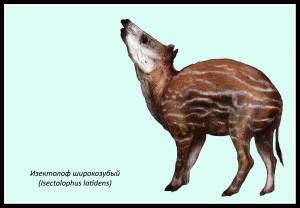
I is for Isectolophus – #AtoZChallenge – 2017 – Uintan Mammals

I is for Isectolophus

Isectolophus is another hoofed mammal. There seem to have been many in the middle Eocene. (The reality is that it’s probably a collection bias – hoofed mammals are bigger and easier for paleontologists to spot than little rodents and primates and things, but that’s a different story.)

Isectolophus is most closely related to modern tapirs.

Isectolophus litidens

H is for Harpagolestes – #AtoZChallenge – 2017 – Uintan Mammals

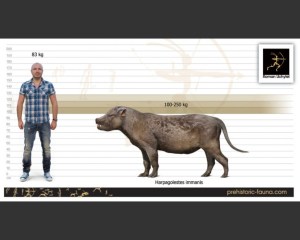
H is for Harpagolestes

So far, every fossil I’ve talked about has been a large, hoofed mammal. Well, something has to eat all those herbivores.

Thus enter Harpagolestes.

Harpagolestes immanis. Credit: Ryan Somma

Harpagolestes was a bear-sized, hyena-like mesonychid carnivore. For a long time, scientists thought that mesonychid carnivores were the ancestors of modern whales due to similarities in the teeth. (New analyses put whales more closely related to hoofed mammals.)

Harpagolestes immanis by Roman Uchytel