S is for Smilodectes
 Smilodectes is an extinct primate that lived in North America during the Eocene.

Credit: Ryan Somma CC 2.0 By-SA
Penny Higgins - Storyteller • Artist • Scientist
Combining Science and Joyful Creativity
S is for Smilodectes
Smilodectes is an extinct primate that lived in North America during the Eocene.
R is for Reithroparamys
 Reithroparamys is another extinct rodent from North America. Species of this genus ranged from the late Paleocene into the mid-Eocene. Four species are known from this genus.
Q is for Quadratomus
 Quadratomus is an Eocene rodent. There are four species within this genus all of which lived in North America.
P is for Protylopus
 Protylopus is an extinct type of camel that lived from the middle to late Eocene in North America. It is the oldest known camel.

O is for Ourayia
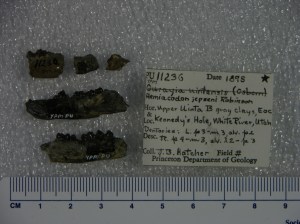
 Ourayia is a fossil primate, which, like Notoparamys, is related to tarsiers. Like many fossil mammals, it is best known for its teeth.
#365papers for April 17, 2017
What’s it about?
Isostylomys is (was) a giant rodent from the Miocene of Uruguay. By giant, I mean larger than the largest rodent today. I mean huge.
The authors here discuss the status of the genus and its relationships with other rodents. Importantly, they show how it is very possible that some species of South American large rodents might be juvenile forms of giant rodents like Isostylomys.Continue reading “Isostylomys: A Rodent of Unusual Size – #365papers – 2017 – 107”
#365papers for April 18, 2017
What’s it about?
Elasmosaurids were marine reptiles that are considered a sub-group of the plesiosaurs. Distinctive features of elasmosaurids are their very long necks and small heads. Here, a new species of elasmosaurid is described that had a relatively short neck and was also fairly small.Continue reading “The Shortest-Necked of the Long-Necked Elasmosaurs – #365papers – 2017 – 108”
#365papers for April 16, 2017
What’s it about?
Ichthyosaurus is (or was) a type of marine reptile that looked sort of dolphin-like.
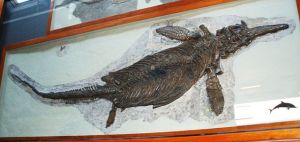

Here, the authors work to distinguish between three common species of Ichthyosaurus, I. communis, I. intermedius, and I. breviceps. The authors also present a better definition for the genus Ichthyosaurus.Continue reading “What Really Is Ichthyosaurus? – #365papers – 2017 – 106”
#365papers for April 15, 2017
What’s it about?
Modern sloths are tiny, tree-dwelling herbivores that dangle below the branches and move very, very slowly. However, in the past, there were enormous sloths that ranged across the landscape.
This paper discusses both anteaters and sloths, the modern components of which have adaptations for eating diets of low nutrition. The fossil record of both closely related groups are studied, and the relationships between great size and inferred metabolic rate and diets are considered.Continue reading “Body Size, Metabolic Rate, and Body Temperature in Giant Sloth Evolution – #365papers – 2017 – 105”
N is for Notoparamys
 Notoparamys was a marmot-sized rodent that lived in the earliest Uintan. It is a member of the rodent group Ischyromyidae, which included some arboreal (climbing) rodents.

 Penny Higgins - Storyteller • Artist • Scientist