BREAKING! How Part of Canada got Stuck to Australia – #ScienceNews

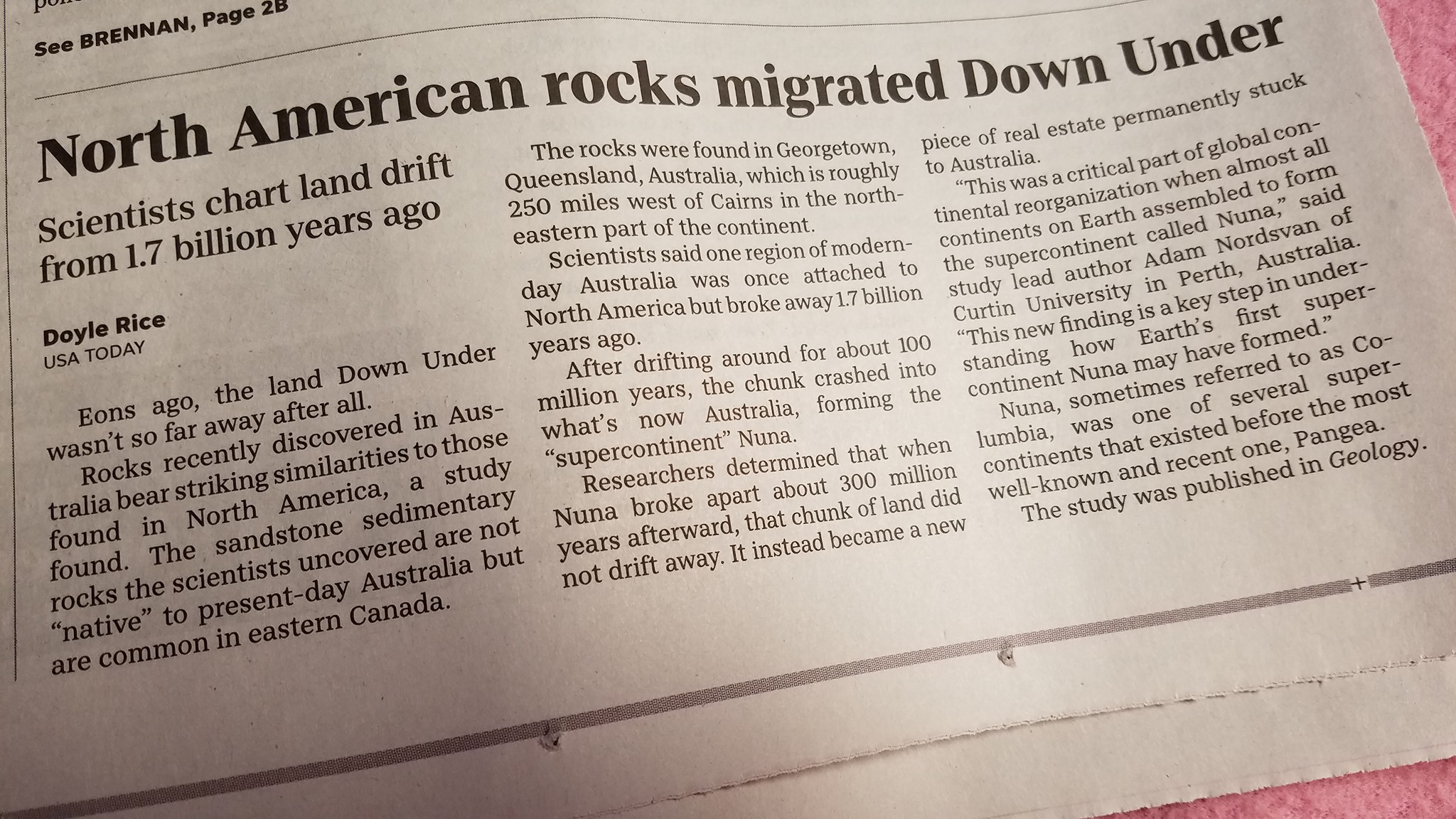
This morning, while reading the newspaper, my eye caught this on the front page:

  Scientists chart land drift from 1.7 billion years ago  Doyle Rice  USA TODAY  Eons ago, the land Down Under wasn’t so far away after all.  Rocks recently discovered in Australia bear striking similarities to those found in North America, a study found. The sandstone sedimentary rocks the scientists uncovered are not "native" to present-day Australia but are common in eastern Canada.  The rocks were found in Georgetown, Queensland, Australia, which is roughly 250 miles west of Cairns in the northeastern part of the continent.  Scientists said one region of modernday Australia was once! attached to North America but broke away 1.7 billion years ago.  After drifting around for about 100 million years, the chunk crashed into what’s now Australia,  forming the "supercontinent" Nuna.  Researchers determined that when Nuna broke apart about 300 million years afterward, that chunk of land did not drift away. It instead became a new piece of real estate permanently stuck to Australia.  "This was a critical part of global continental reorganization when almost all continents on Earth assembled to form the supercontinent called Nuna," said study lead author Adam Nordsvan of Curtin University in Perth, A! ustralia. "This new finding is a key step in understanding ho! w Earth’s first supercontinent Nuna may have formed."  Nuna, sometimes referred to as Columbia, was one of several supercontinents that existed before the most well-known and recent one, Pangea.  The study was published in Geology.
Title reads: North American rocks migrated Down Under.
Photo from the Rochester Democrat and Chronicle.

This naturally piqued my attention.

So I found the original paper.

Nordsvan, Collins, Li, Spencer, Pourteau, Withnall, Betts, and Volante, 2018, Laurentian crust in northeast Australia: Implications for the assembly of the supercontinent Nuna: Geology, doi: https://doi.org/10.1130/G39980.1

Let me distill this in my own way…Continue reading “BREAKING! How Part of Canada got Stuck to Australia – #ScienceNews”

Carboniferous Glaciers of Chad – #365papers – 2018 – 1

Le Heron, 2018, An exhumed Paleozoic glacial landscape in Chad: Geology, v. 46, p. 91-94.

What’s it about?

Rocks of early Carboniferous age (mid-Mississippian, about 340 million years ago) in Chad show evidence of the passage of glaciers. Today, this part of the world is largely desert. This paper discusses the evidence for ancient glaciers and shows that they are not modern features of the wind.Continue reading “Carboniferous Glaciers of Chad – #365papers – 2018 – 1”

How Aluminum in Zircon Can Tell Us What Happened Billions of Years Ago – #365papers – 2017 – 150

#365papers for May 30, 2017

Trail, Tailby, Wang, Harrison, and Boehnke, 2017, Aluminum in zircon as evidence for peraluminous and metaluminous melts from the Hadean to present: Geochemistry, Geophysics, Geosystems, v. 18, p. 1580-1593.

What’s it about?

Zircon is a mineral that forms in igneous rocks. As the rocks erode away, the zircons often survive and can be mixed into younger rocks, including new igneous rocks. Here, the authors use the concentration of aluminum in the zircons to determine the type of igneous rock the zircon originally formed in.Continue reading “How Aluminum in Zircon Can Tell Us What Happened Billions of Years Ago – #365papers – 2017 – 150”

Getting Mountains to Move – #365papers – 2017 – 144

#365papers for May 24, 2017

Malone, Craddock, Schmitz, Kenderes, Kraushaar, Murphey, Nielsen, and Mitchell, 2017, Volcanic initiation of the Eocene Hart Mountain Slide, Wyoming, USA: Journal of Geology, v 125

What’s it about?

The Hart Mountain slide is famous (in geology) for being a land slide that covers at least 3500 km3 and may have moved as far as 85 km. How do you get something that big started? This paper shows that the emplacement of an igneous body below what became the slide may have helped trigger the movement.Continue reading “Getting Mountains to Move – #365papers – 2017 – 144”

How Did the Earth’s Crust Grow – #365papers – 2017 – 133

#365papers for May 13, 2017

Rozel, Golabek, Jain, Tackley, and Gerya, 2017, Continental crust formation on early Earth controlled by intrusive magmatism: Nature.

What’s it about?

The Earth didn’t always have continents. This paper explores how the planet’s first continents probably formed. The major hypotheses were that the continents formed by volcanic eruptions primarily, or by upwellings of magma that never erupted on the surface. It seems that the latter is most likely.Continue reading “How Did the Earth’s Crust Grow – #365papers – 2017 – 133”

Reading the Fossil Record: Look at the Rocks – #365papers – 2017 – 86

#365papers for March 27, 2017

Matthews, Liu, and McIlroy, 2017, Post-fossilization processes and their implications for understanding Ediacaran macrofossil assemblages; in Brasier, McIlroy, and McLoughlin, eds, Earth System Evolution and Early Life: a Celebration of the Work of Martin Brasier: Geological Society, London, Special Publication 448, 19 pp.

What’s it about?

Ediacaran fossils represent the oldest fossils of multicellular life, from between 580 and 541 million years ago (the Ediacaran Period). This paper discusses how the preservation of the fossils – the rock processes of deposition, erosion, deformation etc – affect our interpretations of the organisms.Continue reading “Reading the Fossil Record: Look at the Rocks – #365papers – 2017 – 86”

The Paleocene-Eocene boundary in deep ocean foraminifera – #365papers – 2017 – 65

#365papers for March 6, 2017

Thomas and Shackleton, 1996, The Paleocene-Eocene benthic forminiferal extinction and stable isotope anomalies, in Knox, Corfield, Dunay, eds., Correlation of the Early Paleogene in Northwest Europe: Geological Society Special Publication n. 101, p. 401-441.

What’s it about?

This paper examines the abundance and geochemistry of single-celled organisms called foraminiferans (forams) that were living in the oceans around 55 million years ago. Forams are still present today worldwide. They make little tiny calcite skeletons (called tests) that can be used to identify the species and then can be analyzed.

Using these foram skeletons, the authors identified the many species that lived in the ocean before and after the Paleocene-Eocene boundary and recognized some extinctions associated with the boundary. With geochemical analysis, they showed that there are some significant anomalies (rapid, unexpected changes) at the Paleocene-Eocene boundary.Continue reading “The Paleocene-Eocene boundary in deep ocean foraminifera – #365papers – 2017 – 65”

The World’s Oldest Fossils? – #365papers – 2017 – 61

#365papers for February 2, 2017

Dodd, Papineau, Grenne, Slack, Rittner, Pirajno, O’Neil, and Little, 2017, Evidence for early life in Earth’s oldest hydrothermal vent precipitates: Nature, v. 543, p.60-64.

What’s it about?

This paper describes structures in a rock that lies somewhere in age between 4.28 billion years old and ~3.76 billion years old. (That’s a big range, but it’s an old rock!). The rock was almost certainly deposited in the ocean near hydrothermal activity. The structures appear to be very, very similar to those found in areas where life blossoms around deep-ocean hydrothermal vents. Continue reading “The World’s Oldest Fossils? – #365papers – 2017 – 61”

The Clean SWEEP of the Rocky Mountains – #365papers – 2017 – 50

#365papers for February 19, 2017

Chamberlain, Mix, Mulch, Hren, Kent-Corson, Davis, Horton, and Graham, 2012, The Cenozoic climatic and topographic evolution of the western North American cordillera: American Journal of Science, v. 312, p. 213-262.

What’s it about?

This paper uses a compilation of new and previously published oxygen stable isotope data from all over the Rocky Mountain region to understand the timing and uplift pattern of the Rocky Mountains. It seems that the Rocky Mountains first rose to the north, then grew southward.Continue reading “The Clean SWEEP of the Rocky Mountains – #365papers – 2017 – 50”

Climate Models and Eocene Isotopes, or How to Make My Head Hurt – #365papers – 2017 – 49

#365papers for February 18, 2017

Feng, Poulsen, Werner, Chamberlain, Mix, and Mulch, 2013, Early Cenozoic evolution of topography, climate, and stable isotopes in precipitation in the North American cordillera: American Journal of Science, v. 313, p. 613-648.

What’s it about?

Isotopes of oxygen and hydrogen in precipitation vary based on multiple factors, including how far from water vapor sources (usually the ocean) the precipitation is taking place, and whether or not there are mountains present, which can deflect and change patterns and amounts of precipitation. Because of this, we can use isotopes of oxygen from rocks and fossils, which reflect ancient precipitation, and understand the pattern and timing of uplifts of mountains.

This paper goes a step further, by using mathematical models to predict what oxygen isotopes of precipitation should have looked like based on a few ideas of how the Rocky Mountains may have come up.Continue reading “Climate Models and Eocene Isotopes, or How to Make My Head Hurt – #365papers – 2017 – 49”