Friday Headlines: 1-4-12

Friday Headlines, January 4, 2013

THE LATEST IN THE GEOSCIENCES


FIRST METEOR SHOWER OF 2013 PEAKS THIS WEEK

Quadrantid. Photo by Brian Emfinger in Ozark Arkansas, January 2, 2012

The Quadrantids are a meteor shower that happens in January. They seem to come from an area in the sky between the handle of the Big Dipper and the head of the constellation Draco.

(source: EarthSky Communications, Inc.)

Alas, by the time this is published, the peak will be just past, having been Wednesday night into Thursday morning. Plus, the waning moon (and all the snow where I live) make it difficult to actually observe this meteor shower.

PLANET’S OLDEST FOSSILS FOUND IN PILBARA, EXPERTS SAY


In the Pilbara region of Australia are some of the planet’s oldest rocks, dating back to about 3.4 billion years ago. In these rocks are various evidences for ancient life, including textures (like minute strands connecting to each other in a network similar to that of modern bacteria) and geochemical tracers. Yes, folks, there be isotopes there!

Metabolic processes in bacteria result in an isotopic signature wherein there is more ‘light’ carbon (carbon-12) than ‘heavy’ carbon (carbon-13) than would be expected for a limestone that formed without bacteria present.

Strelley Pool in the Pilbara, where 3.4 billion-year-old fossils have been found. Photo: David Wacey

What’s important is that finding these bacteria in such ancient rocks might suggest that the Earth’s atmosphere had oxygen in it a billion years before we previously thought. Oxygen in the atmosphere has had a profound effect on both the evolution of life on Earth and as well as it’s geologic history.

A GUIDE TO SNOWFLAKES

Snowflake classes

This is just cool. Who knew snowflakes were so complex? In light of all the snow we’ve received of late, this gives me something to look for in the next snowfall.

Bad Geology Movies: 2012, 2009

2012

2009

John Cusack, Chiwetel Ejiofor, Amanda Peet, Oliver Platt, Thandie Newton, Danny Glover, and Woody Harrelson


Premise: What if the end of the Mayan calendar on December 21, 2012 really did mark the end of the world? Could we save ourselves?

Obviously, the world did not end on December 21. The Mayans (modern ones) probably had a good chuckle at the premise of this movie and all the hubbub about the apocalypse. Whatever. In this movie there were some wierd things going on, things that didn’t make sense even within the context of the distorted science of the movie itself. Yeah, it was a disaster movie. A scientific nightmare.

The end of the world has been brought on by excess activity in the sun. Actually, it’s kind of funny because the world will end when the sun finally consumes the planet. But we got a few billion years before we need to worry about that. Anyway, apparently the sun’s activity has brought about a new kind of nuclear particle – a different kind of neutrino that is rapidly heating the Earth’s core, rather like how a microwave heats food from the inside out. This is going to cause the cataclysmic destruction of the Earth as we know it.

Of course, all this is happening because of the alignment of the planets that only happens every 640 thousand years. But wait. 640 thousand years is pretty frequent. Why is there no geologic evidence for this happening? There’s the ‘Nemesis Star,’ but that’s, what, every 26 million years or something? Yeah, I don’t know…

These enormous cracks begin to form along the west coast of North America. But they aren’t due to the action of any tectonic plates (according to one of the characters, the Deputy Geologist of the Office of Science and Technology Policy – which apparently actually exists). Ok, well if it’s not plate tectonic, why aren’t there random cracks elsewhere?

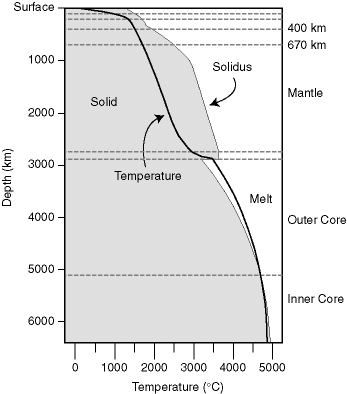
There’s a scene where they’re drilling (or so it seems) into a suddenly-dry lake bed in Yellowstone National Park. Our deputy geologist finds out that the temperature is 2700 degrees C at 40,000 feet deep. First, any real geologist would use meters, not feet. It’s about 12,000 meters or about 12 kilometers. I wonder how long they’d been drilling there. That’s just a gripe. But let’s put this in context. How hot is 2700 degrees C?

The Earth’s geothermal gradient (temperature with depth) compared with the solidus for rocks. If the geotherm is to the left of the solidus, the rocks are not melted.

So we’re looking at mantle temperatures. Not molten rock, mind you. The mantle is solid, but very, very hot. So, under Yellowstone it’s really warm. Well, Yellowstone is also sitting on top of a hotspot, where heat from the mantle (and associated volcanics) make it right to the surface. That’s why Yellowstone is there in the first place. So maybe 2700C isn’t so unexpected?

The other part of the story is that apparently the temperature is increasing by 0.5% every hour in this well at Yellowstone. Well, that’s pretty quick. A few hundred degrees a day or so. That’s substantial. I’d be more worried about that than the absolute temperature.

I guess this phenomenon is occurring at other sites around the Earth as well (in the movie, that is). I wish I knew where. The temperature anomaly at Yellowstone is compelling, but again, it’s a hot spot. It’ll go off again eventually, and we don’t need über-nutrinos to do that. What if the other places on the globe where they’ve been taking measurements are also hot spots. What then?

Regardless, the claim is suddenly made that “The Earth’s crust is destabilizing!” whatever that means, because the “Temperature’s rising with incredible velocity!” Is that even English? Would acceleration be a better word? Can you even use velocity to describe temperature change?

The good news is that crazy Charlie (played by Woody Harrelson) is drinking PBR, which is widely acceptable to geologists globally, for no real clear reason.

Oh yeah, and so you know, there was no major planetary alignment on December 21, 2012. This was just kind of made up…

The Theory of ‘Earth Crust Displacement’ is a big deal in this movie. The idea is that the crust destabilizes (whatever that means) and suddenly the crust rapidly moves around on the earth’s surface. It’s tough to be sure what they mean by this in the movie, as they could be referring to a movement of the crust, or a shift of the Earth’s rotation axis, so that the crust has appeared to have moved relative to the rotation axis. This depends upon a destabilization of the ‘subterranean’ crust and an ‘extreme polar instability.’ I have no idea what these things might mean.

The subterranean crust could be anywhere from just below the surface to 70 kilometers down, so what part are they talking about? Also consider that in the Theory of Plate Tectonics, it’s not just the crust that moves. A real geoscientist would be referring to the lithosphere, which is the crust plus a bit of the underlying mantle. So what’s destabilizing? Maybe it’s the connection between the crust and the mantle that’s destabilized? Wow.

The Theory of Plate Tectonics, does a nice job of explaining how the crust and the rest of the lithosphere, moves about on the surface of the Earth. But the crust isn’t going to rotate 23 degrees to the southwest over the course of a few hours. Sorry folks. Earth Crust Displacement is not a real theory in the Earth Sciences.

So far as ‘extreme polar instability,’ I think this is in reference to the Earth’s magnetic field (the north and south poles), though I can’t be certain. They do discuss the sudden reversal of the Earth’s magnetic field, and that the south magnetic pole is suddenly in Wisconsin. That the Earth’s magnetic field might reverse itself is no big deal. Geoscience has known about this for a while. The magnetic field has gone back and forth many times over the aeons, in an irregular pattern. This pattern has been used to help assign ages to ancient rocks, in fact, in a field of study called magneostratigraphy. That it would happen over night is a little sketchy. The current state of understanding is that it would take at least a thousand years for this to occur, though we’re still working on the details of how the magnetic field is generated. The magnetic pole in Wisconsin is also no big thing, if you’ve rotated all the Earth’s crust by 23 degrees to the southwest. So this is Ok. Sort of.

Earthquakes: This movie suffers from some of the problems of other earthquake movies in that it implies that earthquakes of magnitudes like 10.9 are even possible. Of course, if we can have Earth Crust Displacement, we can have such huge earthquakes, too.

The tsunamis throughout the movie are a real (scientific) disaster. For one thing, just because there’s an earthquake, doesn’t mean that there’s automatically a tsunami. The tectonic situation has to be correct. There needs to be dip-slip displacement along a fault that is underwater. They have these waves arising *poof* out of nowhere!

The other problem is that a 1500 meter tall wave (which is huge, sure) isn’t going to affect a Tibetan monk living at 4000 meters elevation. Unless, of course, Earth Crust Displacement has made the Tibetan Plateau sink. At this point, you see that things only make sense when you suspend all understanding of the current state of science.

Finally, I just gotta say that once again this movie omits the fact that volcanic ash is, by itself,deadly. Movies always portray ash as soft and fluffy and falling like snow. It’s glass folks. They’re inhaling glass shards. And no one is coughing. Sigh.

Beware of Movies! Age of the Earth

The Beware of Movies! series is meant to point out some of the scientific inaccuracies of popular movies, specifically in points related to the geological sciences.

This post will present some basic information about geologic time, how we know how old things are, and how movies often get these things wrong.

How do we know the order in which geologic events happened? And how do we know exactly when they occurred?

Uniformitarianism. This is an important concept used throughout the geological sciences. The short definition is “the present is the key to the past,” meaning that the processes that we observe on the modern Earth are identical to processes that occurred in the Earth’s past. Mountains exist today because of the motions of tectonic plates, thus ancient mountains also formed due to the interactions of plates.

This concept is useful for much of the Earth’s history, but might not be applicable to all of it, so it should be used with some caution. At least for the most recent 600 or so million years, it’s a safe assumption. Older than that, some important conditions on the Earth were different. One thing that is true, however, no matter how old of rocks we observe: Chemistry still works the same. Chemical reactions behaved the same 10 billion years ago as they do today. This is very important later on…

There are two basic ways of assigning ages (or dating) in the geological sciences: Relative and Absolute (or Numerical). Relative dating is used to place geological events in order of which came first, second, third, etc. Relative dating does not assign any ages (like ten thousand years ago) to events.

We’ll begin with relative dating, as this is the basis upon which our geologic time scale was originally developed.

There are six important principles used to assign an order to geologic events. Many of these apply especially to sedimentary rocks. Many of these will seem very, very obvious:

  • Principle of Superposition – When looking at a pile of rocks, the oldest rocks are on the bottom. Because rocks don’t just float in space with big gaps below them.
  • Principle of Original Horizontality – When sediments are deposited, they are deposited in horizontal layers. They’re flat. Thus, if we see rocks that are tilted in any way, we can assume that they were tilted after they were deposited.
  • Principle of Original Continuity – Rock layers are deposited over wide areas, not just in the one place where we see them exposed. We assume that a rock layer in one area is continuous with similar rock layers in other areas, even if we don’t see the direct connection. This is one of the most important principles needed to understand the development of the geological time scale.
  • Principle of Cross-Cutting Relationships – If there is a fault in a rock, or an obvious erosional surface, then we assume that these features occurred after the rock was deposited. That makes sense, because you can’t fault or erode something that does not yet exist!
  • Principle of Inclusions – If there are two rock types (rocks A and B) next to each other, and one (rock A) contains pieces of the other (rock B), then the rock containing inclusions of the other rock must be younger. Rock A is younger than rock B in this example.
  • Principle of Baked or Chilled Contacts – When magma comes into contact with pre-existing rock, reactions happen. The pre-existing rock is much cooler than the magma, causing the magma to cool rapidly and crystallize (making a chilled contact). At the same time the heat of the magma heats up and bakes the pre-existing rock, resulting in a baked contact. A baked rock is older than the igneous rock in contact with it. A chilled rock is younger than the rock it sits against.

Using these principles we can place geological events in relative order. We can trace rocks from one area to another and compile all the rocks in an area, and even on a continent into relative order. It is based upon this that the geologic time scale was developed. The divisions of the geologic time scale (like the Jurassic Period) get their names from the area in which rocks of that age were first described (like the Jura Mountains). Some divisions are also named based upon the types of rocks that characterize that division. The Cretaceous Period gets its name because many of the rocks are composed of chalk. The Latin word for chalk is “creta.” Using relative dating methods much of the Earth’s rocks deposited over the last 600 million years have been put in order.

The Geologic Time Scale

We can then add to this fossils with which we can determine a fossil succession using the principles above. It is from this that much about the evolution of life on Earth is understood.

Biostratigraphy is the use of fossils found in a rock to assign a relative or absolute age to that rock. Biostratigraphic units do not depend upon rock type and are thus defined according to the presence of a particular organism (an index fossil) or a complete fossil assemblage. Biostratigraphy is often used to correlate rocks of similar age but different rock types.

It is through principles of relative dating and biostratigraphy that we know that dinosaurs and humans have never co-existed.

Absolute (Numerical) dating is a means by which we can assign an number age to a rock or a fossil (or a geologic event). The method that most people have heard of is radiometric dating. To understand this, we have to talk a little about chemistry.

The chemical elements come in many forms. Some are stable and some are unstable. The unstable ones are also called radioactive. Some elements can come in multiple forms, some stable and some radioactive. The difference is in how many neutrons are in the nucleus, or what isotope the element is in. Carbon, for example, has three isotopes: Carbon-12, carbon-13, and carbon-14. Carbon-12 and carbon-13 are stable. Most of the carbon in the universe is carbon-12. There’s a little carbon-13, and even less carbon-14. Carbon-14 is radioactive, however. It doesn’t stay around forever. At some point it decays (or self-destructs), which is why radioactive elements are so dangerous.

Carbon-14 breaks down into Nitrogen-14, an electron, and an electron antineutrino, which sounds pretty awful. (And it is, if it happens inside your body! Those little extra bits can cause damage, which can lead to cancer.) Other radioactive elements break down (decay) in similar ways. The original element (in this case, carbon-14) is called the ‘parent.’ What’s left behind (Nitrogen-14) is called the ‘daughter.’ The decay of the parent into the daughter products occurs over a specific period of time, called the half-life, which varies from parent material to parent material. For carbon-14, the half-life is 5,730 years.

The half-life is how long it takes for half of the parent material to decay into the daughter product. Here’s an important thing about half-lives, however. This does not mean that after two half-lives, all the parent product is gone. With each half-life, half of the parent product decays. You never really get rid of all the parent material, though there does come a point where it is so small that it becomes impossible to measure.


Half-life number Percent parent material present Percent daughter product present
0 100 0
1 50 50
2 25 75
3 12.5 82.5
4 6.25 88.75


Radiometric dating uses this relationship to assign ages to rocks. One need only to measure the relative amounts of parent material and daughter products in a rock and know the half-life of the parent material in order to calculate the age of a rock. Different parent materials have different half-lives ranging from days to billions of years. A scientist will use the parent-daughter system that works the best for the age of the rocks their interested in. Here are a few examples:

Parent-Daughter Half-life
Carbon – Nitrogen (radiocarbon dating) 5730 years
Potassium – Argon 1.25 billion years
Uranium-238 – Lead-206 4.47 billion years
Uranium-235 – Lead-207 704 million years


For all of these, there are caveats. Firstly, it is important that all the materials being dated actually originally contained the parent material and has not lost any of the daughter product. This can be a problem for potassium-argon dating, for example, because argon, as a gas, can escape. Radiocarbon dating is only good to about 40,000 years before present, before there is so little of the parent material left that it no longer can work.

It is also important to realize that for all of these methods, time zero (or ‘now’) is actually not right now in 2013. It’s actually 1950, which is when the methods were first established. For most radiometric dating methods, this doesn’t matter a whole lot, but for radiocarbon, it can be problematic. Nothing younger than 1950 can be dated using radiometric carbon.

Beware of movies: In the movie Time Cop, with Jean-Claude Van Damme, there’s this shipment of gold that gets transported from the past into the future. This gold is radiocarbon dated (so they say) which informs the time cop agency that it was stolen from the past. Two problems: 1) There’s no carbon in gold. What exactly did they date? 2) If the gold came forward in time, via time machine, it should seem brand new. It should not date to the past. Unless somehow, radioactive decay speeds up in the beaming forward process.

Other radiometric dating methods:

Detrital Zircons: Most of the methods described above are best used to assign ages to igneous rocks. Only radiocarbon dating really works well for sedimentary rocks (but even then, is only useful back to about 40,000 years before present). Radiometric methods can be used to assign ages to sediments when applied to ‘detrital zircons.’ Zircon is a mineral that forms in igneous rocks as they cool and can be dated using the uranium-lead methods noted above. These zircons are very resistant to weathering and become part of sediments that form new sedimentary rocks.

Zircons can be isolated from sedimentary rocks and dated, which gives the age of the igneous rock that they came out of. From this, we can determine where the sediments came from. We also know that the sedimentary rock cannot be older than the youngest zircon that’s in it. Thus, we can derive a maximum age for the sedimentary rock, which can be useful to know.

Fission-track dating: When radioactive elements decay, they leave trails of damage (or tracks) in the matrix of a crystal. These little trails are obvious under the microscope and most often form from the decay of uranium-238. Counting these tracks can be used to assign an age to the mineral and thus the rock that they came from in ways similar to detrital zircon analysis.

Some other absolute dating methods:

Thermoluminescence (TL) dating is used to determine how long a mineral (and the rock that it is in) has been exposed to sunlight. As the mineral is heated, to emits a weak light signal, which is proportional to how much sunlight it was exposed to and therefore how long it sat on the surface. This can tell us how old a material is (like an archaeological artifact) or how long a surface (like a river terrace) has existed.

The use of cosmogenic nuclides for dating surfaces has also come to prominence of late. As it happens, cosmic radiation bombarding an exposed rock surface can cause the appearance of new elements that wouldn’t be there otherwise. A scientist can measure the amount of these so-called cosmogenic nuclides and assign an age to an exposed rock. This can be used to, for example, assign ages to the advances and retreats of glaciers.

There are other methods used by scientists in assigning ages to rocks and fossils, or the parts thereof. For example, one could simply count rings!

Dendrochronology is also known as tree-ring dating. Most trees have annual growth rings which can be used to count years from the initial growth of the tree to its death. If the tree is still alive, one can correlate events down to the exact calendar year. Dendrochronology can help us study paleoclimate and paleoecology, and has been used to calibrate radiocarbon ages.

Sclerochronology refers to the study of growth lines in the hard tissues of animals and plants. Clams show growth lines, as do corals. Some teeth do as well. These growth lines aren’t necessarily annual and may be annual, monthly, fortnightly, tidal, daily, and smaller increments of time. Study of these can help us understand the biology of ancient and extinct organisms.

Ice cores also have annual layers, due to yearly cycles of dust. It is possible to count the rings in ice cores that go hundreds of meters down and study ancient climate patterns, calibrated to precise years, using other geochemical methods. This is how we know much about global warming, glaciations, and climate changes.

Beware of movies: Actually, this is something they got right in “The Day After Tomorrow.” Ice cores are commonly used to measure the concentrations of greenhouse gasses in the Earth’s past atmosphere. They use layer-counting to get the ages right.

Some methods used for dating depend upon comparing patterns of change with similar patterns derived from rock sections of known age.

Magnetostratigraphy is a technique used to date sedimentary and volcanic rocks. The Earth’s magnetic field has not always been such that the north end of the compass needle points toward the north pole. The field has reversed itself many times, and these reversals have not been regular. Scientists can go out and collect rock samples through a series of rocks and measure which way the magnetic poles were pointing at the time the rocks were deposited. This pattern is then compared with the ‘geomagnetic polarity time scale’ for the Earth (which has ages assigned to it). Where the patterns match gives an age for the rocks.

Chemostratigraphy or correctly termed Chemical Stratigraphy is the study of the variation of chemistry within sedimentary sequences. Much like magnetostratigraphy, variations of particular chemical markers also provide useful time markers. For example, the Paleocene-Eocene boundary (~55 million years ago) is defined by a huge spike in the amount of carbon-12 in the Earth’s atmosphere, which is recorded in the rock. Chemostratigraphy can also be used to track environmental changes, since chemical markers change when climates and environments change.

This post has covered most, but not all, of the potential methods by which geological units and events might be dated by geoscientists. If there are other methods that you’ve heard of, comment about them and I can explain those too.

Bad Geology Movies: The Day After Tomorrow, 2004

The Day After Tomorrow

2004

Dennis Quaid, Jake Gyllenhaal

Premise: When the world’s ocean circulation patterns are disrupted by melt water due to global warming, the Earth is plunged into a sudden ice age.

There’s a fair amount of good in this movie, and a fair amount of hoo-hah as well. I’ll focus on the Earth Science problems that I have at least a little expertice in. I’m not a meteorologist, so I can’t say a lot about the huge storms that play an enormous role in the movie (though I suspect they fall into the category or hoo-hah).

Ice core drilling: This is, in fact, a common means by which we have learned a great deal about Earth’s past climate. And we can go back ten thousand years quite easily. The ice-coring set-up that they have is quite unlike any I’ve ever seen, and I really don’t think any intelligent scientist would be coring on an ice shelf, but for the sake of a movie… ok.

A two-century long ice age that started 10,000 years ago: There was a substantial climate change that occurred ten thousand years ago. It was warming, though, not an ice age that lasted 200 years. This was about the time that humans found themselves in North America and was also about the same time that all the cool ‘megafauna’ went extinct (like mammoths, mastodons, woolly rhinos, ground sloths, etc.) There is a great deal of debate over whether it was the appearance of humans or this climate change that did in the megafauna.

Greenhouse gasses from ice cores: This is actually a commonly used research track by paleoclimatologists. In fact, we have two such scientists in our tiny department here at the University of Rochester. Atmospheric gasses are trapped in snow which is later buried and turns to ice in the massive glacial sheets of the Arctic and Antarctic. These gasses can be retrieved and studied, providing information about past concentrations of greenhouse gasses in the atmosphere.

By the way, we can assign ages to different parts of ice cores by simply counting annual rings. During the winter, snow tends to be clean, but in the summer there tends to be a lot of dust in the snow. Each year, then, there is a layer of clean ice and dirty ice in an ice core. We can count these (like tree rings) to know the age of a part of an ice core. Pretty cool, eh?

Ocean circulations: What the main character says about the disruption of ocean currents by the introduction of fresh water (from melting ice sheets), which then leads to climate change is actually an accepted hypothesis. It has been put forward by Wally Broeker, one of the most respected paleooceanographers in the world.

Unfortunately, the movie does make a mistake here. Not a severe one, but I’m sure Wally himself would facepalm. They talk about the North Atlantic Current – which is a real thing – being shut down by all the meltwater. The North Atlantic Current is a surface current in the ocean. It is the continuation of the Gulf Stream, which runs north along the eastern margin of North America. The Gulf Stream plus the North Atlantic current is what keeps the climate of Europe so pleasant despite being so far to the North. Surface currents, like the North Atlantic Current, are driven by wind.

If you look at the drawings that the main character of the film is referring to, as well as Wally Broeker’s work, you’ll realize that the currents that would be disrupted by the freshwater are not surface currents at all. While it might affect the North Atlantic Current, the influx of meltwater would more likely disrupt the deep ocean currents, called “Thermohaline Circulation.”  These currents are driven by differences in temperature (Thermo-) and salt-content (haline) of the water. Saltier water sinks, as does colder water. This global circulation keeps the ocean water mixed from north to south and from ocean to ocean. An influx of freshwater from melting glaciers in the north and south would stop the downwelling in those areas, which would disrupt this circulation. This, it is widely accepted, could have a profound effect on global climate.

The ocean’s deep currents.

Water inundating New York City: This is a head-scratcher. Sure, if sea-level rises, then water could rush into the city. And now, post Hurricane Sandy, we know that water can make it quite a ways into the city. There is a lot of water tied up in the world’s ice sheets, too, so an immense sea level rise is not out of the question if we melted all of the ice. But the converse is true, too. In an ice age, sea level can drop because all the Earth’s water is tied up in ice sheets at the poles. Somehow, I suspect that these two competing phenomena would have prevented the great wall of water that struck New York in the movie. But it was pretty cool to have a massive ship floating in front of the library, eh?

Only storms in the Northern Hemisphere: Was anyone bothered by this? Why wouldn’t there be enormous storms in the Southern Hemisphere too? How come Australia gets out Scot-free? This actually might not be that big of a problem. It seems that the great ice ages did not affect the Southern Hemisphere in the same way as the Northern Hemisphere. There were no huge ice sheets in the south. Part of this is because there really isn’t much land mass in the south. There are some tall mountains that even now have glaciers that may have expanded during the northern ice ages, but it seems that “ice ages” as we think of them were a primarily northern phenomenon. There’s active research on that topic going on right now. So it’s possible that a new ice age might only affect the Northern Hemisphere.

 An ice age in a week? I think this is fundamentally the biggest problem with “The Day After Tomorrow.” The premise is ok, and the idea that run-away greenhouse gasses could cause major climate disruptions isn’t that far off, but that an ice age can begin and coat much of the Northern Hemisphere in ice in less than a week is a unlikely. Years is a better scenario, and we’d probably have a little warning. Can can observe the flow of the thermohaline currents. We’d see them stopping most likely. Alas, I don’t think that there’s a thing in the world we could do to re-start the flow should it stop. Climatic disruption is the most likely outcome.

Friday Headlines: 12-28-12

Friday Headlines, December 28, 2012

THE LATEST IN THE GEOSCIENCES


ERUPTION MAY HAVE STARTED AT COPAHUE ON THE CHILE/ARGENTINA BORDER


Copahue is a stratovolcano on the border between Argentina and Chile.

This volcano is the result of subduction of the Pacific Plate below the South American Plate.

Subduction Zone

On December 22, a plume of ash was noted in an image from the GOES satellite.

Plume of ash from Copahue on December 22

Since then, alerts have been issued and the volcano is clearly erupting.

FIGHTING MAY HAVE SHAPED EVOLUTION OF HUMAN HAND

Michael Morgan and David Carrier of the University of Utah have shown that the human hand is not only a dexterous appendage, capable of precision gripping, but is also an effective weapon, but only when it is balled into a fist. When the fist is formed, it causes all the forces of a hit to be transmitted through the knuckles – a small surface area – resulting in a focused transmission of the power of the blow, maximizing the potential damage. The human hand can clinch a fist where the curled fingers leave no gaps at the palm of the hand (which would weaken the blow), and where the thumb can further buttress the fingers. No other animal can do this.

X-ray of a hand balled into a fist

PHOTO: MOUNT EVEREST, IN 3.8 BILLION PIXELS

You just have to go and look at this picture. It’s amazing!

Beware of Movies! Volcanoes

The Beware of Movies! series is meant to point out some of the scientific inaccuracies of popular movies, specifically in points related to the geological sciences.

This post will present some basic information about volcanoes and how they work, and point out the major inaccuracies portrayed in movies about volcanoes.

What is magma? How is that different from lava?

It’s a good question. We’ve all heard the terms before, magma and lava, and probably you’ve got a general sense of what they mean, but do you know the specific definitions.

Magma and lava are both words for molten rock. Liquid rock. Very hot. This distinction is that magma is below the surface of the Earth and lava is what you call it when it’s on (or above) the Earth’s surface.

 Types of magma

Molten rock is not all created equal. When you look at rocks, you realize that they’re of all different kinds. So if you melt that rock, it’s going to be of different compositions reflecting the rock that was melted.

To discuss the composition (or types) of magma, we refer back to Bowen’s Reaction Series. Magma can be felsic (high silica, high calcium, aluminum, and potassium) or mafic (low silica, high iron and magnesium), or anything in between. These compositions affect the behavior of the molten rock. Silica tends to polymerize (make chains) in molten rock, which means that a more felsic magma tends to be more viscous (or that it doesn’t flow very well). The high levels of iron and magnesium in mafic magma makes it more dense. Also felsic rocks melt (to make a felsic magma) at much lower temperatures than mafic rocks.

From this discussion, one might gather (and rightfully so), that the composition of a magma is determined by the type of rock that melted to make the magma. There are other ways to change the composition of a magma (which will serve to explain why we have different compositions of rocks in the world)

 Changing the composition of magma

1) The composition of the parent rock (the rock that melted to form the magma) – If you melt a mafic rock, you get a mafic magma. This is the most straightforward means to change or determine the composition of a magma.

2) Assilimation – If a magma body incorporates another rock, which then melts, unless the incorporated rock is of the exact same composition of the magma, the composition of the magma will change. As magma rises through the crust, it ‘eats’ through the rock above it (country rock), melting and incorporating the country rock, changing the composition of the magma body.

3) Magma mixing – Two separate magma bodies while moving together may wind up coming in contact and mixing. Unless the two magma bodies have the exact same composition, a new magma will result with a composition in between the original two magmas.

4) Partial melting of rock – As noted earlier, felsic rock melts at a lower temperature than mafic rock. When any rock melts, the first minerals to melt are the most felsic minerals. Over time, as the rock heats up, the more mafic minerals begin to melt. But a rock doesn’t always completely melt over time. If a rock only partially melts, and the melted rock (magma) moves away, the magma is more felsic than the original rock and the remaining rock is more mafic than the original rock. Thus, through partial melting, a magma may become more felsic.

5) Fractional crystallization – As a magma cools, the first minerals to crystallize are the most mafic ones, causing the remaining magma to become more felsic. These newly-formed mafic minerals might settle out, leaving behind a more felsic magma to continue on its way toward the Earth’s surface.

 Intrusive or extrusive

Not all magma makes it to the surface. If it does, you get an eruption and a volcano. Lava erupts onto the surface to cool and form what we call extrusive igneous rocks. The magma that doesn’t make it to the surface will crystallize below the surface, and is called intrusive igneous rock, or just an intrusion.

Since we’re talking about volcanoes, we’re going to talk only about extrusive igneous rocks formed from lava.

 What comes out of volcanoes?

Lava is the molten rock that comes out of volcanoes, but there is much more that comes out. The opening out of which the lava flows is called a vent. But it isn’t always lava flows that come from vents. There is also ash and other pyroclastic debris. So what does that mean?

The stuff that flies out of volcanoes is called volcaniclastics or pyroclastics. The root ‘clastic’ refers to little bits and pieces that get deposited together. The volcani- part refers to volcanoes (obviously), and pyro- refers to fire. So the words mean bits and pieces of rock coming from volcanoes or coming from fire.

Those bits and pieces have specific names depending upon their size and shape:

Ash – tiny glass shards that form when the lava crystallizes almost instantaneously.

 Beware of movies: It seems that in almost every movie (for example, Dante’s Peak and Volcano), there’s always a ton of ash snowing down upon the main characters of the story. This ash is glass shards! If you inhale this, it will cut your lungs to bits and you will die a miserable death. Yet, somehow, in movies this is never an issue. In paleontology, some of the best fossil assemblages came to be when an eruption occurred and the ash killed the animals in just this way. Then the ash buried the animals and perfectly preserved the animals for geoscientists to later discover.

Lapilli – pea to plum sized fragments that can be streamlined from flying through the air.

Blocks and bombs – apple to refrigerator sized fragments that are shot from a volcano. Blocks are bits of rock that were already cool when they were shot, whereas bombs were molten when they were shot and often are streamlined in flight.

The deposits left behind are also given special names, depending on how they formed:

Ignimbrites (or pyroclastic flows) – avalanches composed of ash or ash plus lapilli. These things can go very fast, riding down the slope on a cushion of air, just like a snow avalanche.

Lahars – a rapid slurry of volcaniclastic material in water (like a mudflow), most often caused when snow caps suddenly melt off of volcano peaks during an eruption.

 Beware of movies: In Dante’s Peak, there was ample opportunity for good pyroclasic flows and lahars, but there weren’t many. There should have been. And the ones that they did show were too slow and did not flow far enough. It was pretty weak, honestly.

 Lava flows and types of eruptions

Different compositions of magma (lava) behave differently as they flow out of a volcano. Because of the polymerization of silica, felsic lavas tend to flow more slowly and in a more ‘chunky’ form than does mafic lava. Mafic flows can move much greater distances than can felsic flows.

Eruptions of fast-moving, low-viscosity mafic lavas are often what we call ‘effusive,’ or characterized by huge flows and lava lakes. Other eruptions like that of Mount Saint Helens in May of 1980 (or of Dante’s Peak), are ‘explosive’, which characterizes eruptions of intermediate to felsic lava.

Magma (and lava) often contains dissolved gasses, which must escape when the lava erupts. If the gas can escape easily, an eruption will be more effusive, but if the gas cannot escape, eruptions may be very explosive.

The interaction of eruptions with water also effects whether and eruption will be explosive or effusive. If a volcano erupts under water (or lava flows into water), the results can be explosive.

 What kinds of volcanoes are there?

The types of flows coming from a volcano (and therefore, the composition of the erupting lava) determines the shape of the volcano.

Shield volcanoes are huge, flat (shield-shaped) volcanoes that result from dominantly mafic flows that are effusive in character. The Hawaiian Islands are all enormous shield volcanoes.

Stratovolcanoes (also called composite volcanoes) are tall, pointed volcanoes, often associated with explosive eruptions and felsic to intermediate compositions of lava. Such volcanoes tend to be composed of repeated layers of flows and pyroclastic depositis. Mount Saint Helens and Mount Rainier are two prominent examples of stratovolcanoes.

 Where do we find volcanoes?

Volcanoes tend to be in specific places throughout the world, not just stuck willy-nilly where ever they seem needed. For example, you don’t find volcanoes in the middle of continents.

The positions of volcanoes on the Earth is almost entirely dictated by plate tectonics. Volcanoes arise do to the interactions of tectonic plates, and thus tend to be at or very near plate boundaries. Additionally, plate tectonics dictates what kind of volcano might be found where.

To review, there are three important types of plate tectonic boundaries: divergent (spreading centers, or mid-ocean ridges), convergent (including subduction zones and collisions), and transform (where plates slide past each other).

Volcanoes are not common along transform faults, and usually only on those that have a slight component of spreading across them. In those cases, some mafic eruptions might occur, but they tend to be very small.

Beware of movies: In the movie Volcano, a volcano forms from the La Brea Tar Pits in the middle of Los Angeles, California. This is along a transform boundary, but not one that would be a candidate for a volcano. This transform boundary has a slight component of convergence, so if anything there should be mountain building, not volcanoes occuring.

Spreading centers, being the place where new crustal material is being formed from eruptions linked right to the mantle, tend to have large, mafic volcanoes. There has been little opportunity for the magma that forms these volcanoes to undergo any of the processes that would make them more felsic.

Convergent boundaries, especially subduction zones, usually have large stratovolcanoes associated with them. Much of the margin of the Pacific Ocean is characterized by stratovolcanoes and subduction zones, and is called the “Ring of Fire” because of it. The magma formed at subduction zones forms as the subducted plate melts. The magma slowly rises through the crust, changing its composition as it goes due to assimilation and fractional crystallization, so that when it erupts it is generally intermediate or felsic in composition.

Beware of movies: in the movie Dante’s Peak, the subject volcano is a stratovolcano in the Cascades. This is perfectly reasonable, as the Cascade Mountains are the result of the subduction of the Juan de Fuca plate under the North American plate. The one mistake that is made in the film is that it depicts rapidly-flowing, presumably mafic flows coming from the volcano, which do not make sense given the type of volcano they’re dealing with.

Not all volcanoes are associated with plate boundaries, however. There are a few exceptions that form due to what are called “hot spots,” or heated plumes of magma that (so far as we know at this time) form at the core-mantle boundary and get all the way to the Earth’s surface. These volcanoes can appear anywhere on the Earth’s surface, two good examples being the Hawaiian Islands and the Yellowstone hotspot. Because the Hawaiian hotspot is in the middle of oceanic crust, the eruptions tend to be mafic, resulting in shield volcanoes. The magma for the Yellowstone hotspot passes through continental crust, resulting in highly explosive, intermediate or felsic eruptions.

 Can we predict volcanic eruptions?

I’ve already discussed at great length that earthquakes cannot be predicted. Is the same true for volcanic eruptions? Actually, the story isn’t as dismal for volcanoes. We do often get some manner of advanced warning of an impending eruption, though the warnings might be months or only hours ahead of an eruption, or they might be false alarms.

The movement of magma below the Earth’s surface, toward vents for example, are detectable by seismometers. In fact, the direction in which the magma flows below the Earth’s surface is even measurable if an appropriate seismometer network is in place. Outgassings, and temperature and pH changes of water bodies can also provide evidence of a possible eruption, similar to what was seen in Dante’s Peak. And, since we tend to know where volcanoes should exist and we know how they are formed, we have some hints about what to look for if an eruption may be immanent.

There’s hope for predicting volcanic eruptions. But to know exactly when or how intense an eruption might be, is elusive.

Bad Geology Movies: Dante’s Peak, 1998

Dante’s Peak

1998

Pierce Brosnan, Linda Hamilton

Premise: What if a seemingly dormant volcano in the Cascades suddenly exploded back into life?

As “Bad Geology Movies” go, Dante’s Peak is not the worst. It has some errors, but at least it gets quite a few things right:

1) The Cascades is a great place to have a volcano suddenly go off, because it is volcanically active and it has had volcanoes (relatively) suddenly explode. Mount Saint Helens, in 1980, only gave a few months of warning before it blew its top. Other volcanoes have been known to go from dormant to exploding in even shorter time frames.

2) The killing of plants and fish by carbon dioxide emitted from vents originating from deep magma bodies is also known to happen. But this does not always mean eruption is imminent.

The movie was not without its errors however.

1) I found it troubling that the volcanologist, played by Brosnan, seemed not in the least bit alarmed by a pH of 3.58 in the mountain lake. That’s a pretty low number, which means it’s pretty acid. With a pH so low, the fish in the lake would surely have been affected in some obvious way (especially since the carbon dioxide had already killed trees). I wouldn’t go in that lake.

2) When the volcano first went off, there was a severe lack of lahars. Lahars are fast-moving slurries of ash, mud, and water that tend to take out towns at the bases of volcanoes. Usually, the water comes from the sudden melting of the snow and ice capping the previously quiet volcano. Dante’s Peak had a significant snowcap, but there were no lahars, at least not right away. There finally were some lahar-like flows toward the end of the movie, but I felt like they needed to be earlier on.

3) Brosnan’s character shouts during an earthquake, “They weren’t tectonic! They were magmatic,” suggesting that somehow, by the way the Earth shook he could tell that the earthquake was not from motion on a fault, but from the movement of magma below the surface. In real life, a person experiencing an earthquake first-hand is not going to be able to make such a distinction.

4) The flows! Ah, the flows! They’ve mixed their flows! An eruption such as this is most likely to only have magma (lava once it erupts) of a single composition. The composition of a magma (how much silica, iron, and magnesium it has, for example) dictates how it flows. One of the earlier eruptions of the volcano has smooth, fast-flowing, ropey magma (known as pahoehoe), indicative of what’s called “Mafic” magma. Later, the characters are stopped by a slow-moving, lumpy flow, similar to what we call A’a’. This type of flow is more expected of “intermediate” to “Felsic” magmas. The truth is that one would not expect mafic magma from a volcano in the Cascades. If I recall, I laughed out loud when I saw that fast flow chasing down the main characters. The slow-moving, lumpy flow is more of what we would expect from a volcano in the Cascades.

5) Whatever the composition, it must be said that one would never, ever be able to drive a truck across an active lava flow. The heat would be so intense that the vehicle and its occupants would begin to burn almost immediately. The main characters should have been incinerated. But it’s Hollywood, so that’s ok.

6) Speaking of characters being killed, there were two more ways in which the entire cast should have died. First, inhaling all that ash that was snowing down would be lethal. It’s nothing more that microscopic shards of glass. Any animal inhaling that would die of massive hemmoraging in the lungs. As it happens, this is how some of the most spectactular fossil localities that we have were formed. Second, when they all stopped to look back and watch the volcano explode, they weren’t far enough away to be safe. The ash and debris would have buried them, if a mudslide hadn’t of taken them out.

But all told, the premise of the movie was realistic – much moreso than others I have watched of late. There is definitely some Hollywoodization taking place, but it has to be there.

I liked the movie and only cringed a few times because of bad science.

If you want a different insight into the film, check out this website.

Bad Geology Movies: Deep Impact, 1998

Deep Impact

1998

Robert Duvall, Téa Leoni, Elijah Wood, Morgan Freeman

Premise: What if a comet was discovered that would strike the Earth in one year’s time? What would we do?

The truth is I really thought this would be ‘bad’ in ways similar to have Armageddon was ‘bad,’ but it wasn’t. Deep Impact is much more a human-interest movie than a science movie. The writers glossed over a lot of the scientific details to get to the story. Since I fancy myself a writer, I appreciate this. In truth, a movie or book or whatever can get itself into trouble by trying to be too realistic or accurate when such accuracy isn’t necessary.

On the whole, I liked the movie (except for that it made me cry a little). Nothing in the science made me groan because they omitted most of the science. I’m all right with that.

One thing I did enjoy, however, is at the beginning, when the journalist played by Téa Leoni discovered the meaning of E.L.E. (Extinction Level Event) on the Internet. She found herself on the UC Berkeley Department of Paleontology website. And you know, I think I’ve been there. More than once.

Yay! A nod to the science of paleontology.

That’s really all I have to say.

Bad Geology Movies: 10.5, 2004

10.5

2004

Kim Delaney, Beau Bridges


Premise: What if there were a whole series of mega-deep faults under the western coast of the United States that could trigger a magnitude 10.5 earthquake in Los Angeles?


This was a television miniseries with two episodes, presumably each of two hours duration. This movie has some of the most absurd instances of pseudoscience that I have ever observed. It was bad. I don’t even know where to begin. So I’ll begin at the beginning.

The show opens with a massive earthquake in Washington state. I admit I wasn’t paying attention to where the seismologists were, but what I do remember is this:

1) Somehow the magnitude of the earthquake – a single earthquake, mind you – increased over time. That doesn’t happen. One earthquake comes from a single rupture/break/motion on a fault. The shaking starts, then it tapers off. Now if other earthquakes were triggered, well, they’d be separate earthquakes and have their own magnitudes.

2) You can’t measure magnitude while the earthquake is happening. This is measured after the fact, using the complete seismographic record. You need to know the timing of all the various seismic waves generated by the earthquake and their magnitudes. You can do that pretty quickly after the quake is over, but not while it’s happening.

3)Speaking of seismic waves, you’d never have “s-waves off the chart!” as exclaimed by one of the movie’s characters in reference to this first quake. S-waves tend to be pretty small compared to the surface waves (which are the ones that do all the damage). Maybe the writers thought that s-waves and surface waves were the same thing… Not.

4)The claim is made by the main character that the earthquake hypocenter (the point in the Earth’s surface where the fault movement is actually taking place) is ‘sub-asthenosphere.’ She later asserts that the earthquake hypocenter must be about 700 kilometers down. Rocks at that depth do not fracture and form cracks or faults. It is solid rock (part of the lower mantle), but temperatures and pressures are so high that the rock will stretch, atom-by-atom, rather than actually fracture and form a fault.

As the movie progressed, there were still references that baffled me.

1) The main character talked about side-to-side motion from the earthquake, later getting excited when she realised it wasn’t side-to-side, bu lateral-skip. Seriously, I have no idea what that is…

2) They made measurements of the magnetic field, for radon gas, and collected soil samples to “prove” these 700-km-down faults. I have no inkling of how that would work. I mean, maybe a magnetic anomaly is something that could happen. Actually, no. I don’t think so. And what about those ruptured pockets of poisonous gasses? Where are those coming from? No idea.

3) There were these wierd thermal activity maps (or something) with which they were identifying the stresses building up prior to a quake. From this, they were predicting earthquakes heading south down the west coast. Again, I have no idea what that was. No such thing exists. And we can’t predict earthquakes.

The funniest part of the movie is when they proposed to fuse the San Andreas Fault using nuclear warheads. Why must all the ‘bad geology movies’ involve nuclear weapons? Anyway, you can’t fuse a fault. You can’t. You can relieve some stress, and maybe mitigate a potential earthquake, but you can’t fuse a fault. Sorry.

The second episode was nearly as funny as the first. (I don’t think it was supposed to be funny, by the way.)

They were drilling their seven (or was it five, or six) perfect holes for the nuclear warheads. The director of FEMA was overseeing each one (why?!). The drilling was slow though. You know why? “Solid layers of rock, all the way down.” What did they expect? Caves? Marshmallows? Of course, the drill they used was also ridiculous, but we’ll let that go.

There’s this river that changes direction after a massive earthquake. I questioned our seismologist’s cognitive abilities after she suggested that a magnetic field could have caused the river to change directions.

The climax of the film is where the San Andreas fault opens up – complete with crazy gas fissures – causing part of southern California to become an island. This follows the misconception that activity along the San Andreas fault will cause part of California to slip into the sea. That’s simply not true. The San Andreas slips such that western California will simply move northward along coast of North America until if finally hits Alaska. It is not going to sink into the sea!

Nor would any fault (even one rooted in the mantle, 700 km down) suddenly open into a vertical-walled chasm over the course of only a few minutes. Though I suppose it does make for good TV. Provided you know NOTHING about geology.

Sigh.

There are other glaring errors and weirdnesses in the movie, but I think I’ll stop there. This movie has its problems. Of all the recent movies (1990’s and newer) I’ve watched and reviewed thus far, this one seems to have the most scientific errors. I think I was actually yelling at my computer as I watched it. It was that bad. Maybe the personal stories in the movie were cute and touching, but I couldn’t get to that, because the science was so awful. That’s my curse.

By the way, there’s a sequel to this: 10.5 Apocalypse. I won’t be seeing that.

Beware of Movies! Earthquakes and Tectonics

The Beware of Movies! series is meant to point out some of the scientific inaccuracies of popular movies, specifically in points related to the geological sciences.

This post will point out the major inaccuracies portrayed in movies about earthquakes, and the mistakes that are made regarding how the important theory of Plate Tectonics works.


Let’s start with earthquakes. Earthquakes are shaking of the earth, typically due to motion along a fault. There are other things that can cause earthquakes, but we won’t worry about those here. Not yet, anyway.

FAULTS

So, what’s a fault?

Most of us have a general sense of what a fault is. It’s a big crack in the Earth’s crust, across which motion (or slip) can occur. Americans usually think of the San Andreas Fault, which cuts California from the northwest to the southeast.

There are tons of misconceptions about faults, some of which are carried into the movies and TV that we watch. Let’s first talk about how faults work, and then address these misconceptions.

TYPES OF FAULTS

Faults are divided into to main types: Strike-slip and dip-slip. Strike slip faults are those where the rocks on each side of the fault slide past each other in a horizontal fashion, to the right or to the left. Dip-slip faults occur when one side of the fault moves up or down relative to the other.

The San Andreas Fault is a strike-slip fault. The rock on the west side of the fault is moving northward with respect to the rock on the east side. If you stood on the Sierra Nevada mountains and looked to the West, across the fault, it would look like the west side was moving to the right. Hence, the San Andreas fault is a right-lateral strike-slip fault.

A right-lateral strike slip fault. The dark band was once continuous across the fault. The cat is wondering how is food bowl moved
A right-lateral strike slip fault, similar to the San Andreas Fault. This is looking down on the fault from above. The dark band was once continuous across the fault. The cat is wondering how is food bowl moved

Beware of Movies: In the TV movie “10.5” (and in other movies like the original “Superman”), it was portrayed as if activation of the San Andreas fault would cause California to sink into the ocean. In fact, lots of people still seem to think this. The truth is that more likely, western California would slide up the western edge of North America and collide with Alaska. But don’t worry. That would take millions of years!

A left-lateral strike slip fault. This is looking down on the fault from above. The dark band was once continuous across the fault. The cat is wondering how is food bowl moved

Many other faults in western North America are dip-slip faults. The fault surface or plane on dip-slip faults tends to be tilted, rather than vertical as in a strike-slip fault. If one were to open up such a fault and try to climb up it, on one side, a person could walk up and on the other a person would need ropes to hang off it. For this reason we call one side of a dip-slip fault the ‘footwall’ and the other side the ‘hanging wall.’

For a dip-slip fault, the motion of the hanging wall relative to the footwall is how we know what caused the fault to form. In faults where the hanging wall moved up with respect to the footwall, we know that compression caused the faulting. This is called a ‘reverse’ fault. If the hanging wall moves down with respect to the footwall, the faulting was caused by stretching, and the fault is called a ‘normal’ fault.

A reverse fault. The cat is standing on the hanging wall. The dark band was once continuous across the fault. The hanging wall has moved up relative to the footwall.

The Wasatch Fault, that runs through Salt Lake City, for example, is dip-slip. It is an example of a normal fault that formed as the continent of North America was stretched out on the west side. All of the mountains of the Basin and Range in the West are bounded by normal faults.

A normalfault. The cat is standing on the footwall. The dark band was once continuous across the fault. The hanging wall has moved down relative to the footwall.
A normal fault. The cat is standing on the footwall. The dark band was once continuous across the fault. The hanging wall has moved down relative to the footwall.

Reverse faults are common in big mountain belts like the Rocky Mountains and the Appalachians. These mountains formed by tremendous forces of compression. There is a special category of reverse faults called ‘thrust’ faults.  Thrust faults are very low angle (close to horizontal) and can slip for hundreds of kilometers. Thrust faults can stack on top of each other (called duplexing) and take up tremendous amounts of shortening of the Earth’s crust.

A thrust fault, a special case of a reverse fault. The cat is standing on the hanging wall. The dark band was once continuous across the fault. The hanging wall has moved up relative to the footwall.

These terms for faults are general. It is important to be aware that most faults don’t fall exactly into one of these categories. For example, there is a little bit of compression that occurs across the San Andreas Fault. The Wasatch Fault has a bit of horizontal motion. Faults are categorized by the type of faulting (strike-slip versus dip-slip) that dominates the motion. If a fault’s motion is between strike-slip and dip-slip (it has components of both kinds of slip), a fault might be called oblique-slip. One such fault might be described as “normal right-slip.”

EPICENTER/HYPOCENTER

When there is an earthquake along a fault, the whole fault doesn’t move at once. Parts of it move, while other parts remain stationary. A fault will remain stationary for a long time as stress builds up across it, then SNAP! It goes.

Earthquakes have epicenters, which most people understand to be where the quake originated. More specifically, the epicenter is the spot on the surface of the land directly above the part of the fault that actually moved. There’s a similar term, hypocenter, which refers to the actual spot, deep under the surface, where the fault moved.

To find the epicenter and hypocenter, a geoscientist looks at the seismic waves from the earthquake as recorded by at least three independent seismic stations. There are several types of waves generated by earthquakes, most importantly p- and s-waves. p-waves are “primary” waves, and arrive at seismic stations first. These are compressional waves. s-waves (“secondary waves”) arrive next. s-waves are shear waves, so they won’t pass through liquids. The separation in time between the s- and the p-waves tells the geoscientist how far away the earthquake happened, but not what direction. With several seismic stations, the actual point (the epicenter) of the earthquake can be found.

Beware of movies: The movie “10.5” had all sorts of gems about epicenters, hypocenters and seismic waves. One quote was “the s-waves are off the chart!” which is interesting because it’s not the p- or the s-waves that are the big sweeping squiggles on a seismogram. The big squiggles are from the surface waves, which come much later. The characters also became excited as they looked at seismograms shouting about side-by-side motion. Honestly, I don’t even know what that is. The characters were delighted that the hypocenter was deeper than they could measure (“sub-asthenosphere” even), which is bizarre. Read on about that.

EARTHQUAKE INTENSITY

Intensity of earthquakes is usually measured on the Richter scale, where greater numbers mean a bigger quake. The Richter scale is logarithmic, meaning that a magnitude 5 quake is 10 times as powerful as a magnitude 4 quake. It is measured in reference to how large the surface waves generated by the quake actually are. The first surface waves are usually the biggest, and then they taper off. The fault moves one time – suddenly – then stops. Aftershocks (renewed motion) might occur, but each of those come with their own seismic signature with p-waves, s-waves, and intensity.

Beware of movies: Here’s the thing: Magnitude of a quake is calculated after the quake is over. In 10.5, they’re measuring (somehow) the intensity of a quake as it is happening. What’s more, the intensity of the quake (in the movie) increases over time. That does not happen with real earthquakes!

WHY ARE THERE FAULTS AT ALL?

Obviously, something has to be driving all this compression and stretching and shearing that causes faults to exist at all. The theory of Plate Tectonics provides the best explanation for the existence of faults and the forces that drive their motion.

As mentioned in a prior Beware of Movies! post, the Earth’s surface (lithosphere – down to about 100 km depth) is broken into several plates, which move around. These plates can be divided into two categories depending upon their thickness and composition. Oceanic plates are under the oceans. They are much thinner but are made of very dense material. Continental plates are the continents, and are thicker but not all that dense (as rocks go). Some plates, like the North American plate, have parts that are continental (all of North America) and parts that are oceanic (the North American plate extends halfway across the Atlantic Ocean).

Major tectonic plates of the world.

TYPES OF BOUNDARIES BETWEEN PLATES

There aren’t gaps between the plates, so something has to happen so that the plates can move. There are three general types of plate boundaries: convergent, divergent, and transform. Convergent boundaries exist where two plates are coming toward each other. Divergent boundaries occur where plates are moving apart. When plates slide past each other, we have transform boundaries.

Three types of plate boundaries.

Convergent boundaries involve compression, so it’s no surprise that faults associated with such boundaries are usually reverse faults. The nature of the boundary itself is dependent upon whether the convergence is between two continental plates, or if oceanic plates are involved. If two continental plates are converging, there will be a collision, just like when India hit Asia millions of years ago resulting in the Himalayas. The Appalachian Mountains of North America are remnants of an ancient collision between Africa and North America (which have since moved apart).

An oceanic plate can sink under another plate, resulting in subduction, where one plate overrides another. A subduction zone is like a colossal reverse fault, though we don’t generally call it as such. Subduction also results in mountain ranges, like the Rocky Mountains and the Andes. Subduction is also associated with volcanoes. The volcanoes of the Cascades and of the Andes are related to subduction.

When plates move apart, stretching and thinning of the plates occurs, along with lots of normal faults. The lithosphere gets so thin that magma comes up from the mantle (below the lithosphere) causing a line of volcanoes. When such stretching begins, especially in the middle of a continent, it is called ‘rifting.’ The East African Rift system is a prime example of this.  Lake Victoria sits in the depression caused by the rifting.

At some point the rift becomes so deep that it is filled with ocean water. New oceanic crust is formed by the volcanic eruptions. This is happening in the Red Sea today. As this continues, a whole new ocean forms. The entirety of the Atlantic Ocean was once just a little rift between North and South America and Europe and Africa.

When plates slide past each other, we get transform faults. These are strike-slip faults. Sometimes there’s a bit of volcanism associated with these but usually the big activity there is earthquakes. The San Andreas Fault is a transform boundary between the Pacific plate and the North American plate.

Beware of Movies: The movie “Volcano” is based on the premise that the plate boundary between the Pacific Plate and the North American plate could spawn a new volcano, similar to those in the Cascades. The problem is that there is no subduction along the San Andreas Fault. There is subduction below the Cascades, but it’s not the Pacific Plate that’s being subducted. It’s the small Juan de Fuca Plate. The Juan de Fuca plate is a remnant of a once much larger plate (the Farallon) that has been completely subducted under North America.

WHERE DO FAULTS OCCUR?

Plate tectonics explains that most faults occur due to motions of the lithospheric plates, resulting in a limitation of where faults might be seen on the Earth’s surface. Faults also are limited to the lithosphere, or the upper 100 km or so of the Earth. The lithosphere – the crust especially – tends to deform in a brittle fashion. That is to say, if you put pressure on the rock, it will likely crack and snap. Below the lithosphere, heat and pressure are so high that rock (though it is still solid rock) deforms in a ductile or plastic fashion. It bends slowly or flows, due to individual motions of atoms. Big cracks and fissures do not exist below the lithosphere.

Beware of movies: In the made-for-TV movie “10.5,” the geologist claims that the massive earthquakes are being caused by faults existing 700 km down. Not only is that below the lithosphere, it’s in the lower mantle! Faulting cannot exist at such a depth.

The take-home message here is that earthquakes do not occur willy-nilly all over the surface of the Earth. They are most often associated with plate tectonic boundaries or mountains. There are a few that pop up in unexpected places. Some are even devastating, like the New Madrid earthquake that hit the mid-western United States in 1812. In that case, the earthquake resulted from the re-activation of an extremely ancient fault system that is no longer active, but had accumulated some stress over millions of years. I hasten to mention that the New Madrid fault is still in the crust!

Beware of movies: We don’t know where every fault is. We can’t predict earthquakes. Don’t believe it when characters in movies (like “Earthquake” or “10.5”) claim to be able to do so. It can’t be done. Not yet, anyway.