The Earth didn’t always have continents. This paper explores how the planet’s first continents probably formed. The major hypotheses were that the continents formed by volcanic eruptions primarily, or by upwellings of magma that never erupted on the surface. It seems that the latter is most likely.Continue reading “How Did the Earth’s Crust Grow – #365papers – 2017 – 133”
Keratin is a major protein making up hair and nails. The authors conduct experiments on modern keratin to emulate fossilization to test whether or not keratin is likely to fossilize. Based on these experiments, keratin should not survive the process of fossilization, though calcium phosphate and pigments might.Continue reading “Keratin Ain’t Gonna Make It – #365papers – 2017 – 132”
Many hypotheses have been put forward to explain global glaciation that happened toward the end of the Paleozoic (started around 340-330 million years ago and ended around 290 million years ago). This paper explores the hypothesis that uplift and subsequent erosion of the ancient Hercynian orogeny (mountain belt) which once straddled the equator may have played an important role.Continue reading “Rock Weathering and its Influence on Climate – #365papers – 2017 – 125”
Fish fossils from the Santana Formation in northeastern Brazil are often exquisitely preserved, with soft-tissues (muscles, eyes, etc) often evident and available for study. The authors here are less concerned with what specifically was preserved, but how it was preserved. In some cases, the fossils were altered to pyrite; in others to kerogen. The path for alteration and preservation depended on minute details of the rocks and the geochemical environment in which the dead organisms were deposited.Continue reading “What Happens to Make Fish Muscle Turn to Pyrite? – #365papers – 2017 – 124”
The Rocky Mountains have been around for a long, long time. This study focuses on a part of the Rockies that was still growing between about 46 to about 34 million years ago. Through the study of fossil soils and fossil snails, the authors show that the difference between the lowest basins and the highest mountain peaks was around 4 km – which is a lot!Continue reading “Highs and Lows of the Rocky Mountains in the Middle to Late Eocene – #365papers – 2017 – 97”
Modern horses have very tall (hypsodont) teeth. This is thought to be an adaptation for grazing, because chewing grass wears down teeth faster than chewing the leaves off a tree.
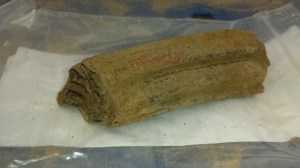
A fossil horse tooth from Natural Trap Cave. The grinding surface is on the left. Only about 1/5 of this tooth stuck above the gum line.
Paleontologists use the height of the tooth (its hypsodonty) to distinguish animals that grazed from those that ate bushes, shrubs, and trees (called browsing).
Isotopically, grasses look different from leaves from bushes. This chemical difference gets recorded into teeth.
The authors of this paper use data from an ocean core collected in the delta of the Amazon River to determine when the Amazon River began to deposit sediments into the ocean and also when it began to carry sediments all the way from the Andes Mountains.Continue reading “Birth of the Amazon River – #365papers – 2017 – 80”
Rapid global warming in Earth’s past had occurred more than once. The most commonly studied episode occurred 55 million years ago, at the boundary between the Paleocene and Eocene epochs (Paleocene Eocene Thermal Maximum, PETM). Several other episodes have happened, including the ETM2 and H2 episodes which are discussed in this paper.

 Penny Higgins - Storyteller • Artist • Scientist