N is for Notoparamys
 Notoparamys was a marmot-sized rodent that lived in the earliest Uintan. It is a member of the rodent group Ischyromyidae, which included some arboreal (climbing) rodents.
Penny Higgins - Storyteller • Artist • Scientist
Combining Science and Joyful Creativity
N is for Notoparamys
Notoparamys was a marmot-sized rodent that lived in the earliest Uintan. It is a member of the rodent group Ischyromyidae, which included some arboreal (climbing) rodents.
M is for Macrotarsius
 Macrotarsius is a fossil primate closely related to and similar in appearance to modern tarsiers.

Modern tarsiers are unique in the structure of their back foot, specifically the ankle bones (the tarsals), hence their common name of ‘tarsier.’
L is for Leptotragulus
 Leptotragulus was a hoofed mammal that would have roughly looked like a deer, but were more closely related to camels and llamas. They were a member of a group called the Protoceratidae, that were unique in having horns on their snouts.
Here is a relative of Leptotragulus, Synthetoceras:

K is for Knightomys
 Knightomys is a rodent. The mys part of the name translates roughly to ‘mouse.’ The Knight part likely refers to Charles Knight, an important paleontologist in the history of Wyoming, for whom many species are named.
J is for Janimus
 Janimus is a rodent. It is thought that it is in the same family as modern beavers, despite some differences. It’s teeny tiny molar teeth were each about 1 mm square. Janimus in life may have been about the size of a large squirrel.
I is for Isectolophus
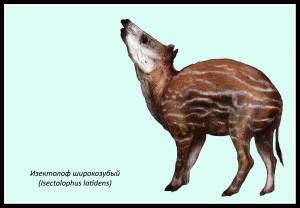
Isectolophus is another hoofed mammal. There seem to have been many in the middle Eocene. (The reality is that it’s probably a collection bias – hoofed mammals are bigger and easier for paleontologists to spot than little rodents and primates and things, but that’s a different story.)
Isectolophus is most closely related to modern tapirs.
H is for Harpagolestes
 So far, every fossil I’ve talked about has been a large, hoofed mammal. Well, something has to eat all those herbivores.
Thus enter Harpagolestes.

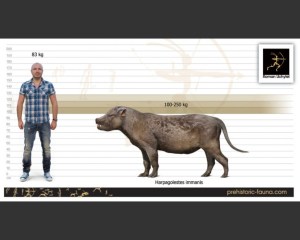
Harpagolestes was a bear-sized, hyena-like mesonychid carnivore. For a long time, scientists thought that mesonychid carnivores were the ancestors of modern whales due to similarities in the teeth. (New analyses put whales more closely related to hoofed mammals.)
G is for Grangeria.
 Grangeria is a large hoofed mammal closely related to horses that lived during the middle Eocene. Whether or not Grangeria is a valid name, or that members of Grangeria are better called Eomoropus is a topic of discussion in paleontology.
Nevertheless, Grangeria is a member of a group called chalicotheres, which were unusual hoofed mammals in that their front legs were proportionately very long, and they may have knuckle-walked like modern anteaters.
F is for Forstercooperia
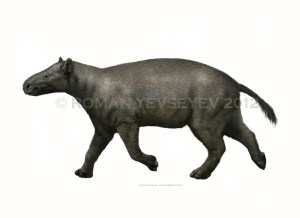
 Forstercooperia is a rhinocerotid (a hoofed mammal closely related to rhinos) from the Eocene of Asia. Originally, this name was applied to a similar mammal from the Uinta Formation of Utah, but the Utahn specimens have since been renamed Uintaceras (“Uinta horn”)
E is for Epihippus.
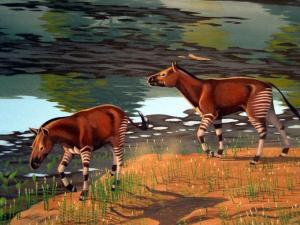
 Epihippus is a fossil horse. You know it’s a horse because of the ‘hippus’ in its name, which means ‘horse.’
These horses were smaller than modern horses and possessed four hoofed toes on its front legs and three hoofed toes on its back legs.

 Penny Higgins - Storyteller • Artist • Scientist