X is for Xylotitan – #AtoZChallenge – 2017 – Uintan Mammals

X is for Xylotitan

Xylotitan is a new species of brotothere, a hoofed mammal related to horses and rhinos. Brototheres were giant mammals, considered the earliest of the ‘megaherbivores.’

Among brototheres, Xylotitan is among the smallest, only about the size of a large tapir.

This new species was named in 2016 by Mihlbachler and Samuels.

V is for Viverravus – #AtoZChallenge – 2017 – Uintan Mammals

V is for Viverravus

Viverravus is a carnivorous mammal. Interestingly, I have written up Viverravus in an earlier A to Z Challenge about Paleocene mammals, here. Viverravus as a genus lasted many millions of years.

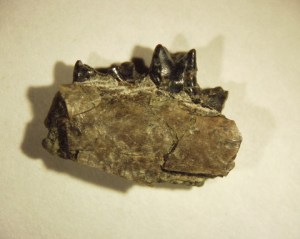
Here is an early Eocene Viverravus from the Yale-Peabody Museum:

Viverravus sp. YPM VPPU 022652. right ramus with P/4, M/1

U is for Uintatherium – #AtoZChallenge – 2017 – Uintan Mammals

U is for Uintatherium

Uintatherium was a massive hoofed mammal that lived during the Eocene epoch. Superficially, they were rather rhinoceros-like, though they were not related.

A reconstruction of Uintatherium.
Credit: Dmitry Bogdanov CC 3.0 By SA

Notably, Uintatheres had many horns and protuberances on their skulls, in addition to robust tusks.

Cast of Uintatherium anceps (Leidy, 1872) – syn. Dinoceras mirabile (Marsh 1872) skull, neck vertebrae.
Credit: Jebulon [Public Domain]

T is for Tapocyon – #AtoZChallenge – 2017 – Uintan Mammals

T is for Tapocyon

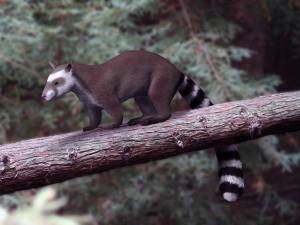
Tapocyon is a genus of miacid carnivores that lived during the Paleocene and Eocene epochs of North America. It was a climbing mammal that likely spent a great amount of time in trees.

Life reconstruction of Tapocyon robustus.
Credit: Nobu Tamura CC 4.0 By SA

O is if Ourayia – #AtoZChallenge – 2017 – Uintan Mammals

O is for Ourayia

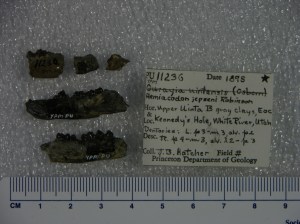
Ourayia is a fossil primate, which, like Notoparamys, is related to tarsiers. Like many fossil mammals, it is best known for its teeth.

VPPU.011236: Ourayia uintensis: HYPODIGM. Utah. Uintah County. Kennedy’s Hole, Uinta Basin. Princeton 1895 Hatcher Expedition. Coll: Hatcher, J. B. 25 Mar 1895. Tertiary. Late Eocene. Uintan. Uinta Fm. Middle Uinta B.
Courtesy of the Peabody Museum of Natural History,
Division of Vertebrate Paleontology, Yale University; peabody.yale.edu