Scientist (Paleontology, Geochemistry, Geology); Writer (Speculative and Science Fiction, plus technical and non-technical Science); Mom to great boy on the Autism spectrum; possessor of too many hobbies.
Yerbua is a genus of hopping rodent. The name “Yerbua” was coined in 1778, but has since been replaced with “Pedetes.” I have this name written down as a Uintan mammal, but Pedetes is a modern taxon from Africa, so I’m not sure what happened. But here you go:
Spring Hare, Pedetes capensis. Credit: Bernard DuPont CC 2.0 By-SA
Homo floresiensis is a species of the genus Homo that was discovered and descibed over 10 years ago. It is a species of small stature from the island of Flores. Many have argued about its placement with other members of the genus Homo and why it might have been so small.
Xylotitan is a new species of brotothere, a hoofed mammal related to horses and rhinos. Brototheres were giant mammals, considered the earliest of the ‘megaherbivores.’
Among brototheres, Xylotitan is among the smallest, only about the size of a large tapir.
This paper is the description of a juvenile turtle attributed to the species Manchurochelys manchoukuoensis. The authors compare this new specimen with several other species of turtle from the Jehol Biota and other faunas of similar age to argue that 1) it is a juvenile and 2) that their species attribution is correct.Continue reading “An Early Cretaceous Baby Turtle! – #365papers – 2017 – 117”
Viverravus is a carnivorous mammal. Interestingly, I have written up Viverravus in an earlier A to Z Challenge about Paleocene mammals, here. Viverravus as a genus lasted many millions of years.
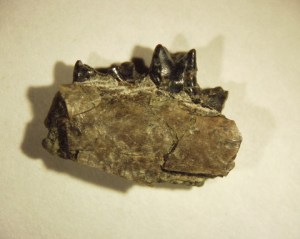
Here is an early Eocene Viverravus from the Yale-Peabody Museum:
Viverravus sp. YPM VPPU 022652. right ramus with P/4, M/1
I’ve been doing so well. Papers read and posts written for 107 papers thus far this year. Then suddenly… Silence.
It’s not that I haven’t been thinking about science. Quite the contrary.
I haven’t been reading or posting because I went there. I marched. In Washington DC. With 40,000 of my science colleagues.
With planning the trip, travel, and actually being there and trying to take in all of Washington’s museums and sights, well… It just didn’t happen. Nevertheless, I will catch up. I have papers selected. I’m ready to read.
Uintatherium was a massive hoofed mammal that lived during the Eocene epoch. Superficially, they were rather rhinoceros-like, though they were not related.
A reconstruction of Uintatherium. Credit: Dmitry Bogdanov CC 3.0 By SA
Notably, Uintatheres had many horns and protuberances on their skulls, in addition to robust tusks.

 Yerbua is a genus of hopping rodent. The name “Yerbua” was coined in 1778, but has since been replaced with “Pedetes.” I have this name written down as a Uintan mammal, but Pedetes is a modern taxon from Africa, so I’m not sure what happened. But here you go:
_(6042009463).jpg)






 Penny Higgins - Storyteller • Artist • Scientist