A New Species in the Family Probovisassistidae (Cnidaria, Anthozoa), from the Eocene of the Uinta Basin, Utah
by Hoosier Gauntlet
(This is a book is available for $0.99 on Amazon for Kindle. It was written in about six hours in response to this challenge on the RocNaNo blog. Feel free to read the book here and review it over on Amazon. That’d be really cool.)
Foreword ( by Penny Higgins)
This book was written for fun. My motivation was a writing challenge put forth by Tim Myers on a blog called “A Newbie’s Guide to Writing.” The challenge can be found at this URL.
The principle is to write, format, and self-publish a book in eight hours. This is my attempt. The concept of this book started with an old glove I found last summer while I was out doing some real paleontology.
Please realize that this book is meant to be humorous. It may be of use, too. The concepts I use to define my new species of Bovisassist are the same principles used to define and describe real fossil species as well. Maybe this can be useful in a classroom.
Or maybe not.
1: Introduction
The existence of Eubosassist claymaytus, and indeed the entire Order Bosassistia, is nearly inexplicable. Only one living specimen remains, and this particular one is intent upon helping consumers easily add pasta to their meat dishes. Only recently have scientists been able to understand the Eubosassist is actually a cnidarian, though it does lack the characteristic cnidocysts that unite the rest of the Cnidaria.
Only recently have fossils been discovered that provide insight into the evolutionary origins of Eubosassist. Described in this paper is the most primitive ancestor found to date.
2: Current Knowledge
Nate Rile, in 2001, discovered Bovisassist praenitrilus in a Miocene quarry in Alberta Canada. This was the first fossil evidence of the evolution of Eubosassist. More recently, Ma Dee-Kao (2008) discovered Probovisassist in northern Maine, and named the Family Probovisassistidae for the fossil relatives of Eubosassist. Dee-Kao (2008) also erected the Family Eubosassistidae for Eubosassist.
2.1. Eubosassistidae
The Eubosassistidae includes only the extant Eubosassist. Only one individual is still alive representing this taxon.
While superficially appearing like a four-fingered human hand, Eubosassist is clearly an invertebrate belonging to the Phylum Cnidaria. It’s closest living relatives are sea anemones (see Velvet Beauvine’s 2005 paper).

Members of the Eubosassistidae are characterized by having a smooth, rubbery, white integument. Eubosassist stands on a red collar that surrounds its mouth. Parts of this collar act as stiffened foot pads, enabling Eubosassist to walk on land.
Eubosassist has three appendages held nearly vertically, and a fourth appendage held at a slight angle to its right, causing it to appear like a left hand with three fingers and a thumb. The center of the body has two eye spots and an incurrent slit. Eubosassist apparently also reproduces by budding off polyps from the reddish swelling between the eye spots and incurrent slit (though this has not been observed).
2.2. Probovisassistidae
The members of Probovisassistidae are known only from fossil evidence. Prior to this study, two fossil members were known: Probovisassist nitrilus and Bovisassist praenitrilus. The fossilized specimens lack evidence for eye spots and the incurrent slit seen in Eubosassist. However, there is a simple collar around the mouth opening, which may have contained foot pads similar to Eubosassist.
Probovisassist, like Eubosassist, has an external, smooth, rubbery integument. There is no obvious internal structure composed of cellulosic fibers. Such a structure is present in Bovisassist, though overlain over about half of the organism’s surface with the rubbery integument shared with Eubosassist and Probovisassist.
3: Bovisassist primaevus
In the summer of 2013, a specimen was discovered in Eocene rocks of Utah’s Uinta basin. It was immediately obvious that this represented a new member of the Order Bosassistia.

3.1. Systematic Paleontology
Kingdom Animalia
Phylum Cnidaria
Class Anthozoa
Order Bosassistia
Family Probovisassistidae
Genus Bovisassist gen. nov.
Species Bovisassist primaevus sp. nov.
3.2. Etymology
Bovisassist Dee-Kao 2008. Named for its similarity to Eubosassist, which is known for his interest in helping with the preparation of meals involving ground beef.
Bovisassist primaevus new genus. Named for its appearance as the oldest and most primitive member of the Order Bosassistia.
3.3. Diagnosis
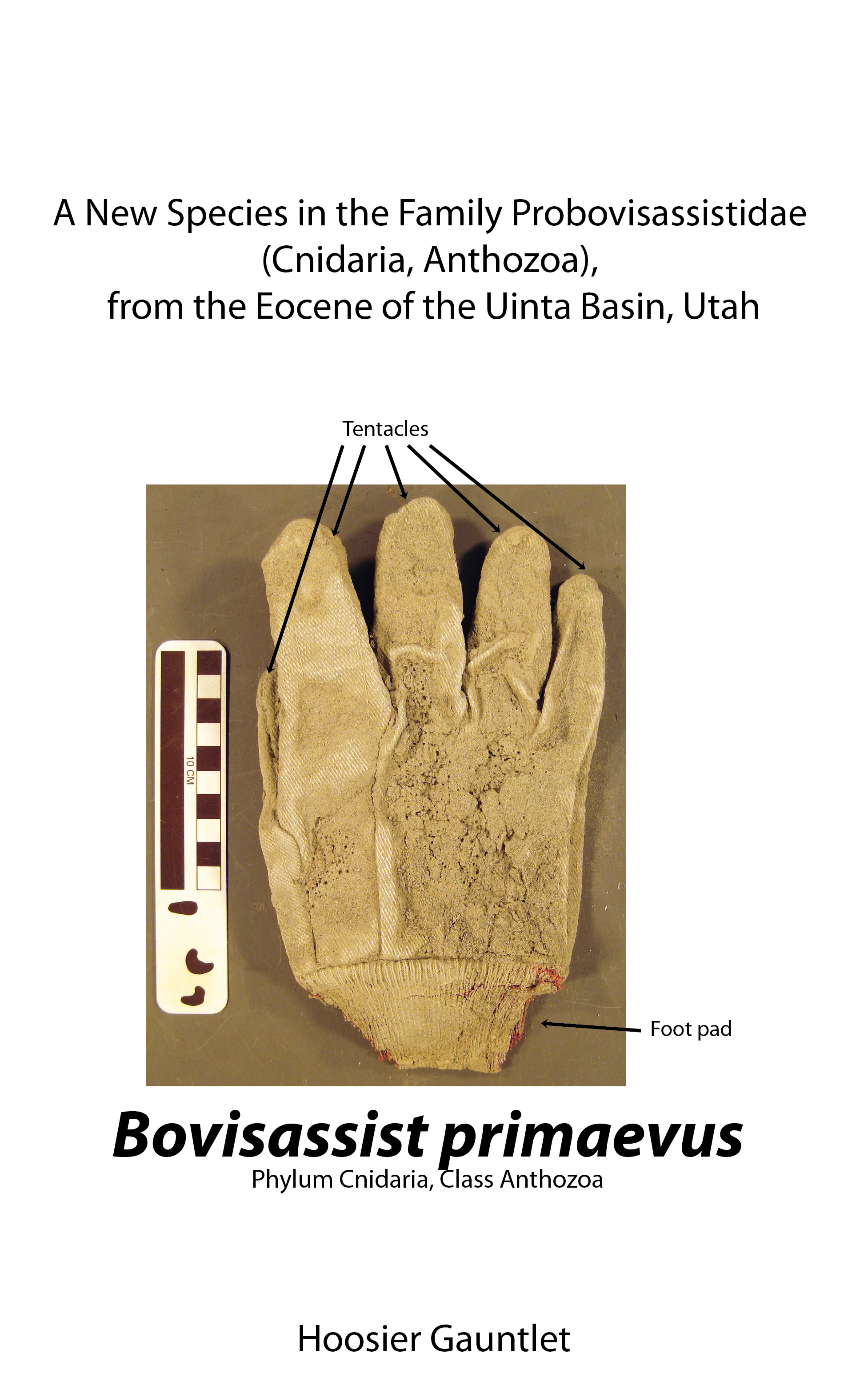
Bovisassist primaevus is distinguished from all other members of the Order Bosassistia by its lack of rubbery integument. Its entire body is supported by a network of cellulosic fibers that give it its hand-like shape. B. primaevus has five tentacles, four held vertically and one offset from the others.
3.4. Description
Below are images of B. primaevus.

The posterior surface was exposed and has experienced significant weathering.
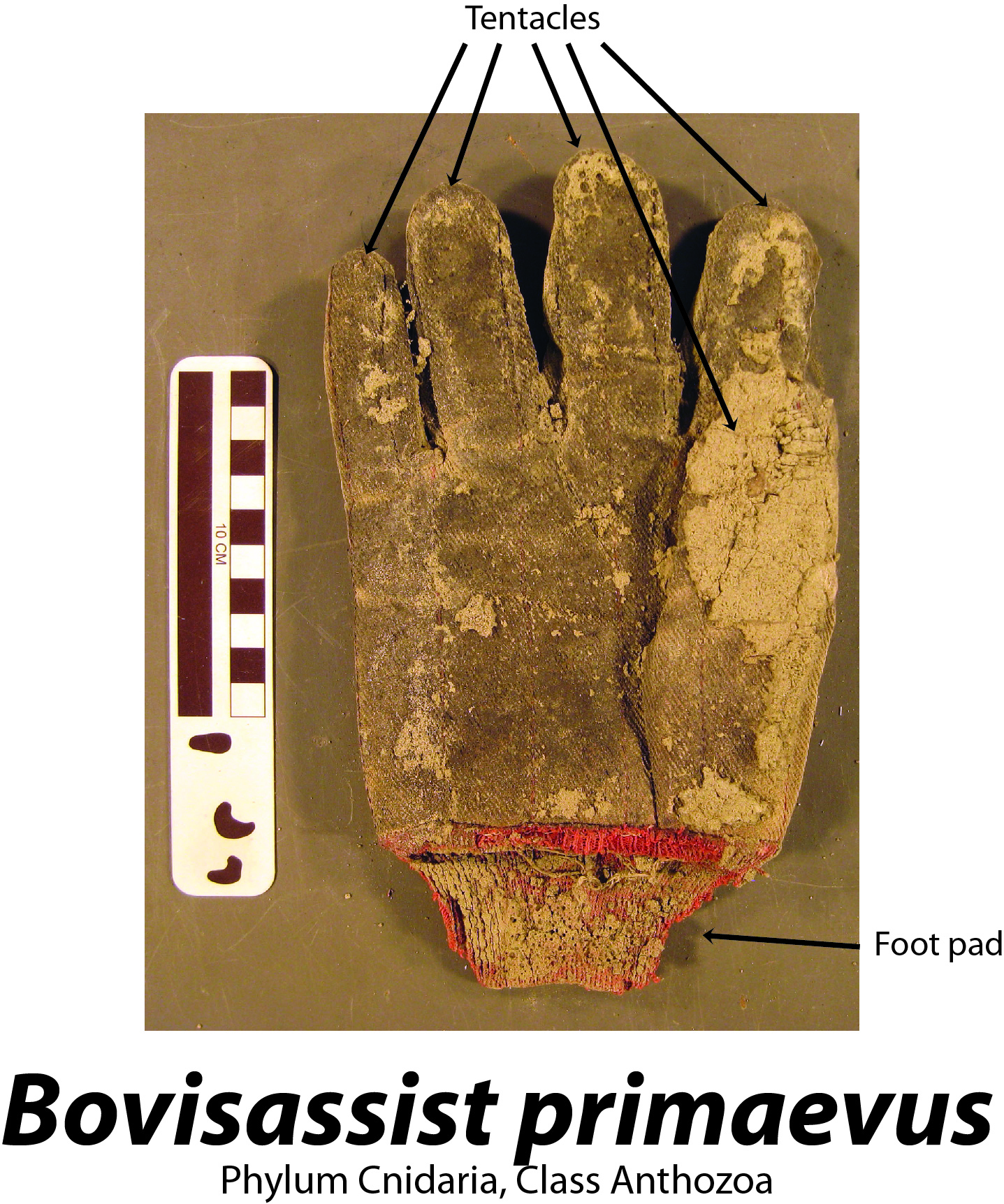
On the anterior surface, there is no evidence of an incurrent slit or eye spots.
Around the base is a red-colored color similar to that of the modern Eubosassist. Though the red collar was somewhat damaged there is still evidence of the foot pads that likely were once there.

Close examination of the red collar reveals where the mouth was previously.
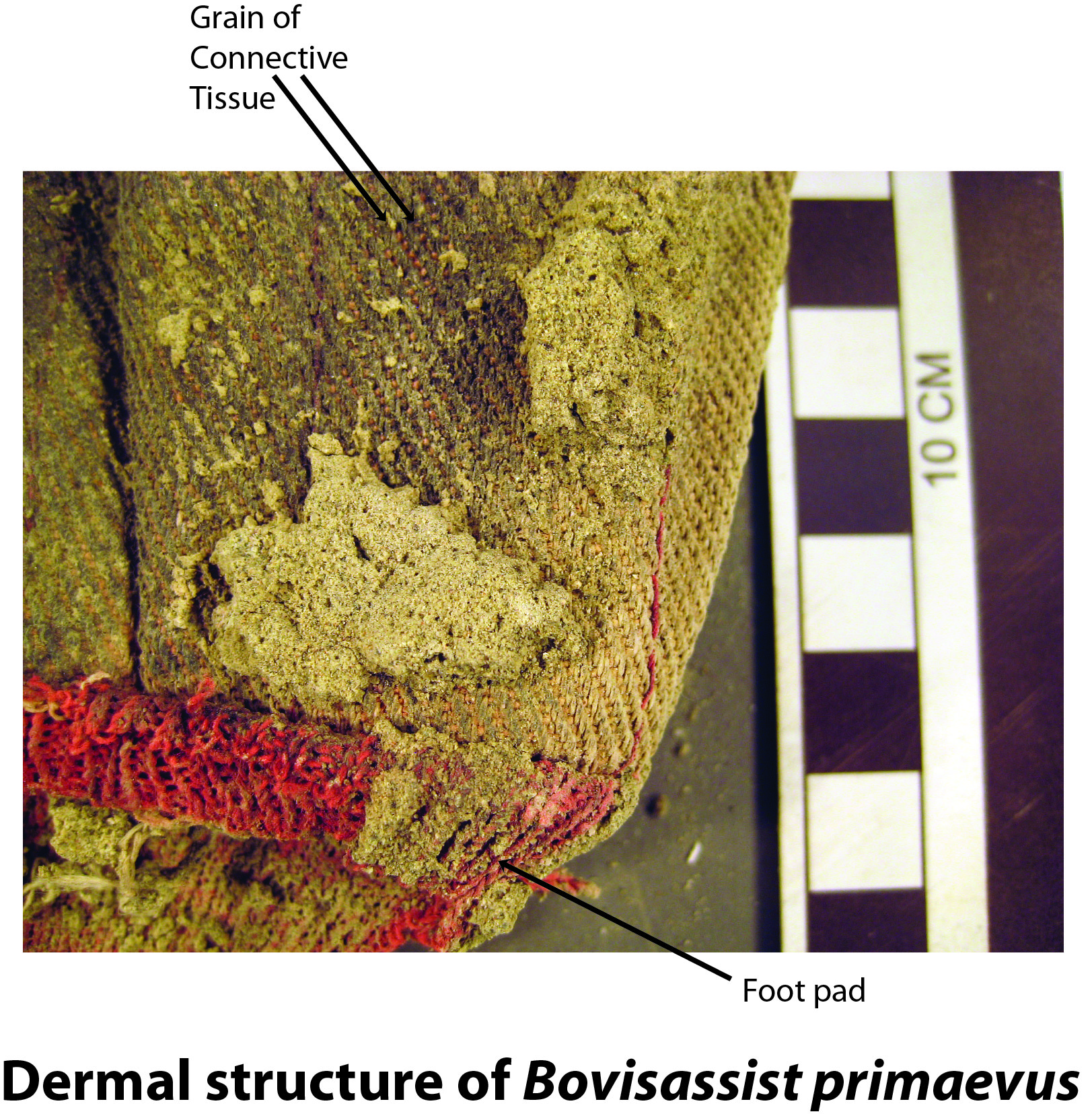
A close up of the interwoven fibers of cellulosic connective tissue reveals a similar pattern to that of Bovisassist praenitrilus.
4: Discussion
This specimen is the oldest known representative of the Order Bosassistidae. It offered a new opportunity to examine the evolutionary history of bosassistids.
4.1. Cladistic Analysis
Cladistic analysis was used to verify the evolutionary relationships among the four species known to belong to the Order Bosassistidae, Eubosassist claymaytus, Probovisassist nitrilus, Bovisassist praenitrilus, and B. primaevus.

Important characters that affected the outcome of cladistic analysis include, the presence or absence of the enlarged red collar with foot pads, and the number of tentacles present. The presence of the red collar on B. primaevus implies that the red foot pads of Eubosassist are not an advanced feature. However, the reduction of tentacles in Eubosassist remains a diagnostic character for that species.
4.2. Validity of the Probovisassistidae
Prior to this analysis, Probovisassist and Bovisassist were considered part of a monophyletic group (Family Probovisassistidae), with a sister taxon relationship with Eubosassist. This new analysis suggests that the Family Probovisassistidae is in fact paraphyletic.
I suggest that Probovisassist might best be placed in the Family Eubosassistidae with Eubosassist, united by the lack of cellulosic connective tissue in the dermal layers. The Probovisassistidae are best united by the presence of this connective tissue layer. However, even with this scheme, the Probovisassistidae remains paraphyletic unless additional steps are added to the cladogram.
5: Conclusion
Bovisassist primaevus is the oldest, most primitive member of the Order Bosassistia. It demonstrates that a layer of cellulosic connective tissue is primitive for the Order, as well as the thick red collar around the mouth of the organism. With this, I suggest a slight revision of the definitions of the families within Bosassistia, reflecting the fact that it is only the presence or absence of this connective tissue that is best for distinguishing the two groups.

 Penny Higgins - Storyteller • Artist • Scientist