
I’m thinking a lot about tooth growth right now. It’s an important part of nearly every project I work on and is of great importance for projects I have interns working on at the moment.
I use the chemistry of tooth enamel to understand the biology of an animal during some part of its life (the part during which the tooth is growing). I use carbon and oxygen in the tooth enamel to understand diet and environmental conditions. I have other blog posts that discuss how this works in the Stable Isotopes category, so I won’t say more here.
What’s important here is that teeth, especially in mammals, grow during a specific part of the mammal’s life and they always grow from crown (the tip or grinding surface of the tooth) to root. They grow incrementally – a little bit at a time – until the whole tooth is formed. The chemical signals that I study are recorded in a more-or-less continuous record that I can then look at by taking multiple samples along the entire height of the tooth.
For many modern mammals, the period over which each tooth grows is known.

As you can see, with both horses and bison, if we have the right tooth (usually the third molar – the equivalent of our wisdom tooth), we can look at everything that happened over at least one and a half years of the individual’s life.
But what does this look like? How does it grow?
All teeth have three basic components. The enamel is on the outside. Tooth enamel is a mineral. It’s essentially a rock. This is why teeth are so often preserved in the fossil record. It’s very, very hard and must be so because that’s where food is all ground up. Just inside of that is the softer, but still mineral, dentine. Inside of that is the pulp cavity, which in life is full of blood vessels and nerves. If you ever have a cavity that eats through the enamel and dentine and into the pulp cavity, that’s when you’re getting a root canal.
Around the tooth is cementum, which is relatively minor in humans, but is of greater importance in plant-eating mammals.

Human teeth are pretty simple. Most other mammals are a little more complex. Take this burro (donkey) for example:

In the case of a donkey, the tooth is very tall and the enamel is folded deeply. This is the case for most grazing mammals. Cementum fills the gaps between folds, keeping the tooth strong.

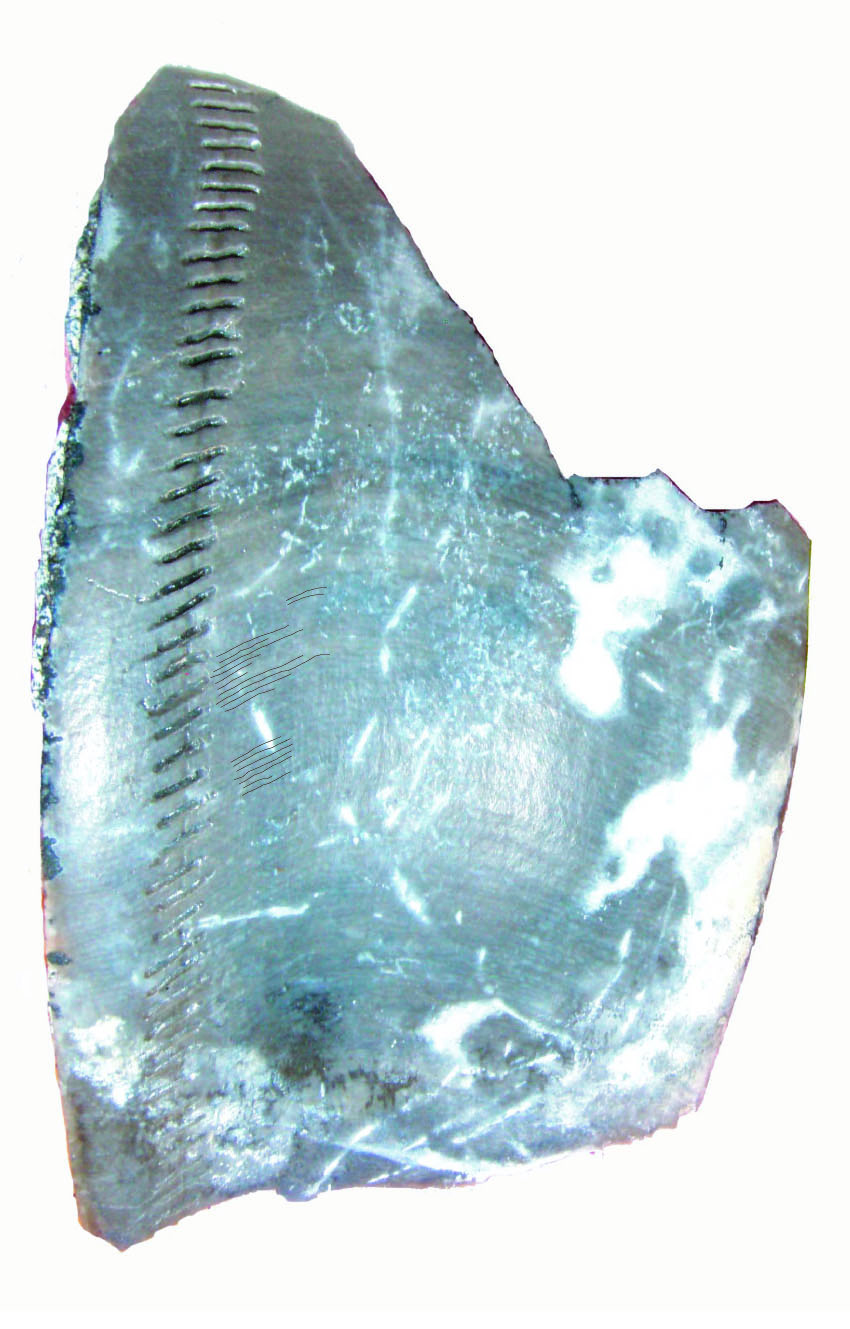
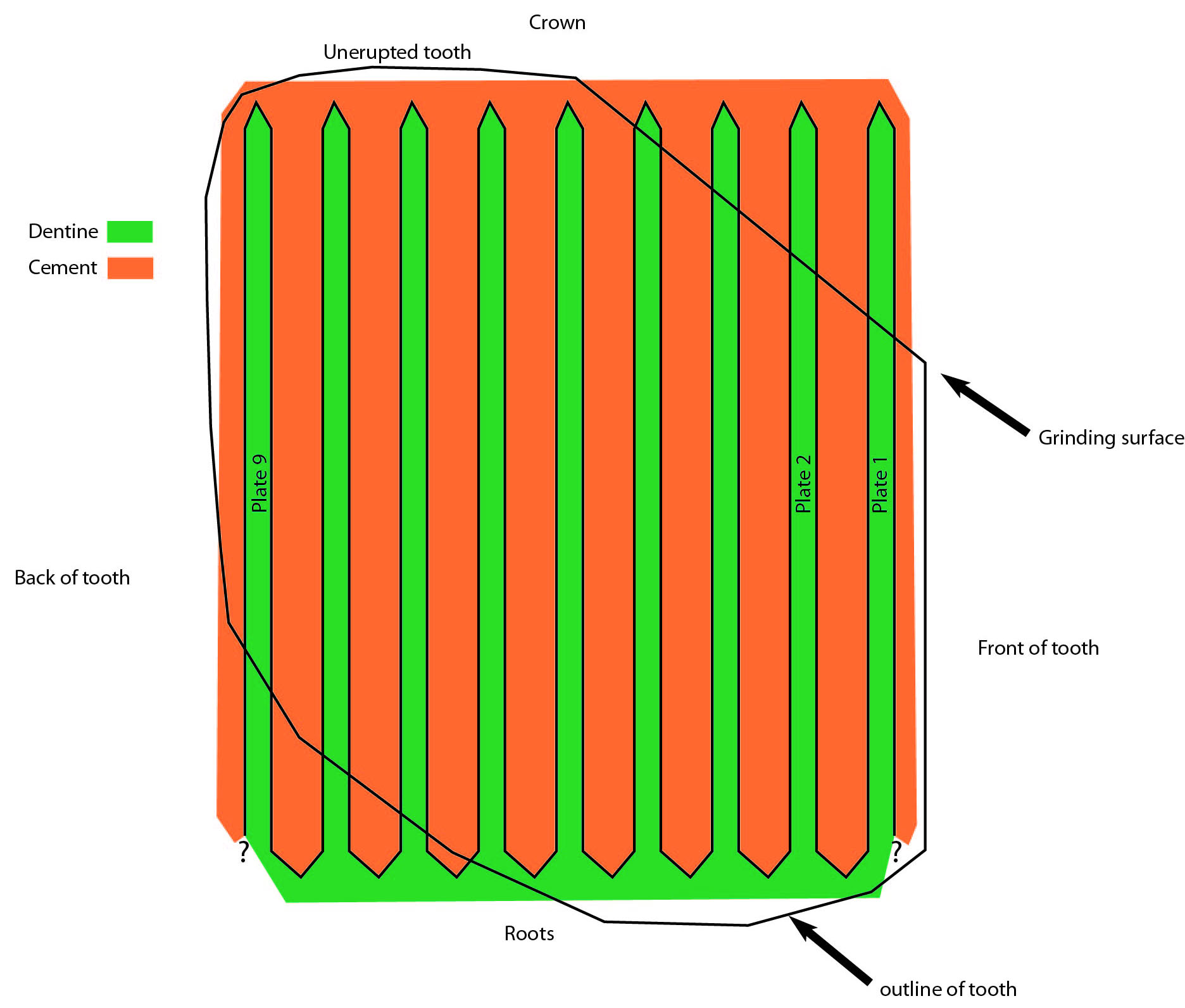
Other mammals, like mammoths, can be even crazier, with massive plates being formed from the alternation of dentine and cementum between thinner layers of enamel.
But how?, you say. How do we grow teeth if they’re minerals?
There are special cells in the jaw that function to form enamel. These are called ameloblasts. Ameloblasts start out all lined up along what later is the contact between the enamel and the dentine (called the enamel-dentine junction or EDJ). Each day, they grow a little bit of enamel mineral in a prism, directly away from the EDJ. The ameloblasts at the tip of the tooth start growing first, then others start growing later, down the length of the tooth toward the root.

Growth continues down the entire length of the tooth toward the root. It gets a little simpler along the sides of the teeth.

The same pattern is seen in dentine, only that the dentine-mineral forming cells (this time called odontoblasts) grow from the EDJ in toward the pulp cavity.
In either case, the tooth forms by mineralizing and thickening the enamel and dentine first at the very tip of the tooth, then commencing toward the root.
Notice that the daily growth fronts (the dark blue lines) are at an angle with respect to the EDJ and the surface of the tooth (pink line). The way the daily growth fronts are depicted in these drawings are actually probably incorrect. In most cases, the angle between the EDJ and the growth fronts is much, much smaller, bringing the daily growth lines closer to parallel with the EDJ.
Now consider how I sample the tooth enamel for chemical analysis. When I collect the powdered enamel, I drill into the tooth, perpendicular to the surface, to a depth as close as I dare to the EDJ.
I illustrate the problem on the drawing below. The sample pit traverses from one increment to another, increments being defined on each side by daily growth lines. Several day’s worth of growth may be collected in one sample pit. If the angle between the EDJ and the growth lines is shallower, even more time may be sampled in one drilled pit. In modern elephants, these lines can be nearly parallel to the EDJ.
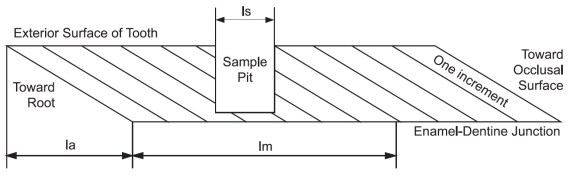
Thus one of the problems we face is with ‘time averaging,’ the idea that a single sample probably includes many days, if not months (depending on the size of the tooth and how quickly if grew). We have to keep this in mind when interpreting our chemical data.
These are the kinds of things I think about every day. The chemistry of the teeth tells me something about the animal’s life, but the very structure of the teeth does as well. I can’t very well understand the chemistry and its implications if I don’t understand how the tooth itself formed.
Yup, it’s always something.

 Penny Higgins - Storyteller • Artist • Scientist