
Sometimes in movies, the scenery is so fantastical that it clearly must be something spawned from the imagination of an artist. One thing I love about being a geologist is the knowledge that some of these places really do exist. Sometimes they’re as fantastic as they appear to be in the movies, and sometimes, it’s all about clever shooting angles. Either way, it’s always a great opportunity to introduce people to some of the geologic wonders of our world.

A lot of the movie John Carter was shot in the deserts of the southwestern United States. This is the place where I learned geology, so I smiled a lot through the film as I recognized several of the vistas. Every time I recognized a place, my brain instantly pulled up the old files on the geologic history of that place.
One such place, Shiprock (which only makes a momentary appearance), gave me an audible chuckle. My introduction to Shiprock as a student was one of the things that solidified in my mind that to be a geologist was what I wanted to do.

Now, when I was an undergraduate, Shiprock actually appeared in almost every single geology textbook (and it still does, really). It was almost always described as a ‘volcanic neck’ or ‘volcanic plug,’ or that which remains after most of a volcano has eroded away, leaving only the core of the volcano behind. This was supposed to be the original channel through which the magma flowed prior to erupting at the earth’s surface.
Well, one of my professors wanted to set that straight. Clearly those idiots writing the textbooks had never actually visited the place. Shiprock is no volcanic neck, he announced. It was better described as a ‘geo-fart.’ Well, this made an impression on me and my classmates, and to this day, I can’t look at a photo of Shiprock without thinking about geo-farts and giggling a little bit.
It is actually a rather apt description to call it a geo-fart. The technical term is ‘diatreme,’ which is a ‘breccia-filled volcanic pipe that was formed by a gaseous explosion.’ Well that’s a mouth full. In regular English, that means that there was a big gaseous eruption – explosive or fart-like, if you will – where lots of angular bits of rock were shot out of a pipe-like structure in the Earth. Rocks fell back in. Things were hot. Some rocks were melted. The end result is this structure, like a volcanic neck, but that is full of jumbled up bits of formerly molten rocks and other bits and pieces all stuck together. (The word ‘breccia’ [pronounced brech-a] refers to a rock composed of angular bits of other rocks all jumbled and fused together.) When the exploding is done, all the softer rock surrounding the newly filled pipe-like structure erodes away, leaving a huge rock that looks a little like a Spanish galleon.

So it must have been a pretty exciting day when Shiprock formed, though it certainly didn’t look much like it does today. It’s really no surprise that something like a geo-fart occurred in the Southwest. There’s volcanic activity everywhere, a lot of which involved lots of gaseous urping and the tossing in the air of lava bits. That’s how all those cinder cones out there formed. (As an aside, one such cinder cone is called SP Crater. Google it and have a chuckle with me!)


OK, but what about those ‘walls’ coming off of Shiprock? Those are real and they formed at or around the same time that Shiprock itself formed. In geology, we have a term for these. We call them dikes (or dykes, depending upon which side of the Atlantic you live on). Dikes are basically walls of volcanic material cut through existing rock layers. You can imagine that while the pipe that later became Shiprock was busy blowing up, that there would be some cracks extending from it. These cracks filled up with volcanic material, forming the dikes. Since the dikes (and volcanic material in general) are more difficult to erode than the softer sandstones that they cut through, they wind up standing like walls and towers after some erosion has taken place. Later, these walls make a great backdrop for a great movie!
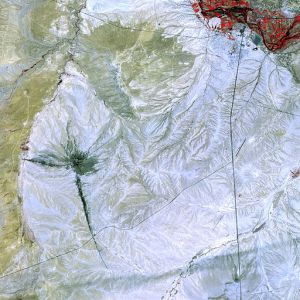
OK, so there it is, the first installment of “Geology in the Movies.” Next time you’re watching John Carter, I hope you giggle when Shiprock appears, just as I did. And when the person next to you asks what’s so funny, you can tell them that you just saw a geo-fart.

 Penny Higgins - Storyteller • Artist • Scientist
Hi Penny, I painted the matte painting showing ship rock for the film John Carter. I had great fun turning that Geo- fart into a ruined martian city! It’s always makes my job easier if I have a good base to start with. Ship rock already looks martian esque is with it’s dykes. It didn’t take much to transform them into a ruined martian Viaduct.
LikeLike
That’s awesome! What a pleasure it is to meet you! The southwestern United States is a very surreal place already. The transformation to Mars was great! Thanks for stopping by!
LikeLike
Yeah I painted a few matte paintings around that area for a few films. There’s some fasinating Geology around those parts, it’s no wonder that they’ve featured in many films over the years. I love a good rock formation! (who doesn’t) Thanks for the info on your blog. Very interesting stuff!
LikeLike