
Have you ever looked at an elephant molar? I mean, really looked?

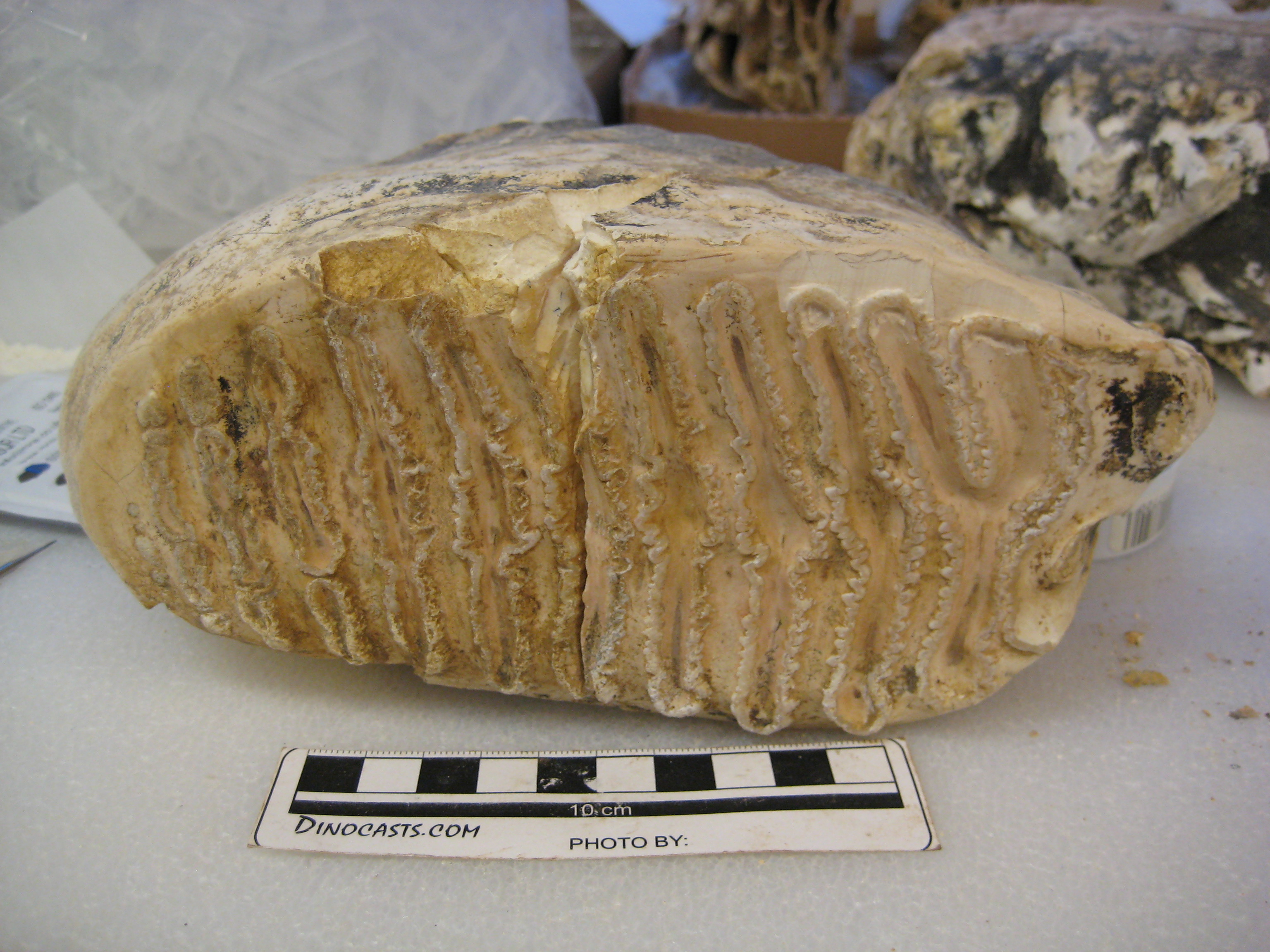
It’s a pretty funky thing to observe. They’re usually comprised of a series of plates – nothing like the teeth we’re more familiar with (i.e. our own) – with roots hanging down, seemingly one root per plate. Well, that’s kind of bizarre. To make matters even stranger, elephant teeth aren’t all in use at the same time. That is to say, usually it’s one or two teeth in use at one time in the mouth in each of the four quadrants (upper right, upper left, lower right, lower left) , while over the span of the elephant’s life there are a total of six or so adult teeth in each quadrant. They come in one at a time, conveyor-belt style, from back to front, falling out the front when they’re too worn to be of any use any more. Aged elephants can die from starvation, when the last of their molars (the M3) falls out and they have no teeth left.
We more-or-less know how the more ‘normal’ teeth of mammals form, like our own teeth. They start to mineralize at the crown (the chewing end), and lengthen incrementally toward the roots. The roots themselves are the last part to form (and in animals with ever-growing teeth, the root never forms, the tooth just keeps growing). People like me take advantage of this pattern of tooth growth because it records the body chemistry of the mammal over the period of time that the tooth mineralized. Sometimes this represents several months to years (and that’s the topic of another blog post). But how does an elephant tooth, comprised of all these plates, form?
Well, since that’s what I’m working on RIGHT NOW, I thought maybe I’d put out some information on what we (being me, and some of the folks at the Mammoth Site in Hot Springs, South Dakota) think might be the case. Then maybe I can tell you about how we’re planning to answer that question.
So there I was, at the Mammoth Site during the summer of 2011. I was given the opportunity to work with the molars of a mammoth, whose skull, unfortunately, had taken a bad fall, but had thereby released its teeth. I was presented with an M3 (still mineralizing) and an M2 (in wear).

Mammoth teeth are a lot like modern elephant teeth. They grow in plates and have roots to accompany each plate. If one were to draw a schematic of the tooth in cross section (which conveniently, I have), it would look like this:
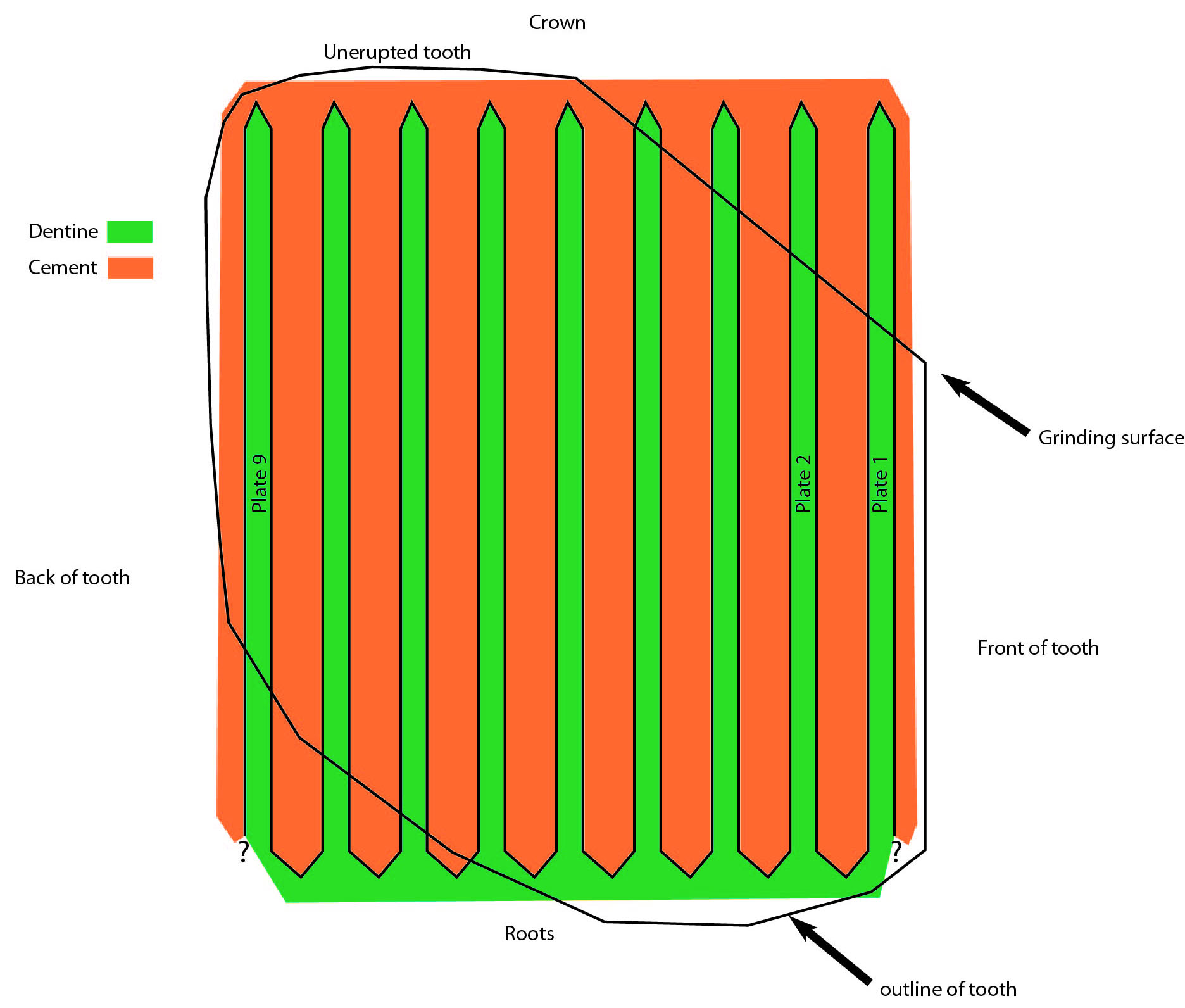
So here’s the crazy thing. I started clearing the cementum off of the M2 to expose the dentine (as seen in the picture below), and discovered that it is not one-root-per-plate, but that the roots, once closed, span between two plates (see the schematic above).
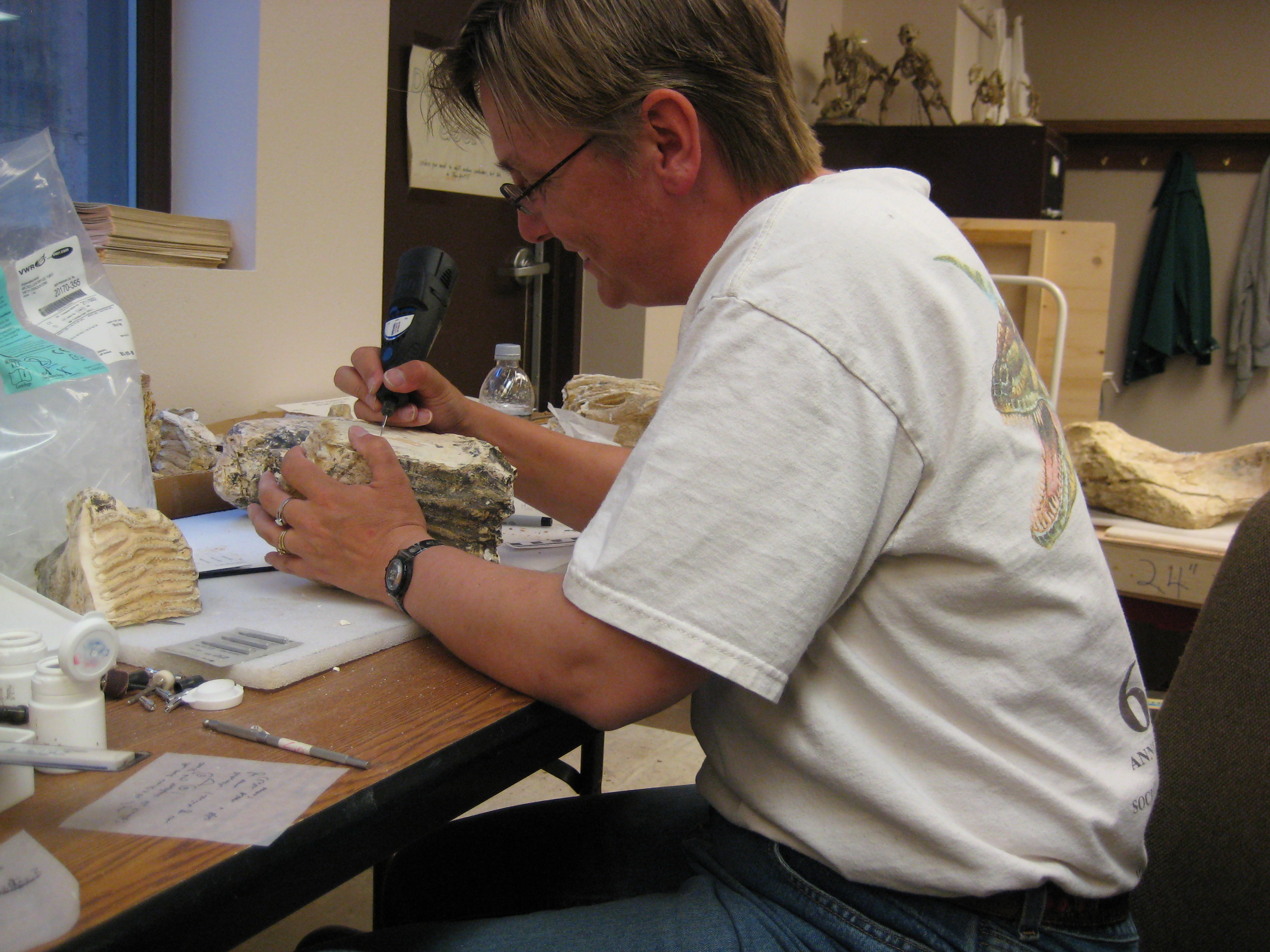
Our collective reaction was a resounding “Huh?” So we cleared all the cementum off of one side of the tooth to make sure we weren’t losing our minds. And this is what we saw:
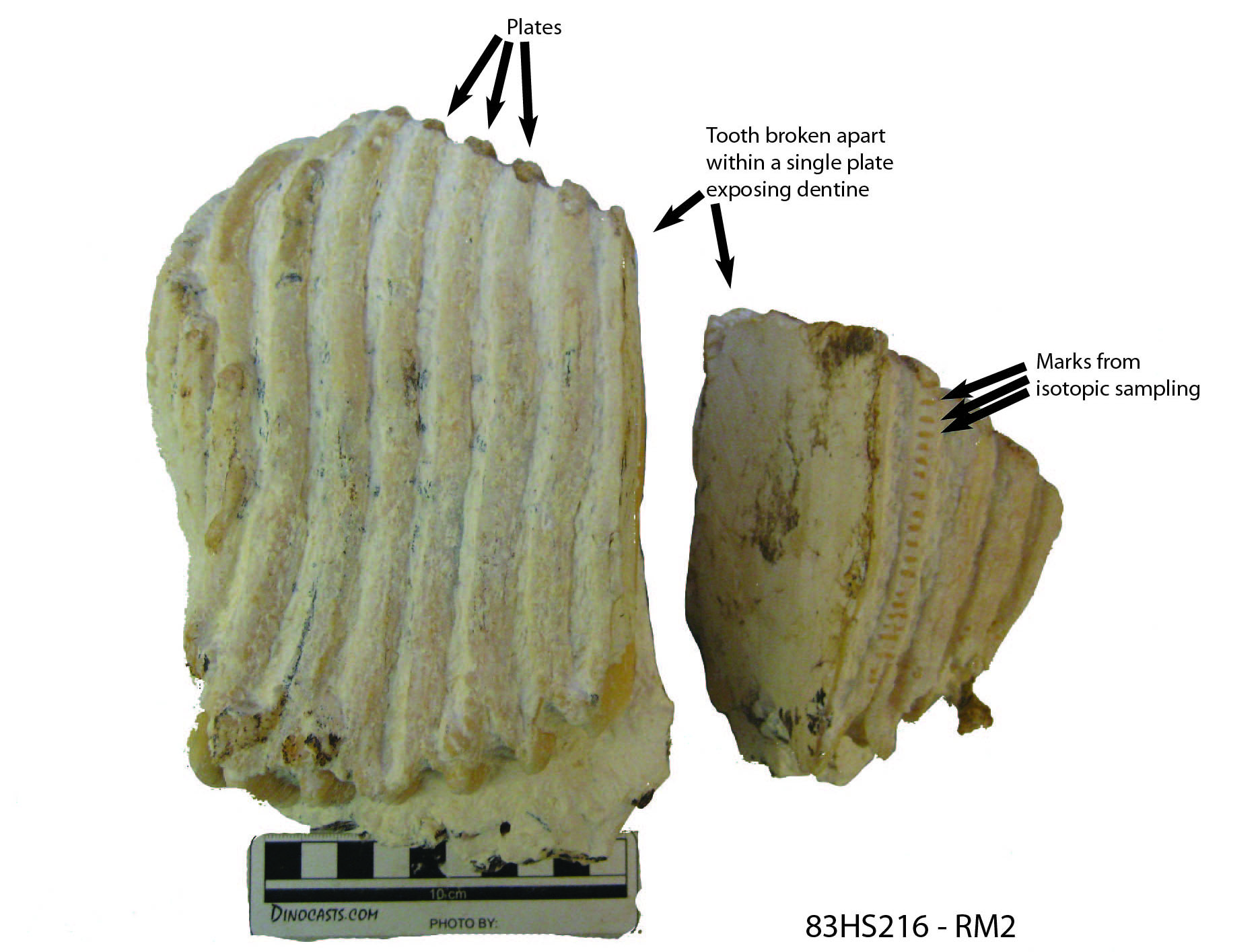
OK, so we’re still not much closer to understanding how mammoth – or elephant – teeth mineralize. But, using this M2, newly cleared of its cementum covering, we have begun the process of more detailed analysis. In the picture above, I’ve pointed out some sample pits for isotopic analysis. Well, remember what I said about the incremental growth of most ordinary mammal teeth. From crown to root, I said. Well, if that is true for this tooth, then we should see annual changes in the isotopic (geochemical) composition of the plate enamel as we move from crown to root. We see this in all other mammal teeth (and, like I said, I’ll explain that better in a later post). A correlary to that, is that we should see the SAME pattern from crown to root on EVERY plate if the mineralization pattern is always crown to root.
But what if it’s different? Since these teeth come in conveyor-belt fashion, and begin to wear at one end first, then maybe they mineralize one plate at at time, starting at the front. In that case, we wouldn’t expect to see any geochemical change from crown to root on any given plate, but might see a change from plate to plate. And of course, there’s the third hypothesis, that the mineralization front is at some angle with respect to the plates – maybe aligned with the grinding surface itself.
How do we do this? Lots and lots of isotopic samples. When that photo (above) was taken, I had only sampled plate 5. Now I’ve sampled plates 5, 6, 7, and 8, and I continue to sample whenever I can (usually while watching episodes of the Tudors on Netflix). Analyses are on-going. The results so far are interesting, but I can’t say much more. Stay tuned…
**************
Added August 30, 2012:
The conclusions of this study will be presented at the Society of Vertebrate Annual Meeting, in Raleigh, South Carolina on October 18, 2102:
Penny Higgins, Olga Potapova, and Larry Agenbroad: MINERALIZATION OF MAMMOTH MOLARS
Presented THURSDAY afternoon, OCTOBER 18, 2012
Poster session 2, Poster number 6

 Penny Higgins - Storyteller • Artist • Scientist