Friday Headlines: 12-28-12

Friday Headlines, December 28, 2012

THE LATEST IN THE GEOSCIENCES


ERUPTION MAY HAVE STARTED AT COPAHUE ON THE CHILE/ARGENTINA BORDER


Copahue is a stratovolcano on the border between Argentina and Chile.

This volcano is the result of subduction of the Pacific Plate below the South American Plate.

Subduction Zone

On December 22, a plume of ash was noted in an image from the GOES satellite.

Plume of ash from Copahue on December 22

Since then, alerts have been issued and the volcano is clearly erupting.

FIGHTING MAY HAVE SHAPED EVOLUTION OF HUMAN HAND

Michael Morgan and David Carrier of the University of Utah have shown that the human hand is not only a dexterous appendage, capable of precision gripping, but is also an effective weapon, but only when it is balled into a fist. When the fist is formed, it causes all the forces of a hit to be transmitted through the knuckles – a small surface area – resulting in a focused transmission of the power of the blow, maximizing the potential damage. The human hand can clinch a fist where the curled fingers leave no gaps at the palm of the hand (which would weaken the blow), and where the thumb can further buttress the fingers. No other animal can do this.

X-ray of a hand balled into a fist

PHOTO: MOUNT EVEREST, IN 3.8 BILLION PIXELS

You just have to go and look at this picture. It’s amazing!

Friday Headlines – 12-21-12

Friday Headlines, December 21, 2012

THE LATEST IN THE GEOSCIENCES


GRAIL MOON MISSION ENDS WITH A BANG

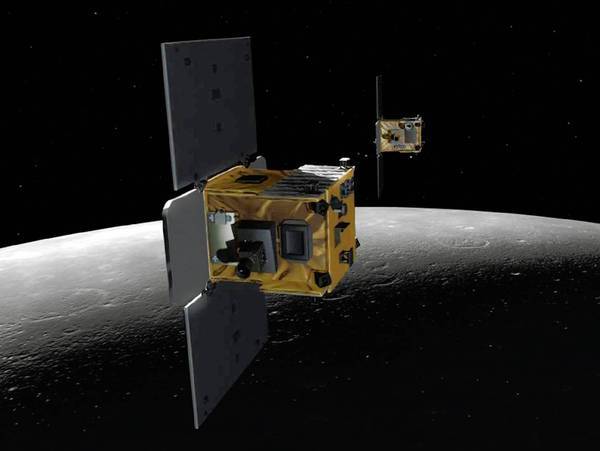
In September of 2011, NASA sent two small spacecraft into the orbit of the Moon. Nicknamed Ebb and Flow, these two tiny craft shared the same orbit, and remained in continuous contact with each other. The mission was called GRAIL (Gravity Recovery and Interior Laboratory), and the purpose was to measure minute fluctuations of the Moon’s gravitational field by precisely measuring changes in the relative velocities of the two spacecraft.

The two GRAIL satellites, Ebb and Flow. This is an artist’s depiction.
Bulk Density of the Lunar Highlands – courtesy of GRAIL

The mission ended on Monday, December 17, 2012, when Ebb and Flow were purposely sent to impact the Moon near its north pole. The craft were no longer at a sufficient altitude to continue scientific study and had not fuel remaining to gain the needed altitude. The impact site was named after the late astronaut Sally K. Ride, who was America’s first woman in space.

I think Sarcastic Rover said it all when the impacts were confirmed and the mission was officially over:


Speaking of things flying through space (and somehow appropriate given the recent reviews I’ve written about asteroid impact movies):

HUGE ASTEROID’S EARTH FLYBY CAUGHT ON VIDEO

The asteroid is called 4179 Toutatis, and was ‘videoed’ when it passed by Earth on December 12 and 13 at a distance of about 4.3 million miles (or 18 times farther than the Moon).


An image of Toutatis

The images were generated using radar images from NASA’s Deep Space Network antenna in Goldstone, CA.

The final headline for 12-21-12:

THE WORLD IS NOT GOING TO END TODAY.

It’s already tomorrow in some places. I don’t think we need to worry.

Or maybe we should:


Friday Headlines: 12-14-12

Friday Headlines, December 14, 2012

THE LATEST IN THE GEOSCIENCES


LAND CREATURES MIGHT NOT HAVE COME FROM THE SEA

Well, this is a little deceptive. What this headline conjures in the imagination is the traditional vision of the fish, dragging itself onto land, developing legs, and ultimately becoming human.

What’s being discussed here, however, is life before vertebrates. Life before bones. The oldest types of multi-cellular life, more than twice the age of that fish that crawled onto land. This new finding (probably pay-walled) is in reference to the Ediacara Fauna, which is thought to have been ancestral to modern organisms, vertebrate and invertebrate. It appears that the organisms of the Ediacara Fauna lived on land, not under water.

Ediacaran fossils are among the most bizarre looking fossils out there, causing paleontologists to scratch their heads for years. They seem to be soft-bodied animals that have been considered potentially related to primitive worms, or jellyfish, or maybe molluscs, all of which presumably would have lived in the ancient ocean.

In the new paper, Greg Retallack argues that the rocks that the fossils are found in are paleosols – which is a fancy term for a fossilized soil. Soils do not form under water. They are a land phenomenon. Retallack used many lines of evidence to support that he was looking at paleosols rather than a sea floor, including the rock texture (it looks more like wind-blown silt than ocean-floor clay), cracks from drying (definitely wouldn’t happen underwater), carbonate nodules (which are common in soils), and stable isotopic evidence.

This new interpretation affects how we think about the origins of multicellular life, because suddenly the earliest multi-cellular forms of life were already on land. It also affects how we interpret the lifestyles of the Ediacaran fossils. Suddenly, they’re not floating around any more and that changes the kinds of things an organism can do.

An important thing to think about here is that this does not mean that life originated on land. It also does not mean that multi-cellular live originated on land. What it means is that the earliest fossils of multi-cellular life that we have on Earth were land organisms. The earliest life-forms were all soft-bodies creatures. They don’t fossilize well, which is why we don’t have much of a record. Hard parts came about in Cambrian times (after the Ediacaran Fauna), and that’s when we suddenly have a great fossil record. There probably were soft-bodied organisms living in the oceans at the same time as the Ediacaran organisms – they just weren’t preserved.


BRILLIANT GEMINID METEOR SHOWER PEAKS TONIGHT (December 13)

The Geminids are a meteor shower that seems to radiate from within the Constellation Gemini. This meteor shower comes every year in early-to-mid December. We’re in luck this year, as it seems we’ll have a new moon, making the sky nice and dark and the meteors especially visible.

The Geminids are cool because they apparently arise from an asteroid (named Phaethon) rather than a comet like most other meteor showers. The orbit of Phaethon is much more like that of a comet than of a typical asteroid. Here’s a cool Java applet that shows its orbit. We know it’s not a comet because it lacks important features, like a tail, that comets have.

The Geminids will be just past their peak when this post goes live, but they should still be evident for a few more nights. Hopefully the skies will be clear so we can all go out and look for a while.
Introducing Friday Headlines

Friday Headlines is something I do in my introductory geology course to make Fridays more interesting and to keep the topic of the course relevant to the students. I put together a short PowerPoint presentation (10 minutes max) and tell them about two or three events in the geological sciences that have happened in the last week.

These events can be global happenings, like an earthquake or volcanic eruption; they could be the interesting findings of a freshly-published paper; or they could be some grand new discovery from NASA, like ice on Mercury or organic material on Mars. I’ve talked about global warming, peak oil, the arrest of geoscientists for incorrectly predicting earthquakes, and the Anthropocene.

What ever I choose, it is something interesting to the general public (thus, my students) and relevant to the geological sciences. My goal is to show students that things happen in the geosciences all the time, so that they understand that what I’m teaching them is actually useful in the real world.

Friday Headlines also make coming to class on Friday a bit more interesting. Students seem to like it for the change, as do I. A standard lecture every day can be pretty dull, even for the instructor.

I’ve enjoyed doing Friday Headlines during the fall semester for the last three years now. I’ve decided to take the concept a bit further and make it a recurring post in my blog. It’ll ensure at least one blog post per week (with the only possible exception being during the field season when I might not be near a computer), and should help me and my followers stay on top what’s happening in the geosciences and remember why geosciences matter.

Tomorrow I’ll post my inaugural Friday Headines article. I hope you’ll enjoy them as much as I do!