How Aridity Drove Plants to Deal with Air in their ‘Veins’ – #365papers – 2017 – 95

#365papers for April 5, 2017

Larter, Pfautsch, Domec, Trueba, Nagalingum and Delzon, 2017, Aridity drove the evolution of extremem embolism resistance and the radiation of the conifer genus Callitris: New Phytologist, doi: 10.1111/nph.14545

What’s it about?

Callitris is a conifer (evergreen) that lives in Australia. Many members of this genus live in highly arid areas and have to cope with long dry spells. These dry spells can result in air being drawn into the xylem (water conducting channels) of the trees. Just like in humans, air bubbles in the xylem (or air in our blood vessels) can be fatal. In both cases, an air bubble is called an embolism

It turns out that there is a relationship between a tree’s ability to resist embolisms and the history of the tree’s ancestors. Trees whose ancestors grew in more arid environments have greater resistance to embolisms.Continue reading “How Aridity Drove Plants to Deal with Air in their ‘Veins’ – #365papers – 2017 – 95”
Tall Teeth and Grazing Diets – #365papers – 2017 – 94

#365papers for April 4, 2017

Feranec and Pagnac, 2017, Hypsodonty, horses, and the spread of C4 grasses during the middle Miocene in southern California: Evolutionary Ecology Research, v. 18, p. 201-223.

What’s it about?

Modern horses have very tall (hypsodont) teeth. This is thought to be an adaptation for grazing, because chewing grass wears down teeth faster than chewing the leaves off a tree.

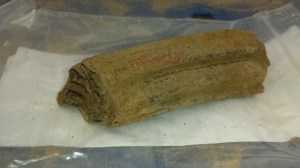
A fossil horse tooth from Natural Trap Cave. The grinding surface is on the left. Only about 1/5 of this tooth stuck above the gum line.

Paleontologists use the height of the tooth (its hypsodonty) to distinguish animals that grazed from those that ate bushes, shrubs, and trees (called browsing).

Isotopically, grasses look different from leaves from bushes. This chemical difference gets recorded into teeth.

The authors use isotopes from early horses that are hypsodont to show that tall teeth are related to doing more grazing.Continue reading “Tall Teeth and Grazing Diets – #365papers – 2017 – 94”

Puppy Play Bows Don’t Always Mean the Same Thing – #365papers – 2017 – 93

#365papers for April 3, 2017

Byosiere, Espinosa, Marshall-Pescini, Smuts, and Range, 2016, Investigating the function of play bows in dog and wold puppies (Canis lupus familiaris, Canis lupus occidentalis): PLOS one, v. 11, e0168570.

What’s it about?

Dog owners are familiar with the friendly play bow of their dogs, with the front legs outstretched and the rump high in the air. Where pet dogs are concerned, this is usually associated with playing – the kind of playing that doesn’t look much like playing but more like two dogs are going to kill each other. Ok, well maybe just my dogs.

Wolves (adults and puppies) also use the play bow. The question posed by the authors is what purpose does the play bow serve.Continue reading “Puppy Play Bows Don’t Always Mean the Same Thing – #365papers – 2017 – 93”

Feelings. Tyrannosaurid feelings – #365papers – 2017 – 92

#365papers for April 2, 2017

Carr, Varricchio, Sedlmayr, Roberts, and Moore, 2017, A new tyrannosaur with evidence for anagenesis and crocodile-like facial sensory system: Nature Scientific Reports. DOI:10.1038/srep44942.

What’s it about?

This paper describes a new member of the Subfamily Tyrannosaurinae from the late Cretaceous of Montana. Two important things came from this study:

  1. The different species of tyrannosaurids that occur at different times may be the result of evolution along a single lineage, a process called anagenesis
  2. The structure of the skull suggests that the face of this tyrannosaurid was highly sensitive to touch.

Continue reading “Feelings. Tyrannosaurid feelings – #365papers – 2017 – 92”

Cats Really Do Like Us – #365papers – 2017 – 91

#365papers for April 1, 2017

Vitale Shreve, Mehrkam, and Udell, 2017, Social interaction, food, scent or toys? A formal assessment of domestic pet and shelter cat (Felis silvestris catus) preferences: Behavioural Processes http://dx.doi.org/10.1016/j.beproc.2017.03.016

What’s it about?

The authors here studied whether cats preferred social interaction with humans over food, scents, or toys. They studied both pet cats and cats in shelters.The results showed that cats really do like engaging with people, especially when there’s play involved. Food comes in a close second though.Continue reading “Cats Really Do Like Us – #365papers – 2017 – 91”

When the Environment Changed, Animals Made Skeletons – #365papers – 2017 – 90

#365papers for March 31, 2017

Wood, Ivantsov, and Zhuravlev, 2017, First macrobiota biomineralization was environmentally triggered: Proceedings of the Royal Society B, v 284: 201700059

What’s it about?

It’s skeletons that we mostly see in the fossil record. The fossil record prior to the advent of mineralized skeletons (bones and shells, for example) is pretty sparse. Here, the authors show some very early organisms with skeletons (from around 550 million years ago) that have similar counterparts that lack the skeletons. Skeletons appear to have developed during times of environmental change, when minerals naturally grew around the bodies of the originally soft-bodied animals. Later, organisms took charge of this mineral growth to build the complex skeletons that we see in modern animals and plants.Continue reading “When the Environment Changed, Animals Made Skeletons – #365papers – 2017 – 90”

Not All Joints Are Flexible – #365papers – 2017 – 89

#365papers for March 30, 2017

Bailleul and Holliday, 2017, Joint histology in Alligator mississippiensis challenges the identification of synovial joints in fossil archosaurs and inferences of cranial kinesis: Proceedings of the Royal Society B, v. 284: 20170038

What’s it about?

In the past, when paleontologists have observed joints between bones, especially in the skull, that possess smooth surfaces, an assumption as been made that these joints are flexible. Flexible joints in the skull result in cranial kinesis, where the head can be deformed as exemplified by modern snakes as they consume prey much larger than their own heads. The authors show, through study of modern alligator skulls, that smooth joint surfaces don’t necessarily mean that a joint was movable, and that detailed study of the structure of the bone itself is needed to know if a joint could bend or not.Continue reading “Not All Joints Are Flexible – #365papers – 2017 – 89”

Telling the Boys from the Girls in Fossils – #365papers – 2017 – 88

#365papers for March 29, 2017

Mallon, 2017, Recognizing sexual dimorphism in the fossil record: Lessons from nonavian dinosaurs: Paleobiology, DOI:10.1017/pab.2016.51

What’s it about?

In paleontology, we define species by what they look like. This can be problematic if males and females of one species look markedly different from one another. Some authors have claimed to see sexual dimorphism, the difference in shape between males and females in a species, based on size. Here, the author shows that it is essentially impossible with the fossil record to make such determinations.Continue reading “Telling the Boys from the Girls in Fossils – #365papers – 2017 – 88”

When Water Stopped the Dinosaurs – #365papers – 2017 – 87

#365papers for March 28, 2017

Getty, Aucoin, Fox, Judge, Hardy, and Bush, 2017, Perennial lakes as an environmental contol on theropod movement in the Jurassic of the Hartford Basin: Geosciences, v. 7, doi:10.3390/geosciences7010013

What’s it about?

This is a paper about dinosaur tracks. Specifically, it discusses how dinosaur tracks, when they all seem to go in the same direction, are used as evidence that dinosaurs traveled in herds. Here, they show that the reason why the dinosaurs were all going the same way has to do with a lake near by, and not that the dinosaurs were all traveling together.Continue reading “When Water Stopped the Dinosaurs – #365papers – 2017 – 87”

Reading the Fossil Record: Look at the Rocks – #365papers – 2017 – 86

#365papers for March 27, 2017

Matthews, Liu, and McIlroy, 2017, Post-fossilization processes and their implications for understanding Ediacaran macrofossil assemblages; in Brasier, McIlroy, and McLoughlin, eds, Earth System Evolution and Early Life: a Celebration of the Work of Martin Brasier: Geological Society, London, Special Publication 448, 19 pp.

What’s it about?

Ediacaran fossils represent the oldest fossils of multicellular life, from between 580 and 541 million years ago (the Ediacaran Period). This paper discusses how the preservation of the fossils – the rock processes of deposition, erosion, deformation etc – affect our interpretations of the organisms.Continue reading “Reading the Fossil Record: Look at the Rocks – #365papers – 2017 – 86”